But Waxman did.
Good.
And fancy that, the Blue Dogs say the Democrat leadership in the House lied to them! Say it isn’t so, Nancy!

But Waxman did.
Good.
And fancy that, the Blue Dogs say the Democrat leadership in the House lied to them! Say it isn’t so, Nancy!
Ex-president Zelaya appears to be on his way to the Honduran border.
Here’s what our country has to say about it:
When asked about Zelaya’s stated return, U.S. Assistant Secretary of State Philip Crowley called it “unwise.”
“Any step that would add to the risk of violence in Honduras or in the area, we think would be unwise,” Crowley said.
Boy, if I were Zelaya, that would certainly have me shaking in my shoes.
Some violence seems to have already begun, with Zelaya supporters massing at the border as their hero edges closer, and Honduran police using riot control:
Zelaya arrived at Las Manos, on Nicaragua’s border with Honduras, at around midday (1800 GMT) as anti-riot police fired tear gas on hundreds of his supporters massed on the other side.
Zelaya supporters, including some armed with stones, faced off with hundreds of soldiers and anti-riot police, while the Honduran government imposed an 18-hour curfew in border areas.
The Honduran army earlier closed the border with Nicaragua and said it would not guarantee Zelaya’s safety.
First Obama encouraged Zelaya’s claims to legitimacy and therefore egged him on to this sort of action. Now he thinks a few words can stop him. And does he even want to? Who knows.
We do know that Obama’s attempt to curry favor with the far Left of Latin America hasn’t earned him the kudos he might have hoped:
Zelaya was traveling in a 50-vehicle caravan alongside his Foreign Minister Patricia Rodas; Venezuelan Foreign Minister Ricardo Maduro, and Nicaraguan former rebel leader Eden Pastora.
Leaders across the region were meanwhile in rhetorical high gear, with the leftist alliance of Venezuela, Cuba, Bolivia, Nicaragua and Ecuador generally blaming the United States for the deadlock.
[Update.]
Charles Krauthammer mentions Obama and the Democrats’ dirty little secret: they refuse to even consider tort reform, which would probably be the simplest and most effective way to improve the health care system by saving the public tons of money.
Why is this such a hush-hush subject for Democrats? Simple: “The Democrats are parasitically dependent on huge donations from trial lawyers.”
Susan Estrich is a liberal Democrat through and through. But I’ve noticed that every now and then she writes a column that goes against the party line.
In this recent one she shows a great deal of common sense, speaking for the average person and questioning what’s up with the health care reform bill being pushed so heavily by her party leaders:
So am I for health care reform? Do I support the House bill, whatever it is, or the Obama plan, which may or may not be the same thing?
Not yet. Not until I know what it is. Not until someone convinces me that whatever it is will do more good than harm, both for the country and for my family.
Estrich, like most Americans, likes her health plan. And, like most Americans, she is skeptical of being asked to throw her support to something no one can explain, or even cares to try:
The president is “not familiar” with the bill. No one can explain how it will work yet, as Sen. Ben Cardin, D-Md., told a contentious town meeting. There are various plans, and negotiations are still in the early stages.
But whatever it is, we should be for it.
Am I missing something?
Well, in my opinion Estrich often misses a lot. But on this particular point she’s right on. This health care reform bill emperor has no clothes—or, what’s even worse, is dressed in smelly old infectious rags.
And then there’s our very own naked emperor President, whose (metaphoric) nudity is being noticed by more and more people every day. Will Estrich ever be one of them?
Gerard Vanderleun has made Sirius’s slogan into a bumper sticker you can print out and put on your car. Enjoy!
I was otherwise engaged for most of Obama’s presser yesterday, but I happened to watch the last few minutes of it on CNN.
The very first thing I heard in the wrap-up was their political correspondent (a woman; I didn’t catch her name) declaring somewhat testily that Obama hadn’t said much of anything new. That was so different from the usual CNN ObamaLove fest that it made me realize he must have done very poorly indeed.
Point-by-point takedowns of his statements at the press conference abound in the blogosphere, so there’s really no need for me to add to them with another general critique. But consider this: even the ordinarily Obamaphile AP found his performance pretty bad, and deceptive as well.
But I did hear Obama’s remarks on the Gates arrest. Even though very little that Obama says these days surprises me, I was still somewhat in awe at the cleverness of his description of the incident. If you didn’t know the facts of the case—and I’m betting that most people listening to his presser didn’t (including Obama, according to his own admission)—you might think that Obama’s remarks made perfect sense [emphasis mine]:
I don’t know all the facts. What’s been reported, though, is that the guy forgot his keys, jimmied his way to get into the house; there was a report called into the police station that there might be a burglary taking place.
So far, so good, right?…The police are doing what they should. There’s a call. They go investigate. What happens? My understanding is, at that point, Professor Gates is already in his house. The police officer comes in. I’m sure there’s some exchange of words. But my understanding is — is that Professor Gates then shows his ID to show that this is his house, and at that point he gets arrested for disorderly conduct, charges which are later dropped.
Now, I’ve — I don’t know, not having been there and not seeing all the facts, what role race played in that. But I think it’s fair to say, number one, any of us would be pretty angry; number two, that the Cambridge police acted stupidly in arresting somebody when there was already proof that they were in their own home.
As you can see, Obama eliminated from the story the notion that there might be any behavior on Gates’s part that could have actually justified the charge, and then called the police’s action “stupid.” Yes, “any of us would be angry” if he/she were arrested for no reason. But any of us would not be angry if police had come to investigate the understandable report of an apparent break-in—which even Obama admits at that point was “so far, so good” on the part of the police.
So, what’s up with the “exchange of words” (a euphemism for: “Gates said angry things to the cops”)? Why would Gates have been angry at that point, when the police had done nothing wrong, which even Obama admits (“so far, so good”)? And if Gates’s words were angry enough and abusive enough, are the police supposed to ignore that because the person is in his own house and didn’t commit burglary?
What was the fuss then? Well, we all know what the fuss must have been: race. At the very least, Gates was most likely accusing the police of being racists, and so is Obama implicitly by his support of Gates, despite his denials ” (“I don’t know…what role race played in that”). As Obama is well aware, white people who are argumentative and/or verbally abusive with police officers are hardly immune to charges of disorderly conduct. Au contraire; but they can’t cry “racism” if that happens. Would Obama call the police “stupid” for arresting a white person (and non-Harvard non-professor) for disorderly conduct, if none of the other facts of the case were changed?
Somehow I doubt it. Obama is (among other things) a lawyer; surely he knows better than to pre-judge the actions of the police here, in a case in which the police are alleging belligerent conduct on the part of Gates as the reason for his arrest.
It’s true that we don’t know how belligerent Gates did or didn’t get. But that’s all the more reason for the President to simply have passed on making a judgment. Perhaps Obama, who attended Harvard Law School (which, after all, is in Cambridge) has some sort of history himself with Cambridge cops stopping him for lack of cause, and it’s payback time? At any rate, I wonder how his accusation against the police played with the National Association of Police Organizations, and what its members are thinking right about now of their pre-election endorsement of Obama.
And here’s that nefarious neocon Bill Kristol on the subject of Obama’s “stupid” remark:
Does he really know enough about what happened to say that? Maybe it was Professor Gates who behaved stupidly, or at least arrogantly. He is, after all, a Harvard professor. I was once a Harvard professor, and my instinct is to side with the Cambridge cops.
It would be funny if it weren’t so sad.
As for the cop in question, James M. Crowley, he’s hanging tough and refusing to apologize to Gates. Crowley is by all accounts a consummate professional as a police officer who “has led his colleagues in diversity training.” But no matter; Obama’s rush to judgment on national TV may put this man in grave jeopardy, although I hope not.
[NOTE: Before Crowley became a Cambridge policeman he was an EMT and police officer at Brandeis University, and in an odd coincidence he was the person who answered the call and administered CPR when Celtics star Reggie Lewis collapsed and died in a Waltham gym back in 1993, a terribly tragic event known to all New England sports fans.]
[ADDENDUM: If you go to Drudge, you’ll find a link to some of the facts that Obama couldn’t wait for, excerpts from the police report (excuse me: the stupid police report) of the incident.
It states that Gates was threatening and belligerent from the start, accusing the officer of racism. His belligerence and threats and declarations that the officer had no idea who he was “messing” with continued unabated, despite the officer’s warnings that he was becoming disorderly. There were many witnesses to much of this, which continued out on the street.
Interestingly enough, it comes out in the police report that Gates’s door had been damaged in a previous attempt at a real break-in by some unknown burglar. You’d think Gates would have been grateful at the police arriving so promptly in response to the neighbor’s call-in. Apparently not.]
[ADDENDUM II: Well, there’s one police organization that doesn’t think too much of what Obama said, although its spokesperson is more measured and careful in his remarks than our President was last night.
And I can’t help but characterize Obama Press Secretary Gibbs’ attempt at damage control as “stupid,”—although I admit that Obama didn’t give him much good material to work with:
Let me be clear. He was not calling the officer stupid, OK?” Gibbs told reporters on Air Force One. “He was denoting that … at a certain point the situation got far out of hand, and I think all sides understand that.”
Actually, Mr. Gibbs, I think “all sides” understand what the phrase “the Cambridge police acted stupidly” means.]
[ADDENDUM III: The officer with Crowley, the one who wrote the report of the incident, appears to have been a wise Latino named Carlos Figueroa. And “Gates’ attorney, Harvard Professor Charles Ogletree, said his client showed his driver’s license and Harvard ID — both with his photo — but did not dispute other details of the arrest.” That would tend to mean that Gates was every bit as abusive and threatening as Crowley and Figueroa have alleged, and that there are enough witnesses to support that fact.]
I’m busy, but for those of you who want a thread to comment on the talk Obama is currently giving, go to it.
What we do know is that this man is dangerous, and that if his predecessor George Bush had tried a stunt like this, he would have been widely excoriated.
What am I talking about? You may recall that Investor’s Business Weekly article I wrote about here and here, the one in which the authors interpreted the health care reform bill as prohibiting the writing of new individual private medical insurance policies once the bill is passed. Obama was doing call-ins over the radio and he was asked about the provision in question, which the caller helpfully explained.
Here’s the passage:
CALLER: …from an opinion piece in Investor’s Business Daily[sic], where they’re saying that HR3200 will make individual private medical insurance recalled, and they actually quote from Section 102 of the bill, which is grandfathering the existing policies. Is this true, will people be able to keep their insurance and will insurers be able to write new policies even though HR3200 is passed?
OBAMA: You know, I have to say that I am not familiar with the provision you’re talking about. Let me just speak for the Obama administration. I have committed myself consistently to a very simple proposition: if you have health insurance, you like it, you have a doctor that you like, then you can keep it. Period. And I won’t sign a bill that somehow would make it tougher for people to keep their health insurance.
The problems with Obama’s answer:
(1) He’s making the case against his own rush to pass this bill if he’s admitting he’s unfamiliar with its provisions on such a basic point.
(2) The original IBW article was not obscure. It was discussed at Instapundit, for example, a blog so large and influential that the administration should be monitoring it on a daily basis. Someone should have at least briefed Obama on it, if he didn’t know the answer already.
(3) Note how careful Obama is to not answer the question, which is about writing future policies, not keeping the one you have. He is parsing his words in order to appear to answer the question but never addresses it at all. Even if he didn’t know the answer about the specifics of that provision in the bill, he should have said he would defend the right to keep policies and also the right to get new ones. But he doesn’t, which is highly suspicious.
Of course, it’s possible that the video is strategically truncated, and that Obama addresses the issue of future policies a moment later. But I very much doubt it, since a search revealed nothing of the sort (although I’ve not been able to locate a transcript of the entire episode). And a look at an article about the call-in at Daily Kos (written by the blogger who asked Obama the question, who turns out to be on the Left and not the Right, and is getting hammered by the Kos kids for asking it in the first place), revealed no such extra statement by Obama that had been edited out. Surely, if there was such a thing, it would constitute some sort of defense and would have been mentioned in the post at Kos (I’m not providing a link because I have a policy not to link to Kos; you’ll have to find it yourself if you care to).
(4) This also may be a case of Obama preparing the defense I mentioned here: “Don’t blame me, blame Congress!”
(5) And of course the whole thing is disingenuous anyway, because once the public option is in place it will tend to crowd out private options and in a while these plans will no longer be offered even to those who were grandfathered in. Unless there’s some special provision in the bill protecting them, which there is not.
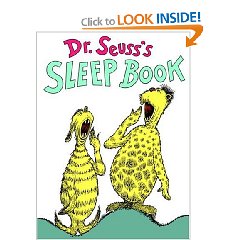
…you see, like a cough. It just takes one yawn to start other yawns off.”
That’s Dr. Seuss, in The Sleep Book, one of the childhood favorites of my sleep-resistant son.
And it’s true; I’m sure you’ve noticed how hard it is to resist yawning when you watch others do so. In fact, even reading this and seeing the word in print, you may be feeling one coming on…
I’ve long found it fascinating that yawns are so contagious. That’s why I was excited when I saw the headline for this article: “Why Is Yawning Contagious?”
But the article itself turned out to be a big yawn. The psychologist authors of the study involved don’t know; they speculate that it’s a form of empathetic response, similar to laughter.
Well, I can speculate too, and I agree, but so what? Unfortunately, no one knows why yawning, of all things, should be shared, or by what mechanism this happens.
Obama is acting as though he won a mandate. And why not? His election margin of victory was approximately six points, and the post-2008 election Congress is more strongly Democratic than Congress has been since the 1970s—which means very strongly Democratic indeed.
So when Obama says “I won,” he means it. And although presidents don’t usually say such an infantile thing as “I won!” out loud, my guess is that many presidents would feel the same in Obama’s position—strong win, supportive Congress; it’s a clear mandate.
The only problem is this: although most (if not all) presidential candidates do some dissembling and spinning during their campaigns, and all make promises they are not able to keep, and most are met with circumstances that require them to be flexible about some of the matters they campaigned on, I believe that Obama is the very first president whose campaign persona was a studied lie and a con.
In his campaign, Obama presented himself as a different person—different not only than the person he has become, but different than the person he has been in the past. Perhaps there are some other presidential hopefuls who would have attempted such a trick if they could have gotten away with it, but in the past it has not been possible because they had amassed a much clearer and longer public record prior to their declaring for office. Their resumes could not be fudged or hidden. The public knew them in some basic ways.
What’s more, Obama’s predecessors could not have done what he did, even if they had wanted to, because the press wouldn’t have let them. It would have done its job in following clues and exposing the scam. Obama gambled that the press would never treat him like that, either because of his narcissistic belief in his own specialness (which they seemed to share), the fact that they’d not successfully done it to him before despite opportunity, and/or his feeling that they would be unlikely to criticize him because of fear that charges of racism would be hurled back at them. Whatever his reasons, he found out early on that he could get away with it, and so he did.
Obama presented himself as a moderate Democrat, dedicated to reaching across the aisle. He is not. In addition, he was often foggy about the details of his programs, and this was no accident. When details did come out, either about Obama’s proposals or his personal past, it was often by accident or at the tail end of the campaign, and the press chose to cooperate with Obama in deflecting them rather than to highlight them (except, of course, for the conservative press, which didn’t reach the people who needed to be reached). A few examples are the “spread the wealth” incident with Joe the Plumber, his statement that cap and trade would cause utility bills to “skyrocket,” and videos of Reverend Wright’s sermons surfacing.
So what was Obama’s mandate for? Someone who would govern more or less from the center or slightly to left of center. Someone who would forge compromises.
Someone other than Obama.
This may not matter to our current president, because now he’s got the power. But his current haste to ram bills through may be evidence of a growing apprehension on his part that he’s not only losing the American people as they get to know the real Obama (which he may not even care about, if he still gets to enact his far-Left agenda), but that he’s losing the moderate Democrats in Congress who give him some of his majorities and some of his power.
Yesterday blogger Ann Althouse, who voted for Obama, declared that he’s lost her.
Although Althouse’s post was very brief, I applaud her for having the courage to change her mind and to go public with it. I hope that the Althouse change is indicative of a huge number of other people undergoing a similar change.
In some ways Althouse may be quite characteristic of people whose support for Obama was never really strong in the first place; she was really more against McCain than for Obama. Althouse’s post on why she turned on McCain during the election was much longer than her recent one about Obama. But it was a mirror image of it in the four reasons she states at the end.
For McCain, Althouse offered:
1. He did not understand economics, the most important issue.
2. He lost the ability to make the experience argument.
3. He never defined himself as a principled conservative.
4. Erratic and incoherent, he lacked sufficient mental capacity.
And for Obama, as of yesterday:
1. He did not understand economics, the most important issue.
2. He [never had] the ability to make the experience argument.
3. He never defined himself as a principled [liberal].
4. Erratic and incoherent, he lack[s] sufficient [courage].
Although the symmetry is cute, I don’t quite agree. I think Obama understands economics at least somewhat; he just has a different goal and agenda than he led us to believe. And the “experience argument” argued against voting for him in the first place; it’s hardly new. Obama is only “erratic and incoherent” if one thinks he is trying to fix the economy and defend and save capitalism; I don’t think he is. And courage? He’s got plenty—to push his agenda through no matter what, and to meddle in Israel’s and Honduras’s affairs while holding back against the tyrants of Iran.
Today Althouse writes this longer post, in which she states:
And I cling to the belief that Obama has the ability to save us from the destructive path Congress has chosen for itself. But will he use it?
How much of an ideologue is he anyway? We’ve come this far, and still we don’t really know. Is he, at heart, the committed leftist his staunchest opponents say he is? I know Rush Limbaugh is fond of saying ”” over and over ”” that Obama is intentionally destroying the economy (so that nothing will be left for us but socialism).
I still think Obama is a pragmatist. I also think he’s mainly interested in attaining personal glory. If that’s right, the prospect of his own defeat in 2012 should shock him into standing up to the bunch of Democrats who ”” I hope and I hope he sees ”” will be crushed in 2010.
So: hope and change. Come on, Obama. We need some now.
I used to agree with exactly what Althouse is saying here—that Obama the narcissist would trump Obama the ideologue (how’s that for a choice of what to hope for?). However, as recent readers of this blog know, in the last month or two I’ve jumped the shark and ended up thinking that Obama is deeply committed to his agenda, and willing to sacrifice members of Congress and even his own second term in order to implement it.
Far from Congress enacting its own agenda which is more to the Left than Obama’s, I think they are at the very least in agreement, or that it’s Obama who’s more to the Left than Congress. He delegates the details to the Pelosi/Reid Congress because he knows those two are on much the same far Left page as he, and it also gives him the ability to say “It’s not me; it’s Congress!” Theoretically, this affords him some deniability if he should ever need to activate it.
Our president hasn’t given up on overturning the rule of law in Honduras, as well as subverting the autonomy of the people in that supposedly sovereign state. And Hugo Chavez obviously sees Obama as his ally in this endeavor:
Mr. Zelaya was shipped out of the country because Honduras believed that jailing him would make him a lightning rod for violence. Interim President Roberto Micheletti promised that presidential elections scheduled for November would go forward.
That might have been the end of it if the U.S. had supported the Honduran rule of law, or simply refrained from meddling. Instead President Obama and the State Department joined Mr. Ché¡vez and his allies in demanding that Mr. Zelaya be restored to power. This has emboldened Venezuela….
Mr. Ché¡vez understands that Mr. Zelaya’s star is fading, which is why he called Tom Shannon, the State Department’s assistant secretary for the Western Hemisphere at home at 11:15 p.m on July 9. Mr. Shannon told me that Mr. Ché¡vez “again made the case for the unconditional return of Mr. Zelaya, though he did so in a less bombastic manner than he has in the past.”…
[T]he U.S. continues exerting enormous pressure for the return of Mr. Zelaya.
Why?
Please forgive me if I’m starting to resemble Cato the Elder in my repetitive monomaniacal insistence that Obama is a smooth-talking hypocrite who is attempting to sell the American public a socialist bill of goods, and who’s not above going the Chavez/Zelaya extra-constitutional route himself if he needs to. That’s what I see, and I feel the need to get the word out.
[NOTE: See Fausta for more Honduras links.]
[ADDENDUM: Meanwhile, there’s more important things to talk about.]