The humorist-bot:
I couldn’t agree more, myself, but not everyone is as clever as you seem to be. Or as I seem to be! HA! :-p

The humorist-bot:
I couldn’t agree more, myself, but not everyone is as clever as you seem to be. Or as I seem to be! HA! :-p
This WaPo article from last Sunday describes the reading habits of former presidents, including the much-maligned Bush who was apparently a voracious reader, and President Obama who sometimes mentions books he’s reading and is presumed to be one.
It’s always difficult to know whether a president is actually reading a book he says he’s reading, especially if the reading of said book would send some message the president wishes to convey. But the next time Obama mentions a book he’s reading or has read, I would dearly love to see the interviewer actually ask him a few penetrating questions about it and see what answers he gives.
Would they be very general—sort of like in a school book report when the student writes, “I liked this book; it was very good”? Or would they show that he’s actually read and thought deeply about it? My guess is that the man doesn’t read nearly as much as he claims he does, although perhaps that’s true of most politicians.
That’s not to say (as Bush’s critics falsely claimed of Bush) that Obama lacks the basic intelligence to do so. I have always believed Obama to be an intelligent man in the academic sense (yes, he was magna cum laude at Harvard Law, which does mean something), although certainly not the super-genius he’s purported to be.
It’s not been my impression that Obama is especially interested in most books, though, except for political strategy books, or books about other matters highly relevant to his goals and agenda. That perception of mine is based on his interviews; he almost never makes a literary reference in passing conversation, only when directly asked about his reading tastes, and then his remarks about the books he’s read seem to be rather general.
In researching this post, I kept coming up with articles such as this. They mention how obviously erudite and bookish Obama is (after all, he wrote the great Dreams From My Father!), and then deal with lists he’s provided of influential books in his life. But I haven’t yet found any links to an interview in which he’s asked more detailed questions, and discourses at length on just what passages he liked or what he thought was so fine about it. Perhaps such interviews exist; if so, feel free to provide a link in the comments section, and I’ll take a look.
What I found instead was the curious assertion that Obama didn’t really take up book reading until college. This is not usually the case for writers, and makes me even more suspicious of the provenance of Dreams. Speaking of which:
Apparently, Obama’s childhood was not particularly bookish but his love of literature was sparked at Occidental College in California where he admitted to reading “tons of books”. In December 1997, he even reviewed a book for the Chicago Tribune ”“ William Ayers’ A Kind and Just Parent: The Children of the Juvenile Court.
Curiouser and curiouser, as Alice would say (there, that’s a literary reference from one of my favorite works; it just slipped out. Book aficionados usually are first and foremost avid readers, ordinarily from early childhood, and we’re always quoting this and that author or poem.)
And now that I’ve said that, I’m trying to think of a good literary quote to end this post—and of course I’m having trouble doing so. So I’ve turned to trusty Google and I get this:
There is a great deal of difference between an eager man who wants to read a book and a tired man who wants a book to read. ~G.K. Chesterton
[NOTE: The blogger “zombie” has done some research on that Obama book review of Ayers’s work. It’s not a full review, but was part of a feature in the Tribune called “Mark My Word,” in which “Chicago notables praise their favorite current books.” So we can conclude that, despite the fact that the Ayers book does not appear on any present-day list of Obama’s favorite literary works (pity, that), in the year 1997 it headed the pack.
Here’s the review in full, as far as I can see:
A searing and timely account of the juvenile court system, and the courageous individuals who rescue hope from despair.
I assume it was in the nature of an “you scratched my back, I’ll scratch yours” thank-you note to Ayers, although for what I can hardly say. Perhaps for the campaign kick-off party for Obama in 1995. Or maybe for the help in writing Dreams, if Jack Cashill is correct.
A guest blogger at Michelle Malkin’s dug up another nugget, this time from Ayers’s book A Kind and Just Parent itself. On page 82 Ayers wrote of his Hyde Park neighborhood [emphasis mine]:
Our neighbors include Muhammad Ali, former mayor Eugene Sawyer, poets Gwendolyn Brooks and Elizabeth Alexander, and writer Barack Obama.
At that point in time (1997), “writer” was certainly not Obama’s most salient characteristic—unless for some reason Ayers wanted to emphasize it. You can draw your own conclusions about that. But Obama had started his political campaign in 1995 (right around the same time as the publication of Dreams) and had been elected to the Illinois State Senate in 1996, before Ayers wrote A Kind and Just Parent. Obama’s biggest claim to fame at the time besides that was probably having been the first black president of Harvard Law Review.
At first, Obama’s book Dreams appears to have had only modest sales; it was long out of print until it was reissued in 2004 as a hot property in light of Obama’s Democratic Convention speech. What’s more, if you look at the notes here, all of the great praise of Dreams as a fabulous literary work seems to have come after its 2004 reissue (here’s the original 1995 NY Times review, which is mostly descriptive), and especially during the 2008 campaign when Obama was a celebrity and people were taking a look back at it. But Ayers knew about the book way back in 1997 and even characterized lawyer/activist/politician Obama as a “writer” and nothing else.
As I said, curiouser and curiouser.]
[NOTE II: Here’s an audio interview with Obama in 1995 on the publication of his book. It’s interesting that even in this interview he specifically mentions his grandmother as having had a fear of “black men on the street.” That’s the incident he cited in his famous post-Reverend-Wright race speech in which he used her as an example of bigotry. But if you look at the story Obama actually relates in his book, it is nothing of the sort: his grandmother mentioned being harassed by one particular aggressively panhandling man on the street, and it was Barack’s grandfather (and Frank Marshall Davis) who pointed out that the man was black and that the grandmother was racist in fearing him.]
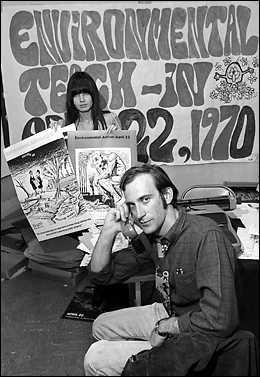
It’s the fortieth anniversary of Earth Day and the official website wants you to celebrate by being afraid, being very afraid:
Forty years after the first Earth Day, the world is in greater peril than ever. While climate change is the greatest challenge of our time, it also presents the greatest opportunity ”“ an unprecedented opportunity to build a healthy, prosperous, clean energy economy now and for the future.
Apparently they didn’t get the Climategate memo.
I remember the very first Earth Day, which despite the gloomy rhetoric I recall as a much lighter thing—filled with helium balloons and mellow crowds smoking grass on the grass.
Love that Peter Max-inspired lettering:
I first saw the Paul Taylor Dance Company perform in 1970. I was immediately impressed, even though it’s a modern dance company and at the time I tended to prefer ballet. But Paul Taylor’s work had a unique set of characteristics that wowed me: wonderful music, powerful dancers, incredibly inventive choreography, contrasts of lightest light and darkest dark, an emphasis on the interrelationships between people, and even that rarest of commodities in dance—humor.
Taylor himself was a revelation. Dancers tend to be short and to look taller onstage. But he really was tall, and muscular like an athlete. When he wanted to (and every now and then he did want to, if it suited his dramatic purposes), he could walk onto the stage and not even look like the trained dancer he was—but like a regular Joe instead.
Taylor is still churning out dance works a few months shy of his eightieth birthday. His choreography doesn’t sound as though it would be extraordinary, and yet it is. Solid technique is present, to be sure. But mere steps and flash are never the point: movement is, and what movement expresses. If I write that in one of my favorite works of his—“Esplanade”—he eschews conventional dance steps and uses movements that derive almost entirely from natural everyday motions such as walking, running, and falling, it sounds boring. But Taylor transforms these steps into one of the most exhilarating and joyous dances ever created, one that at times exhibits an almost sublime tenderness, and at other times makes the audience gasp with its bold daring, lightning speed, and the dancers’ sheer physical power as they hurl themselves with reckless abandon into each others’ arms and then down to the floor and up again.
I’m visiting New York right now, and last night we went to see Paul Taylor 2 (Taylor’s chamber company) at the Joyce Theater. To my delight, “Esplanade” was on the program, and once again I thrilled to its timeless choreography, every bit as fresh now as it was the day it was created in 1975.
I always feel like apologizing when I post dance videos here. I’m glad to have them, of course. But they can only give the barest idea of the power of the thing itself in its live, three-dimensional, living and breathing onstage manifestation. The following You Tube clip shows rare documentary footage of Taylor himself dancing the work “Aureole” (see 2:32-2:39), and contains an excerpt from the exuberant aforementioned finale of “Esplanade” (minus Taylor; he retired from active performing in 1974, before the work was created), which starts at minute 3:49 and lasts until the video’s end:
This is pretty wonderful, too. It’s another video showing nearly the same excerpt from “Esplanade,” only this time much of it is filmed from the wings, offering a very different perspective:There was a question-and-answer session after the performance last night, and one of dancers described the way Taylor conducts auditions for his company. Taylor always first has the dancers walk across the floor, one by one, and then each must run. He is looking at their quality of natural movement; if that isn’t up to his standards, he’s not interested. After the walk/run he lets many of them go, and then works with the ones who are left, winnowing them down until the lucky dancer or dancers remain who will get the chance to dance his choreography onstage as members of his company.
I once took a master class from a group of Paul Taylor’s dancers back in 1970. As is often the case with such lessons, they taught us some excerpts from his works. I well remember how wonderful those little snippets felt to actually perform. There was a freedom and a sweep to them, a musicality and a sense that we were almost flying across the floor, dancing in a way that expressed the joy that can sometimes be found in dance—and in life.
From the start, the MSM has been determined to trivialize and/or demonize the Tea Partiers. Although the Tea Party movement has been consistent in focusing almost entirely on fiscal matters and small government, one of the most consistent and favored charges against them has been the race card.
So they have always been called bigots by the MSM. The original favored meme was that they are blue-collar, ignorant, unlettered, extremist, angry white male bigots. But just for variety—and as a result of a Times/CBS poll) the MSM has switched lately to accusations that they are privileged, well-educated, extremist, angry white male bigots. Make up your minds, MSM!
That original characterization of the Tea Partiers kept reminding me of something, though. Something very familiar, from the past. Who or what could it be?
And then I realized the answer: Archie Bunker, of the 1971-1979 TV show “All in the Family.”
Archie was created by noted liberal Norman Lear as a typical blue collar conservative, bigoted and narrow-minded and selfishly out to protect his own pocketbook. Archie was heavy and red-faced, and his speech was studded with mispronounced words and malapropisms.
Enlightened viewers were supposed to look down on Archie and his highly vocal racism—as well as all his viewpoints, expressed in his gritty New York accent. But Bunker was brillliantly played for laughs by liberal actor Carroll O’Connor, who somehow conveyed that you were paradoxically supposed to sort of like him too, because underneath all the bluster he had the proverbial heart of gold. O’Connor walked an exquisitely fine line in conveying both ideas simultaneously—very different from the undiluted rancor of today’s Tea Party critics towards members of the movement.
What’s more, the liberals on the show such as Archie’s foil and live-in son-in-law Michael Stivic (portrayed by Rob Reiner, another liberal in real life) aka “Meathead” were not portrayed as faultless, either. Those were the days.
I loved the show at the time. Glancing back via You Tube, I am surprised to find myself now thinking the old guy scored a couple of political points, too (although not the racist ones). Take a look for yourself at Archie expounding on gun control. When he makes his over-the-top suggestion on how to foil what were then known as airplane “skyjackings.” think of 9-11 and its aftermath, and note why there have been no airplane hijackings since Flight 93:
And now, here’s Archie on Democrats, speaking during the Carter years. Plus ca change, plus c’est la meme chose:
[NOTE: Here’s an interesting factoid about O’Connor and the creation of the show:
Wanting a well-known actor to tackle the controversial material, Lear had approached Jackie Gleason and Mickey Rooney to play Archie; both declined. O’Connor accepted, not expecting the show to be a success and believing he would be able to move back to Europe. (In her book Archie & Edith, Mike & Gloria : the Tumultuous History of All in the Family, Donna McCrohan noted that O’Connor requested that Lear provide him with a return airline ticket to Rome as a condition of his accepting the role, so that he could return to Italy when the show failed.) Instead, the show became the highest-rated television program on American television for five consecutive seasons until the 1976-1977 season (the sixth season).]
First, Arizona passes a much-needed (and much-criticized) crackdown on illegal immigrants.
Now, is Arizona becoming a birther? Interesting:
[The law] would require U.S. presidential candidates who want to appear on the ballot in Arizona to submit documents proving they meet the constitutional requirements to be president.
Phoenix Democratic Rep. Kyrsten Sinema said the bill is one of several measures that are making Arizona “the laughing stock of the nation.”
Mesa Republican Rep. Cecil Ash said he has no reason to doubt Obama’s citizenship but supports the measure because it could help end doubt.
Note how the mere act of requiring candidates’ birth certificates to be produced has become, in many Democrats’ eyes, a cause for ridicule.
…because he finally managed to pass HCR.
Please remind me: why is this man considered some sort of foreign affairs expert?
Here’s a bunch of photos of familiar political figures back in their callow youths.
Get a load of Dick Cheney in particular.
Arizona has just passed a tough anti-illegal immigration law, requiring:
…state and local police to determine the status of people if there is “reasonable suspicion” that they are illegal immigrants and to arrest people who are unable to provide documentation proving they are in the country legally.
It also makes it a crime to transport someone who is an illegal immigrant and to hire day laborers off the street.
This country is going to have to decide whether it wants to wink at illegal immigration or whether it wants to crack down on it. To crack down, it would take the will to do so, plus a two-pronged program: one to deal with illegals who are already here, and one to prevent more from coming.
Neither will be perfect, of course, and neither is the least bit simple. But the first would have to involve something resembling this bill, and the second would have to involve some sort of fence or at least better policing of the southern border.
Critics of this law cry “racial profiling.” But how on earth could anyone crack down on illegal immigration from Mexico (overwhelmingly the largest group) without profiling people? Profiling has gotten a bad name from the PC police. But a ban on any profiling that uses ethnic origin would make it impossible to enforce our immigration laws effectively, and would make them a joke. In a sense, they already are, because they are barely enforced at all.
And that’s what the people who cry “foul” about racial profiling want; they much prefer that illegal immigrants be allowed to stay here and that more be encouraged to come—which has been the effect so far of of our lack of enforcement coupled with our good educational and health care systems. The demographics of illegal immigration tend to favor the Democratic Party, which ultimately gain voters through it.
Then there’s the religious angle voiced by Los Angeles Cardinal (and blogger!) Roger Mahoney:
The law is wrongly assuming that Arizona residents, including local law enforcement personnel, will now shift their total attention to guessing which Latino-looking or foreign-looking person may or may not have proper documents…I can’t imagine Arizonans now reverting to German Nazi and Russian Communist techniques whereby people are required to turn one another in to the authorities on any suspicion of documentation…
We are a nation of immigrants, and their commitment and skills have created the finest country in the world. Let’s put a human face on our immigrant friends, and let’s listen to their stories and their desires to improve their own lives and the good of the nation.
A series of quite extraordinary statements by the Cardinal: first the likening to Nazi Germany, then the usual and misleading conflation of illegal immigrants with immigrants in general. But ever since this country became fairly well settled around the time of the early 20th century, we limited immigration in various ways (some of them, admittedly, by country of origin, although those differential restrictions were eliminated in 1965) because otherwise we would have been overwhelmed. In addition, virtually all countries have rules on who can enter legally and who cannot. To pretend otherwise is to be hopelessly disconnected from reality.
Cardinal Mahoney does not completely ignore the legal vs. illegal question. However, he discounts it in the following misleading manner:
Almost all of our immigrant families are “mixed,” that is, some members have legal documents to be here and some members do not.
That may be true in some areas of Cardinal Mahoney’s Los Angeles, but I see no evidence that it’s true for the American population as a whole. Mahoney also mischaracterizes the Arizona law itself. It does not require the sort of reporting and informing by relatives and friends or even state agences that he describes. Rather, it “mandate[s] such action only from law enforcement officers ‘when practicable.'”
Mahoney is not alone in his opinions:
Tucson Diocese Bishop Gerald Kicanas, who helped spearhead the letter, said parishes in his diocese have participated in “immigration academies” to learn about the issue and how Scripture and church teachings apply to it. In Leviticus, for instance, God instructs Moses not to mistreat aliens and to welcome them as if they were native-born.
“It’s pretty clear that all of our religious traditions speak of welcoming the stranger and assisting people in need,” Kicanas said. “I believe this is a drastic, punitive measure that will not benefit the states.”
These statements by Mahoney and Kicanas are an indication of just how far left some officials of the church have become, and how dedicated they are to eliminating the idea of immigration laws at all. But Leviticus instructs us in a lot of things that we don’t do today, although I suppose one can pick and choose to make a political point. And one could also argue (I think quite correctly) that by allowing and even welcoming legal immigration to an extent greater than most countries on earth over the years, the US has fulfilled any Levitican instruction to welcome the stranger—many times over.
…may have overstated the case with the volcano and its effect on airplanes:
Flawed computer models may have exaggerated the effects of an Icelandic volcano eruption that has grounded tens of thousands of flights, stranded hundreds of thousands of passengers and cost businesses hundreds of millions of euros.
The computer models that guided decisions to impose a no-fly zone across most of Europe in recent days are based on incomplete science and limited data, according to European officials. As a result, they may have over-stated the risks to the public, needlessly grounding flights and damaging businesses.
“It is a black box in certain areas,” Matthias Ruete, the EU’s director-general for mobility and transport, said on Monday, noting that many of the assumptions in the computer models were not backed by scientific evidence.
Gee, wonder what that reminds me of?
And somehow, the following differences between the rules in the US and Europe do not surprise me either:
“If you take the situation across the Atlantic, there the advice would probably be: don’t fly over the volcano. Otherwise, it is up to you to take the precautions necessary,” Mr Ruete said.
While the US system leaves air carriers with the responsibility to determine whether or not it is safe to fly “the American model is not a model of less safety”, he said. “You just need to look at the statistics to see that.”
Under European rules, member states have the power to decide whether or not their airspace should be open. But decisions during the past week have been guided by computer models from the Volcanic Ash Centre in London and Eurocontrol, an organisation that co-ordinates air travel.
It’s Patriots’ Day—the anniversary of the Battles of Lexington and Concord, regarded as the official start of the American Revolution, although Massachusetts and Maine (once part of Massachusetts) are the only states that officially celebrate the occasion.
Boston does so mainly by the running of the Boston Marathon, which has nothing to do with the history but is still a good show, if you like that sort of thing (I’m not a keen fan, although it’s fun to watch in person). But here on this blog let’s just think a moment of the repercussions of that day back in 1775, when they fired the shot heard round the world .
No one really knows who fired that first shot; eyewitness reports varied, as they often do. But it was considered the true beginning of the military conflict that ended with the establishment of our country, and was fought by militias composed of ordinary citizens who were defending (among other things) their right to their munitions. You might say they were clinging to their guns, although not bitterly.
There was no internet, and no cellphones then. Nevertheless, the militias had developed an efficient way of communicating, and not just through the illustrious horseman Paul Revere:
The ride of Revere, Dawes, and Prescott triggered a flexible system of “alarm and muster” that had been carefully developed months before, in reaction to the colonists’ impotent response to the Powder Alarm. This system was an improved version of an old network of widespread notification and fast deployment of local militia forces in times of emergency. The colonists had periodically used this system all the way back to the early years of Indian wars in the colony, before it fell into disuse in the French and Indian War. In addition to other express riders delivering messages, bells, drums, alarm guns, bonfires and a trumpet were used for rapid communication from town to town, notifying the rebels in dozens of eastern Massachusetts villages that they should muster their militias because the regulars in numbers greater than 500 were leaving Boston, with possible hostile intentions. This system was so effective that people in towns 25 miles (40 km) from Boston were aware of the army’s movements while they were still unloading boats in Cambridge.
The original Boston Tea Party had already occurred, and Britain had passed what were known here as the Intolerable Acts to punish the rebellious colonists, the most intolerable being:
The Boston Port Act…[which] closed the port of Boston until the East India Company had been repaid for the destroyed tea and until the king was satisfied that order had been restored…
The Massachusetts Government Act…Under the terms of the Government Act, almost all positions in the colonial government were to be appointed by the governor or the king. The act also severely limited the activities of town meetings in Massachusetts. Colonists outside Massachusetts feared that their governments could now also be changed by the legislative fiat of Parliament…
The Administration of Justice Act allowed the governor to move trials of accused royal officials to another colony or even to Great Britain if he believed the official could not get a fair trial in Massachusetts…George Washington called this the “Murder Act” because he believed that it allowed British officials to harass Americans and then escape justice…
The Quartering Act…allowed a governor to house soldiers in other buildings if suitable quarters were not provided…
The Acts were meant to punish Massachusetts. But like many acts of tyranny, they only caused a backlash. The outrage spread to other nearby colonies, and were seen as a threat to the liberty of all:
The acts unintentionally promoted sympathy for Massachusetts and encouraged colonists from the otherwise diverse colonies to form the First Continental Congress. The Continental Congress created the Continental Association, an agreement to boycott British goods and, if that did not get the Coercive Acts reversed after a year, to stop exporting goods to Great Britain as well. The Congress also pledged to support Massachusetts in case of attack, which meant that all of the colonies would become involved when the American Revolutionary War began at Lexington and Concord.
Which brings us back to today, Patriots’ Day.
By the rude bridge that arched the flood,
Their flag to April’s breeze unfurled,
Here once the embattled farmers stood,
And fired the shot heard round the world.
The foe long since in silence slept;
Alike the conqueror silent sleeps;
And Time the ruined bridge has swept
Down the dark stream which seaward creeps…
[ADDENDUM: This is not entirely unrelated.]
One of Obama’s most enduring characteristics (one he shares with many on the left) has been his belief in the power of words [emphasis mine]:
When the Right, in trying to figure Obama out, says “watch what he does, not what he says,” they’re using a principle that seems self-evident. But it’s not that way for liberals and the Left, who are often far more interested in declarations of intent, in eloquence rather than achievement. If a person has the right goals in mind, if a person sounds like a good person, that’s the most important thing. And if liberals and the soft Left (the hard Left is quite different) are moved so mightily by words and speeches, they tend to conclude that everyone in the world shares that tendency.
Aha, you might ask, but what about Reagan? When conservatives credit Reagan’s bold words in a speech for the fall of the Soviets, they’re making the same mistake, aren’t they? But when Reagan said “tear down this wall” the words were not spoken in isolation. There was conviction behind them, but far more importantly, they were not “mere words.” They were embedded in a lengthy policy of many years’ duration towards the USSR (he made the speech in June of 1987), plus knowledge of Russia’s own internal weaknesses and the ascension of Gorbachev the reformer.
This is not only very typical of left, it’s true of post-modern trends in academia. Obama has long been surrounded by people for whom “text” and “narrative” reign supreme.
But PC academia is about as far as you can get from the sphere of ruthless leaders and nations jockeying for power and position in an armed and very non-abstract world. Does Obama truly believe that the administration’s efforts to verbally re-brand our enemies will matter to anyone except a few English lit professors [emphasis mine]?:
Rogue states” is being pushed aside in favor of the less confrontational “outliers.”
“Islamic radicalism” is being converted to the less religiously freighted “violent extremism.”
And in one of the most important speeches of his presidency, Barack Obama omitted a term that was the Bush administration’s obsession: terrorism ”“ part of a larger effort to de-emphasize the problem in Obama’s relations with Muslim states…
The White House often tries to downplay the changes, but observers say officials must expect that the linguistic shifts will have substantive impact – otherwise they wouldn’t bother with moves that leave Obama so vulnerable to criticism.
“They are taking a significant political risk when they do these kinds of things, when they make any kind of deviation from the status quo,” said Dan Drezner, a professor at Tufts University’s Fletcher School. “These sorts of things generate all kinds of blowback. They have to think the blowback is worth it, otherwise making the changes would be both stupid and thankless.”
The administration defends the moves, saying that by needlessly antagonizing or alienating nations and groups, it can make it harder for the U.S. to build alliances against them.
The Obama administration has shown zero understanding of how to build alliances even domestically, much less internationally. But in general, alliances are built by finding common goals and/or by quid pro quos in the real world that appeal to self-interest. Without such grounding in reality, words are flimsy meaningless things—otherwise known as BS.
As for convincing Muslim nations to ally with us against terrorists, they will do so if they find it worth their while. In this endeavor, does Obama truly think anything is served by refusing to use the word “terrorists?”When last I checked, many Muslim countries themselves suffer at the hands of terrorists and are quite Draconian in the methods they use to fight them.
Joe Lieberman seems to get it:
“This is not honest,” Lieberman said on “Fox News Sunday.” “Three thousand Americans were killed not by some amorphous group of violent extremists or environmental extremists or white supremacist extremists. They were violent Islamist extremists motivated and organized by the ideology preached by Osama bin Laden.”
“And unless we’re honest about that,” he said, “we’re not going to be able to defeat this enemy.
Of course, it will take a lot more than honest language to defeat terrorism. But honest language is a requisite step, and dishonest language fools no one. The Obama administration’s refusal to call things by their proper names communicates nothing but pandering and weakness rather than resolve and strength. And even Osama bin Laden knew that the Muslim world admires a strong horse and looks down on the weak.
[NOTE: Therapists often adopt the same verbal ploy Obama is using here. They call it “reframing;” here’s a post I wrote a few years ago about how this phenomenon works in the world of therapy vs. the world of terrorism.]