…very tired, of carrying Obama’s water for him.
And if Obama’s lost E. J., there’s probably nobody left.

…very tired, of carrying Obama’s water for him.
And if Obama’s lost E. J., there’s probably nobody left.
…after reading this piece, that at some point in our not-too-distant future the government will try to ban driving while eating.
Ah, those obdurate Republican naysayers, trying to hold up progress during the lame duck session:
FOX has obtained a letter being circulated to Senate Republicans that calls for a filibuster blockade of any legislation not directly related to time-sensitive votes on taxes and spending.
All 42 Republican senators have signed on to the plan, which would effectively end Democratic hopes to push through controversial measures like allowing gays in the military to express their sexualities and offering amnesty to illegal immigrants who attend college or volunteer for the military.
…”We are now less than a month away from a huge across-the-board tax increase for every American and just days away from running out of operating funds for the federal government,” one [Republican] aide told Power Play. “It doesn’t seem unreasonable to insist that Democrats focus on those things instead of the remaining items on their failed liberal agenda.”
No, it doesn’t.
Nor does it seem unreasonable for the wounded Democrats to at least try to cram in as much of that failed liberal agenda as possible before relinquishing power. After all, the die is cast, the vote is over, and they’ve been turned out; why not get a few licks in before they actually have to clean out their desks and surrender their keys?
Lame ducks are widely thought to lack power and influence because of their outgoing status. But, paradoxically, they also enjoy the advantage of not having to answer for their actions by being vulnerable to loss in elections, since the loss has already occurred.
Defiant lame duck activities have a hoary history, after all. For example:
Such actions date back to the Judiciary Act of 1801 (“Midnight Judges Act”), in which Federalist President John Adams and the outgoing 6th Congress amended the Judiciary Act to create more federal judge seats for Adams to appoint and the Senate to confirm before the Democratic-Republican Thomas Jefferson was inaugurated and the Democratic-Republican majority 7th Congress convened.
Other actions often involve executive pardons, such as the huge number issued by Bill Clinton as he left office.
I’m not so sure, however, that there’s ever been a case of the electorate roundly repudiating an entire party in control of Congress, and then that very same Congress attempting in its subsequent lame duck session to pass seminal legislation that it knows the voters don’t want (if any of you history buffs are aware of such cases, please offer examples in the comments section).
Usually, even parties that have been voted out of power remain cognizant of their own future, trying to protect it for next time by not insulting and thwarting the will of the voters. This Congress, however, has been different almost from the start. It has defied the wishes of the American people and become an overbearing majority, as presciently described by Madison in Federalist Paper #10.
Lame duck status won’t change that impulse. The only thing it may affect is their ability to realize it, especially if the situation emboldens some Democrats who managed to escape the voter’s wrath in 2010 to defy their leaders’ kamikaze plans.
Whenever I get blue, and want a little pick me up, I visit GoFugYourself, and am almost never disappointed.
Today is no different. Feast your eyes on this:

It’s a bird! It’s a plane! It’s…it’s…it’s a cross between a a tutu and a corset and camouflage for lying in wait in a duck blind.
Predictably, Sarah Palin calls Obama out for not doing something about Wikileaks sooner. It’s a good question; why hasn’t he?
There are those who believe that it’s because Obama is so intent on sabotaging the United States and its standing in the world that he’s secretly happy about the embarrassment of the latest Wikileaks dump. But those people ignore the fact that it’s the Obama administration itself that is most revealed, and most damaged, in its ability to use diplomacy and communicate with its allies. As Heather Hurlburt points out in the New Republic, the lack of protective secrecy will have a chilling effect on what she calls “progressive” foreign policy: i.e. Obama’s reliance on and faith in diplomacy.
It is telling that it’s only now that the Obama administration seems to care about Wikileaks. When the dump was just about the military, his objections were ho-hum. Now they seem to have a little more bite, because it’s getting personal—especially for Hillary Clinton.
Whether or not anything will come of threats by Holder to “investigate” whether Assange has violated the espionage or any other act (no doubt he’s shaking in his shoes in Sweden or Switzerland or Iceland, thinking about a nice warm vacation in Ecuador) remains to be seen.
One of the hallmarks of the Obama administration so far has been a curious lead-footedness, a slowness to react to breaking events. I’m not sure whether it is due to Obama’s personal indecisiveness, or some problem with his chain of command, or his desire to placate all sides by not taking a stand until the last possible moment, or all of the above, or some other factor. But this slowness has been quite noticeable in many arenas, and is part of the perception of weakness and hesitancy that Obama and company have engendered.
I doubt very much whether Julian Assange feels Obama and Holder to be any sort of threat at all to his safety. And my guess is also that, even though the recent dump was widely telegraphed by Assange in advance, Obama had trouble believing it would actually happen to him. After all, he’s the good guy—he’s not Bush; he’s Obama, the one who means well, the one who keeps apologizing for America abroad and who wants to end American exceptionalism.
Nothing in Obama’s previous life has prepared him for anything but worldwide adulation and approval from the likes of someone like Assange. When Robert Gibbs remarked that it’s an understatement to say that Obama was “not pleased” by the most recent Wikileaks disclosures, one can be fairly sure he’s telling the truth. Not pleased, and surprisingly surprised.
Another day, another Wikileaks dump. And it will go on until there are negative consequences with teeth in them for such acts.
At the moment, secret communications seem easy to obtain and to leak, and no one seems all that afraid of punishment. Julian Assange is sitting pretty and free as a bird. Newspapers run no risk. And, although Bradley Manning, the Army intelligence underling who seems to be the original Wikileaker, was arrested last spring and charged with “transferring classified data” and “delivering national defense information to an unauthorised source,” which could carry a maximum sentence of 52 years in jail, no one else seems especially perturbed by the idea of prosecution. His trial has not begun, and I, for one, doubt he will receive anywhere near that sentence.
Does anyone really think Rep. Peter King’s calls to prosecute Assange under the Espionage Act, or to designate Wikileaks a Foreign Terrorist Organization (the better to go after those who help and fund them), will be heeded? Not I. And it’s interesting that this is happening under Obama’s watch, perhaps because he is even less feared than his predecessor.
The US has become a paper tiger in this respect, even before Obama. There should be huge and negative consequences for those who do this sort of thing. But it’s been clear for quite some time (since, perhaps, Daniel Ellsberg and the Pentagon Papers) that no significant punishment will be forthcoming for the self-proclaimed whistleblowers who just can’t stand the hypocrisy of a government that fails to live up to its highest principles.
That means the targets of groups such as Assange’s Wikileaks can only be Western nations that aspire to something close to morality, who seem to have principles, not the bad guys who are unapologetically bad. And of course, it’s the unelected, self-appointed heads of Wikileaks, the NY Times, and Spiegel who can best decide what’s in the public’s interest to know, what will be harmful and what helpful.
Somehow it will always be something they hope will embarrass the West and especially the US. Isn’t it odd how it works out that way?
[NOTE: I mention Daniel Ellsberg, and it’s not a coincidence. This sort of thing started during the Vietnam era, and is being actively fostered today by people such as Ellsberg and what he calls his “Truth-Telling Project.”]
I almost hesitate to write about this topic anymore, it unleashes such a storm of vitriol.
But here are some facts to ponder about marriage and children (from the recent Pew study I previously discussed here):
Only 64 percent [of children today] live with married parents, as compared to 87 percent in 1960.
Some 41 percent of babies are born out of wedlock (an eight-fold increase since 1960).
Today 72 percent of black babies are born out of wedlock.
These statistics chronicle the breakdown of the institution of marriage as a vehicle for child-rearing, especially in the black population but among Americans as a whole. And once broken, can the family—like Humpty Dumpty—ever be put back together again?
In practical terms, many of the motivations that used to foster marriages have almost entirely disappeared, or at least weakened. They were sexual, societal, and economic. When it was far more difficult for a man to have sex with a woman who wasn’t a prostitute, marriage provided sex. When it was far more difficult to be part of polite society when your “wife” was your mistress and your children that quaint old term known as “bastards,” marriage provided respectability and a community of like-minded acquaintances. And when women didn’t have many other economic options because the doors to most professions were closed to them, marriage provided financial support for them and whatever children they bore.
Notice I don’t say “then let’s go back to the good old days.” That’s because (a) in many ways they weren’t so good; and (b) even if we wanted to, it doesn’t work that way. You go through certain doors and they close behind you.
On that recent thread on this topic, a few commenters jumped in to say that divorce should be made more difficult, including the elimination of no-fault divorce and a return to a fault basis (at present, all states—including New York, the last straggler—have no-fault divorce as an option).
I don’t see fault divorce as a solution for a host of reasons, among them the following:
(a) Fault divorce often encouraged perjury, because the majority of divorces even then did not involve marital “offenses” such as an affair, and such events had to be staged and lied about. This will occur if no-fault divorce is eliminated. Most people will get out of marriages if they need to and want to, and fault divorce will not stop them.
(b) Fault divorce did not exist in a vacuum. It occurred in the context of the other incentives for marriage mentioned above. These are now largely gone. Therefore, if divorce becomes slightly more complicated to obtain and fault-based, one of the possible results is that the marriage rate will go down even further. Why marry at all?
Why, indeed? If you watch TLC’s TV show “Say Yes to the Dress” (as I must confess I sometimes do), the answer would appear to be, at least for some women: “so I can wear a sexy wedding gown that costs big bucks.”
That’s the cynical answer. The real answer is because it addresses human needs in one of the deepest ways possible, one that has stood the test of time and is probably the best way to further the stability and happiness of children. And the well-being of children is necessary for the continuation of any productive society.
It’s been about two and a half months since my 96-year-old mother broke her hip and had surgery, and I’m pleased to report that she’s doing pretty well so far.
She was in the rehab wing of the hospital for three weeks, and then in the rehab wing of a nursing home for a few more. Most of the staff were competent and kind. Some were curt and somewhat nasty, and some were clueless, but fortunately those were very much in the minority. I don’t envy them their very difficult jobs; I would never, never, ever want to work in a hospital or nursing home, but I’m very glad somebody does.
My mother hated the hospital food (so what else is new?). She would rather eat pizza and cookies than vegetables, but that’s an old story. She displayed a surprising stoicism, though, and stopped taking opiates just a day or two after the surgery, not complaining too much of pain.
She didn’t want to cooperate with physical therapy in the hospital, but she did it. When she got to the nursing home, though, she stopped cooperating, and they threw her out.
Well, maybe that description’s a bit dramatic. They didn’t throw her out, not exactly. But they said they were sending her home to her assisted living apartment early because she was refusing to do PT. Going home is what she wanted, anyway, because she hated, hated, hated the nursing home.
So home she went, although she wasn’t completely ready physically, and the doctors said she needed more physical therapy. She was ecstatic to be back, and everyone was overjoyed to see her.
In assisted living, ask not for whom the bell tolls, it tolls for thee—and when a 96-year–old breaks her hip and gets carted away for surgery, most of the other residents are quite reasonable to doubt they’ll ever see her again. But here she was, phoenix-like, rising from her own ashes, which gave everyone hope for themselves, too. Not only that, she was walking with a walker, more or less as before only a bit weaker.
It’s the “bit weaker” part that concerns us all. For a while she refused outpatient physical therapy in the assisted living place, too. But we finally appealed to her motherly instincts (“Ma, we’re worried about you; do it for us, Ma!”) and that seems to have worked.
So far.
I always say “so far,” because of course there’s no denying the woman is 96, almost 97. She is sometimes very puzzled at her advanced age; it was nothing she ever expected. Yes, her heredity is pretty good. But she’s outlived everyone in her family. Were her health habits anything special? Not really. She was fairly active by the standards of her generation, but not by today’s. She ate pretty much what she wanted when she wanted. She smoked heavily from about the age of 18 to her early 40s, and then she quit the first time she tried. She grew up in a neighborhood where she knew a lot of people, married someone from the same neighborhood, and never left until she moved near me for a few years and then back again.
So it’s a mystery, but a very welcome one. I’m in New York for Thanksgiving, saw her Thursday and plan to see her tomorrow before I drive back home. And at this point, my mother’s being basically okay is another huge thing for which to be thankful.
.
We’ve come to expect this sort of thing for the holidays.
Somali-born US citizen Mohamed Osman Mohamud, 19, (double Mohamed there) was arrested yesterday in Portland, Oregon, after attempting to detonate what he thought was a real bomb but which was actually a fake helpfully provided by FBI agents posing as confederates. The article makes it clear, without ever actually mentioning the word “entrapment,” that although FBI agents were with him almost every step of the way and even provided the “bomb” material, the impetus for the bombing and the determination to execute it came directly from Mohamud himself.
The idea was to cause a double holiday bang by bombing the Thanksgiving weekend Christmas tree lighting ceremony, maximizing the horror factor and dismembering families with little kids into the bargain. There is no information yet as to how the agents initially discovered Mohamud, but it’s reassuring to know they did. Nor is there anything about the influences on the would-be bomber: mosque, family, friends?
It’s not at all surprising that bombers such as Mohamud exist in this country, and that they are among the immigrant population from predominently Muslim countries. Nor is it a wonder that, while so much attention was focused on the new airplane rules that resulted from the last holiday bomber (underwear guy), the new kid on the block’s modus operandi was completely different.
It’s the day after Thanksgiving, otherwise known as Black Friday. The day to wait patiently in store lines for bargains—in-between bites of turkey salad sandwich, doses of Tums, and the famous ritual of making turkey carcass soup.
But neo-neocon readers needn’t wait in those lines if you (act of shameless self-promotion coming up) just use neo-neocon as the portal for your Amazon holiday gift purchases. Click on any of the Amazon widgets in the right sidebar, and everything you buy during that visit will send a tiny bit of money my way, and it won’t cost you an extra cent.
So relax and just eat those leftovers to your heart’s content. And I hope that you, unlike me, have access to pecan pie. My sister-in-law, who is a cook extraordinaire, doesn’t like the stuff and so we never have it when we’re at her place. But it’s a small price to pay for all the other wonders.

I was looking at a wonderful book I own, Paintings of New England, when I noticed this work by Thomas Hart Benton:

It’s of Martha’s Vineyard, a place Benton regularly summered, and a spot I’ve visited on occasion.
Benton is not one of my favorite artists. But this particular painting appeals to me, in part because it illustrates so forcefully the way the artist’s vision works. Millions of people could see that same sight—in fact, millions have. Other painters have even painted it (such as, I believe, this watercolor by Mina Goddard, from the late 1800s):
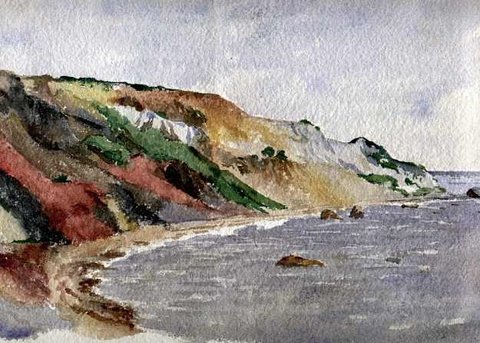
But no one sees it like Benton.
All artists—all good artists, that is—have a signature way of looking at the world. Benton sees nature and even people as dramatically scooped sculptural shapes that have a striking force. Everything he paints has been passed through that special sensibility and altered accordingly. As a result, students in art history courses can take those exams in which the professor shows them a painting they’ve never seen before, and if they’ve done their homework they can almost always identify the artist by his or her style fingerprint.
Here’s a photo of what I’m fairly sure is the original scene. You’ll see the resemblances to the Benton painting. But you’ll also see how much more exaggerated and dramatic Benton’s vision is:
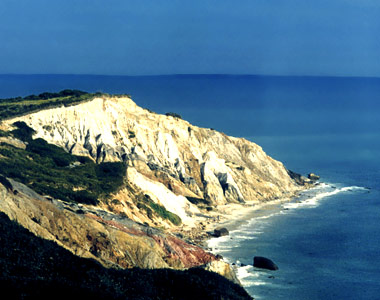
Beautiful indeed, but without the almost aggressively scooped shapes of the Benton work. Art imitates nature, but changes it by filtering it through the human mind.