
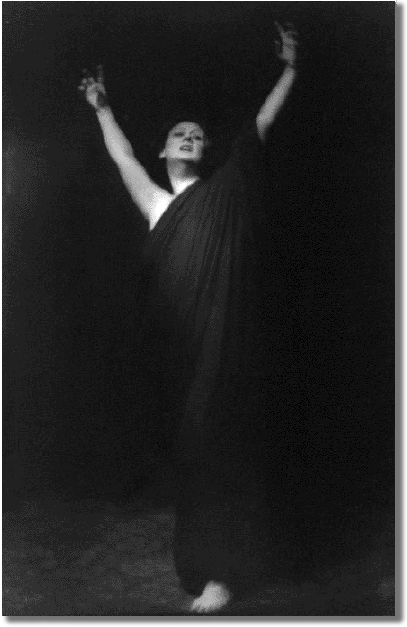
Take a look at this photo of dancer Isadora Duncan and see how powerful it is. I challenge you to find anything remotely like it in a contemporary dancer. But then, Duncan was sui generis even in her time, or probably in any time.
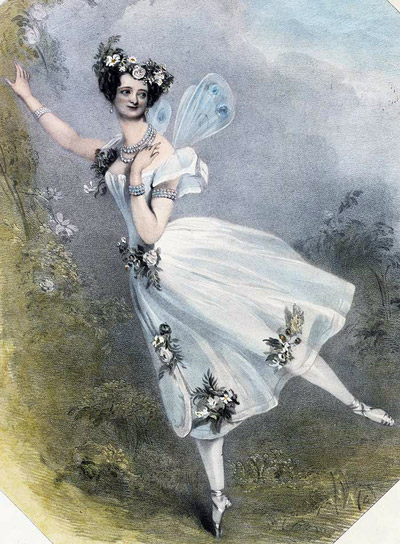
Dance is among the most ephemeral of arts, and that was especially true before the advent of the camera. Prior to that, we had verbal descriptions, painting, and lithographs. But those only tell us what the viewer perceived, not the dancer’s corporeal form in space:
The advent of the photo was a great advance, although it still did not involve movement, and movement is the heart of dance. That’s why as a child, although I was fascinated with tales of Isadora Duncan—her pioneering, scandalous, and tragic life, and most of all her revolutionary way of choreographing and dancing that left viewers transfixed and spellbound—she would always remain a mystery, impossible to comprehend and know, because although there are still photos there are virtually no films (except a grainy couple of seconds that are hardly helpful).
The still photos say a surprising amount, though. In all of them, Duncan is timeless and monumental, weighted and yet graceful and reminiscent of classical sculpture, which she used as inspiration. Take a look:
A contemporary of Duncan was another very different dancer of legend, Anna Pavlova. She was before my time, and yet tantalizingly recent enough that my mother when a tiny child had seen her dance, an experience my mother remembered and described to me in glowing terms. With Pavlova we do have a number of short films, but there we encounter the enormous and surprising limitations of dance on film, in which is a three-dimensional art usually suffers greatly from its translation to two dimensions, even now.
With Pavlova there are extra difficulties. The first is the sometimes herky-jerky quality of the old film itself, the second is her terribly old-fashioned choreography and technique, and the third are what Sir Frederick Ashton (in the following clip) describes as Pavlova’s physical limitations, which she managed to transcend. Watch, and listen, and you might see a small glimmer of why she was considered one of the greatest dancers of all time:
When I was growing up and as a young woman, I had the great good fortune to be in or near New York City and able to view many of the greats of the 50s, 60s, and 70s in person. There is nothing like the experience of the living, breathing dancer on a stage. The physical dimensions may number three, but the spiritual and emotional ones can seem almost infinite.
[NOTE: The title of this post comes from a remark by Ashton in the clip.]