↓
 

The New Neo

A blog about political change, among other things

  • Home
  • Bio
  • Email
Home » Page 1539 << 1 2 … 1,537 1,538 1,539 1,540 1,541 … 1,933 1,934 >>

Post navigation

← Previous Post
Next Post→

Kennedy assassination conspirators again: how they operate

The New Neo Posted on June 20, 2011 by neoAugust 13, 2019

There are two topics almost guaranteed to draw a lot of heated commentary and trolls.

No, I’m not speaking of tits and ass (hey, I just threw that in to see if some traffic would come). I’m speaking of (a) anything defending Israel; and (b) anything challenging the Kennedy assassination conspiracy theorists.

Saturday’s post on the latter topic conformed quite nicely to the rule, calling forth much sturm and drang in the comments section.

I have noticed a pattern now too often for it to be a coincidence: people who believe in conspiracy theories cling to them in the face of all evidence to the contrary. In fact, when they are offered evidence to the contrary, they often will not even look at it. Why let the facts get in the way of a good (or bad) argument? It’s easier to just raise more objections, or to repeat the original assertion.

I’ve mentioned that Bugliosi’s book debunking the JFK assassination conspiracy theories is very long, in part because it attempts to deal with every single one. Most people are not going to read the whole thing. But the first 500 pages or so are quite doable, often riveting, and present a ton of facts that are exceedingly convincing to those who have minds open enough to take it all in objectively.

The rest of the book can be considered as a reference—and a handy one at that, since it is also available though Kindle, and a great deal of it is posted online for free at Google Books.

Since Bugliosi has pondered virtually every aspect of the Kennedy assassination and its conspiracy buffs, he’s pondered how they go about their business, and he has this to say (see pp. 951 ff):

It is remarkable that conspiracy theorists can believe that groups like the CIA, military-industrial complex, and FBI would murder the president, but cannot accept the likelihood, even the possibility, that a nut like Oswald would flip out and commit the act, despite the fact that there is a ton of evidence that Oswald killed Kennedy, and not an ounce showing that any of these groups had anything to do with the assassination.

It is further remarkable that these conspiracy theorists aren’t troubled in the least by their inability to present any evidence that Oswald was set up and framed. For them, the mere belief or speculation that he was is a more-than-adequate substitute for evidence. More importantly, there is a simple fact of life that Warren Commission critics and conspiracy theorists either don’t realize or fail to take into consideration, something I learned from my experience as a prosecutor; namely, that in the real world—you know, the world in which when I talk you can hear me, there will be a dawn tomorrow, et cetera—you cannot be innocent and yet still have a prodigious amount of highly incriminating evidence against you…

…[T]he evidence against Oswald is so great that you could throw 80% of it out the window and there would still be more than enough to prove his guilt beyond all reasonable doubt…

The Warren Commission critics and conspiracy theorists display an astonishing inability to see the vast forest of evidence proving Oswald’s guilt because of their penchant for obsessing over the branches, even the individual branches. And, because virtually all of them have no background in criminal investigation, they look at each leaf (piece of evidence) by itself, hardly ever in relation to, and in the context of, all the other evidence.

Bugliosi is describing something I’ve noticed as well. There is indeed a mountain—or a forest, or whatever comparison you like—of solid evidence implicating Oswald, from a multiplicity of sources, such that it could not be planted simultaneously. There are countless witnesses to actions before and after the assassination, and that involve the murder of Officer Tippit as well. There are fingerprints. There are mail orders for firearms and fake IDs written in Owald’s handwriting and photos that are NOT faked (and that his widow attested to having taken herself—did she frame Oswald as well?).

There is an absence of all of this evidence for everyone else. All that is left is “well, this person talked to that person once” or “this person was acquainted with that person” or “this group had reason to want Kennedy dead,” and on and on and on. Tiny discrepancies—common to all prosecutions of all crimes that do not involve a video of the perpetrator committing the act and an uncoerced confession—are found and focused on. Witnesses might disagree on a detail here and there. Sometimes some change their story. Not every single fact is completely nailed down. But, as Bugliosi points out, the evidence for Oswald as the sole perpetrator is so enormously overwhelming that it has been proven not only beyond a reasonable doubt, but beyond a doubt.

However, doubting remains, and is extremely prevalent. A poll from 2003 indicated that 70% of Americans believe there was a conspiracy. The persistance of such ideas reflects, among other things, the fact that people are reluctant to believe that an insignificant individual such as Oswald could have committed an act that changed history. But it happens all the time—and, by the way, it was one of Oswald’s motivations: he wanted to change history and to change his own insignificance and turn it into significance.

Yet another reason for the prevalence of Kennedy assassination conspiracy theorists is that the sort of logical thinking that makes for the evaluation of a good legal case is not necessarily common among humanity. Critical thinking is difficult, and understanding a huge and unwieldy body of evidence is time-consuming and somewhat boring. Much more fun, and much easier, to poke a hole in a fact or two, to rely on outright lies or misrepresentations of what happened, and to jaw at length in paranoia on various and sundry discussion boards.

[NOTE: to those who point out that Bugliosi has written some rather sketchy books on other topics, my answer is that while this may be so (I haven’t read those), on this one he is both exhaustive and accurate. That is because it is in his wheelhouse, the prosecution of a criminal act, whereas the sketchy ones are not (one, for example, is about Bush being guilty of war crimes, which is not in Bugliosi’s field of expertise as an LA deputy district attorney). I have read Bugliosi’s Helter Skelter, about the Manson murder case which he had prosecuted; it is an excellent book on the subject.]
Posted in History, Law, Violence | 87 Replies

Supreme Court rules against Walmart class action suit

The New Neo Posted on June 20, 2011 by neoJune 20, 2011

The Supreme Court has shown some sense and dismissed the Walmart class action suit as way too broad and inclusive.

I had written about the Walmart suit previously:

There is really no evidence of a discriminatory policy on the part of Walmart, either. In fact, Walmart’s official policy is explicitly non-discriminatory, but promotion decisions are de-centralized and made through individual discretion. The plaintiffs contend that, through some sort of oozing osmosis, these individual decisions become saturated with gender discrimination that flows down from above and is therefore Walmart management’s responsibility.

How did it come to this? How did we get to the point of ignoring actual policy and looking only at equality of outcome as the indicator of what a policy might be?

That’s a rhetorical question, of course; we know how.

It is encouraging that the Supreme Court made the ruling in a rare but encouraging instance of unanimity (although they ruled with the usual 5-4 split on a secondary issue in the case). The plaintiffs are still allowed to sue in individual lawsuits alleging discrimination and prove it in time-honored fashion, but they cannot tie all whatever-million female employees of Walmart to their tail. Such an act would not only have probably destroyed Walmart (which many on the left would have considered a feature rather than a bug), but also had a chilling effect on many other businesses.

Posted in Law | 18 Replies

Father’s Day

The New Neo Posted on June 19, 2011 by neoJune 19, 2011

[NOTE: This a slightly edited version of a previous post of mine.]

It’s Father’s Day. A sort of poor stepchild to Mother’s Day, although fathers themselves are hardly that. They are central to a family.

Just ask the people who never had one, or who had a difficult relationship with theirs. Or ask the people who were nurtured in the strength of a father’s love and guidance.

Of course, the complex world being what it is, and people and families being what they are, it’s the rare father-child relationship that’s entirely conflict-free. But for the vast majority, love is almost always present, even though at times it can be hard to express or to perceive. It can take a child a very long time to see it or feel it; but that’s part of what growing up is all about. And “growing up” can go on even in adulthood, or old age.

Father’s Day—or Mother’s Day, for that matter—can wash over us in a wave of treacly sentimentality. But the truth of the matter is often stranger, deeper, and more touching. Sometimes the words of love catch in the throat before they’re spoken. But they can still be sensed. Sometimes a loving father is lost through distance or misunderstanding, and then regained.

There’s an extraordinary poem by Robert Hayden that depicts one of these uneasy father-child connections—the shrouded feelings, both paternal and filial, that can come to be seen in the fullness of time as the love that was always, always there. I offer it on this Father’s Day to all of you.

THOSE WINTER SUNDAYS

Sundays too my father got up early
and put his clothes on in the blueblack cold
then with cracked hands that ached
from labor in the weekday weather made
banked fires blaze. No one ever thanked him.

I’d wake and hear the cold splintering, breaking.
When the rooms were warm, he’d call,
and slowly I would rise and dress,
fearing the chronic angers of that house.

Speaking indifferently to him,
who had driven out the cold
and polished my good shoes as well.
What did I know, what did I know
of love’s austere and lonely offices?

[ADDENUDM: Charles Blow talks about one of these troubled father-son relationships—his own, with his father.]

Posted in Uncategorized | 15 Replies

The Kennedy conspiracists’ conspiracy

The New Neo Posted on June 18, 2011 by neoJune 18, 2011

I’ve been reading a book by Vincent Bugliosi entitled Reclaiming History, which purports to definitively prove that Oswald killed JFK by himself and was not part of any conspiracy. Bugliosi amasses a mountain of evidence (almost literally; the book is huge) and strikes down each and every conspiracy theory point by point by point.

It’s a gargantuan task. I’ve not read the entire thing and probably won’t, but I’ve read a good deal of it, and I think he does a remarkably (and almost frighteningly) thorough job, and a convincing one as well.

Bugliosi makes an especially interesting point in his introduction, one I hadn’t really thought of before, which is that although most of the people who believe in the various conspiracies are probably sincere in their beliefs, many of those who actually write the conspiracy books are not. They are lying and they know it, but they count on their readers not to realize this.

The Kennedy assassination involves an almost unimaginable amount of data and evidence, so much so that most of us have forgotten many of the details although we may think we remember them. Authors of conspiracy books—who generally are exceedingly familiar with these details—are counting on their readers’ faulty or incomplete memories.

On pages xxviii-xxix of the introduction to his book, Bugliosi points out:

The conspiracy theorists are so outrageously brazen that they tell lies not just about verifiable, documentary evidence, but about clear, photographic evidence, knowing that only one out of a thousand of their readers, if that, is in possession of the subject photographs. Robert Groden (the leading photographic expert for the conspiracy proponents who was the photographic adviser the Oliver Stone’s movie JFK) draws a diagram on page 24 of his book High Treason of Governor Connally seated directly in front of President Kennedy in the presidential limousine and postulates the “remarkable path” a bullet coming from behind Kennedy, and traveling from left to right, would have to take to hit Connally—after passing straight through Kennedy’s body, making a right turn and then a left one in midair, which, the buffs chortle, bullets “don’t even do in cartoons.” What average reader would be in a position to dispute this seemingly common-sense, geometric assault on the Warren Commission’s single-bullet theory?…But of course, if you start out with an erroneous premise, whatever flows from it makes a lot of sense. The only problem is that it’s wrong. The indisputable fact here—which all people who have studied the assassination know—is that Connally was not seated directly in front of Kennedy, but to his left front.

Bugliosi goes on to add that Connally’s jump seat was also three inches lower than Kennedy, and his head was turned to his right (which is clear from the Zapruder film) at the time the bullet hit. The proper trajectory of the bullet was therefore exactly as the Warren Commission stated. None of these facts are all that difficult to ascertain, and there is little doubt that conspiracy author and consultant Groden is (or should be) well aware of them. And this is just a single point on which conspiracists prevaricate; there are countless others.

Bugliosi continues [emphasis mine]:

I am unaware of any other major event in world history which has been shrouded in so much intentional misinformation as has the assassination of JFK.

The question is why? Bugliosi notes that conspiracy sells, and he is correct. There is no question that some of the motivation to write these things is to make money. But for at least some of the conspiracy authors and promoters there is probably another reason, which is that belief in conspiracies undermine faith in our government as a whole. Earl Warren had this to say about the matter (page xxi of the introduction):

To say now that [the FBI, CIA, Secret Service, and Departments of State and Defense], as well as the [Warren] Commission, suppressed, neglected to unearth, or overlooked evidence of a conspiracy would be an indictment of the entire government of the United States. It would mean the whole structure was absolutely corrupt from top to bottom, not one person of high or low rank willing to come forward to expose the villainy, in spite of the fact that the entire country bitterly mourned the death of its young president.

I would add that, as the years have gone on and conspiracy theories that allege that the above government agencies were responsible for killing Kennedy—rather than just incompetent or engaged in a coverup—have proliferated, Warren’s statement has become even more true.

I’ve never seen an analysis of whether Kennedy assassination conspiracists are predominately of the left or of the right. But my gut sense is that, although there are some on each side, the left is far more amply represented (Oliver Stone himself being a prime example). The left has a special reason not only to undermine faith in the US government but to exonerate Oswald as well, because there is no question (to any sane person, at least) that Oswald was a devoted man of the far left.

Somehow even that latter point has gotten somewhat lost. A significant number of pundits have been asserting for quite some time that the far right was responsible for Kennedy’s death (I discussed the phenomenon at greaster length here).

From my reading of Oswald’s testimony and demeanor, he was well aware that he would be championed and/or exonerated by those who would want to believe him innocent. His famous “I am a patsy” remark was a brilliant statement along those lines. Bugliosi’s book explains that Oswald maintained a resistance to police interrogation that was impressive; he virtually never lost his imperturbable demeanor during the time he was in custody. When confronted with clear evidence of his guilt, he calmly and arrogantly denied whatever implicated him, no matter how powerfully it did so. When asked, for example, to explain a fact that pointed strongly to his guilt, he merely answered, “I don’t explain it” (page 255).

Perhaps Oswald correctly surmised that others would do his explaining for him.

[ADDENDUM: Coincidentally, Ed Driscoll has some thoughts on a similar subject.]

Posted in History | 127 Replies

Libya, Obama, the lawyers, and the press

The New Neo Posted on June 18, 2011 by neoJune 18, 2011

News is that President Obama rejected the counsel of the two topmost lawyers when he decided, against their advice, to forego Congress’s consent for the war action in Libya [emphasis mine]:

President Obama rejected the views of top lawyers at the Pentagon and the Justice Department when he decided that he had the legal authority to continue American military participation in the air war in Libya without Congressional authorization, according to officials familiar with internal administration deliberations…But Mr. Obama decided instead to adopt the legal analysis of several other senior members of his legal team ”” including the White House counsel, Robert Bauer, and the State Department legal adviser, Harold H. Koh ”” who argued that the United States military’s activities fell short of “hostilities.”…Presidents have the legal authority to override the legal conclusions of the Office of Legal Counsel and to act in a manner that is contrary to its advice, but it is extraordinarily rare for that to happen. Under normal circumstances, the office’s interpretation of the law is legally binding on the executive branch.

This is interesting on a number of grounds. The first is that it demonstrates what we already know about Obama: his conviction that he’s always the smartest guy in the room. That can be strength, I suppose, if the decisions a person makes are correct—that is, if he/she really is the smartest guy in the room. All too often, however, Obama is merely arrogant, and does not know what he does not know.

The second interesting thing is that the NY Times is covering this particular story at all. In the past, news critical of Obama ordinarily would have been left to the press on the right. But, as I noted just yesterday, for some reason the Times has decided to take a strong stand against Obama on the Libya issue. This means, of course, that stories that would ordinarily be ignored are instead given attention.

And that in turn highlights another point: the MSM shapes perceptions not just by its slant on the stories it covers, but by what it chooses to cover in the first place.

But the Times is not totally critical of Obama, of course. On the first page of the article it states [emphasis mine]:

The administration followed an unusual process in developing its position. Traditionally, the Office of Legal Counsel solicits views from different agencies and then decides what the best interpretation of the law is. The attorney general or the president can overrule its views, but rarely do.

In this case, however, Ms. Krass was asked to submit the Office of Legal Counsel’s thoughts in a less formal way to the White House, along with the views of lawyers at other agencies. After several meetings and phone calls, the rival legal analyses were submitted to Mr. Obama, who is a constitutional lawyer, and he made the decision.

In my drafts there’s a post I’ve yet to finish, but one I’ve researched at length, about Obama the constitutional lawyer/professor/instructor (I don’t care what title you give him; that’s not my concern here, although I’m aware that there’s controversy about whether he really was a professor rather than instructor at the University of Chicago, where he taught constitutional law). That’s a meme that sounds awfully good, but it turns out that Obama’s field of expertise in constitutional law was a narrow one: due process and equal protection with a special focus on racism, as described in this NY Times article from 2008:

His most traditional course was in the due process and equal protection areas of constitutional law. His voting rights class traced the evolution of election law, from the disenfranchisement of blacks to contemporary debates over districting and campaign finance. Mr. Obama was so interested in the subject that he helped Richard Pildes, a professor at New York University, develop a leading casebook in the field.

His most original course, a historical and political seminar as much as a legal one, was on racism and law. Mr. Obama improvised his own textbook, including classic cases like Brown v. Board of Education, and essays by Frederick Douglass, W. E. B. Dubois, the Rev. Dr. Martin Luther King Jr. and Malcolm X, as well as conservative thinkers like Robert H. Bork.

Mr. Obama was especially eager for his charges to understand the horrors of the past, students say. He assigned a 1919 catalog of lynching victims, including some who were first raped or stripped of their ears and fingers, others who were pregnant or lynched with their children, and some whose charred bodies were sold off, bone fragment by bone fragment, to gawkers”¦

None of this should be a surprise, and equal protection and due process (and even the sorry history of lynching) are all important and valid areas of study. But they have absolutely nothing to do with many other major concerns of constitutional law, and most definitely nothing to do with the issue at hand—the War Powers Act and its interpretation for the chief executive. On that score, Obama’s legal acumen probably is no better than that of any law school graduate, who may never even have encountered the topic in law school or in preparing for the bar exam.

Posted in Law, Obama, War and Peace | 19 Replies

The left and Obama: is breaking up getting easier to do?

The New Neo Posted on June 17, 2011 by neoJune 17, 2011

I’ve often described the left’s relationship with Obama as akin to romantic love. It’s been evident for quite some time (see this, for example) that the early flush of intense infatuation is over. But a more quiet and realistically cynical love remained.

Now I wonder if that has ended, as well. One indication of that possibility is this editorial in today’s NY Times, which for the first time (at least as best I can recall) breaks quite strongly with one of Obama’s hypocritical policies. The issue is Libya and the War Powers Act. These are pretty strong words for the usually Obama-enabling Times to use:

…Mr. Obama cannot evade his responsibility, under the War Powers Act, to seek Congressional approval to continue the operation. The White House’s argument for not doing so borders on sophistry…No word games can get him off the hook.

The Times goes on to blame the Republicans for partisan maneuvering. But the editors come back at the very end to calling on Obama to comply with the law:

Partisan brinkmanship or not, Mr. Obama doesn’t have a choice. He needs to go to Congress and make his case.

Another sign of discontent is this sort of thing (the article even uses the metaphor of a romantic breakup). Progressives are not very happy with Obama, and they’re saying so. They perceive him as a squishy middle-of-the-road kind of guy. But this is hardly new. The real question is what they’ll do at the polls–stay home, or hold their noses and vote for him?

Posted in Obama, Press | 39 Replies

John Hinderaker asks…

The New Neo Posted on June 17, 2011 by neoJune 17, 2011

…whether Michele Bachmann has been underestimated.

Not just by her enemies, but by her friends.

As for me, I don’t yet have a firm opinion about Bachmann, simply because so far I’m not familiar enough with her. That will emerge over time if she continues to be a candidate. But my initial impression is that those on the left who call her a lunatic or stupid are confusing her with somebody else, or with their own wishful thinking. Unlike their other nemesis (and her supposed doppelganger) Sarah Palin, Bachmann is generally articulate in the more conventional sense; and her academic and professional credentials, although not Ivy League, are more conventionally impressive as well: JD from Oral Roberts University, LLM in tax law (not, one would imagine, an especially easy course of study) from William and Mary Law School, and then a lawyer for the IRS. What a dum-dum!

[NOTE: The above is not meant to imply that Sarah Palin’s lack of graduate degree, law credentials, or “more conventional” articulation means that she is stupid or any of the other things of which she is accused by her enemies. It merely means that, without that veneer, she is easier to make fun of, and it is somewhat more difficult for her to reach and gain the respect of the vast middle of the electorate.]

Posted in Politics | 26 Replies

Freedom: is it any surprise…

The New Neo Posted on June 16, 2011 by neoJune 16, 2011

…that the large and liberal states of New York and California rank low on the scale of individual freedom?

And what do New Hampshire and Indiana have in common? Not only do they rank very high, but they both are islands of individual freedom surrounded by states that rank very low.

New Hampshire seems quite aware of this—after all, its state motto is the famous “Live Free or Die” (I wrote about that here). What’s Indiana’s secret?

Posted in Liberty | 23 Replies

The Gershwins and multiple talents

The New Neo Posted on June 16, 2011 by neoJune 16, 2011

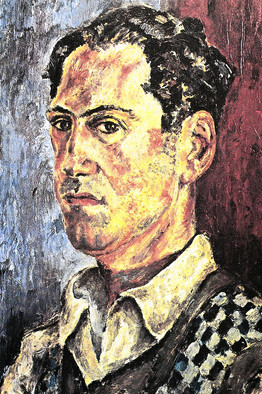
I’ve been doing some research about George Gershwin (this is an especially wonderful biography), and I’ve been surprised to learn that, in addition to his formidable musical talent, Gershwin was a major collector of modern art and a credible painter himself. Here’s a self-portrait:

If you want to see a bunch more of Gershwin’s paintings, go here (the site contains all sorts of warnings against reproduction of the images, so I’m linking to the source rather than reproducing them here). They have two characteristics: they are portraits, and they are very fine. He was not a dabbler.

Sometimes geniuses—and Gershwin was most definitely a musical genius—are successful because they have tunnel vision and are quite obsessed with what they do. But sometimes they are multi-talented; Churchill comes to mind; he was also a skilled painter, with his work consisting primarily of landscapes. Although I greatly admire Churchill, I don’t think much of his paintings, which seem far less distinctive than Gershwin’s.

It is not unusual to be multiply-talented in linked fields—such as, for example, music and mathematics. Music and painting are a more unusual duo, and Gershwin was somewhat unique in reaching such a high level in both. What’s more—and of special interest to me—Gershwin had three siblings, all of whom were highly and often multiply-talented, despite the fact that their parents did not seem especially gifted in the arts at all. Nor did the children receive a lot of training in the arts.

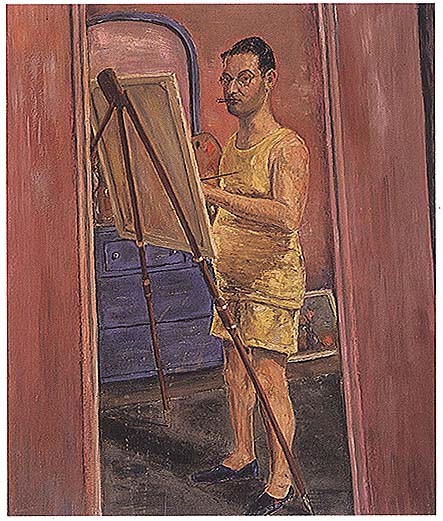
Most people who know anything about the Gershwins are already aware that George’s brother Ira was as wonderful a lyricist as George was a composer. They were musical collaborators and very good friends for most of their lives. But Ira was an excellent painter, too. Here’s a self-portrait:

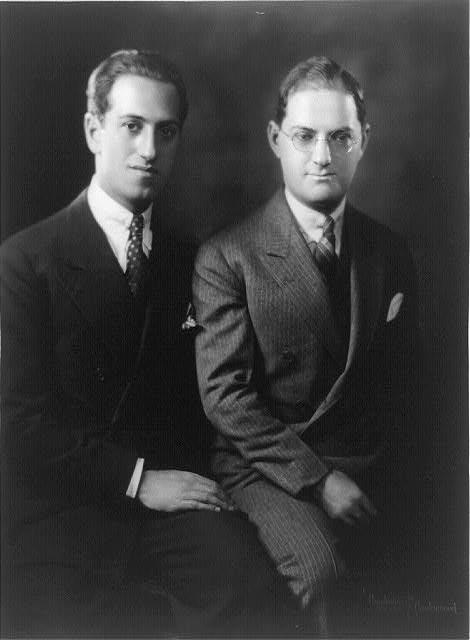
And if you’d like to see how good those portraits are, here is a photo of the duo George and Ira:

Their baby sister Frances—although far less well-known—sang, composed music, and painted, too. She had quite a life. She was a child performer and dancer, as well as a singer:

Frequently summoned to George’s lair on the fifth floor, she was often the first to sing Gershwin songs that would later be Broadway hits, and when George was in rehearsal for ”Lady Be Good,” brother and sister would try out steps he had learned from the show’s star, Fred Astaire.

Although her husky voice was small by stage standards of the day, George, who loved her interpretations of his sometimes complicated music, particularly the way she kept the rhythm going, made her his personal chanteuse, and the two entertained at countless flapper-era parties in New York and elsewhere.

What’s more, she became a painter and sculptor once she married and moved to Connecticut, and had many exhibits that were well-received. But her performing career wasn’t over, either:

Although painting remained her main artistic outlet, in her later years [Frances] re-emerged as a singer. Her 1975 album, ”Frances Sings for George and Ira,” won wide acclaim, and after a granddaughter suggested she get vocal training, she began a long-deferred professional career, singing Gershwin tunes at the Lambs Club and elsewhere until two years [before she died in 1999].

And what of sibling number four, Arthur? He was a composer too, natch, although his day job was stockbrocker:

He composed the two-act musical A Lady Says Yes (1945) which is set in 1545 and 1945 and takes place in Venice, Washington D.C. and China. It ran on Broadway from Jan 10, 1945 to Mar 25, 1945 at the Broadhurst Theatre and had 87 performances.

His song Invitation to the Blues with lyrics by Doris Fisher, was used in the film Tootsie (1982) and has been recorded by Julie London.

Arthur is the sole Gershwin sibling who doesn’t seem to have painted as well—although it’s hard to say, because there isn’t a whole lot of information about him.

From whence comes this sort of talent and achievement? No doubt, as with just about everything else, it’s some complex combination of nature/nurture. The structure of the brain must be part of it, but we still know very little about how this sort of thing happens. Composers are often child prodigies, or at least show an extraordinary interest in music at an early age. Despite George Gershwin’s relative lack of musical education (he did have about five years of lessons as a teenager, but his training was neither especially rigorous or intense), by all reports he was deeply interested in music at an early age, and markedly skilled at improvisation as well. Music just seemed to flow out of him for most of his short life.

Last October in the WSJ, Terry Treachout attempted to analyze the phenomenon of dual-talents, but I can’t say he shed much light on it. Much of his article had to do with people (such as Nat King Cole, or Benjamin Britten) who were talented in two musical fields; or artists such as Degas, who both painted and sculpted. That’s impressive, but not all that impressive, since it’s obvious that such arenas as singing and piano playing might be linked, although certainly not always (Gershwin, for example, who was by all accounts an extraordinary pianist, had a terrible singing voice—although he’s said to have been a terrific dancer).

Painting and music seem to be widely separated modalities. One is visual, the other auditory. If one stretches for links, however, a few can be found. For example, both painting and piano playing require tremendous manual dexterity and fine motor control, although composing does not. And I suppose all of them have something to do with harmony in the most general sense—although doesn’t most art?

[NOTE: The composer Arnold Schoenberg was also an amateur painter, but to my eye his work was markedly inferior.

The Gershwins had a first cousin, Henry Botkin, who was a fairly successful painter. Botkin gave George Gershwin a few art lessons, and that seems to have been the extent of George’s art education.]

Posted in Music, Painting, sculpture, photography, People of interest | 27 Replies

Weiner: going, going…

The New Neo Posted on June 16, 2011 by neoJune 16, 2011

…going, but not gone.

But soon. Very soon.

Posted in Uncategorized | 16 Replies

The Dalai Lama as straight man…

The New Neo Posted on June 15, 2011 by neoJune 15, 2011

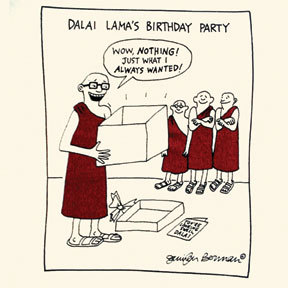
…is funnier than the original joke:

I like this joke better, anyway:

Posted in Uncategorized | 19 Replies

Humans on the planet

The New Neo Posted on June 15, 2011 by neoJune 15, 2011

Erle C. Ellis, associate professor of geography and environmental systems at the University of Maryland, writes that we’re fully in the Anthropocene, a proposed term to describe an era in which the environment has been heavily influenced by humankind:

Earth’s biodiversity, biogeochemistry and evolution are now profoundly reshaped by us – and are therefore in our hands.

Ellis goes on to assure his readers that this is not cause for despair. Although he appears to fully buy into the concept of anthropogenic global warming (“We are warming the atmosphere, melting the ice caps…”), he thinks the cure for the problem is more of the hair of the dog that bit us:

There will be no returning to our comfortable cradle. The global patterns of the Holocene have receded and their return is no longer possible, sustainable or even desirable. It is no longer Mother Nature who will care for us, but us who must care for her…We most certainly can create a better Anthropocene. We have really only just begun, and our knowledge and power have never been greater. We will need to work together with each other and the planet in novel ways. The first step will be in our own minds.

Ellis actually seems to be trying to counsel against the “humans are a cancer on the planet” crowd. In doing so, however, he overestimates the effect of humans, both good and bad. It is by no means clear that any global warming that has occurred has been caused by humans. And it is by no means clear that we understand any of these processes well enough to alter them in the desired ways. The law of unintended consequences is a bitch, especially in complex systems, and the ecology of the earth is nothing if not a complex system.

One of the commenters at the article has this to say:

Our “cradle” NEVER was “comfortable.” That’s why we, you know, CHANGED it. Just what was comfortable about that cradle? Living in the wild all the time? Smallpox epidemics? Yellow fever? Malaria? Black plague? Measles?

Add your own misery to the list.

The author appears to define the Anthropocene as when human ACTION began changing the Earth’s environment. I don’t think this hits what the actual CORE difference is here. After all, the action of cyanobacteria RADICALLY changed Earth’s atmosphere from carbon dioxide at high pressure to oxygen and nitrogen at relatively low pressure. Going by action alone, we could just as easily call the geologic age since the cyanobacteria the Cyanocene.

It is human UNDERSTANDING that is the unique difference.

Agreed. And human understanding of these things is in its infancy.

[NOTE: One very interesting part of Ellis’s article is how early it was that humans began to significantly shape the global environment:

Significant human alteration of the biosphere began more than 15,000 years ago as Palaeolithic tribes evolved social learning, advanced hunting and foraging technologies, and the use of fire, and used them to open up forested landscapes and kill off megafauna.

These Palaeolithic human impacts were significant and extensive, but they were minor compared with the impact of the rise of agriculture more than 8000 years ago. By domesticating plant and animal species and engineering ecosystems to support them, humans introduced a wide range of unambiguously anthropogenic processes into the biosphere.

Human alteration of Earth systems tends to be far more extensive and complex than one would expect based on numbers alone. Even 8000 years ago, with a population of just 10 million or so, humans had already altered as much as a fifth of Earth’s ice-free land, primarily by using fire to clear forest. The reason small populations had such extensive impacts is that early agriculture emphasised labour efficiency. Early farmers did not use the plough, and that meant constantly shifting cultivation to the most fertile areas. As a result, most of the landscape was in some stage of recovery, giving rise to “semi-natural” woodlands. These were among the first anthropogenic biomes, or “anthromes”.]

Posted in Nature, Science | 63 Replies

Post navigation

← Previous Post
Next Post→

Your support is appreciated through a one-time or monthly Paypal donation

Please click the link recommended books and search bar for Amazon purchases through neo. I receive a commission from all such purchases.

Archives

Recent Comments

  • Brian E on Open thread 11/7/2026
  • Karmi on Open thread 11/7/2026
  • Mike Plaiss on Open thread 11/7/2026
  • Mike Plaiss on Open thread 11/7/2026
  • neo on My trusty rusty old car

Recent Posts

  • My trusty rusty old car
  • If you don’t vote because you’re tired of voting for the lesser of two evils, you get the greater of two evils
  • On fraud: New Hampshire turns blue with a tiny purple spot
  • Open thread 11/7/2026
  • So, why am I renewing my passport?

Categories

  • A mind is a difficult thing to change: my change story (17)
  • Academia (330)
  • Afghanistan (98)
  • Amazon orders (6)
  • Arts (8)
  • Baseball and sports (164)
  • Best of neo-neocon (91)
  • Biden (536)
  • Blogging and bloggers (599)
  • Dance (292)
  • Disaster (244)
  • Education (328)
  • Election 2012 (360)
  • Election 2016 (566)
  • Election 2018 (33)
  • Election 2020 (513)
  • Election 2022 (114)
  • Election 2024 (403)
  • Election 2026 (124)
  • Election 2028 (14)
  • Evil (130)
  • Fashion and beauty (324)
  • Finance and economics (1,053)
  • Food (319)
  • Friendship (48)
  • Gardening (18)
  • General information about neo (4)
  • Getting philosophical: life, love, the universe (737)
  • Health (1,169)
  • Health care reform (546)
  • Hillary Clinton (184)
  • Historical figures (338)
  • History (718)
  • Immigration (452)
  • Iran (467)
  • Iraq (227)
  • IRS scandal (71)
  • Israel/Palestine (835)
  • Jews (444)
  • Language and grammar (365)
  • Latin America (216)
  • Law (2,997)
  • Leaving the circle: political apostasy (125)
  • Liberals and conservatives; left and right (1,334)
  • Liberty (1,119)
  • Literary leftists (14)
  • Literature and writing (394)
  • Me, myself, and I (1,523)
  • Men and women; marriage and divorce and sex (934)
  • Middle East (385)
  • Military (327)
  • Movies (355)
  • Music (534)
  • Nature (262)
  • Neocons (32)
  • New England (185)
  • Obama (1,740)
  • Pacifism (16)
  • Painting, sculpture, photography (132)
  • Palin (93)
  • Paris and France2 trial (25)
  • People of interest (1,051)
  • Poetry (259)
  • Political changers (179)
  • Politics (2,797)
  • Pop culture (397)
  • Press (1,636)
  • Race and racism (885)
  • Religion (431)
  • Romney (164)
  • Ryan (16)
  • Science (642)
  • Terrorism and terrorists (983)
  • Theater and TV (266)
  • Therapy (71)
  • Trump (1,637)
  • Uncategorized (4,631)
  • Vietnam (109)
  • Violence (1,465)
  • War and Peace (1,035)

Blogroll

Ace (bold)
AmericanDigest (writer’s digest)
AmericanThinker (thought full)
Anchoress (first things first)
AnnAlthouse (more than law)
AugeanStables (historian’s task)
BelmontClub (deep thoughts)
Betsy’sPage (teach)
Bookworm (writingReader)
ChicagoBoyz (boyz will be)
DanielInVenezuela (liberty)
Dr.Helen (rights of man)
Dr.Sanity (shrink archives)
DreamsToLightening (Asher)
EdDriscoll (market liberal)
Fausta’sBlog (opinionated)
GayPatriot (self-explanatory)
HadEnoughTherapy? (yep)
HotAir (a roomful)
InstaPundit (the hub)
JawaReport (the doctor’s Rusty)
LegalInsurrection (law prof)
Maggie’sFarm (togetherness)
MelaniePhillips (formidable)
MerylYourish (centrist)
MichaelTotten (globetrotter)
MichaelYon (War Zones)
Michelle Malkin (clarion pen)
MichelleObama’sMirror (reflect)
NoPasaran! (bluntFrench)
NormanGeras (archives)
OneCosmos (Gagdad Bob)
Pamela Geller (Atlas Shrugs)
PJMedia (comprehensive)
PointOfNoReturn (exodus)
Powerline (foursight)
QandO (neolibertarian)
RedState (conservative)
RogerL.Simon (PJ guy)
SisterToldjah (she said)
Sisu (commentary plus cats)
Spengler (Goldman)
VictorDavisHanson (prof)
Vodkapundit (drinker-thinker)
Volokh (lawblog)
Zombie (alive)

Meta

  • Log in
  • Entries feed
  • Comments feed
  • WordPress.org
©2026 - The New Neo - Weaver Xtreme Theme Email
Web Analytics
↑