I’ve been doing some research about George Gershwin (this is an especially wonderful biography), and I’ve been surprised to learn that, in addition to his formidable musical talent, Gershwin was a major collector of modern art and a credible painter himself. Here’s a self-portrait:
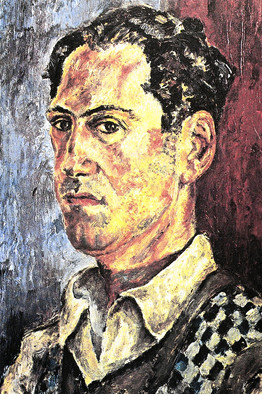
If you want to see a bunch more of Gershwin’s paintings, go here (the site contains all sorts of warnings against reproduction of the images, so I’m linking to the source rather than reproducing them here). They have two characteristics: they are portraits, and they are very fine. He was not a dabbler.
Sometimes geniuses—and Gershwin was most definitely a musical genius—are successful because they have tunnel vision and are quite obsessed with what they do. But sometimes they are multi-talented; Churchill comes to mind; he was also a skilled painter, with his work consisting primarily of landscapes. Although I greatly admire Churchill, I don’t think much of his paintings, which seem far less distinctive than Gershwin’s.
It is not unusual to be multiply-talented in linked fields—such as, for example, music and mathematics. Music and painting are a more unusual duo, and Gershwin was somewhat unique in reaching such a high level in both. What’s more—and of special interest to me—Gershwin had three siblings, all of whom were highly and often multiply-talented, despite the fact that their parents did not seem especially gifted in the arts at all. Nor did the children receive a lot of training in the arts.
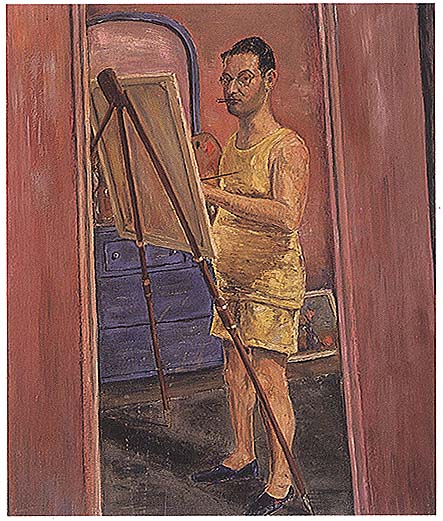
Most people who know anything about the Gershwins are already aware that George’s brother Ira was as wonderful a lyricist as George was a composer. They were musical collaborators and very good friends for most of their lives. But Ira was an excellent painter, too. Here’s a self-portrait:
And if you’d like to see how good those portraits are, here is a photo of the duo George and Ira: 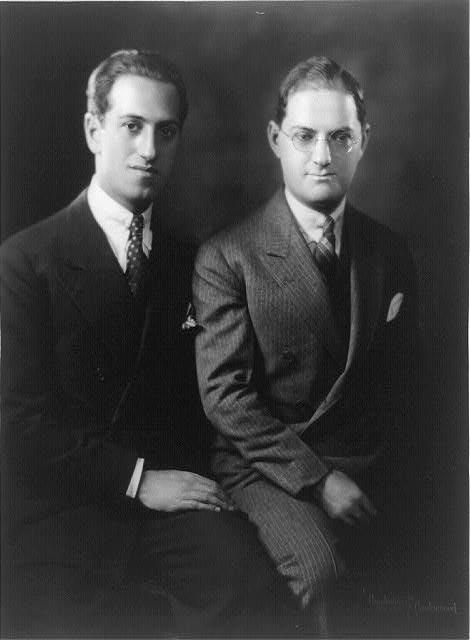
Their baby sister Frances—although far less well-known—sang, composed music, and painted, too. She had quite a life. She was a child performer and dancer, as well as a singer:
Frequently summoned to George’s lair on the fifth floor, she was often the first to sing Gershwin songs that would later be Broadway hits, and when George was in rehearsal for ”Lady Be Good,” brother and sister would try out steps he had learned from the show’s star, Fred Astaire.
Although her husky voice was small by stage standards of the day, George, who loved her interpretations of his sometimes complicated music, particularly the way she kept the rhythm going, made her his personal chanteuse, and the two entertained at countless flapper-era parties in New York and elsewhere.
What’s more, she became a painter and sculptor once she married and moved to Connecticut, and had many exhibits that were well-received. But her performing career wasn’t over, either:
Although painting remained her main artistic outlet, in her later years [Frances] re-emerged as a singer. Her 1975 album, ”Frances Sings for George and Ira,” won wide acclaim, and after a granddaughter suggested she get vocal training, she began a long-deferred professional career, singing Gershwin tunes at the Lambs Club and elsewhere until two years [before she died in 1999].
And what of sibling number four, Arthur? He was a composer too, natch, although his day job was stockbrocker:
He composed the two-act musical A Lady Says Yes (1945) which is set in 1545 and 1945 and takes place in Venice, Washington D.C. and China. It ran on Broadway from Jan 10, 1945 to Mar 25, 1945 at the Broadhurst Theatre and had 87 performances.
His song Invitation to the Blues with lyrics by Doris Fisher, was used in the ï¬lm Tootsie (1982) and has been recorded by Julie London.
Arthur is the sole Gershwin sibling who doesn’t seem to have painted as well—although it’s hard to say, because there isn’t a whole lot of information about him.
From whence comes this sort of talent and achievement? No doubt, as with just about everything else, it’s some complex combination of nature/nurture. The structure of the brain must be part of it, but we still know very little about how this sort of thing happens. Composers are often child prodigies, or at least show an extraordinary interest in music at an early age. Despite George Gershwin’s relative lack of musical education (he did have about five years of lessons as a teenager, but his training was neither especially rigorous or intense), by all reports he was deeply interested in music at an early age, and markedly skilled at improvisation as well. Music just seemed to flow out of him for most of his short life.
Last October in the WSJ, Terry Treachout attempted to analyze the phenomenon of dual-talents, but I can’t say he shed much light on it. Much of his article had to do with people (such as Nat King Cole, or Benjamin Britten) who were talented in two musical fields; or artists such as Degas, who both painted and sculpted. That’s impressive, but not all that impressive, since it’s obvious that such arenas as singing and piano playing might be linked, although certainly not always (Gershwin, for example, who was by all accounts an extraordinary pianist, had a terrible singing voice—although he’s said to have been a terrific dancer).
Painting and music seem to be widely separated modalities. One is visual, the other auditory. If one stretches for links, however, a few can be found. For example, both painting and piano playing require tremendous manual dexterity and fine motor control, although composing does not. And I suppose all of them have something to do with harmony in the most general sense—although doesn’t most art?
[NOTE: The composer Arnold Schoenberg was also an amateur painter, but to my eye his work was markedly inferior.
The Gershwins had a first cousin, Henry Botkin, who was a fairly successful painter. Botkin gave George Gershwin a few art lessons, and that seems to have been the extent of George’s art education.]