
George W. Bush really helped the people of South Sudan achieve their independence.
In the airport: security at TSA security
As a friend of mine learned to his dismay the other day, “security” at the security checkpoint isn’t all it’s cracked up to be.
I’d already read about a growing problem with TSA agents stealing from luggage. But, as my friend learned, it’s also necessary to watch out for theft by fellow-travelers—or people posing as such—while going through the security lines. An already irksome procedure could become a nightmare, if you’re not careful (and perhaps even if you are).
Boston’s Logan is one of those airports graced with the new body scanners; I’ve been through them a couple of times myself. My friend was preparing to board a plane there and asked to put his wallet in a plastic bin, before assuming the usual stick ’em up pose for the machine’s benefit:
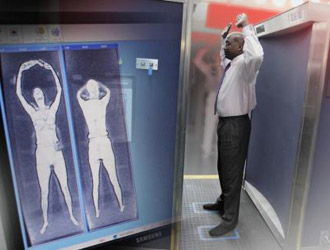
It turned out that for him, “stick ’em up” was no metaphor. Afterward, when he turned to retrieve his wallet from its resting place, it was gone.
The wallet contained lots of cash, and of course all his credit cards and driver’s license. Have you ever thought how lost you’d be on a trip without ID and your other plastic (although in this case he’d already gone through security, so he knew he’d be allowed to get on the airplane)? How do you rent a car, for example? How do you get cash from an ATM machine?
Anger and frustration are mild words for what ensued. My friend reported the theft at once to security, and a bunch of cops descended on the scene. Here’s where the story becomes more amazing: within a half hour, they had located the security tapes and handcuffed the thief, who still had the wallet and its contents on his person.
One of the reasons the thief was relatively easy to catch seems to have been that the surveillance camera indicated he was wearing a distinctive garment, a short white flowing robe, over his slacks. He didn’t seem agitated at all, even when caught, and said to my friend something on the order of, “Salaam, brother!”
Needless to say, this did not sit well. Hardly filled with the milk of human kindness at that moment, my friend yelled in response, “Don’t call me brother! You’re not my brother! Brothers don’t steal wallets from brothers!”
With intact credit cards and ID, but minus the original considerable amount of cash (which the police said he’d probably get back later, after they processed the guy) my friend boarded the plane. The rest of the trip was uneventful, after his heart rate had calmed down to normal.
But I’m passing the story on to you because it illustrates some problems of which I’d previously been unaware, although I’d always wondered why luggage theft at the carousel is not more common. This website has some excellent tips for avoiding having something similar happen to you. It focuses more on the ordinary security line than the scanners (I think people are more vulnerable at the latter, because their possessions are probably out of their sight for longer), but it’s generally helpful for all conditions.
It also has the following to say about the phenomenon of airport thieves, who seem for the most part to be a well-organized and professional group:
…[T]here are some thieves who make their living in airports…[T]hey find the lowest fare for travel from a high traffic airport and check in early online. By checking in online these thieves can have their boarding pass for a 9:00pm flight 24 hours before boarding the plane, and get through security when the security check point opens at 5:00am. The thieves spend their day people watching. They are looking for body language, items out in the open, people who seem unfamiliar with security procedures and those who seem confused and easily distracted by dealing with all the procedures for crossing from the “land side” to the “air side” of security. The “professional airport thief” has a subtle way of getting in line behind their target. You won’t know the thief is there until they are gone.
In the course of a day a skilled thief can go through security…a dozen times. These thieves go from one check in point to another and use tactics like waiting for lunch shifts and shift changes. By waiting for shift changes these thieves can cross back and forth without being noticed, they can avoid the problem of already having a screeners initials on their boarding pass by print multiple copies of their boarding pass on their home computer, hotel computer, or anywhere they choose to check-in online. To blend in these thieves dress like business travelers, carry a roll-aboard bag with a small amount of clothes or a brief case with basic items inside as to not raise any red flags. In short, they blend in and blend in well.
Some very experienced thieves fly short point-to-point, or low cost “hub flights” at the end of their stealing day. Why? Because if they buy tickets frequently and never fly the route a few times they will raise red flags in both the airlines system and the US Dept of Homeland Security’s system. These people do not want any red flags. Some really good thieves gain “elite status” and use airline clubs to further their stealing endevours.
Human ingenuity knows no bounds, apparently.
Travel is already stressful enough without adding this phenomenon to the list of worries. Nevertheless, forewarned is forearmed. Now, happy traveling!
Gay marriage: the law of unintended consequences
Some large companies say to gays “You want equality? I’ll give you equality.”
But this much equality may not be what gay rights activists bargained for:
Now that same-sex marriage has been legalized in New York, at least a few large companies are requiring their employees to tie the knot if they want their partners to qualify for health insurance.
Corning, I.B.M. and Raytheon all provide domestic partner benefits to employees with same-sex partners in states where they cannot marry. But now that they can legally wed in New York, five other states and the District of Columbia, they will be required to do so if they want their partner to be covered for a routine checkup or a root canal.
On the surface, this appears to put the couples on an even footing with heterosexual married couples. After all, this is precisely what they have been fighting for: being treated as a spouse.
The companies are allowing a grace period to phase in the policy. They are still in the minority; other companies have not announced any plans to end domestic partner benefits for same sex partners. Query: are there any straight rights activists who are now going to take up the cause of making straight couples equal to gay couples?
[NOTE: And what dental insurance covers the cost of a root canal? I’ve never had dental insurance, but I was under the impression that it usually barely covers an annual checkup and tooth-cleaning.]
RIP Betty Ford
Former First Lady Betty Ford has died at the age of 93. She was catapulted to fame through an unlikely and unique set of circumstances, her husband appointed VP by Nixon after the disgraced Agnew was forced to leave, and then seguing into the presidency after Watergate forced Nixon’s own departure. So America didn’t get to know the couple the usual way, through a long campaign.
Most obituaries mention the fact that Betty Ford was very likable and outspoken, and she was. She was also matter-of-fact about her flaws, such as an addiction to pain-killers and an alcohol problem. But instead of a lot of weeping and wailing she was solution-focused, setting up the Betty Ford Center for drug and alcohol treatment in 1982, a few years after her husband’s defeat by Jimmy Carter.
Robert Stacy McCain at The Other McCain writes, “‘Dancer’ is probably not the first thing you think of when you think of Betty Ford…” But for me, it actually is—for obvious reasons. It was probably the first thing I ever learned about her, and it endeared her to me.
And Ford was no slouch at dance, either. She was a serious student of the renowned modern dance pioneer Martha Graham:
After being accepted by Graham as a student, Ford moved to Manhattan’s Chelsea neighborhood and worked as a fashion model for the John Robert Powers firm in order to finance her dance studies. She joined Graham’s auxiliary troupe and eventually performed with the company at Carnegie Hall.
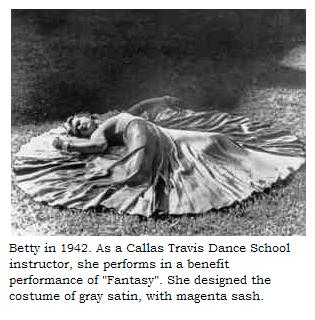
This was certainly a unique history for a First Lady. Photos such as the following (neither of which I’d ever seen before today) make it clear just how unique. The first is from her dancing past, in a costume of her own design:
And the second is during her tenure as First Lady, a moment of levity in the Cabinet room:

RIP.
Romney…
…shows a bit of fire here.
In the Alzheimer’s unit
Last week I visited two elderly relatives who’ve recently moved to an assisted living facility not too far from me. They’re in their mid-eighties, and although they’ve been married for more than 50 years they live in separate wings of the place, because his problems are physical and she has Alzheimer’s.
These are people who were long known for their lively, upbeat personalities, always fun to be around. He’s still gamely trying to be cheery, despite some pain and enormous fatigue, plus his concern about what’s going on with his wife, but it’s a challenge he doesn’t always meet. He’s the one with the full awareness, after all, which is mainly a blessing but has its drawbacks when things are bleak.
But his wife has no such problems. Her mental state hasn’t deteriorated too much yet. She’s still, as they say, “well oriented”—at least in space, if not in time. She’s aware that he lives in a different building, but she thinks it’s a temporary thing, a sort of hospital, and that they’ll soon be reunited for good. He visits her a couple of times a week, and her ordinarily cheerful personality seems intact so far.
Both her parents died a couple of decades ago (her father of Alzheimer’s), but in her mind they remain alive and well, as do a host of other deceased relatives. No use trying to introduce some reality on that score: what would be the point of inducing fresh pain, over and over? So it’s best to play along when she asks after other aunts and uncles who are no longer alive. The answers that seem to make sense are “fine,” “about the same,” or “holding their own.” And after all, who’s to say that’s not the case?
If you adjust to the fact that in her mind it’s about two decades earlier, conversation can go fairly smoothly and the visit is even fun. It’s important to stave off the awareness that next visit she’ll probably be worse, and the next and the next. Since her body seems strong, the day may come when she knows no one, and even speech departs. It’s not a good thing to contemplate; best to keep it at bay.
During this visit there was even a moment of unintentional humor. Shown a recent photo of her only surviving aunt, who is now 95, she gave a gasp of shock.
“What happened to her? She looks terrible!”
“She got very old. She’s 95!” was the answer. But she didn’t accept it, because to her the passage of years stopped quite some time ago, and she tried to do the math and came up short. But it was easy enough to distract and soothe her by changing the subject, because her memory doesn’t hold things for long.
Will she remember my visit? Almost undoubtedly, no. But was she happy to see me? Almost undoubtedly, yes. And doesn’t that have its own value?
Another changer
Here’s another story of political change, this time from Rima Greene, a Jewish leftist feminist lesbian (yep, all four) in San Francisco who woke up to a few realizations [emphasis mine]:
When I was part of the Left, I thought “evil” and “enemy” were outdated concepts brought on by indoctrinated mental patterns. When I was at a peace camp in Portugal—a German peace community—I met the people who’d paraded through Israel with the banner: WE REFUSE TO BE ENEMIES. This is new age thinking, that you can refuse reality and just keep going on your merry way. We as Jews are targeted. We as infidel Americans are targeted. We are the ultimate prize as the Big Satan ”” although Jewish blood is the best for the West’s contemporary adversaries.
We do not grasp the mental universe of our enemies…We in the West have not a clue…That is what I was trying to sort out with the Daniel Pearl incident, but my friend tried to put a stop to my thinking by calling me a racist.
I opened up my mind to understand the mindset of those who want to vanquish us. I read Nonie Darwish and Ayaan Hirsi Ali, and books by Paul Sperry and Robert Spencer. I was willing to connect the dots. My friends are not…
I was a lost soul, up for grabs by the default program of the Left. But I was not a Believer, I was not deeply imprinted, because I am an experimenter, an adventurer, and finally, my mind opened to going to Israel.
Many of the long term friendships I have had were with people, mostly women, who are not really people who loved me, but only ideological fellow travelers who cannot follow me now.
Greene’s change story is unique and personal, as is everyone’s. But it has universal aspects, in particular the pre-change mindset that is open to taking in new information despite an already-existing belief system. As Greene indicates, she may have been a believer, but she wasn’t a Believer.
Fast and furious
Fareed Zakaria says…
So I guess that—on her next test administered by the Charles Gibsons of the world—Sarah Palin would be getting a presidential “doctrine” question wrong again, because I think she’d answer that the Obama Doctrine is “coddling our enemies while alienating allies.”
Zakaria’s column is almost painful to read, so hard must he twist and turn in his attempt to justify Obama’s foreign policy and try to make it sound coherent, thoughtful, and beneficial to this country. In doing so, Zakaria leaves out any reference to Honduras, one of Obama’s earliest and most vile forays into the international arena. Nor does Zakaria explain why helping push Mubarak out in Egypt and make room for the Muslim Brotherhood was so all-fired great.
Aside from the above characterization of the Obama Doctrine by Sarah Palin (and on this blog, way back when), there’s been another unifying principle at work in Obama’s foreign policy for the last year or so, and that is to do what he thinks will help him get elected. This has caused some zigzagging between options that appeal to the left and those that appeal to the middle.
Speaking of which—in an arena that is more domestic—is Obama about to work some sort of compromise for Republican cooperation on the debt ceiling? And is this true, or just a lot of hot air?
A different approach to the health care insurance problem
This doctor has what seems to be an awfully good idea for a way to reduce health care costs for the patient.
Is insurance really responsible for that much of the cost of everyday medical care? Shocking.
The Atlanta cheating scandal: it’s raaaacism!
The idea of putting the cheating Atlanta educators in prison is racist, say a group of black clergy in Atlanta. Just what’s racist about it they don’t bother to explain.
Do they mean that, if the offenders had been white, there would have been no chance of them going to jail? Are they saying that prison itself is racist, since a disproportionate number of inmates are black? Or is the charge of racism so reflexive by now that they’re not even thinking of a justification for it?
The irony here is that it seems the vast majority of the characters in the story are black: the perpetrators, the DA who wants prison terms for them, and the victims, the schoolchildren and parents of Atlanta. Most Atlanta public schools are virtually all black—and quite a few of them, such as Booker T. Washington High, Martin Luther King Jr.’s alma mater, have never been integrated, passing seamlessly from the days of de jure segregation to de facto segregation despite official integration.
The Atlanta cheating scandal has shed a light on the current state of public education, particularly for black students in poor urban areas. If education has any chance of countering trends in that community towards family disintegration and the glorification of an anti-academic, outlaw mentality, it isn’t being helped along by certain attitudes of the leadership of the black community, as exemplified in these clergymen—or by some of the moves of the NAACP and the teachers’ unions:
The American public education system is failing many groups, but none more miserably than black males. The numbers are shocking. The Schott Foundation recently reported that only 47 percent of black males graduate from high school on time, compared to 78 percent of white male students…
The way urban city school districts fail black males is more disconcerting considering that black professionals are in charge. Urban districts are among the worst at graduating black males: Atlanta, 34 percent; Baltimore, 35 percent; Philadelphia, 28 percent; New York, 28 percent; Detroit, 27 percent; and St. Louis, 38 percent.
There are surely many reasons for such failure, and family breakdown must rank high among them. Schools may be powerless to transform black family life, but they should not be left off the hook for turning in a dismal performance. In a recent interview, Dr. Steve Perry, principal and founder of Capital Preparatory Magnet School in Hartford, Conn., repeatedly places the blame for the black achievement gap at the feet of the partnerships between the teachers unions and the NAACP, “a civil-rights relic.” The places where black students excel, says Perry, are those where students have access to choice. Sadly the NAACP and the NEA have long undermined the push for low-income black parents to exercise freedom to choose the best schools as a national norm.
For example, even with mounting evidence demonstrating that single-sex education for blacks males from low-income households represents one of the best opportunities for graduation, the NEA petitioned the Department of Education in 2004 to prevent single-sex options from becoming nationally normative, balking because “the creation of an artificial single-sex environment [will] ill prepare students for life in the real world.”
More thoughts on the Casey Anthony verdict
As I wrote yesterday, I didn’t follow the Casey Anthony trial.
But playing a bit of catchup today, and reading an admittedly brief roundup of news about it, I offer these observations:
Our justice system emphasizes people’s actions, not who or what they are. In other words, although most murderers are lying scumbags, not all (or even most) lying scumbags are murderers. Casey Anthony seems to be a lying scumbag, but the act of murder (or manslaughter) would have to have been proven for a conviction. The problems with the proof the prosecution offered seems to have been:
(a) lack of cause of death. This does not make conviction impossible, but it does make it difficult.
(b) shaky or incomplete physical evidence tying Casey Anthony to the corpse.
(c) lack of evidence of any prior child abuse or even mistreatment of the child. The evidence on this score was all for after the child’s death, and it was inferred from Casey’s partying and especially her failure to report the child’s disappearance/death in a timely fashion, plus her lies about a babysitter. But although this goes to some sort of coverup (and a very suspicious lack of grief at the horrendous event), it still runs up against the lack of a prior motive to the alleged killing.
(d) many people have noted that the popularity of such shows as CSI accustom jury members to an unrealistically high standard of forensic proof. I agree. But this case only met a very low standard.
(e) the defendant was a pretty, young woman. This can mean the jury was sympathetic and reluctant to convict. However, it could also have worked against her: “temptress,” “selfish mother,” “amoral slut.”
(f) the prosecution erred by not emphasizing manslaughter, by far their strongest charge.
The case reminds me most (although it’s hardly identical) with the Susan Smith case. Smith was not a sympathetic figure to most people, nor is Casey Anthony. Like Anthony, Smith initally lied (remember her sad pleas for the supposed kidnapper to return her children?) through her teeth, and her attorneys also alleged she was the victim of parental abuse when young (in her case, the abuser had confessed). The motive somewhat resembled the prosecution’s allegations about Anthony: Smith was trying to keep her lover, a man who apparently didn’t want the burden of children. Unlike in the Anthony case, there was a lot of physical evidence against Smith, including an obvious cause of death and intact bodies, and Smith confessed before trial. Her defense was her terrible mental state, and the defense alleged she had originally planned to kill herself along with the children but spontaneously jumped out at the last minute. It was all to no avail for Smith, who is serving a life sentence.
It seems highly unfair that a child murderer—which Casey Anthony may indeed be—could get away virtually scot free. Unfortunately, murderers get away quite often, due to lack of evidence. It’s not unusual for the police to have a very good idea who committed a crime, but to lack the evidence to bring a case to trial. In Casey Anthony’s case they may have brought charges impatiently and prematurely.
[ADDENDUM: And speaking of Susan Smith—sheesh!]