Have you given any thought at all with converting your current blog in to German?
No.

Have you given any thought at all with converting your current blog in to German?
No.
…otherwise known as letting the so-called “Bush tax cuts” expire for those making over $250,000.
Are these really “rich” people? Was Charles Schumer (he’s a Democrat, but he’s from New York) correct when he said last year that, “in large parts of the country, that kind of income does not get you a big home or lots of vacations or anything else that’s associated with wealth in America”?
And whether they are “rich” or not, will this really help the economy? Mitt Romney certainly doesn’t think so, with a spokesman saying, “Gov. Romney understands that the last thing we need to do in this economy is raise taxes on anyone.”
As usual, Obama’s idea of “cooperation” is to have his opponents do what he says, even though (or especially when) it is against the policies they advocate:
The president, speaking in the East Room of the White House, said he wants to break through the “stalemate” over taxes in Congress.
“We don’t need more top-down economics,” Obama said. “We need policies that grow and strengthen the middle class.”
His advisers are calling it the “tax fairness” argument, capitalizing on the idea that in order to be “fair,” the rich must foot even more of the very considerable bill they already pay. Republicans believe that $250K is not the dividing line that defines “rich; that those “rich” are not only already paying at least their correct share already, or more; and that the increase will have a chilling effect on small business and on the economy in general.
And even Obama himself used to agree with those Republicans; back in 2009 he said that letting any of the tax cuts expire would be “the last thing you want to do” because it would “take more demand out of the economy.”
But it’s different now. Many pundits believe the real purpose here is not to pass the bill, but to propose it, drive home the message that Obama is the champion of the middle class and Republicans are elitist fat cat champions of the rich, observe the GOP fight the bill, have it fail to pass, and then say the reason the economy is still stalling is Republican intransigence. Obama is a master at this, but I sure wouldn’t call it “cooperation.”
[ADDENDUM: And in a move that should surprise absolutely no one, Schumer changes his mind and now agrees with Obama:
“[Schumer] still believes that the millionaire strategy is the best one. But he believes more that party unity at this time is even more important,” a person close to Schumer told POLITICO, who emphasized that any daylight between the White House and Hill Democrats was tactical, not philosophical.
“He’s going to be a team player for the president.”]
This article describes several theories which seek to explain why music is a human universal. All of them focus on group cohesion of some sort, and the fact that music seems to foster it, whether it be in work, play, or interaction or communication with other groups.
While that may all be true, I think there’s a great deal more going on. Music is akin to mathematics, an order that underlies the universe, and I think our brains are wired to key into it because it is part of our very essence.
Author and neurologist Oliver Sacks has written a wonderful book called Musicophilia that studies the brain’s relationship to music on the physical and behavioral level. Here’s a portion of an interview with Sacks that describes the complexity of the matter:
There’s no one musical part of the brain, and in fact there are, sort of, a dozen different parts of the brain which respond to pitch, to rhythm, to timbre, to melodic contour. Even…the cerebellum, is very crucial. And, in fact, you find that visual parts of the brain and motor parts of the brain, and also the parts of the brain concerned with anticipation and expectation, because one doesn’t listen to music passively, one sort of decodes it as one listens, one sees where it’s going, one has expectations.
ALAN YENTOB: Processing music requires the orchestration of many regions in the brain, a neurological feat that science is just beginning to understand. Pitch, volume, timing and so on are each analyzed separately, and then combined together to create a musical experience.
Despite the fact that all cultures value and make music, people have varying degrees of interest in it—from those who dedicate their lives to its study to those who can take it or leave it.
And then there are those who don’t get it at all, according to Sacks:
You can be deaf to music and to different aspects of music. You can be deaf to pitch, you can be deaf to rhythm, or, even if you hear pitch and rhythm normally, you may be deaf to melody””just not catch melody””or deaf to harmony. And all of these things are called amusia.
So each capability is separate, although in most people they are united and appear as part of the whole.
I’ve always had a strong love of music, although I’ve never been good at playing any musical instrument. But even as a child I was powerfully affected by the records I’d play on a scratchy old record player in our basement. I’d dance around the room, improvising the movement, and I learned the words to every song in our collection.
To this day, music is one of the things that can regularly bring me to tears—even music without words, although words help. When I find a new song or other piece of music that I like, I’ll often listen to it over and over, perhaps twenty times in a row, until it becomes an earworm. Then it plays in my head off and on, perhaps for days, while I listen to it some more and it solidifies and becomes part of my memory. Then I can relax for a while.
Here’s one of my favorite pieces of music. I chose a live performance with a video of the musicians because I think that seeing the physicality of the music-making enhances the experience:
This comment from a thread at Hot Air seems spot on to me:
I noted very early on in O’s presidency that it was clear their tactic was to overwhelm us with previously unthinkable acts, that it was going to be impossible to keep up with their machine gun pace. That’s exactly what they’re doing. I can’t think of a single day where they haven’t done something to be furious and fearful about. Sometimes the hits come on an hourly basis. Even if the mainstream media were paying attention, there’s only so much they can report on in-depth (never mind break through to people who aren’t news junkies and hear very little news).
I noticed this even during the 2008 campaign. I remember that before the election I tried to explain my perception of Obama to friends, and why I distrusted him so (the Alice Palmer incident, campaign finance switcheroo, etc.), and all I got were blank stares. I told them I thought they would see later what I was talking about, but I don’t think they have seen. A person has to be paying very close attention and reading on the right and not just the left, and how many people are?
Obama knows that and counts on it, and knew it from the start.
…on the eve of the sort-of millennium makes for some fascinating reading in retrospect.
I call it the “sort-of” millennium because it took place in late December of 1999, whereas the real millennium would have begun with the year 2001. But no matter; Conquest, who wrote the book (actually, several books) on the Soviet and especially Stalinist crimes of the 20th century, had quite a bit to say in the interview:
ROBERT CONQUEST: Well, we’ve seen the ravages committed by the Nazis and Communists in the huge scale. I mean, millions have killed but in this book I’m not so much concerned to present the actual ravages as to how they came about, how people who went in to perform these horrible operations, what motivated them. Where did they pick up these awful ideas?
ELIZABETH FARNSWORTH: It is ideas, ideas you are exactly what you blame for these ravages.
ROBERT CONQUEST: With a capital “I” these things not ordinary idea like you and I would have but an overwhelming idea that we’ve got everything right, we know the answers for everything, and we can do anything to enforce it…
ROBERT CONQUEST: Well, it’s very attractive in some ways. People do want answers; this is natural, but the ordinary man in the street didn’t think he got all full answers. He knew he didn’t – it was the intellectual, creating the single, perfect answer and time and time again this has happened.
ELIZABETH FARNSWORTH: You use a term that is — Orwell’s term actually — that I like “the lure of the profound” — what do you mean by that?
ROBERT CONQUEST: Well, that I use because in the book I’m trying to avoid anything plotted and incomprehensible or referring to things that nobody is going to be interested in. I tried to keep it like in Orwell’s terms, clear, and making the points and illustrating with many examples — not just examples of horror or stupidity but striking ones.
ELIZABETH FARNSWORTH: But the lure of the profound is also one of the things that at least from what I’ve observed, drives intellectuals into these totalitarian ideas, right?
ROBERT CONQUEST: Yes.
ELIZABETH FARNSWORTH: They want the deepest, most scientific, most modern and most profound idea to be theirs?
ROBERT CONQUEST: I think they think it’s modern, that counts as profound…
ELIZABETH FARNSWORTH: So, do you think that there are still in our intellectual life right now, ideas that are like – or remnants of ideas that are still quite dangerous?
ROBERT CONQUEST: Well, I think there are ideas that given much more scope and importance than they are willow wisps on a dangerous marsh. I would include the idea of the European Community, for example. I mean, Europe is not really, cannot be a nation state. So it’s a big thing, horrendous bureaucracy. And it can’t hang together. But that’s nothing like the totalitarian ideas, it’s still an idea with a rather small, capital letter, which is distorting European history and the West —
ELIZABETH FARNSWORTH: What else do you see right now that worries you for the next century?
ROBERT CONQUEST: Well, we’re nearly there. Russia, of course, is in a terrible state. And we don’t know what’s happening today in Chechnya for one thing, in Moscow. And it doesn’t look very nice, and that could cause real trouble. But I still think that –
ELIZABETH FARNSWORTH: Expand on that, what do you mean?
ROBERT CONQUEST: Well, it could spill over into the caucuses, into Azerbaijan or somewhere. But I still think that real trouble is getting the real unity of the democratic countries which will be able to face the troubles together, based, of course, on American alliance, and be able to cope with the really rogue states. There are states worse than Russia that don’t have much arms, but enough to cause trouble.
ELIZABETH FARNSWORTH: You’re talking about —
ROBERT CONQUEST: North Korea. Iraq. There are rogue states which have to be somehow accommodated or prevented from doing — it’s a dangerous situation.
Conquest is a poet as well as historian, which makes him a rara avis in my eyes. His 95th birthday is due to arrive on July 15. As recently as 2010 he was still actively writing poems, such as this one entitled “Getting On”:
Into one’s ninetieth year.
Memory? Yes, but the sheer
Seethe as the half-woken brain’s
Great gray search-engine gains
Traction on all one’s dreamt, seen, felt, read,
Loathed, loved”¦
. . And on one’s dead.
-Which makes one’s World, one’s Age, appear
Faint wrinkles on the biosphere
Itself the merest speck in some
Corner of the continuum.
More on Conquest and the intellectuals (and of course he himself is one, but a gadfly to the left rather than a member of it):
[Conquest] accused [left-wing intellectuals] of denying the full scale of the [Stalin-induced] famine, attacking their views as “an intellectual and moral disgrace on a massive scale.” He later wrote that the western world had been faced with two different stories about the famine in the 1930s, and accused many intellectuals of believing the false one: “Why did an intellectual stratum overwhelmingly choose to believe the false one? None of this can be accounted for in intellectual terms. To accept information about a matter on which totally contradictory evidence exists, and in which investigation of major disputes on the matter is prevented, is not a rational act.”
My favorite anecdote about Conquest is the following (which probably is not about Conquest at all but rather his longtime friend, the writer Kingsley Amis):
After the opening up of the Soviet archives in 1991, detailed information was released that Conquest argued supported his conclusions. When Conquest’s publisher asked him to expand and revise [his book] The Great Terror, Conquest is famously said to have suggested the new version of the book be titled I Told You So, You Fucking Fools. In fact, the mock title was jokingly proposed by Conquest’s old friend, Kingsley Amis.
And it comes as no surprise that, like so many illustrious minds on the right who understood the mentality of the left, Conquest was a political changer:
In 1937, after studying at the University of Grenoble, Conquest went up to Oxford [and got a doctorate in Soviet history], joining both the Carlton Club and, as an ‘open’ member, the Communist Party of Great Britain…
In 1944, Conquest was posted to Bulgaria as a liaison officer to the Bulgarian forces fighting under Soviet command, attached to the Third Ukrainian Front, and then to the Allied Control Commission…At the end of the war, he joined the Foreign Office, returning to the British Legation in Sofia. Witnessing first-hand the brutal Stalinist takeover in Bulgaria, he became completely disillusioned with communist ideas…
Conquest joined the Foreign Office’s Information Research Department (IRD), a unit created by the Labour government to “collect and summarize reliable information about Soviet and communist misdoings, to disseminate it to friendly journalists, politicians, and trade unionists, and to support, financially and otherwise, anticommunist publications.”
Conquest has kept on doing so for the bulk of his very long and productive life.
I’m planning a several-part series comparing three ballerinas in the lead role in “Swan Lake,” and changing styles in dance and art. I got the idea after an evening of surfing around on YouTube and watching old favorites and new up-and-comers, and marveling at the marvelous opportunity YouTube confers on any viewer who cares to so so to compare and contrast in a way previously only available to documentary-makers and their audiences.
But why bother? After all, who does care? Who cares about ballet, who cares about ballerinas, and above all who cares about stupid tales of maidens under spells who turn into swans and back again, and fall in love with princes in the process?
My answer—besides the obvious: “I do”—is that the stories are not the point. They are merely the vehicles for human transcendence both physical, emotional, and spiritual. To me, that’s the essence of dance, and of most (perhaps all) arts: the combination of technical skill with artistry, and the depiction of some sort of human truth.
I’ll be looking at three dancers from three distinctly different eras, all of them Russian-trained: Maya Plisetskaya (from the Bolshoi under the Soviets in the 40s and 50s; if you do a search on my blog for her name, you’ll find I’ve written a great deal about her); Natalia Makarova (Kirov-trained, defected to the west in 1970, famous in the 60s and 70s); and Polina Semionova (Bolshoi-trained, born in 1984, now with the Berlin State Opera). All are considered great, and I’ve seen all but the young Semionova in person, many times. All are very different from each other, and the point of my series will be to explore those differences and what they say about how art has changed in the last seventy years or so.
First, though, a few more words about that old warhorse which debuted almost 150 years ago, “Swan Lake.” Schmaltzy and preposterous, it’s still an audience favorite because its premise allows some lovely and magical choreography and its music is justly famous. Pretty much a Russian artifact all the way, it’s loosely based on German and Russian tales, the Russian Tchaikovsky wrote the score, and the choreography was split between the Russian Lev Ivanov (the “white” acts) and the Frenchman who lived in Russia for decades, Marius Petipa (the folksy first act and the fiery third, which takes place in court).
There’s a lot of confusion about Odette, the Swan Queen, and her Prince Siegfried. Let’s clear it up right now: the prince does not fall in love with a swan, nor is he guilty of bestiality. He goes out to hunt some swans, sees a flock, takes aim at one, and before his eyes she turns into a swan-woman. She’s a maiden who fell under the spell of an evil magician who decreed that she be a swan by day and a woman by night—and even in human form she still retains some of her swan nature.
Here’s Plisetskaya as the Swan Queen:

Makarova in the same role:
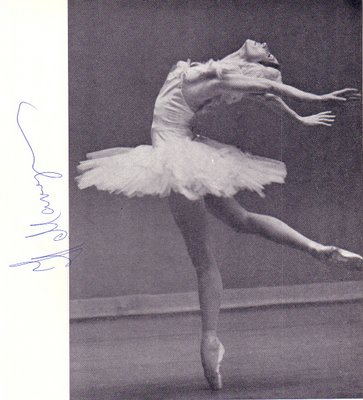
Semionova, likewise:

In the midst of the flurry of attention in the press and blogosphere given to the commerce clause vs. penalty/tax controversy in the SCOTUS decision on Obamacare, I began to wonder whether it was possible that the Medicaid part of the ruling, which was given relatively scant scrutiny in comparison, would turn out to be a sort of sleeper cell that could ultimately doom the whole Obamacare endeavor.
It turns out that might be the case, according to Michael D. Tanner of the Cato Institute:
So what will state legislators do now?
If they agree to expand their Medicaid programs anyway, they’ll be choosing to pile new costs on their state budgets and new taxes on their constituents.
And if a state doesn’t expand its Medicaid program, most of those who would’ve been eligible for Medicaid will now become eligible for subsidies through ObamaCare’s health-insurance exchanges. And those subsidies are paid in full by the feds…
Of course, if states do shift those costs back to the feds, that will cause the federal cost of ObamaCare to skyrocket. If every state were to refuse to expand its Medicaid program, the feds would save roughly $130 billion in their share of Medicaid costs in 2014, but would have to pay $230 billion more in new exchange-based subsidies ”” for a net added cost of $100 billion. And that’s just for the first year.
Remember, this is a law that already will cost as much as $2.7 trillion from 2014 to 2024, and will add more than $823 billion to the federal deficit ”” estimates that assumed state taxpayers would be picking up some Medicaid costs. How will Congress react if billions or perhaps trillions of dollars in new costs are added to the federal budget?
Here’s another complicating factor: Most states have not yet set up an exchange. Many, especially ones with Republican governors or legislatures, may refuse altogether. By most estimates, as few as 15 states are likely to have exchanges in operation by the 2014 deadline.
ObamaCare gives the feds the authority to step in, setting up and operating an exchange in any state that doesn’t set up its own ”” but there is reason to doubt that they have resources to do so in so many states.
Anyway, federal subsidies are available only through exchanges that the states set up. The feds can’t offer subsidies through a federally run exchange.
Thus, if states neither expanded Medicaid nor set up exchanges, that would effectively block most of ObamaCare’s new entitlement spending.
I wonder whether anyone thought this stuff through beforehand.
I don’t think anyone really expected SCOTUS to rule the way it did on the states, even though that portion of the decision was one on which even some of the liberal justices concurred (I believe the vote was 7-2 on that section). But even if politicians and tacticians on the far left didn’t see this exact thing coming (and I don’t think they did), my strong suspicion is that they didn’t really care all that deeply if the Obamacare legislation ran into big trouble, because that would help pave the way for their preferred solution and ultimate goal, single-payer.
[Hat tip: Althouse.]
There’s been an email going around alleging that Muslims will be exempt from the Obamacare tax/mandate.
It’s not true, at least at the moment, but it stands a remote possibility of becoming true. The facts are here and here, and are based on the Muslim prohibition against insurance, plus a provision in the Obamacare bill that exempts people from the requirement who have religious objections and come under a particular section of the IRS code that requires not only an organized objection but a refusal to accept the benefits of Social Security (which is the previous area in which the rule has been applied, mostly for Amish and Mennonites but never for Muslims).
So most interpretations have claimed that Muslims would not be exempt from Obamacare, either. And although SCOTUS has become a bit less predictable lately than in the past, so that we can safely say “you never know,” my strong suspicion is that the law will continue to be applied in the same way it has before, and only the aforementioned sort of groups would be exempt if they requested it.
This brings up another question: how far should religious exemptions go? How much adherence to our cultural and legal norms is required, and how much deviation allowed?
In this country we guarantee religious freedom, but only up to a point. That point is certainly exceeded by certain basic acts prohibited by criminal law: for example, if there were a sect that wanted to revive the Aztec religion and practice ritual sacrifice in which living humans had their hearts torn out of their chests, it would be outlawed despite their right to religious freedom. Members of the sect of renegade Mormons practicing polygamy are sometimes prosecuted for it, and there are animal rights advocates who would like to make the slaughtering of animals under kosher and/or halal laws a criminal offense. We have even seen that in one recent German court, circumcision has been ruled illegal.
The US has a lengthy tradition of allowing conscientious objectors to opt out of military service when there’s a draft, but only if they are members of a religious group such as the Quakers who are against such things on religious grounds (see my series on the Quakers and pacifism, here). However, in 1971, a case known as Gillette v. United States broadened those grounds and made the general category “conscience” an excuse to be exempted from service as well, under certain circumstances. Here’s how the situation stands today:
In the United States, there are two main criteria for classification as a conscientious objector. First, the objector must be opposed to war in any form, Gillette v. United States, 401 U.S. 437. Second, the objection must be sincere, Witmer v. United States, 348 U.S. 375. That he must show that this opposition is based upon religious training and belief was no longer a criterion after cases broadened it to include non-religious moral belief…
Military conscription ended in the US in 1973, and so this sort of thing is no longer front page news. But you can bet it would become a hot button issue again in the unlikely but conceivable circumstance of a re-institution of the draft.
…for a little particle has culminated with its discovery.
Maybe:
Signaling a likely end to one of the longest, most expensive searches in the history of science, physicists said Wednesday that they had discovered a new subatomic particle that looks for all the world like the Higgs boson, a key to understanding why there is diversity and life in the universe…
“I think we have it,” said Rolf-Dieter Heuer, the director general of CERN, the multinational research center headquartered in Geneva…He and others said that it was too soon to know for sure, however, whether the new particle is the one predicted by the Standard Model, the theory that has ruled physics for the last half-century. The particle is predicted to imbue elementary particles with mass. It may be an impostor as yet unknown to physics, perhaps the first of many particles yet to be discovered.
According to the Standard Model, the Higgs boson is the only manifestation of an invisible force field, a cosmic molasses that permeates space and imbues elementary particles with mass…Without the Higgs field, as it is known, or something like it, all elementary forms of matter would zoom around at the speed of light, flowing through our hands like moonlight.
Well, it wouldn’t flow through our hands, exactly, because we wouldn’t exist. But still, I appreciate the NY Times waxing so poetic.
[NOTE: Another Times article on the search manages to inject some politics into the discussion, natch, reminding readers that in 1993 the US canceled the construction of the “superconducting super collider,” which might have found the Higgs boson instead of ceding the glory to CERN. A few people in the comments section of that article waste no time trashing the stupid Republicans of the religious right, as well as Reagan.
Only thing is, who controlled the presidency and Congress in 1993? Why, it was the Democrats (House 258 to 176; Senate 57 to 43). I confess that I paid absolutely no attention to the superconducting super collider’s sad fate at the time, but I’m capable of looking it up, and when I did I found that the project was begun under Reagan and Bush I, and killed under Clinton and the Democratic Congress because of gargantual cost overruns.
Leaving aside the question of whether canceling the collider seemed like a good decision at the time (although it may indeed have), the project died through lack of Democratic support. Clinton had initially been against continuing it, although he’d changed his mind by the time of the Congressional vote. Democratic Texas Governor Ann Richards was against it, and that mattered because it was being built in her state. The drive to kill it in the House was spearheaded by Democratic Kansas Congressman Jim Slattery.
Here’s the story of Reagan’s participation:
On January 29, 1987, at the beginning of the semi-final year of the Reagan Administration, the DOE presented its plan for the new SSC project to the President and his cabinet. The price tag was $4.4 billion, quoted in 1988 dollars omitting inflation and the cost of detectors that the new accelerator would need. After the DOE experts had made their pitch, Reagan recalled his days as a sports reporter interviewing a star quarterback whose watchword had been “Throw deep!” This was the advice he gave the DOE regarding the SSC project.
“Mr. President,” remarked OMB Director William Miller, “you’re going to make a lot of physicists ecstatic.”
“That’s probably fair,” Reagan replied, “because I made two physics teachers in high school very miserable.” With that the SSC received its start.]
A circular firing squad.
See this and this, wherein the Weekly Standard gives Romney a tongue-lashing for his style of focusing on the economy, and the WSJ excoriates Romney for taking pretty much the only tack open to him on the bizarre SCOTUS decision on Obamacare.
Now, I don’t say their suggestions are bad. The WS thinks Romney shouldn’t just say the economy’s in trouble, but be more clear about what he would propose to fix it. Fine, great—but my guess is that, since the campaign still hasn’t reached what you might call a fever pitch where people are paying a ton of attention (that would involve the conventions and the selection of a VP and then the debates), perhaps Romney will be planning to do more of that in the future? And that a private message to that effect, or a more subtle public one, rather than a tongue-lashing in a piece comparing him to Mike Dukakis might be a better way for the press on the right to handle it at this point?
And the WSJ could acknowledge that the SCOTUS decision on Obamacare=tax presented any Republican candidate with the dilemma of past statements on the mandate as a penalty and the present need to call it a tax (plus Romney’s own history in Massachusetts re mandates), which necessitated a legalistic response such as the one Romney gave: “It’s a tax because SCOTUS has spoken, but I disagree with SCOTUS.”
Nope, it’s hardly the strongest position possible, and yes, I agree that Romney could and should have followed up with something more hard-hitting, but watch the video and see what he actually said. Remember, also, that the format was a joint question-and-answer interview with his wife Ann, not a campaign speech (and may indeed be only an excerpt from a longer exchange with reporter Crawford, because the tape seems to begin in the middle of the discussion):
Here’s part of the WS critique of the interview and Romney’s words on the economy:
But what are voters to think when they hear the GOP nominee say, as he did yesterday to CBS’s Jan Crawford, “As long as I continue to speak about the economy, I’m going to win”? That they’re dopes who don’t know the economy’s bad, but as long as the Romney campaign keeps instructing them that it is bad, they’ll react correctly and vote the incumbent out of office?…
The economy is of course important. But voters want to hear what Romney is going to do about the economy. He can “speak about” how bad the economy is all he wants””though Americans are already well aware of the economy’s problems””but doesn’t the content of what Romney has to say matter? What is his economic growth agenda? His deficit reform agenda? His health care reform agenda? His tax reform agenda? His replacement for Dodd-Frank? No need for any of that, I suppose the Romney campaign believes. Just need to keep on “speaking about the economy.”
Recall once again that this wasn’t a speech, this was a short question-and-answer format joint interview with Romney and his wife. Not really the venue for outlining his economic plans. And here’s what Romney actually said right before that quote [emphasis mine]:
The people of America will stop and say, “Is my life better because of the president? Did his policies get us back to work? Did they improve our lives? And if not, does Mitt Romney offer different answers with a different possibility for us?” And the question is, of course, that’s why I’m in the race. I’ve laid out what I’d do to get this economy going, and as long as I continue to speak about the economy, I’m gonna win.
There’s no other interpretation of the quote possible than that Romney meant “as long as I can to offer solutions about the economy,” exactly the opposite of the WS critique.
Now, don’t get me wrong. Romney’s campaign, and Romney as a candidate, are far from perfect. Although I’ve supported him from the start as the best GOP candidate willing to run this year, I’ve made it clear he’s not the person I would have selected from the entire Republican pool if I were dictator of the world. He has lots of flaws, as does almost every possible candidate. And he will make errors, as would anyone.
I expect the left and the usual MSM sources to compare Romney to Dukakis and Dole and whoever else is thought of as a loser. I expected the harshest of criticism from the other candidates during the Republican primaries, and we got it. I most definitely expect it from Obama and Axelrod and the rest of the administration shills. And I expect them all to distort what Romney says in order to put the worst possible light on it. And I expect the right to criticize Romney as well, but I don’t expect that sort of distortion and hyperbole from the right, not when we’re in the fight of our lives.
But then again, remember:

[NOTE: Some of you may say that other candidates would have been less vulnerable to this. I agree that Romney has some special weaknesses in the area of HCR because of the Massachusetts health care law many refer to as Romneycare (although the version passed is not the version he originally proposed, but that’s too fine a point). I agree that many other candidates (among them one of my original favorites, Christie) have more forceful and combative personalities. But because Romney is the nominee, we are seeing his weaknesses rather than theirs. Believe me, had any of them been the nominee, we’d be wringing our hands over that person instead.]
[NOTE: A portion of this post has been recycled, and part is very new.]
For many days after 9/11 I found myself going to the ocean and sitting on the rocks.
Everyone remembers that blue blue sky of 9/11, but I don’t know how many recall that it stayed that way for days afterwards. The weather was spectacular, almost eerie in its beauty, and very serene, although I felt anything but.
At the ocean, I would ordinarily see airplanes on a regular basis. But those post-9/11 days, the almost supernaturally blue skies were very, very quiet. I thought about many things as I sat there. I believed another large attack was imminent, maybe many attacks. I had no idea what could ever prevent this from happening. I thought about George Bush being President, and at the time the thought did not fill me with confidence, but rather with dread. Snatches of poems and songs would wander in and out of my head, in that repetitive way they often do. One was the “Star-Spangled Banner”—all those flags newly-flying on cars and homes brought it to mind, I suppose.
I’d known the words to that song for most of my life, and even had been taught about Francis Scott Key and the circumstances under which he wrote them. But I had never really thought much about those words before. To me it was mostly a song that was difficult to sing, not as pretty as “America the Beautiful” or “God Bless America” (the latter, in those very un-PC days of my youth, we used to sing as we marched out of assembly).
The whole first stanza of our national anthem is a protracted version of a question: does the American flag still wave over the fort? Has the US been successful in the battle? As a child, the answer seemed to me to have been a foregone conclusion–of course it waved, of course the US prevailed; how could it be otherwise? America rah-rah. America always was the winner. Our very existence as a nation had never for a moment felt threatened.
The only threat I’d ever faced to this country was the nightmarish threat of nuclear war. But that seemed more a threat to the entire planet, to humankind itself, rather than to this country specifically. And so I had never before really heard or felt the vulnerability and fear expressed in Key’s question, which he asked during the War of 1812, so shortly after the birth of the country itself: does that star-spangled banner yet wave, o’er the land of the free and the home of the brave?
But right after 9/11 I heard his doubt—and I felt it myself, too. I saw quite suddenly that there was no “given” in the existence of this country—and its continuance and its preciousness began to seem to me to be as important and as precarious as they must have seemed to Key during that night in 1814.
And then other words came to my mind, as well–the Gettysburg Address, which those crabby old teachers of mine had made us memorize in its entirety: …that government of the people, by the people, for the people, shall not perish from the earth. Here it was again, the sense of the nation as an experiment in democracy and liberty, inherently special yet intensely vulnerable to destruction. That was an idea I had never until that moment grasped. But now I did, on a visceral level.
Today is the Fourth of July, the celebration of the birth of the United States, and once again I feel the preciousness and precariousness of this country and its liberties. The holiday of the Fourth has another name, too, but it isn’t “US Day” or “America Day,” as one might imagine. Nor does it celebrate the day the American Revolution ended, which might be considered the natural date of the beginning of the country.
No, the day is known as “Independence Day,” and the July 4th it honors is that of 1776, the date shown on the Declaration of Independence. That was the real beginning of the United States of America, and the “independence” it pays tribute to is not merely the historic break with Great Britain, although that’s certainly part of it. The “independence” we celebrate today is also the more general one expressed in the document itself:
We hold these truths to be self-evident, that all men are created equal, that they are endowed by their Creator with certain unalienable Rights, that among these are Life, Liberty and the pursuit of Happiness. ”” That to secure these rights, Governments are instituted among Men, deriving their just powers from the consent of the governed…
Since I began writing this blog over seven years ago I’ve had many occasions to ponder those words, and I certainly don’t lack reason to think of them now. Their beauty lies not only in their succinct and graceful expression of the sentiment, but in the idea itself, so simple yet so deep. The rights listed are humanity’s birthright, endowed by the Creator, not granted by government but only “secured” by it.
Our Constitution was written in an attempt to create a government designed to do just that. It’s an exemplary document, but that piece of paper and the institutions it establishes are only as good as the people’s devotion to liberty. That was the critical factor in 1776, and it remains so today.
It’s a thought that’s also echoed in the national anthem I discussed earlier. The banner isn’t what really matters, it’s the American people’s devotion to liberty that is so vital. So let’s say, in the words that were written so long ago: the star-spangled banner, O long may it wave, O’er the land of the free and the home of the brave.

The SCOTUS leaks are coming—to coin a phrase—fast and furious. The other day we heard through CBS’s Jan Crawford that two highly-placed anonymous sources described Umpire Roberts’ late innings mind change on Obamacare, and that rumors that Roberts wrote the dissent are false.
Today’s leak is to Salon‘s Paul Campos, who claims that he’s got a source that says Roberts wrote 3/4 of the dissent.
So there.
Well, I’ve got a source who says Chief Justice Roberts is also a time-traveler who wrote the Gettysburg Address and the works of Shakespeare.
So, what’s up with all this leaking? It’s just another one of the very unusual things about this case.
[ADDENDUM: Ace has some theories.]