
More on Syria
For some background, here’s an article that seems worth reading.
Obama’s looking more and more like…
But a very smooth and audacious deer in the headlights who tells us “who are you going to believe, me and my shills in the MSM or your lying ears?”
The problem is, of course, that this sort of thing might work, because most people just don’t pay close enough attention.
Here’s the video of one of his latest ads:
All Romney need do is make a new ad, showing the part of this ad where Obama is saying his words were taken out of context, and then a clip of what Obama actually said—complete with some of Obama’s words both before and after to provide that context, and to demonstrate that the context was worse than the quote.
But Obama’s counting on the fact that people are already sick of the whole thing, and since the MSM is saying that the quote was taken out of context, they’ll just buy it when he repeats that charge.
Note also that in this ad, Obama claims that in his original speech on small business, “What I said was that we need to stand behind them, as American always has.” Note also that he doesn’t show a clip of himself saying that, and that’s because there isn’t one; he never said those words.
He’s also setting up a false dichotomy, because there would have been no contradiction between him saying “you didn’t build that” to small business owners and also saying, “so we need to stand behind you and help you”—if indeed that had been what he was saying. But it’s not what he was saying, at least according to every ounce of evidence we have about what he did say.
The actual context was very clear: he was exhorting the “successful” to pay more money in taxes. He was saying that the “successful” (and that would have to include successful small businesses with incomes over $250,000) should realize they’re no smarter or hardworking than others who are not successful. But don’t take my word for it; let’s watch the fullest excerpt from the speech that I could find online. It lasts three minutes:
Here’s Obama in full outraged innocence mode about it all:
“I have to tell you, I generally have patience with what the other side says about me, that’s a requirement of this job,” Obama said during a $5,000-per-plate fundraiser here, according to the pool report.
“And if you don’t like folks talking about you, you probably shouldn’t run for president. The one thing I do have no patience for is this argument that somehow what I’m criticizing is success”¦ I want to promote success,” Obama said.
Hey, the best defense is always a good offense, right?
Time (and the Olympics) marches on: Comaneci is 50
It’s Olympics time again. I used to be a big fan, but in recent decades I’ve hardly paid attention. The hype is too big, the athletes too interchangeable.
But I came across this clip of Nadia Comaneci, the star of the 1976 Olympics. She’s 50 now, which stunned me, although it shouldn’t have—surely I know that the fierce little girl who wowed the crowd back then would now be all grown up and then some.
I liked her in ’76 not just because of her formidable skills, but because of her stern, tough, no-nonsense demeanor, which I found somehow refreshing compared to the syrupy-sweet cuteness of so many gymnasts.
Here she is:
Nadia grew up to defect and then to marry fellow-gymnast Bart Conner, and to have a baby at the age of 44. Here’s a photo that’s a portent of things to come. It was taken in 1976, when she was a soon-to-be-famous 14-year old and he a well-known 18-year-old.
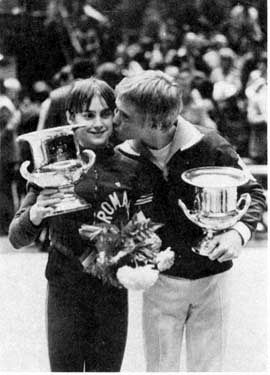
The kiss was hardly spontaneous; it was orchestrated by a prescient photographer, as this article written in 1995 (when they were engaged) makes clear:
Before the revolution in Romania, before the political defections, before the Olympics, before the perfect 10, before anything was possible. Madison Square Garden. March 28, 1976. The American Cup Gymnastics Competition.
The little girl from Romania is hoping to do well in the Olympics later that year. She wins the women’s trophy in the New York competition. She is 14. The towheaded boy from Chicago, on his way to the University of Oklahoma, wins the men’s trophy. It is his 18th birthday. The photographers pose the winners together.
“Give her a little kiss,” one of the photographers calls out, and the boy leans over, dutifully, and kisses the little girl on the cheek.
Years later, Conner will remind her about that moment. He remembers it all. But for Comaneci, it is part of a youth that was lost in training and competition and the painful search for a perfect score in an imperfect life.
“I just remember it was some little blond guy,” she teases.
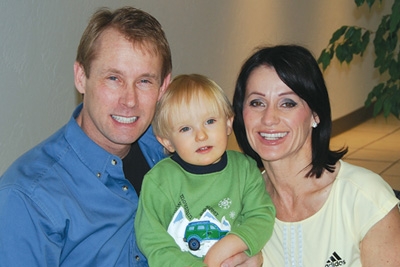
Here’s another little blond boy:
Romney: the authentically nice politician?
“Authentically nice politician”—is that a double oxymoron?
Not according to Sven Wilson, whose article on the subject was brought to my attention by a reader. I’m in nearly complete agreement with what he says here:
Romney has, as we all know, an “authenticity problem.”…I think most of it is personal and visceral, the way people react to his demeanor, the pitch and texture of his voice, the smile that looks like it was painted on his rugged, handsome face as the finishing touch by a make-up artist. He is always trying to please, to make people like him, to tell people what they want to hear. Of course that is the nature of electioneering. The trick in politics is to craft a finely-tuned, polished message that pushes as many positive buttons as possible and, at the same time, seems genuine and heart-felt. What people see with Mitt is the craft, which makes him seem, well, crafty.
But to me, Mitt’s supposed inauthenticity can be interpreted as a deeply genuine, deeply held aspect of who he is as person…Romney’s attempt to please, to iron out wrinkles, or to give ground is not a faé§ade covering a bitter, nasty ambition. It is his ambition. He is a fixer, a problem solver, a negotiator, a worker, a pragmatist…
…Romney went on to be a Stake President in the [Mormon] church (which is roughly equivalent to the Bishop of a Catholic diocese), where he oversaw a number of Boston-area congregations. This involves…trying to lift people’s burdens, ministering to their needs and, again, dealing with all their crap. A typical stake president is a successful professional…who volunteers countless hours to church administration and ministry. If you were to meet one, you would likely find him an accomplished person, a dedicated family man, and one who might strike you as overly-nice or friendly to a fault. Someone a lot like Mitt Romney, in fact.
But my message is that the niceness is almost always genuine. It is authentic. It has been groomed and refined through years of personal, intimate interactions with people from all walks of life. These include many happy, pleasant, inspiring interactions but also many efforts to help people who are burdened by sin, who are struggling financially, who are spiritually unsettled, who are pathetic in myriad ways. The goal is treat all of these people the same way, with the same warm heart and good will.
In the brutal world of presidential politics, nice usually comes in last. The Romney campaign knows this and has been as negative and brutal as anyone else. And he will take his licks, too. He will be hated and reviled””sometimes for his politics, but often just for who he is and what he stands for.
Sven Wilson is a Mormon; I’m not. But for whatever reason, I’ve known quite a few Mormons very well, and I can say this about all of the ones I’ve known: they are extraordinary people, smart as well as “nice,” without being the least bit phony or inauthentic. One of them was either a Bishop in the Mormon Church or a Stake President (I never paid attention to his exact title), and although he had a certain cornball too-good-to-be-true quality, as far as I can tell he was authenticallly nice.
Of course, he wasn’t a politician. It’s dangerous to consider a politician to be sincere, or a good person. After all, politicians tend to be people who’ve developed dissemblance and lying in the service of persuasion to a fine art—something like the proverbial used car salesman, or con artist. Obama attracted a lot of voters in 2008 because he didn’t seem to be a phony to many people (although I have to say he seemed that way to me pretty early on); they thought he was authentically authentic. Romney repels many voters because he does seem to be a phony (who looks like that and sounds like that any more, golly gee whiz?). And yet paradoxically he most likely isn’t.
So their cynicism makes some voters dislike Romney. Others just don’t like his politics. And some wouldn’t like him even if he were being sincere—maybe especially if he were being sincere. They don’t like his style.
In his post, Wilson reproduced the following picture of the Romneys on vacation. It’s a great example of the sort of Up With People wholesomeness that turns so many off. How can any family look like this? And what’s with the blue outfits—don’t they know Republicans wear red?
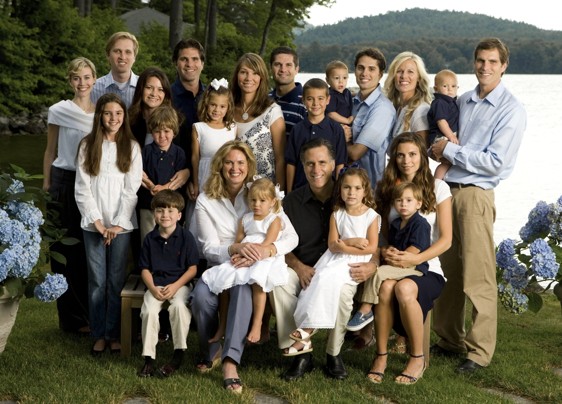
[NOTE: I decided to keep the photo a bit too large, the better to see the detail.]
Space stinks
But it’s not an unpleasant smell.
Brooks Barnes fully supports gay marriage…
…it’s the weddings he’s having trouble with.
[Hat tip: Althouse.]
Oh, and about that Paleo diet…
One more thing about that Paleo diet we’ve been discussing with such vigor: it is my distinct impression that the digestive physiology of human beings has changed quite a bit since Paleo times, in ways both known and unknown.
For example—one with which I’m rather intimately familiar, as you will see—take the phenomenon of lactose intolerance. Actually, it would be better to take the phenomenon of lactose tolerance, because that, rather than its opposite, was the anomaly (and still is; the majority of the world’s humans still cannot digest milk).
Lactose intolerance—the inability to digest the milk sugar lactose—was the norm past childhood throughout most of mankind’s prehistory. Young children could digest milk (human and otherwise), but after that, who needed to? However, once people started raising cattle and milking them, it became an advantage to be able to drink their milk past childhood. And so the natural selection process began:
…[I]n dairy consuming areas, a mutation in the gene regulating the ”˜switching off’ of lactase production, situated on chromosome 2, has now become very common. Such a mutation is known to have arisen among an early cattle-raising people, the Funnel Beaker culture, who lived in north-central Europe around 5,000 to 6,000 years ago. This lactase-persistence allele is found in more than 90 per cent of Danes and Swedes, and 50 per cent of Spanish and French ”“ illustrating that the mutation becomes progressively less common in Europeans who live at increasing distances from the ancient Funnel Beaker region. The mutation is rare in non-pastoral communities such as the Chinese (only 1 per cent of the population have it). In pastoral areas in East Africa, there is a very low frequency of this allele, although many adults are lactose tolerant. An international team of researchers has found that lactose tolerance in East African adults is served by three newly discovered variants of the lactase gene, all of which are independent of each other and the European strain. As in the European allele the mutation is present in the control region of the gene. These African variants appear to have arisen several thousand years later than the European allele.
That’s one of the reasons I can’t stand milk: I’m 100% lactose intolerant. How do I know that? For some reason lost in the mists of antiquity and my medical history, I was required to take a test for it when I was about thirty years old. I remember it well: it involved fasting, then drinking a supersized cup of a liquid that consisted mostly of lactose, and then having my blood drawn at regular intervals for the next few hours in order to see whether my blood glucose went up.
It also involved my becoming sick as a dog.
Cruel? You betcha. But when they found that my glucose levels had budged not one whit, the doctors could safely say I had the highest degree possible of lactose intolerance—although the technician was actually able to venture a guess at that even before the results came back, when I told him how I’d been spending my free time in-between blood pricks.
It was a learning experience. And one of the things it taught me was that, although for most of my friends milk was their friend because of recent evolutionary advances, I’d been left behind; it was most definitely not my friend. But of course, I already knew that.
And yes, I fully understand that milk is not included on the Paleo diet, but my point has nothing to do with drinking milk or not drinking milk. My point is that different populations have developed for many thousands of years in response to different diets, and ultimately we are all individuals. For those of you who love the Paleo diet (or the this diet or the that diet), that’s great. I’m happy for you. But diets are very idiosyncratic things.
[NOTE: For a discussion of some of the controversy over the Paleo diet and human evolution, see this.]
[ADDENDUM: Diet wars of another kind.]
Love those Neanderthals
Here’s some evidence that modern humans mated with Neanderthals, and that we carry remnants of the encounter in our genetic code.
I’ve long had a fondness (of the platonic sort!) for Neanderthals. At least in my imagination; in real life I might be a bit more perturbed by them, although by recent accounts they would hardly draw much attention on a modern street, if dressed and shaved properly.
And their behavior? They seem to have nursed their sick and wounded; had some sort of speech, even if rudimentary; made simple tools; kept largely to themselves as a group; harnessed fire; skinned animals; made shelters of some complexity; and buried their dead (with flowers, yet). They were successful hunters and might even have been responsible for some of the cave art once thought to be the exclusive province of Cro-Magnons. But there is great controversy over whether or not Neanderthals practiced cannibalism, or whether the evidence can be explained as ritual defleshing.
For those who are aficionados of the Paleo diet, there’s also this to ponder:
Early studies indicated that Neandethals were highly carnivorous and obtained all the protein in their diet from animal sources. Recently, however, traces of fossilized plants have been extracted from Neanderthal teeth found in Belgium and Iraq, indicating they also ate plants such as grains and legumes in addition to meat.
Perhaps they were just craving those carbs.
Romney’s going abroad
I don’t know why Howard Portnoy, who wrote this piece at Hot Air, is so negative about Romney’s forthcoming trip to Europe. I think it sounds smart, with Romney both imitating Obama (visiting Europe and the Middle East as a mere candidate) and highlighting the contrasts between himself and Obama.
What are those contrasts? Well, just take a look at where Romney is headed:
The Associated Press reports that the GOP candidate plans on lifting a chapter out of candidate Obama’s playbook next week, when he “travels to England, Israel and Poland looking to establish credibility as a potential commander in chief.”
A chapter out of Obama’s playbook does not involve making nice to allies that Obama has dissed, insulted, ignored, and/or betrayed. Romney did not select these countries by randomly sticking a pin in a map.
It’s not that Obama has never visited them—he has. And he even traveled to two of them as a candidate: Israel and Britain. But ever since his inauguration he’s been busy upsetting all three in ways large and small (see this and this and this for just a few examples).
I look forward not only to Romney’s trip, but to the messages he delivers while there.
[ADDENDUM: Think Obama’s noticed? I certainly do.]
Obama and the economy: you didn’t break it…
…but by now you own it.
At least in part.
Although Obama didn’t break the economy, it’s now three and a half years since he took office, and the American people appear to think he should have put more of the pieces together by this time:
The poll, conducted for The Hill by Pulse Opinion Research, found 53 percent of voters say Obama has taken the wrong actions and has slowed the economy down. Forty-two percent said he has taken the right actions to revive the economy, while six percent said they were not sure.
But wait a minute Republicans; don’t get too happy:
While 64 percent of voters consider this downturn to be “much more severe” than previous contractions, barely one quarter (26 percent) say the agonizingly slow pace of the recovery was unavoidable.
While voters feel Obama carries a greater portion of the blame than others, the poll found almost 6-in-10 are unhappy with the actions of Republicans in Congress who have challenged the president on an array of policy initiatives.
The voters seem to feel there’s plenty of blame to go around.
Do the American people have common sense?
Sometimes I think this election will boil down to the answer to the above question. Do they or don’t they?
If they do, the relentless spin of the left will not matter. And the efforts of the Obama forces to say he was taken out of context when he made his “you didn’t build that” remark will drive the public to look at the context—the whole speech, which is even worse than the excerpt (I wrote at some length about that here).
As this editorial in the NY Daily News puts it:
Regardless of whether Obama was talking about “roads and bridges” or about “a business” when he said, “you didn’t build that,” there is no question that as he extolled the virtues of government ”” the government he claims Romney would dismantle ”” the President demeaned the qualities of initiative, industriousness and ingenuity that drive America’s ladder-climbers.
So why are Obama’s spinners trying to get people to look at the context, as though that would help the situation, when it will not? Probably because (a) they have no other way to defend it; and (b) they are counting on the fact that most people will either not bother to look at the context, and will instead take their word for it, or will look at it and lack the ability or will to evaluate or understand it properly. If they’re right on either score, it could help lead to Obama’s re-election.
And then issue won’t just be limited to Obama’s re-election; it will bode ill for many future elections and for the long-term future of this country.
The newest meme in the “build” controversy involves Obama’s supporters trying to say that Mitt Romney said much the same thing during his tenure as head of the Olympics. Again, they’re counting on either the electorate’s laziness or its inability to understand the spoken or written word and its meaning. Here’s what Romney said:
You Olympians, however, know you didn’t get here solely on your own power,” said Romney, who on Friday will attend the Opening Ceremonies of this year’s Summer Olympics. “For most of you, loving parents, sisters or brothers, encouraged your hopes, coaches guided, communities built venues in order to organize competitions. All Olympians stand on the shoulders of those who lifted them. We’ve already cheered the Olympians, let’s also cheer the parents, coaches, and communities. All right! [pumps fist].
Hardly a speech about capitalism and what drives success in business. More importantly, virtually no one on the right alleges that people do things entirely on their own, so the whole thing’s a strawman argument. If Obama had merely said what Romney said in this quote, “you didn’t get here solely [emphasis mine] on your own power,” there would have been no furor at all about his remarks. It would have been a ho-hum statement, and to pretend otherwise is either deeply ignorant or deeply disingenuous (or perhaps both).
But let’s fervently hope that the American public can reason all this out for itself.