…to make vast strides towards becoming one of the few liberal talking heads who seem quite reasonable.
She does not think highly of Obama’s Big Bird ad:

…to make vast strides towards becoming one of the few liberal talking heads who seem quite reasonable.
She does not think highly of Obama’s Big Bird ad:
…to this.
In the Ann Romney Jay Leno outfit thread, quite a few people criticized the currently fashionable bare leg look for women.
Random Thoughts also dissed the usual alternative, pantyhose:
I absolutely detest pantyhose, and am beyond thankful that they are no longer “de rigeur.” I can’t think of a more dated, uncomfortable and useless piece of female apparel, unless it’s shoulder pads in blouses.
I agree on the pantyhose, although I do prefer the look of some sort of stockings to bare legs, especially for older women (disagree on the shoulder pads—how can they be uncomfortable? And they’re flattering if you have narrow shoulders. But I digress.)
Pantyhose are one of the worst fashion innovations ever. It’s almost humorous that they are/were touted as an advance over old-fashioned stockings with garters, when they are a huge negative in the comfort arena. They became popular when miniskirts came in, because the skirts had become too short for gartered stockings. It seems there was no turning back, except as an occasional novelty in the bedroom.
The problems? Getting into them is awful. When one leg gets a run, you have to throw the entire apparatus out. The choice of what size to purchase is a never-ending coin toss. Don’t get me started on the bathroom issues.
And did I say they were uncomfortable?
Looking it up for historical accuracy, I find that yes, my memory is correct, pantyhose were (was?) popularized during the 60s—the era that which was supposed to be about freedom and non-encumbrance. Hrumph. And the Wiki entry lists scads of health problems that come from pantyhose. You can skip that, too, if you like.
But if anyone wants to know why so many women seem to be jettisoning the pantyhose and all the alternatives and going au natural, it’s no mystery. Although come to think of it, maybe it is a mystery, because women certainly wear a ton of other fashion items that are remarkably uncomfortable—such as, just to take one small example, heels so high that walking becomes a perilous and painful undertaking.
“Obama doesn’t really want to be president any more” is a popular explanation for his lackluster performance in the October 3 debate—one that, unlike some of the others, actually makes a certain amount of sense and doesn’t involve accusing Romney of anything.
Is it true? I don’t pretend to have the inside info, but I’d say “Partly yes, but basically no. He wants to be re-elected.”
Note my emphasis: Obama wants to be re-elected. His ego demands it, although his ego would come up with a lot of self-absolving buck-passing excuses if he were to lose. Obama doesn’t like the work of actually being president, however; he likes the perks and the power.
Why would he like the work? It’s a tough job, and he’s never been a workaholic. Obama would prefer to be king and be able to command rather than lead, and he thinks he’d be a remarkably benevolent despot. He’d prefer to do everything by executive fiat and never have to ask Congress for anything at all. He disdains getting his hands messy, and he’s tired.
Tired. A great many people—many of them supporters—have noticed that. Why would Obama, one of our youngest presidents, and a seemingly healthy man, be so tired? One of the many notable things about Wednesday’s debate was the relative energy of the 65-year-old Romney compared the 51-year-old Obama. That’s somewhat odd. But the last four years have been a double-edged sword for Obama, giving him the power and adulation he craves but in a format that’s been more difficult than he expected.
I still firmly believe he wants to be re-elected, and that he believes a second term will be easier since he won’t have to worry about what the people think. But some part of him—what we might call the animal spirits part of him—is discouraged and enervated.
[NOTE: The tendency to be easily exhausted was one of the very first things I ever noted about him (see the date on this post). And Byron York makes the excellent point that Obama has always been easily bored.]
Breitbart.com calls it a bombshell.
And it should be, it should be:
…[T]he Obama.com website is not owned by the president’s campaign but rather by Obama bundler Robert Roche, a U.S. citizen living in Shanghai, China. Roche is the chairman of a Chinese infomercial company, Acorn International, with ties to state-controlled banks that allow it to “gain revenue through credit card transactions with Chinese banks.”
There’s more.
The unusual Obama.com website redirects traffic directly to a donation page on the Obama campaign’s official website, my.barackobama.com, which does not require donors to enter their credit card security code (known as the CVV code), thereby increasing the likelihood of foreign or fraudulent donations. The website is managed by a small web development firm, Wicked Global, in Maine. One of Wicked Global’s employees, Greg Dorr, lists on his LinkedIn page his additional employment with Peace Action Maine and Maine Voices for Palestinian Rights. According to the GAI report, 68 percent of all Internet traffic to Obama.com comes from foreign visitors.
Please read the whole thing.
There’s also this:
The FEC does not require basic security for Internet donations. And in the case of the Obama campaign the gate appears to be wide open. You need to use the CVV security code on your credit card to buy an Obama hoodie, but not to make a donation. And there is very real evidence that the campaign is not using the address verification system (AVS) in any real way. There are simply too many contributions they accept with either no zip code or an incorrect zip code. To make matters worse, donations under $200 don’t even need to be disclosed. Twenty years ago that might not matter but in the era of robo-donations its a huge problem.
I think it’s especially telling that you need the CVV security code to buy merchandise, but not for donations. I can’t quite think of any reason for that except to make sure the former are on the up-and-up and to wink at (or facilitate) fraud in the latter.
It’s a tired cliche, but I have to say it again: imagine if these facts were true of the Romney campaign. Then you would see them in screaming headlines on the front page of every newspaper. The candidate would be dogged with reporters questioning him about it at every turn. But since it’s Obama—and since this sort of thing was already known about Obama’s website back in 2008 (minus the names, as I recall), to the sound of chirping crickets—I wonder whether this bombshell will fail to explode.
That’s one of the scariest things about the Obama phenomenon—the complete and utter abdication of any sense of responsibility or fairness on the part of the press, to a degree previously unattained. I would be very happy to be proven wrong on this prognostication, by the way; very happy.
…gives his reasons for switching his vote to Romney, based on Wednesday’s debate.
It’s caused dissension in his marriage, by the way, because his wife “considers me a traitor to the very essence of America, providing a helping hand to those in genuine need.” The writer, whose name is Buzz Bissinger, shows no comprehension whatsoever of the arguments the right mounts to explain how it is that the conservative approach will actually help those “in genuine need” more than the liberal one, and how it judges that the “help” liberals offer is self-serving and illusory.
But every vote counts, and we’ll take it.
I’ve got a new article up at PJ.
It’s all about the narrative, you know.
It might be the case that fraud was unnecessary for the Chavez win. But if fraud was necessary, then fraud was committed. There is virtually no chance Chavez was going to be allowed to lose.
The lede says it all [emphasis mine]:
With 90 percent of the votes in, President Hugo Chavez was declared the winner in the Venezuela presidential election. Chavez received 54 percent of the vote to serve an unprecedented third term after he changed the country’s constitution, NBC News reported.
I’ll close with my favorite quotation from Dostoevsky’s Grand Inquisitor, from The Brothers Karamazov:
In the end they will lay their freedom at our feet, and say to us, “Make us your slaves, but feed us.”
What’s wrong with Romney? He didn’t make enough money, says comedian William D. Cohan in the WaPo.
He’s not a comedian, you say? He’s the author of a serious book entitled House of Cards: A Tale of Hubris and Wretched Excess on Wall Street,” described in press releases and reviews as a “blistering narrative account of the negligence and greed that pushed all of Wall Street into chaos and the country into a financial crisis,” and “a brilliant job of sketching in the eccentric, vulgar, greedy, profane and coarse individuals who ignored all these warnings to their own profit and the ruin of so many others”?
So Cohan should be praising Romney for making less than he might have, right? Wrong; after describing all the various ways Romney might be hiding his true, higher, wealth, Cohen concludes with this:
If [Romney] were perceived as the first real billionaire to run for president, it would only exacerbate popular doubts about how someone living so removed from the concerns of average Americans ”” or even just 47 percent of them ”” could effectively represent them.
And if he is not a billionaire, doesn’t it suggest that he was not a great private-equity investor after all, thus torpedoing his claim to understand how to create jobs and get the economy back on track?
Something to keep in mind on Nov. 6.
Yes, Goldilocks, we’ll keep it in mind. And I guess Obama’s far lower wealth and complete lack of experience in any business or knowledge of how it works, plus his demonizing of the wealthy, are things we should keep in mind as well, and signify that his claim to understanding how to create jobs and get the economy back on track is high credible?
Did you know there’s an election today in Venezuela? It’s flown under the radar, hasn’t it?
I would ordinarily assume Chavez would win—by hook or by crook. But a blogger I respect, Daniel in Venezuela, confidently predicts an opposition victory.
If that happened, I would be very pleasantly surprised. I don’t see how Chavez would allow it to happen, and if it did happen I don’t see that he would allow it to stand. Daniel in Venezuela has explained his reasons for thinking challenger Capriles has mounted a brilliant campaign:
…I remember that I was mocked about suggesting that the winner of the primary shall visit every one and each of the 300+ municipalities. That is why I complained that the primary date was too late because it would not give enough time to do it.
Today on TV you see politicians admitting that they were surprised at the success of the “casa por casa” which was nothing else but an excuse to visit all Venezuelan municipalities. That was successful because 1) Chavez was not going to do it, even had his health been better and 2) the media empire of the regime only left the option of a close and personal visit as the only way to compensate. Amen that it was taking advantage of the regime mistake in its campaign, to rely more on its media control than actual street campaign. and to contrast more the unbound energy of the challenger again the semi dead president.
Today I can write in all confidence that we would not be discussing a Capriles momentum if he had not done what he did between November and April. Which brings us to the other two things that made all the difference in the campaign.
Capriles has been a formidable campaigner. For a city kid, well educated and cosmopolitan, he morphed spectacularly into a kisser of any frog on his path. And many of these frogs became pro Capriles princes and princesses. He displayed a remarkable energy. True, he is thin, short and athletic, but still, his campaign was nearly herculean. Well, was herculean. And it showed how tired the revolution was.
In other words, Capriles has managed to vault over the obstacles presented by the Venezuelan press—sound familiar? But can he vault over the extremely distinct possibility of fraud?
In a televised interview two nights ago, the president said he would honor the will of the people””as expressed in the results announced by the National Electoral Council. However, the opposition will remain on high alert until the last minute of balloting, and if the result is suspicious, it could be called a fraud. On the other hand, Chavistas have never accepted the possibility of losing, and if they do lose, they could also make accusations of fraud.
I know on what side I think the fraud will be occurring.
[ADDENDUM: Daniel in Venezuela has some reflections on what he plans to do if Chavez wins and what he plans to do if Chavez loses. The “if Chavez wins” may strike a few harmonic chords in some of you:
I have written for ten years against the bastard, starting when hardly a few suspected his fascist nature. If after 14 years the Venezuelan people do not get it, if they prefer subsidy at the price of much degraded living conditions, so be it. I cannot waste any more time blogging, I do not have that many years before retirement and that is now my priority, becoming a bolibourgeois if needed. You want it? Have it! I cannot keep caring and fighting anymore. If what you want is to be screwed, I”˜ll try my best…The blog was started to educate intelligent folks outside the country. This has been done successfully. Others will write the downfall.
Well worth reading.]
…appearing on the Jay Leno show: biker chic.
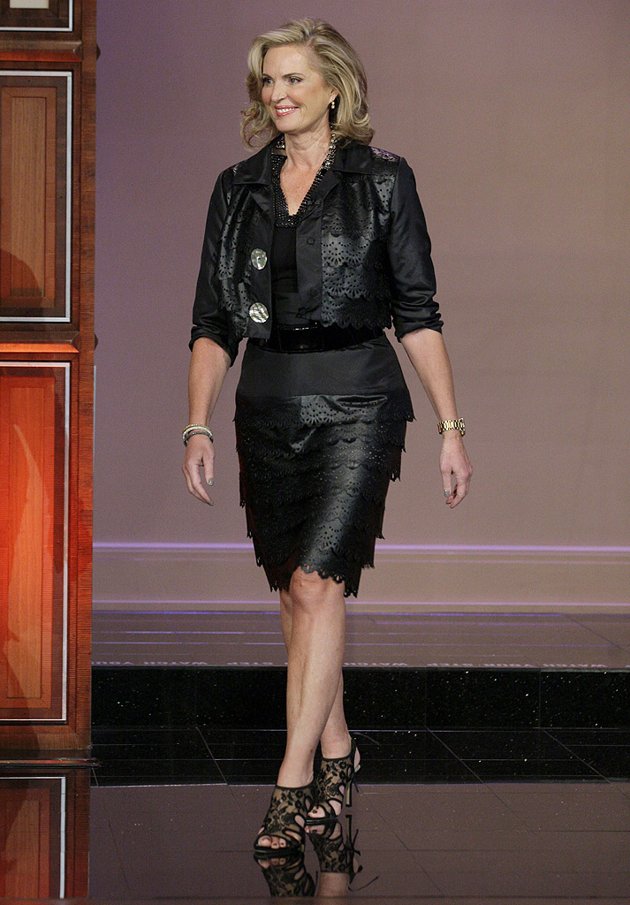
It’s a little much, but I kind of like it. How many 63-year-olds could pull this look off? Very very few.
The comments at HuffPo are interesting. Some actually approve, despite not liking Ann herself. Some say she looks like a whore. Funny, in this day and age—and she is so covered up, how could this be?
I think it’s because she’s an inherently sexy woman, and something even a tiny bit suggestive on her looks pretty hot, whether there’s much skin showing or not. It looks like she’s revealing more than she is.
…why it would be such a great achievement for Obama to be inaugurated as president under economic conditions he himself described as nearly akin to the Great Depression, then rack up unemployment figures that are even higher than that during the entire four years of his presidency, and at the very last minute post unemployment figures that are equal to those from when he took on the job, and consider this trajectory to be a great selling point?
And that’s the case even if you accept September’s figures as correct.
I’m sincerely puzzled. Take a look at this Guardian article (I know; I know; it’s the Guardian). The lede:
The US jobless figures are out today and show American unemployment has taken a drop to 7.8% – below the 8.2% Barack Obama inherited in 2009.
Scroll down to the chart, however, and you’ll see that when Obama was inaugurated in January of 2009 the figure was 7.8. And that information is in the very same article.
This CNN article states that the rate is now the same as when Obama took office.
Bravo! Quite an achievement. The evil mojo of the nefarious Bush takes much more than four years to undo, I guess.
[ADDENDUM: Ed Morrissey delves into the media coverage in 2004 versus today. As one might expect, there’s somewhat of a difference—to say the least.]