↓
 

The New Neo

A blog about political change, among other things

  • Home
  • Bio
  • Email
Home » Page 1363 << 1 2 … 1,361 1,362 1,363 1,364 1,365 … 1,917 1,918 >>

Post navigation

← Previous Post
Next Post→

The wheels of justice: the Isabella Stewart Gardner perps

The New Neo Posted on March 19, 2013 by neoMarch 19, 2013

It was a spectacular art heist, memorable even today, twenty-three years later: the theft of thirteen works of art valued at a grand total of five hundred million dollars, but actually priceless because they are irreplaceable.

There was this rare Vermeer:

Jan Vermeer's "The Concert," oil on canvas, painted circa 1658-1660, was one of the 13 paintings sto..

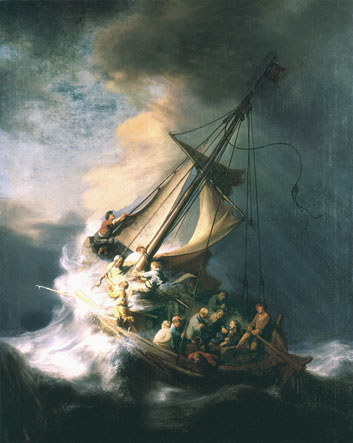
And this Rembrandt:

rembrandt

In stolen police uniforms, they came to the museum one evening and rang the buzzer for the guards to let them in. Then they tied the guards up, disabled the video system, and went about their work:

…in the Dutch Room, where they yanked one of Rembrandt’s earliest (1629) self-portraits off the wall. They tried to pry the painted wooden panel out of its heavy gilded frame, but when Rembrandt refused to budge, they left him on the floor, a little roughed up but remarkably sturdy at age 376. They crossed worn brown tiles to the south side of the room and cut two other Rembrandts out of their frames, including the Dutch master’s only known seascape, Christ in the Storm on the Sea of Galilee, and a double portrait titled A Lady and Gentleman in Black. From an easel by the windows, they lifted The Concert, a much-loved oil by Johannes Vermeer, and a Govaert Flinck landscape, long thought to have been painted by Rembrandt, whose monogram had been forged on the canvas. Before the intruders departed, they snapped up a bronze Chinese beaker from the Shang era (1200-1100 b.c.) and a Rembrandt etching, a self-portrait the size of a postage stamp.

A hundred paces down the corridor and through two galleries brimming with works by Fra Angelico, Bellini, Botticelli and Raphael, the thieves stopped in a narrow hallway known as the Short Gallery. There, under the painted gaze of Isabella Stewart Gardner herself, they helped themselves to five Degas drawings. And in a move that still baffles most investigators, they tried to wrestle a flag of Napoleon’s Imperial Guard from its frame and, failing, settled for its bronze eagle finial. Then, back on the ground floor, the thieves made one last acquisition, a jaunty Manet oil portrait of a man in a top hat, titled Chez Tortoni. By some miracle, they left what is possibly the most valuable painting in the collection, Titian’s Europa, untouched in its third-floor gallery.

The raiders’ leisurely assault had taken nearly 90 minutes. Before departing the museum that night, they left the guards with a promise: “You’ll be hearing from us in about a year.”

But the guards never heard a word…

There were many false sightings of the works, but they have never been found. The world of black market art is vast and the thieves are often hugely successful:

Some 160,000 items””including paintings, sculptures and other cultural objects””are currently listed by the Art Loss Register, an international organization established in 1991 to track lost or stolen art around the world. Among the objects on their list today are the 13 items snatched from the GardnerMuseum as well as 42 other Rembrandt paintings, 83 Rembrandt prints and an untitled painting attributed to Vermeer that has been missing since World War II. The register records more than 600 stolen Picassos and some 300 Chagalls, most of them prints. An additional 10,000 to 12,000 items are added each year, according to Alexandra Smith, operations director for the London-based registry, a company financed by insurers, leading auction houses, art dealers and trade associations.

Such registries, along with computer-based inventories maintained by the FBI and Interpol, the international police agency, make it virtually impossible for thieves or dealers to sell a purloined Van Gogh, Rembrandt or any other wellknown work on the open market. Yet the trade in stolen art remains a brisk one.

In recent years, big-ticket paintings have become a substitute for cash, passing from hand to hand as collateral for arms, drugs or other contraband, or for laundering money from criminal enterprises. “It would appear that changes in the banking laws have driven the professional thieves into the art world,” says Smith of the Art Loss Register. “With tighter banking regulations, it has become difficult for people to put big chunks of money in financial institutions without getting noticed,” she explains. “So now thieves go out and steal a painting.”

Read the whole thing; it’s really quite fascinating.

But that article was written in 2005, and today the Gardner thieves have been named. Or actually, they haven’t been named, although the FBI says it knows their names and that they are members of a large New England-based art theft ring.

Why so mum? Here’s why:

The statute of limitations has since run out on the theft and officials have said naming the suspects would be “imprudent,” given the continuing effort to recover the art work. DesLauriers said the announcement today, on the 23rd anniversary of the heist, was intended to increase public awareness, possibly leading to the artwork being found.

“The FBI believes with a high degree of confidence in the years after the theft the art was transported to Connecticut and the Philadelphia region and some of the art was taken to Philadelphia where it was offered for sale by those responsible for the theft,” DesLauriers said…

Although the statute of limitations has run out, anyone in possession of the paintings could still be held criminally liable, according to U.S. Attorney Carmen Ortiz.

Authorities urged those who are in possession of the art to turn it in, whether they leave it at a church, go through an attorney, or find another way to anonymously return it.

“As we have said in the past, the U.S. Attorney’s Office will consider the possibility of immunity from criminal prosecution for information that leads to the return of the paintings based on the set of facts and circumstances brought to our attention.

So the statute of limitations has run out on the perpetrators, but not on the accessories after the fact, the buyers (who may or may not know of the illegal provenance of the works, although common sense tells us they of course do know)? This seems backwards to me. A crime of this magnitude should have a longer period in which it can be prosecuted. And by using the word “magnitude” I’m not just talking about the monetary value, although that’s part of it. This is a crime that robs us all of the chance to see works that are part of the world heritage of great art.

I’m guessing that the owners of the art will not be coming forward and returning the paintings, with such a tepid offer of possible immunity. First of all, they will lose the money they’ve invested in the art, which was probably a pretty penny. Second of all, they almost certainly knew the art was stolen when they bought it and do not care. No, this case will only be cracked if the FBI finds who the buyers are and arrests them. As for the perps, they’ve been laughing all the way to the bank.

Except they probably don’t use banks.

Certainly not ones in Cyprus—not anymore, anyway.
Posted in Law, New England, Painting, sculpture, photography | 6 Replies

Thank you, thank you, thank you!

The New Neo Posted on March 18, 2013 by neoMarch 18, 2013

To all who donated, a huge and heartfelt thanks! Every bit is appreciated, and helps me continue this blog.

And thank you to all my readers.

Posted in Blogging and bloggers, Dance | Leave a reply

The Steubenville rape

The New Neo Posted on March 18, 2013 by neoMarch 18, 2013

The young men in the Steubenville rape case are guilty and responsible for their actions, and need to pay the penalty.

However—and I say this without any weakening of my contention that the above sentence is true—the entire incident highlights the fact that large segments of adult society have become profoundly remiss about teaching and supervising and monitoring young people. Why were these high school kids in an environment where this could happen so easily? Where were there parents? How did they get the liquor? We don’t know the exact answers, but I think we do know the answers in the general sense: the kids were either out of their parents’ control, or their parents didn’t care what they did.

The impulse to use sex as a game and group sport is nothing new. It was well-known when I was in school, and that was a long time ago. And the dangers to a woman (yes, especially a woman) who gets drunk in that environment were well-known back then, too. Very well-known.

Since I’ve been blogging for such a long time now, I find that it’s not unusual that I’ve already written something that’s apropos to a current situation. So I’ll just quote this post of mine from 2007:

The older rape laws were embedded in a societal structure that regulated women’s freedom in a way hard to fathom today. And yet many of these mores were still in place in my own youth, and I’m not that old. No, an unmarried woman wasn’t required to have a chaperone for any encounter with a man who wasn’t a close relative, as in an earlier century. But boys were only allowed on the ground floor of a girls’ dormitory and were confined to the public areas (at least three of the four feet owned by a couple needed to be on the floor, please, as they necked—archaic word, that—on the couches).

We girls knew the rules, and they weren’t just empty meaningless exercises. I recall being on the terrace of a fraternity house in my college days, at a party, and hearing some raised voices upstairs, one of a woman, quite drunk. A female head with long blond hair (a fellow student from my dorm whom I knew, although not very well) poked out from one of the windows on the upper floor (where we were not allowed!). She yelled some slurred words to raucous laughter. Just as quickly, her head was withdrawn, but she didn’t come down, and all of us girls knew what was going on.

Or rather, we knew and didn’t know, all at the same time. The details could be imagined, and they weren’t good. Whether the sex she was having was group or individual, technically consensual or non, we downstairs knew that she’d put herself in a highly vulnerable position.

Did we think she was to blame? At least partly—not for whatever rape might be occurring (even then I would have put that responsibility squarely at the proverbial feet of the guys involved) but for sheer stupidity and reckless behavior. Everyone knew the code, even though we found the whole situation distasteful and sad, and wished it were otherwise…

I’m all for female freedom. But the checks and balances of the society in which I was raised, restrictive and limiting though they undoubtedly were, kept the behavior of most of us more reasonable. In other words, we learned the art of self-protection and even something known as good judgment, all in all not bad things to learn in this imperfect world.

Because the law isn’t able to prevent all bad things from happening. It can only try to punish the perpetrator after the fact, and that doesn’t mend a broken life or repair a deep trauma.

Now a new wrinkle has been added since I wrote that post: the ubiquity of cell phone cameras and social media have combined with the mainstreaming of pornography to further desensitize kids to what they’re doing. These guys were playing at making a porno flick of sorts, and thought it was perfectly okay to do so with a very drunk 16-year-old and themselves as the subjects.

Posted in Education, Law, Me, myself, and I, Men and women; marriage and divorce and sex | 42 Replies

Cyprus: does this make sense?

The New Neo Posted on March 18, 2013 by neoMarch 18, 2013

To save the Cyprus banking system, they have to destroy people’s faith in it.

Does that make any sense to you? It doesn’t to me.

Ah, but they promise they won’t do it again—just this once! But why would anyone believe them?

And while I don’t often agree with Kevin Drum, I’m in complete accord with this piece of his.

By the way, the whole thing reminds me a bit of what Obama did during the Chrysler negotiations (see also this).

The Cyprus bottom line is that you can’t build faith in a system by breaking the promises underlying it. It’s sort of like strengthening your marriage by having an affair.

And please remind me what’s so great about the EU.

Posted in Finance and economics | 18 Replies

The MSM won the Iraq War

The New Neo Posted on March 18, 2013 by neoMarch 18, 2013

The propaganda war, that is.

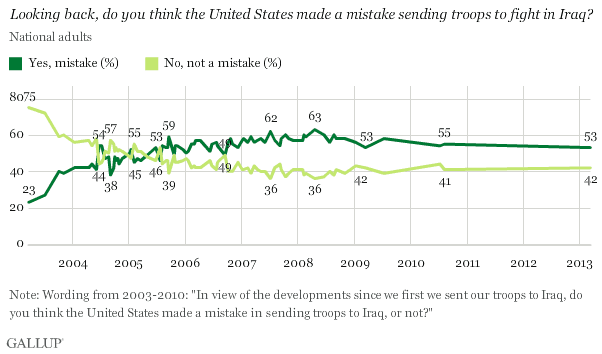
I’m actually somewhat stunned by the results of this recent Gallup poll about the war (taken in honor of the tenth anniversary of its start), but not necessarily in the way you might think. After nearly a decade of relentless and mostly negative media/liberal/leftist spin to a war that was complex and mixed in its origins, execution, and results, but hardly uncalled-for; and which deposed a long-term tyrant (and his heirs-apparent) and replaced him with a flawed but much-improved functioning democracy; the war’s disapproval/approval rate is only 53/42.

I would have expected the ratio of disapproval to approval to be higher. What’s more, it used to be higher. Here’s the chart:

Iraqwar.jgp

The disapproval rate was as high as the low 60s in 2007-2008, and 55 in 2010. I suppose the fact that for the most part Iraq isn’t being closely covered and reported on anymore by the MSM plus the withdrawal could account for the recent drop in disapproval.

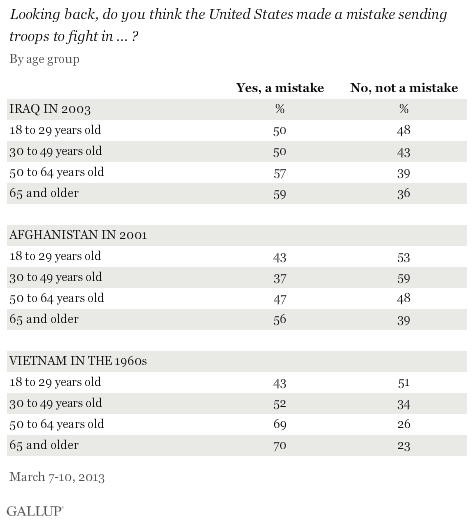
And this is a puzzlement of sorts: although the opinion results differ by age, it’s the reverse of what I would have thought. Among respondents over 65 years of age disapproval/approval is 59/36, and among those 19-29 it’s 50/48 (for ages 30-49 it’s 50/43, and for 50-64 it’s 57/39). What’s more, the same trends hold true for the Afghan War (which in general has more approval). Even the Vietnam War follows the same trend, with young people 19-29 the only age group that approves (51/43) and all other groups disapproving, with people over 65 disapproving most, to the tune of 70%.

It’s really rather startling. Take a look:

warsapproval

The fact that disapproval of the Vietnam War is high in the older age groups is no surprise at all. After all, they not only were the ones who lived through it (and the draft), but they were highly subject to the MSM’s extremely successful propaganda war against it. What’s puzzling to me is the fact that young people are for it, as well as the Afghan War, and their disapproval of the Iraq War is relatively low, too. These same young people are highly liberal, the cohort that voted for Obama in droves in 2012. And their elders—the 65 and over crowd—voted against him in huge numbers.

The American people are nothing if not inconsistent. But this seems particularly odd to me. The reason can’t be that younger people remember the wars from the action-hero-figure glow of their childhood, because the Vietnam War ended long before they were born. Is it that younger people are more bloodthirsty? More inured to violence? More admiring of their peers who serve in the military? They’re certainly not more conservative, if their voting habits are any indication.

[ADDENDUM: More here and here.]

Posted in Afghanistan, Iraq, Vietnam, War and Peace | 34 Replies

Prepare a face…

The New Neo Posted on March 16, 2013 by neoAugust 6, 2018

…to meet the faces that you meet:

Backstage Beauty at The New York City Ballet from Racked.com on Vimeo.

Such a contrast between the relatively drab starting point and the very glam finish. And false eyelashes are only a little less uncomfortable than pointe shoes. But anything for beauty—and art.

[NOTE: the title of this post comes from this.]

Posted in Dance, Fashion and beauty | 2 Replies

Counting casualties

The New Neo Posted on March 16, 2013 by neoMarch 16, 2013

There’s a new study of the costs of the Iraq War. It got some publicity yesterday on memeorandum, among other places.

Counting war casualties is almost always fraught with uncertainty and is one of the areas most ripe for exploitation by writers with an agenda. And don’t ever doubt that most of them have an agenda.

This is not to say that the cost of war, both monetary and in human suffering and death, is not very high. Nor is it the case that all wars are worth that cost. But if you’re going to use statistics involving deaths in war, at least make an attempt to get the figures correct.

And at least acknowledge that the details of how one arrives at such statistics is of the utmost importance.

And yet the author of the study, Professor Neta Crawford, writes:

Although the intricacies of the different methods and their assumptions are fascinating, to focus on the arguments about how to record the dead and wounded is to sometimes to obscure the toll of the war.

No, it is to illuminate and clarify and help to get at the truth of the costs of the war.

However, having skimmed through the entire study, I have to say that it’s by no means one of the worst of its kind. At least Crawford discusses the subject of the competing studies and methods in an appendix. But basically she is just guessing, which is hardly unusual. Crawford does mention that the US official estimate is around 77,000 dead and the Iraq Ministry of Human Rights’ estimate is around 86,000 (from January 2004 to late 2008, the period in which casualties were highest), so my best guess would be to place the number of actual deaths as being closer to that range plus some thousands more, although not as high as Crawford’s estimate. But I agree it’s virtually impossible to know.

But the most interesting thing, at least to me, are the statistics that appear in the full study (28 pages long) but which are nowhere to be found in the lengthy press release about it, and that is the fact that the vast majority of the deaths were perpetrated by terrorists (“unknown” perpetrators).

The casual reader who does not delve deeply into the study is not informed of this rather salient fact—and that’s no surprise, is it?

Posted in Iraq, Press, Violence, War and Peace | 19 Replies

“Scott Walker opens up about White House ambitions”

The New Neo Posted on March 16, 2013 by neoMarch 16, 2013

That’s the headline of this Politico piece.

Pul-ease. “Opens up”? As in, “Gives the usual non-committal, cover-all-bases, completely uninformative answer to a question from a reporter fishing for a story”?

…[W]hen pressed about his White House ambitions, the Wisconsin Republican said: “Would I ever be [interested]? Possibly. I guess the only thing I’d say is I’m not ruling it out.”

Big friggin yawn.

And similar yawn to this:

Perhaps even more notably, Walker wouldn’t commit to serving throughout a second four-year term. He said his focus is on substance, not longevity.

Now, I happen to be a Walker supporter, mainly because I think he’s smart and he’s a fighter and, as he indicated in the interview, he can point to good results he’s gotten in his state from following conservative principles. And although I think that, all things being equal, the 2016 Republican candidate should be a half-Hispanic half-African-American lesbian woman (just kidding there, but you know what I mean) I think a white man could win if that person was sufficiently strong, clear, “likeable” (whatever that means; I seem to not quite get the concept in politicians), and able to bring out both the conservative and the moderate vote.

And I don’t think it would take the reincarnation of Ronald Reagan to do this, either, at least theoretically. Nor am I saying Scott Walker is that person. But he could develop in that general direction, and there’s a lot that can happen between now and 2016—and some of it might even be good.

[NOTE: I guess I had a short vacay.]

Posted in Politics, Press | 12 Replies

More child heroes

The New Neo Posted on March 16, 2013 by neoMarch 16, 2013

I love these stories when they have happy endings:

“I had him in my arms and still screaming over and over. Then I ran outside. I saw two boys playing across the street, and I yelled, ‘Go ask your parents to call 911,'” Rohm said.

But the two boys were able to do more than help. Nine-year-old Ethan Wilson sprang into action, showing Rohm how to perform CPR on young Isiah while 10-year-old Rocky Hurt helped as well. Rocky says he learned the CPR technique from a poster in a health class at their school, Sedalia Park Elementary.

Back in the 80s and 90s when I used to watch one of my favorite TV shows, “Rescue 911” (I’ve written about it before in a number of posts), I noticed that one of the recurrent themes was child rescuers. So although the phenomenon may be rare it’s hardly unheard of. And although society has changed a lot since that time, children are probably even better informed about safety than they once were. Even though kids may be more jaded now, they’re probably still eager and willing to be heroes if they get the opportunity, and are often fully capable of rising to the occasion.

Here are some excerpts from my very first post on “Rescue 911” and children who help save others. I found the phenomenon moving then, and I find it moving now:

[“Rescue 911”] was one of my guilty pleasures. A reality show that featured staged reenactments of actual 911 calls and their aftermath, it was something I watched often although I learned that people would make fun of me when I’d talk about it so enthusiastically…Rare was the show (most of them featuring three or four vignettes) when at least one of its tales didn’t make me cry.

Was I a softie? Maybe. But part of the reason the show engendered such emotional responses was that the episodes were believably done, and part of the reason for that was that the actors were frequently the original participants, who often seemed to experience a sort of psychodrama effect during the reenactments. Another reason was that you never knew how it would end (unless you saw the original participant narrating at the outset; then at least you knew that that person had survived). Most had happy outcomes, but not all by any means.

Last night it occurred to me that I might be able to go to YouTube and watch some of the shows. Sure enough, that turned out to be the case. In fact, one could spend many many MANY hours doing so. Therefore I warn you that if you’re of a certain cast of mind, this activity could be addictive.

…I chose to watch the following one first, almost at random…Something about these little girls (who now would be grown women) touched my heart—their sweetness and kindness, and then the surprising twist at the end when…well, I won’t tell you. Watch for yourself:

Posted in Getting philosophical: life, love, the universe, Pop culture, Theater and TV | 10 Replies

Note…

The New Neo Posted on March 15, 2013 by neoMarch 15, 2013

…that for today I’m taking a little vacay from politics.

It should come as a relief to you; it certainly does me. Sometimes I just can’t deal with what seems like the task of pointing out the same stuff over and over.

But I doubt it’s a relief to you that I used the word “vacay” in that first sentence. Going against type, I am. I also learned (because I just can’t resist looking things up) that the word had its maiden voyage in the movie “Legally Blonde.”

Posted in Language and grammar | 18 Replies

Spambot of the day

The New Neo Posted on March 15, 2013 by neoMarch 15, 2013

Spambot with an obscure problem:

What’s happening, prominent blog on greasy loss.

It suddenly occurs to me, though, that maybe it has something to do with dieting.

Posted in Blogging and bloggers | 7 Replies

Sound and sense: “but I am now with you”

The New Neo Posted on March 15, 2013 by neoDecember 28, 2022

[NOTE: In one of yesterday’s posts I reproduced some photos of people when young alongside the very same people considerably older. Then I offered—without any commentary—one of my favorite poems, “Spring and Fall: To a Young Child” by Gerard Manley Hopkins. I called the photos “heartbreaking, heartwarming, and fascinating,” but a couple of people took issue with the word “heartbreaking.” I’m not saying everyone should find them heartbreaking, but I’d assumed the reason I called the photos “heartbreaking” was explained in the poem.

Which brings us to this post, which is about poetry.]

I first encountered Hopkins’ “Spring and Fall: To a Young Child” when I was still pretty much a child myself, maybe eleven or twelve. My brother, three years older than me, would sometimes—in those boring stretches when nothing much was on TV, and his football practices didn’t intervene—show me interesting things he’d encountered in his high school classes. Thus, this poem:

SPRING AND FALL:

to a young child
by Gerard Manley Hopkins

Margaret, are you grieving,
Over Goldengrove unleaving?
Leaves, like the things of man, you
With your fresh thoughts care for, can you?
Ah! As the heart grows older
It will come to such sights colder
By and by, nor spare a sigh
Though worlds of wanwood leafmeal lie;
And yet you wi­ll weep and know why.
Now no matter, child, the name:
Sorrow’s spri­ngs are the same.
Nor mouth had, no nor mind, expressed
What heart heard of, ghost guessed:
It i­s the blight man was born for,
It is Margaret you mourn for.

It grabbed me immediately, even though it was difficult—very difficult—for a child of that age to understand. But, just as Margaret in the poem doesn’t quite know why she’s weeping and yet (according to the poet) will come to understand the springs (that is, the sources) of her sorrow better as she grows older, I grew to understand the poem and its meaning as time went on but had “guessed” it right at the outset.

Why do some people love poetry and others either have no use for it or actively dislike it? I don’t know. In fact, since most of the people in my family seemed to like it—and two of the four of us actually wrote it—I assumed that liking it was the default position of humanity. I was an adult before I learned how wrong I was.

For me, though, poetry is something like music—that is, it enters the mind and heart through a different and more emotional route than ordinary prose. The best poetry encapsulates a thought, emotion, observation, juxtaposition, truth, or some or all of the above, in an economy of expression that also has a beauty of sound that resonates and amplifies.

That description is reflected in the title of one of my favorite poetry textbooks—one I also encountered around the age of twelve via my brother, whose teacher used it in an English course. In idle hours (of which I had plenty) I would leaf through it with pleasure, and I still have that dog-eared copy, complete with my brother’s notes. It’s called Sound and Sense, and is still in print today, albeit in a newer edition.

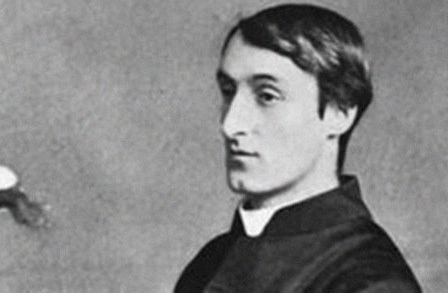
Gerard Manley Hopkins was a master of both sound and sense, even though his poems were unknown in his lifetime, and although a great many people still have a great deal of trouble with the sense of what he’s saying. That’s not surprising, because even though Hopkins wrote most of his poetry back in the 1870s and 1880s the works were unlike anything ever written before or since. Hopkins was avant garde, and in some ways he still is. He is completely unique, this lonely and almost certainly depressed cleric (like the new pope, Hopkins was a Jesuit priest) who was in conflict about whether he should even give his energies to writing poetry at all but was “unable to suppress his desire to describe the natural world,” a world that seemed to him to be awash in beauty to the glory of God.

Hopkins invented words and used meter in an unusual manner he called “sprung” rhythm, which he saw as a way to escape the “same and tame” qualities he saw in most verse of his time. His syntax is sometimes purposely complicated and sometimes very direct and clear, and the reader sees that especially in “Spring and Fall,” with its lines like “Leaves, like the things of man, you/With your fresh thoughts care for, can you?”—full of questioning hesitations and pauses, making the reader hesitate and pause too in order to understand what Hopkins is asking the child—followed by the clarity and simple declarative force of “And yet you will weep and know why” and “It is Margaret you mourn for.” No misunderstanding that.

I could go on and on analyzing the poem line by line. But this is not a poetry course (and it’s already getting late today!), so I’ll just point out a few especially lovely things that are part of the reason the poem gave me a pleasant yet bittersweet chill even back when I was a child, and continues to engender the same reaction in me now lo these many years later. Hopkins’ language is close to being over-the-top in its lush use of alliteration and sounds that echo each other. In fact, “lush” is the word that keeps coming to my mind. It’s as though his feelings are so strong they overflow into the language and push it past the usual boundaries into a surprising sensuality and abundance for a man whose life was apparently very austere.

But no one could ever use the word “austere” to describe Hopkins’ language. Lines like these, with their combination of unique words and harmonically echoing sounds show his lushness very well, as well as how he always stops just short of overdoing it (at least, to my mind):

Margaret, are you grieving
Over Goldengrove unleaving?

Though worlds of wanwood leafmeal lie

The only really difficult line in the poem, I think, is this one, “What heart heard of, ghost guessed,” and the reader is helped by learning that the word “ghost” refers to “soul” or “spirit” rather than Casper or the movie.

If you don’t like poetry, all of this will probably strike you as rather odd and uninteresting. My love for poetry might seem an eccentric although harmless hobby, like collecting Star Wars figures or model trains. But for me poetry is one of the quickest roads through the mind to the heart, and the fusion of both with beauty and grace.

Hopkins has been dead for well over a century, but he speaks very loudly nonetheless. We don’t know him, of course. But in a way we do, as another trailblazer poet of approximately the same era but who lived far away from Hopkins, across an ocean, wrote:

Full of life, sweet-blooded, compact, visible,
I, forty years old the Eighty-third Year of The States,
To one a century hence, or any number of centuries
hence,
To you, yet unborn, these, seeking you.

When you read these, I, that was visible, am become
invisible;
Now it is you, compact, visible, realizing my poems,
seeking me,
Fancying how happy you were, if I could be with
you, and become your lover;
Be it as if I were with you. Be not too certain but I
am now with you.

Hopkins

Whitman

Posted in Getting philosophical: life, love, the universe, Poetry | 13 Replies

Post navigation

← Previous Post
Next Post→

Your support is appreciated through a one-time or monthly Paypal donation

Please click the link recommended books and search bar for Amazon purchases through neo. I receive a commission from all such purchases.

Archives

Recent Comments

  • Tregonsee314 on A lost skill
  • physicsguy on Open thread 9/5/2026
  • Richard Aubrey on The Lindsay Clancy possibilities
  • om on The Lindsay Clancy possibilities
  • Jimmy on A lost skill

Recent Posts

  • A restrained AI spam comment
  • A lost skill
  • The Lindsay Clancy possibilities
  • Open thread 9/5/2026
  • The new AI spam comment generator is very very clever

Categories

  • A mind is a difficult thing to change: my change story (17)
  • Academia (328)
  • Afghanistan (98)
  • Amazon orders (6)
  • Arts (8)
  • Baseball and sports (164)
  • Best of neo-neocon (91)
  • Biden (536)
  • Blogging and bloggers (595)
  • Dance (292)
  • Disaster (244)
  • Education (323)
  • Election 2012 (360)
  • Election 2016 (566)
  • Election 2018 (33)
  • Election 2020 (513)
  • Election 2022 (114)
  • Election 2024 (403)
  • Election 2026 (92)
  • Election 2028 (13)
  • Evil (129)
  • Fashion and beauty (324)
  • Finance and economics (1,042)
  • Food (317)
  • Friendship (48)
  • Gardening (18)
  • General information about neo (4)
  • Getting philosophical: life, love, the universe (734)
  • Health (1,161)
  • Health care reform (545)
  • Hillary Clinton (184)
  • Historical figures (337)
  • History (716)
  • Immigration (448)
  • Iran (464)
  • Iraq (227)
  • IRS scandal (71)
  • Israel/Palestine (821)
  • Jews (437)
  • Language and grammar (365)
  • Latin America (212)
  • Law (2,975)
  • Leaving the circle: political apostasy (124)
  • Liberals and conservatives; left and right (1,321)
  • Liberty (1,117)
  • Literary leftists (14)
  • Literature and writing (394)
  • Me, myself, and I (1,498)
  • Men and women; marriage and divorce and sex (929)
  • Middle East (384)
  • Military (324)
  • Movies (353)
  • Music (533)
  • Nature (261)
  • Neocons (32)
  • New England (183)
  • Obama (1,738)
  • Pacifism (16)
  • Painting, sculpture, photography (131)
  • Palin (93)
  • Paris and France2 trial (25)
  • People of interest (1,043)
  • Poetry (258)
  • Political changers (178)
  • Politics (2,793)
  • Pop culture (397)
  • Press (1,635)
  • Race and racism (882)
  • Religion (428)
  • Romney (164)
  • Ryan (16)
  • Science (641)
  • Terrorism and terrorists (971)
  • Theater and TV (266)
  • Therapy (71)
  • Trump (1,630)
  • Uncategorized (4,553)
  • Vietnam (109)
  • Violence (1,445)
  • War and Peace (1,027)

Blogroll

Ace (bold)
AmericanDigest (writer’s digest)
AmericanThinker (thought full)
Anchoress (first things first)
AnnAlthouse (more than law)
AugeanStables (historian’s task)
BelmontClub (deep thoughts)
Betsy’sPage (teach)
Bookworm (writingReader)
ChicagoBoyz (boyz will be)
DanielInVenezuela (liberty)
Dr.Helen (rights of man)
Dr.Sanity (shrink archives)
DreamsToLightening (Asher)
EdDriscoll (market liberal)
Fausta’sBlog (opinionated)
GayPatriot (self-explanatory)
HadEnoughTherapy? (yep)
HotAir (a roomful)
InstaPundit (the hub)
JawaReport (the doctor’s Rusty)
LegalInsurrection (law prof)
Maggie’sFarm (togetherness)
MelaniePhillips (formidable)
MerylYourish (centrist)
MichaelTotten (globetrotter)
MichaelYon (War Zones)
Michelle Malkin (clarion pen)
MichelleObama’sMirror (reflect)
NoPasaran! (bluntFrench)
NormanGeras (archives)
OneCosmos (Gagdad Bob)
Pamela Geller (Atlas Shrugs)
PJMedia (comprehensive)
PointOfNoReturn (exodus)
Powerline (foursight)
QandO (neolibertarian)
RedState (conservative)
RogerL.Simon (PJ guy)
SisterToldjah (she said)
Sisu (commentary plus cats)
Spengler (Goldman)
VictorDavisHanson (prof)
Vodkapundit (drinker-thinker)
Volokh (lawblog)
Zombie (alive)

Meta

  • Log in
  • Entries feed
  • Comments feed
  • WordPress.org
©2026 - The New Neo - Weaver Xtreme Theme Email
Web Analytics
↑