
People are not dumb. They get around a law if they can. And Obamacare is a terrible, terrible law, passed in a terrible manner.
Egypt vs. Iran: revolutions and coups
I often agree with editorials in the Wall Street Journal. But this one seems to hit a flat note, to wit [emphasis mine]:
The result [of Morsi’s overreach in Egypt] was political polarization, with the opposition and military uniting against the Brotherhood supporters who were Mr. Morsi’s last defenders. The millions of Egyptians who took to the streets were also protesting chronic gas and food shortages and a sinking economy. The uprising shows that the worst fate for Islamists can be to take power and thus be accountable for results. Unlike Iran in 1979, Egypt retains enough competing power centers such as a secular business class and judiciary to prevent an Islamist revolution.
Well, I suppose it depends what you mean by “retain.”
Iran before the revolution of1979 was actually fairly robust and “modern” (relatively speaking) under the Shah, at least as countries in that neck of the woods go. True, those elements of society (secular business class, judiciary) did not prevent an Islamist revolution in Iran, but that Islamist revolution was accomplished (much as Morsi’s election was) by stealth and deception. In other words, prior to Khomeini’s taking power (which, by the way, was the result of a referendum—in other words, people voted) the Ayatollah had held himself out to be a far more moderate person than he actually was (just as Morsi did). Khomeini’s revolution had had widespread support from people who should have known better but did not see what was coming.
And after he came to power, it didn’t take long at all for Khomeini to play his cards, and what cards they were! Khomeini makes Morsi seem like a meek lamb in comparison. For starters, Khomeini declared “”do not use this term, ”˜democratic.’ That is the Western style…” And then on to the main course, where he followed the glorious example of late-eighteenth century France [once again, emphasis mine]:
The first to be executed were members of the old system ”“ senior generals, followed by over 200 senior civilian officials, as punishment and to eliminate the danger of coup d’é‰tat. Brief trials lacking defense attorneys, juries, transparency or opportunity for the accused to defend themselves, were held by revolutionary judges such as Sadegh Khalkhali, the Sharia judge. By January 1980 “at least 582 persons had been executed.” Among those executed was Amir Abbas Hoveida, former Prime Minister of Iran.
In mid August, shortly after the election of the constitution-writing assembly, several dozen newspapers and magazines opposing Khomeini’s idea of theocratic rule by jurists were shut down. When protests were organized by the National Democratic Front (NDF), Khomeini angrily denounced them saying, “we thought we were dealing with human beings. It is evident we are not… After each revolution several thousand of these corrupt elements are executed in public and burnt and the story is over. They are not allowed to publish newspapers.”
Between January 1980 and June 1981, when Bani-Sadr was impeached, at least 900 executions took place, for everything from drug and sexual offenses to `corruption on earth,` from plotting counter-revolution and spying for Israel to membership in opposition groups. In the 12 months following that Amnesty International documented 2,946 executions, with several thousand more killed in the next two years according to the anti-regime guerillas People’s Mujahedin of Iran.
It goes on—and on, and on—with purges of more moderate clerics and the like. But I think you get the idea. The majority of the people of Iran, and the former power structure in the country (judiciary, military) did not like what Khomeini was doing. But as Khomeini knew, ruthlessly killing the opposition tends to have the effect of making that opposition rather ineffective. What’s more, it has a tendency to scare off further opposition.
So far at least, Morsi has done nothing of the sort, so those groups in Egypt have been able to “retain” some power.
Another huge difference between 1979 Iran and current Egypt is that the Shah had become an unpopular figure with a lot of baggage himself, having been in power far far longer than Morsi, and being a monarch (rather than elected) as well. The analogy with Egypt’s long-time leader (although not monarch) Mubarak would be more accurate, rather than Morsi (another parallel: Carter withdrew support from the Shah, much as Obama did with Mubarak). And Khomeini was a revered and powerful figure with a huge following, unlike Morsi. All of that helped Khomeini solidify his hold on the country. But his willingness to be absolutely and uncompromisingly ruthless in murdering the opposition was a huge part of what happened there, which cannot be ignored when comparing the two countries.
I’ve done a lot of thinking about how often it is that popular revolutions are betrayed by the leaders who are their beneficiaries (see this for a lengthy post on the subject). It’s the norm, actually, with the United States being one of the rare exceptions.
So, why hasn’t the Muslim Brotherhood in Egypt followed the path of Khomeini in simply killing the opposition? I submit that it’s for three reasons: Morsi isn’t a tower of ruthlessness like Khomeini (who was more in the mold of 20th century tyrants, although he was a religious figure and most of them were not); Morsi lacks the political support, spooky presence, and aura of sanctity that Khomeini had built up; and public relations has become more important to dictators in this digital age in which opposition can be organized through Facebook and Twitter, and the whole world is watching far more intently.
But remember, just because Egypt’s Muslim Brotherhood has not gone the Khomeini route so far doesn’t mean they won’t in the future.
[ADDENDUM: I see that the military in Egypt has now arrested many Brotherhood leaders. That sort of thing has been going on in Egypt since the Nasser era, although Nasser himself was more Draconian, establishing concentration camps for the Brotherhood and torturing them, although only killing a few. Sadat and Mubarak made the Brotherhood illegal, but their imprisonment waxed and waned periodically depending on circumstances, and few if any were killed. However, it was Muslim fundamentalists (although not Brotherhood members) who assassinated Sadat (for a longer post I’ve written on the Brotherhood in Egypt, please see this).
The Shah of Iran had imprisoned Khomeini, but as ruthless as the Shah was purported to be (and I think it’s unclear how ruthless he really was), he stopped short of killing him. That may have been his big error, although killing Khomeini may instead have had the effect of elevating him to martyr status and inspiring a revolution anyway. When faced with a force like that, or the Muslim Brotherhood, it sometimes seems as though there’s no good way to handle it.
I’ve written many posts in the past about the Iranian revolution. If you want to do some reading, this list includes the majority of them. And this one seems especially relevant right now.]
Happy Fourth—and a deviled eggs question
First, the all-important deviled eggs question: do you use pickle relish in them, like it says here?
Mash yolks with mayonnaise. Add relish, mustard, salt, and pepper; stir well.
And if you do add the relish, are you from the South? To me, pickle relish in deviled eggs would be an abomination. Of course, I’m from the Northeast, so what do I know?
Now that I’ve gotten that weighty matter out of the way, I hope you have a wonderful Fourth with friends, family, or strangers, or even alone; at a picnic, barbeque, party, parade, or fireworks display, or in the privacy of your home.
Every Fourth is serious, too. But this one seems even more serious than the last one or the one before that. So many of us (and not only the conservatives and/or libertarians) feel that our liberty has been more threatened lately than it was before.
But liberty has always been threatened, or about to be threatened. There are so many temptations to do so: power beckons to tyrants and tyrant wannabees, as well as to those with good intentions and a bad knowledge of human nature; surrender beckons to people who want their lives to be easier and think that giving up a bit more liberty will help them get stuff they want or keep them safe from harm. And then a little more liberty, and a little more, and pretty soon…
It’s been odd timing this year to watch the crowds demonstrating in Tahrir Square for a change of leadership in their country. Yesterday they got their change, and maybe later on they’ll get their chance to have their say and elect someone who will better represent their interests. We’ll see; I have grave doubts. But I can’t help but think—even though this is the Muslim world we’re talking about, where liberty is not traditionally a big value, to say the least—that at least a small part of what some of them yearn for is liberty, whether they would describe it that way or not.
Liberty is strong, but it is also both precious and fragile. Paradoxically, like many things, it is often most missed and valued after it is lost, and then it can be too late. I hope it’s not too late here.
To end on a happier note, we have the re-opening of the Statue of Liberty. It had been closed to tourists after sustaining damage during hurricane Sandy. Let’s hear it from a visitor:
“This to us, Liberty Island, is really about a rebirth,” said Heather Leykam, whose mother’s home in Breezy Point was destroyed during Sandy. “It is a sense of renewal for the city and the country.”
A renewal for Liberty. Sounds good to me.

Something dramatic…
[BUMPED UP]
…seems to be happening in Egypt, although it’s not clear what it is.
[UPDATE: It’s a military coup, with a suspension of the Constitution (supposedly, the parts Morsi had added will be rewritten), and an interim president.
Egypt has a long history of the military (or a segment thereof) stepping in when things get rough, or when they want a change. And I mean a long history (although come to think of it, maybe not such a long history by Egyptian standards).
For example, Nassar and the overthrow of King Farouk:
In Egypt, the clandestine revolutionary Free Officers Movement was composed of young junior army officers committed to unseating the Egyptian monarchy and its British advisors. It was founded by Colonel Gamal Abdel Nasser in the aftermath of Egypt’s defeat in the 1948 Arab-Israeli War.
And then there was Sadat:
Sadat was a senior member of the Free Officers group that overthrew Farouk I in the Egyptian Revolution of 1952 and a close confidant of President Gamal Abdul Nasser, whom he succeeded as President in 1970…
The last months of Sadat’s presidency were marked by internal uprising. Sadat dismissed allegations that the rioting was incited by domestic issues, believing that the Soviet Union was recruiting its regional allies in Libya and Syria to incite an uprising that would eventually force him out of power. Following a failed military coup in June of 1981, Sadat ordered a major crackdown that resulted in arrest of numerous opposition figures. Though Sadat still maintained high levels of popularity in Egypt, it has been said that he was assassinated “at the peak” of his unpopularity.
Earlier in his presidency, Islamists had benefited from the `rectification revolution` and the release from prison of activists jailed under Nasser but Sadat’s Sinai treaty with Israel enraged Islamists, particularly the radical Egyptian Islamic Jihad. According to interviews and information gathered by journalist Lawrence Wright, the group was recruiting military officers and accumulating weapons, waiting for the right moment to launch “a complete overthrow of the existing order” in Egypt. Chief strategist of El-Jihad was Abbud al-Zumar, a colonel in the military intelligence whose “plan was to kill the main leaders of the country, capture the headquarters of the army and State Security, the telephone exchange building, and of course the radio and television building, where news of the Islamic revolution would then be broadcast, unleashing – he expected – a popular uprising against secular authority all over the country.”
In February 1981, Egyptian authorities were alerted to El-Jihad’s plan by the arrest of an operative carrying crucial information. In September, Sadat ordered a highly unpopular roundup of more than 1500 people, including many Jihad members, but also the Coptic Pope and other Coptic clergy, intellectuals and activists of all ideological stripes. All non-government press was banned as well. The round up missed a Jihad cell in the military led by Lieutenant Khalid Islambouli, who would succeed in assassinating Anwar Sadat that October.
According to Tala’at Qasim, ex-head of the Gama’a Islamiyya interviewed in Middle East Report, it was not Islamic Jihad but his organization, known in English as the “Islamic Group”, that organized the assassination and recruited the assassin (Islambouli). Members of the Group’s ‘Majlis el-Shura’ (‘Consultative Council’) ”“ headed by the famed ‘blind shaykh’ ”“ were arrested two weeks before the killing, but they did not disclose the existing plans and Islambouli succeeded in assassinating Sadat.
And of course when Mubarak fell, it wasn’t just because President Obama withdrew his support. It was because the military did, and they were in charge of the transition government, as now. This is the official Egyptian military, not some activist Islamicist segment as in the Sadat assassination. But the common denominator in all cases is the military.]
Before the horror
The following photo, which I saw for the first time the other day, is of the Grand Duke Ferdinand and his wife on the day of the famous assassination.

It immediately reminded me of this—the motorcade, the smiles, the roses, and the unawareness of the terrible fate to soon befall them:

I know a lot about the events that occurred right after that second photo was taken, and most likely you do, too. And of course the events shortly after the first one included World War I. But I hadn’t known most of the details about Ferdinand’s assassination itself, including the fact that his wife the Duchess Sophie (the woman in the photo) was murdered also. The details are astounding in their tale of conspiracy (real that time, not fantasized), missed opportunities, and a chain of fateful circumstance that led to the assassins’ unlikely success.
Oh, I’ll just postpone the employer mandate: how typically Obama
Let’s see: Congress passes the health insurance law that comes to be known as “Obamacare.” Obama seems to have taken the name to heart: it’s his law and he can do what he wants with it.
So by executive fiat, he changes it. Don’t like the part where businesses employing over 50 people people have to sign up or pay tax penalties? Okay, he’ll delay it a year, despite the fact that the law as passed by Congress never said the timing would be left up to Obama; it was specified that it would begin on January 1, 2014.
It doesn’t take a great deal of insight to see why Obama might want to do this: the law is highly unpopular in general, and that particular portion of it is especially complex and will create trouble for businesses. An election is coming up in 2014, one in which Obama would like to get more power to do whatever he wants, because right now only the pesky House stands in his way.
I don’t think this sort of changing of an act of Congress by fiat is something previous presidents have done, because they lacked the imagination and sheer audacity of this president. He figures why not do whatever he wants? Who’s to stop him? Congress? It’s to laugh.
In general, for most of our history, our elected officials have agreed there are certain lines you do not cross. The Founders tried to build in safeguards against tyranny and to protect the rule of law, but they could only go so far to protect us. For example, impeachment is in the end a political process, and if Congress lacks the political will, it won’t impeach no matter what a president does.
Perhaps I’m wrong. Perhaps I just don’t know enough American history. But I can’t think of a parallel to Obama’s action here. The moment that does come to mind is FDR’s court-packing scheme, but even many members of Roosevelt’s own party refused to back him up for that one. I guess there was just a bit more integrity back then, because now I predict that you will see nothing of the sort from Congressional Democrats about this little action of Obama’s.
The move is indeed “deviously brilliant”, as former Congressional Budget Office director Douglas Holtz-Eakin has called it. Just as the original Omamacare bill delayed the pain until after the 2012 election, and timed the cost so that the CBO was forced to score it favorably and misleadingly, this newest ploy is supposed to fool the American people in 2014 in order to keep that election from being a debacle for the Democrats.
The American people proved themselves stupid enough not to get (or care about) what was happening in 2012. Will they be any smarter in 2014?
And at the risk of repeating myself (which I suppose I’ve already done many many times), all of this should come as no surprise. It’s the Obama way (which is the Chicago way plus an extra special little something that might be called the Venezuela way).
[ADDENDUM: I give some kudos to a guy I’ve criticized mightily in the past, Ezra Klein. He doesn’t think Obama is going about this the right way. Of course, Klein is a mere pundit, not a Democrat politician.]
If you’re following the Zimmerman trial…
…remember that Legal Insurrection is the go-to place.
Snowden is starting…

Surprise: the presidency actually requires some skills
We in America have been pretty lucky for quite a long time. Despite the fact that our method of electing presidents hardly guarantees greatness or even competence, we’ve mostly had presidents who displayed at least the latter, competence. And we’ve even be blessed with quite a few who might merit the former: greatness.
So perhaps this got too many of us to thinking that the presidency isn’t such a difficult job after all, and doesn’t even necessarily require a lot of skills that any relatively savvy person would lack.
The unrelenting Bush-bashing was evidence of that, in a sort of twisted way. After all, if under this absolute idiot (village idiot, if I recall correctly), the country still survived, then how hard could it all be?
So for the majority of people, voting for Barack Obama for president seemed like a nifty idea. He appeared to be smart, personable, gave an inspiring speech, wanted to bring us together, wanted to treat other countries right, all that good stuff. So what if he lacked managerial, governing, really almost all national or even local leadership experience except oratory? In the immortal words of Hillary Clinton (although most definitely not on the same subject), what difference did it make?
Put aside for a moment your antipathy to Obama’s leftism or lies or mannerisms or whatever part or parts of his politics and persona you hate. Put aside even the fact that that Obama probably wants to weaken the US on the world stage. I’m just talking about basic skills here: negotiation, managing, communicating, knowledge of the nature of other countries.
Western Europe has gotten used to American competence, too, and started out in 2008 by thinking not only that Obama’s inexperience didn’t matter but that he would be a superior president because of his attitude, with which they could identify and which seemed more like theirs. The Soviets and Chinese probably were more aware of the significance of his lack of skills, but for them his inexperience would be a good thing. And the Arab world was probably dancing with glee, after Bush.
Well, here we are. Even most of Obama’s supporters are either angry at him or somewhat embarrassed for him by now, which can’t possibly be what he intended. They’re not angry about Benghazi, which has gotten the goat of only the right. Nor was it the IRS scandal, which to a lot of people so far seems to be about big government in general and the IRS in particular rather than pinned directly on Obama (and besides, since the targets were on the right, many on the left applaud the IRS’s behavior in the matter).
It’s the NSA story that seems to have been the thing that has upset the left as well as the right. Most of Snowden’s revelations are of things that are not too different from what Bush did, or of what the left thought Bush did. But they had thought better of Obama. And still another thing that has highlighted this more widespread and bipartisan sense of Obama’s incompetence has been the spectacle of Obama impotently asking Russia et al to be nice and help with returning Snowden, as John Hinderaker points out here (also see this).
We’ve had other inexperienced and even somewhat incompetent presidents, especially in certain areas (for example, governors virtually never have prior international experience). But we’ve been fortunate in that for the most part they’ve tended to be aware of their own inexperience, and tried to appoint people to positions in foreign policy who are the opposite from them in having both knowledge and experience. Obama has very different criteria for his appointees; he prefers the inexperienced and/or easily controlled.
For all you American history buffs out there: has any other president whose only previous national experience was a single term as senator (one he essentially left in order to campaign) appointed as his Secretary of State another senator with foreign experience only marginally greater than his own (Hillary Clinton)? I certainly can’t think of one.
You may argue that this essay is predicated on the idea that Obama would do better if he could, and that he has the US’s best interests at heart in the foreign arena. But as I said before, I think he does not, but that doesn’t really change the points I’m trying to make, which are that (a) Obama has a very high opinion of his own foreign policy skills despite his utter lack of experience (he made that crystal clear during the 2008 campaign; see this); (b) he doesn’t want the world to see him as incompetent; (c) he prefers equally incompetent advisors; and (d) lulled into a false sense of security, American voters failed to see his lack of experience coupled with his hubris as a huge red flag, although they should have done so.
It’s (d) that worries me the most, because even if we survive Obama’s two-term presidency it does not bode well for the future, and says nothing good about the judgment of the American people. I began this essay by saying Americans have mostly been lucky in their previous presidents. But maybe it was a luck informed by a certain amount of common sense and even knowledge. I don’t think that someone with Obama’s background would have been elected just a decade or two ago, and certainly not before. And by the word “background” I am not talking about his race, I’m referring to all the facts about Obama that were in the public domain before November of 2008 (and most definitely by November of 2012): his lack of managerial experience and foreign policy knowledge, his tremendous arrogance and narcissism, and his leftist ties and previous leftist statements.
Down Where the Drunkards Roll
I enjoy comparing different versions of songs I like, especially ones that highlight changes with the passage of time, and the variations among interpreters. Here’s a “compare and contrast” of three versions of Richard Thompson’s “Down Where the Drunkards Roll” (lyrics here).
The first version is the oldest. Here’s the original original, with Richard Thompson doing guitar and back-up singing and spotlighting his then-wife Linda, back in the mid-70s (they endured a bitter divorce a few years later). This is not my favorite version of the three, which is odd because I usually like the originals best. Not this time (I’ve saved the best, IMHO, for last):
Here’s a fairly recent double-Wainwright version (Loudon III and son Rufus). I like it about as well as the first one; the song has a more bitter and less plaintive quality when sung by men. Loudon is a friend of Thompson’s, and he was also married to a famous singer, in Wainwright’s case Kate McGarrigle of the Canadian group the McGarrigle sisters. They had a very bitter divorce, too, in the mid-70s. Rufus is one of two offspring of that union, and he is now a more famous singer than his dad ever was, although I prefer the old guy’s stuff:
And here’s my absolute favorite, with really no competition. The master, composer of the song, and still undisputed champion—Richard Thompson, in a 2011 performance (note that Loudon Wainwright is backing Thompson up here). From the moment he opens his mouth, Thompson rivets me with his intensity, sorrow, and bite:
Meanwhile, back in Egypt…
…protests against the Morsi government rise to a new level.
It’s always somewhat difficult to estimate the strength of demonstrators in terms of how much they can really undermine a government willing to play hardball with them: how tough that government is willing to become to shore up its rule, and what percentage of the general population is sympathetic to the protestors or to the government. But the level of protest here in terms of sheer numbers seems formidable so far.
As for Obama’s role, although I deeply respect John Hinderaker, I submit that in this case he doesn’t quite get it. Hinderaker writes:
What is bizarre is that Obama hasn’t just tolerated the Brotherhood’s rise to power, he has abetted it. It would be defensible to argue that we have little power to influence events in Egypt, and, moreover, attempts on our part to exercise influence are likely to backfire; therefore we should stand aside and do nothing. But why Obama would consider it a good idea to put America’s thumb on the scale on the side of the Brotherhood is beyond me.
I can only speculate why it might be that Obama favors the Brotherhood’s rise to power. But I do have some theories, offered in order of escalating perfidy.
The first is naivete: Obama believes his own rhetoric (and Brotherhood propaganda) that the Brotherhood has softened in recent years and is no longer the fire-breathing anti-Western anti-American entity it always has been (which to me is something like believing Hamas is now just an altruistic social service organization). The second is hubris: Obama believes that his own influence should have been enough to magically stop a Brotherhood takeover from happening. The third is intent: that Obama actually favors the existence of an Islamic regime in Egypt.
Now, why would Obama support such a thing? Once again, I can only offer theories: he wants to weaken US influence in the region and the world. He is sympathetic to Islam (hates Jews? memories of his Indonesian childhood?).
And by the way, Obama can be sympathetic to Islam without actually being a Muslim. Even though FactCheck is not my favorite site, I long ago independently researched a lot of those quotes that supposedly show that Obama is a closet Muslim and found them to be deceptively truncated, much as FactCheck details in this piece.
One thing is for certain, though: Obama ought to have known that the most likely outcome of the overthrow of Mubarak would be the rise of the Brotherhood in Egypt. Even I—most assuredly no expert on Egypt—saw this from the very moment the original protests began, about two and a half years ago. And although Obama and the left assured us this rise of the Brotherhood would not happen—or, if it did, the Brotherhood was actually nothing to fear—it was also crystal clear that they were most likely wrong in the assertion that the Brotherhood was now a tame and docile force (see this for a long post I wrote way back when as to why this was so).
John Hinderaker has also posted this photo from the most recent protests, which he found at Bret Baier’s site:
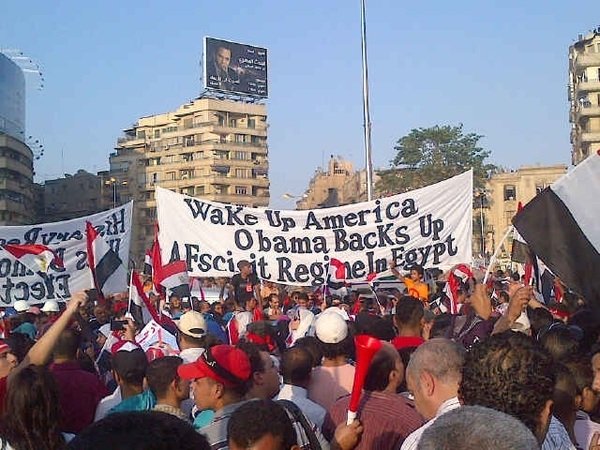
The protestors, at least, seem to get it. And isn’t this tendency of Obama’s what many of us recognized long ago, what might be called the Obama Doctrine? To refresh your memory:
[O]ffend our allies and friends, and cozy up to our enemies.
So far it’s been playing out as expected. The real question is whether the resistance in Egypt in strong enough to stop the effects of Obama’s influence.
[NOTE: And I missed the part where Obama calls for Morsi’s resignation, like he did with Mubarak. Actually, he’s explicitly refusing to do so.]
For those who think Snowden’s a hero…
…here’s what your hero has been up to lately.
With more to come from that team of modest, self-effacing patriots, Snowden and Glenn Greenwald; and their mouthpiece of choice, the leftist Guardian; who only have our very best interests in mind.
For those who might want a refresher course in my opinion on the subject, see this and this.
[ADDENDUM: From Ed Morrissey at Hot Air:
All nations collect intelligence on as wide a selection of allies and enemies as possible ”” and everyone knows it. Once it gets out into the open, though, each government has to express its outrage so as to keep their own citizens from asking tough questions, such as how their nation wasn’t smart enough to encrypt their own fax machines rather than buy off-the-shelf encryption.
As for Snowden, this puts a different spin on his actions. Instead of being a freedom fighter against Big Brother, this looks more like animus against the US, and a revelation that serves no other real purpose than embarrassment.
Actually, I disagree with Morrissey in one respect: this revelation doesn’t put a “different spin” on his actions. From the very start, it was clear he was going to reveal sensitive information about US non-domestic spying operations on other countries, both enemies and friends. The only thing different is that this information was published, and the information he gave to enemies has been privately tendered. But Snowden’s motives have been clear for quite some time, and they are not good. And it is my opinion that on balance, what he has done will do more harm than good.]
[ADDENDUM II: The heroics continue, as Snowden plays a cat and mouse game with Putin.
Oh, by the way, Snowden’s the mouse. My contempt for this man knows no bounds. What did he think would happen?]