
↓
 

The New Neo

A blog about political change, among other things

  • Home
  • Bio
  • Email
Home » Page 1256 << 1 2 … 1,254 1,255 1,256 1,257 1,258 … 1,917 1,918 >>

Post navigation

← Previous Post
Next Post→

Elia Kazan, changer

The New Neo Posted on April 11, 2014 by neoApril 11, 2014

Elia Kazan was a great director, especially according to many of the actors who worked with him and from whom he coaxed (or tricked, or bullied, or squeezed) their best performances. But he was an exceptionally polarizing figure in Hollywood because of his testimony for HUAC, when he named names and earned lifelong enmity from the left.

Why did he do it [emphasis mine]?:

When [Kazan] was in his mid 20s, during the Depression years 1934 to 1936, he had been a member of the American Communist Party in New York, for a year and a half.

In April 1952, the Committee called on Kazan, under oath, to identify Communists from that period 16 years earlier. Kazan initially refused to provide names, but eventually named eight former Group Theater members who he said had been Communists…All the persons named were already known to HUAC, however. The move cost Kazan many friends within the film industry, including playwright Arthur Miller…

In later interviews, Kazan explained some of the early events that made him decide to become a friendly witness, most notably in relation to the Group Theater, which he called his first “family,” and the “best thing professionally” that ever happened to him:

“The Group Theatre said that we shouldn’t be committed to any fixed political program set by other people outside the organisation. I was behaving treacherously to the Group when I met downtown at CP [Communist Party] headquarters, to decide among the Communists what we should do in the Group, and then come back and present a united front, pretending we had not been in caucus…

“I was tried by the Party and that was one of the reasons I became so embittered later. The trial was on the issue of my refusal to follow instructions, that we should strike in the Group Theatre, and insist that the membership have control of its organisation. I said it was an artistic organisation, and I backed up Clurman and Strasberg who were not Communists… The trial left an indelible impression on me… Everybody else voted against me and they stigmatised me and condemned my acts and attitude. They were asking for confession and self-humbling. I went home that night and told my wife “I am resigning.” But for years after I resigned, I was still faithful to their way of thinking. I still believed in it. But not in the American Communists. I used to make a difference and think: “These people here are damned fools but in Russia they have got the real thing,” until I learned about the Hitler-Stalin pact, and gave up on the USSR.”

Mills notes that prior to becoming a “friendly witness,” Kazan discussed the issues with [Arthur] Miller:

“To defend a secrecy I don’t think right and to defend people who have already been named or soon would be by someone else… I hate the Communists and have for many years, and don’t feel right about giving up my career to defend them. I will give up my film career if it is in the interests of defending something I believe in, but not this.”

Miller put his arm around Kazan and retorted, “don’t worry about what I’ll think. Whatever you do is okay with me, because I know that your heart is in the right place.”

Kazan had personal experience of what the Party was capable of when they read him the riot act for his lack of obedience, and demanded he say his mea culpas. When no one stood up for him he understood that loyalty among this group was only to the Party; people were expendable. Why should he risk himself for a group like that (not to mention what he learned about Stalinism later)?

Kazan’s conscience was at peace with his decision [emphasis mine]:

[Kazan’s] controversial stand during his testimony in front of the House Committee on Un-American Activities (HUAC) in 1952, became the low point in his career, although he remained convinced that he made the right decision to give the names of Communist Party members. He stated in an interview in 1976:

“I would rather do what I did than crawl in front of a ritualistic Left and lie the way those other comrades did, and betray my own soul. I didn’t betray it. I made a difficult decision.”

Of course the Left, in its usual Orwellian inversion, considered what he did a betrayal. But before he betrayed them, they—and Communism itself—had betrayed him. That version of the story goes, of course, against the usual leftist meme that Kazan had “betrayed old friends” versus “behaving with silent honor” by keeping his mouth shut.

In the Guardian piece I just linked, David Thomson writes that in Kazan’s autobiography (which I haven’t read) “you will feel his agony, you will hear of the old friends who never spoke to him again, and you realise how Kazan was haunted by the incident as long as he lived.” One implication is that he caved to pressure and that his conscience troubled him. He may have caved to pressure, but I don’t think it was his conscience that troubled him at all. It was the realization that his erstwhile friends would ostracize him, as many of them did—including Arthur Miller, who (despite his supposed promise otherwise) didn’t speak to him again for twelve years, and only reconciled due to the peacemaking efforts of Marilyn Monroe, who earlier in her life (before her marriage to Miller) had had affairs with both men.

The fact that Kazan was unrepentant about his HUAC testimony may have stung even more than the testimony itself. Just as his earlier “trial” at the hands of the Party had contained a prescription for his recantation and repentance, so did the later condemnation of Kazan for his HUAC testimony contain the need that he apologize. Far from doing so, he had actually taken out “a full-page ad in the NY Times justifying himself” after his testimony, and never retreated from that position.

Earlier, Kazan had betrayed himself and his friends at the Group Theater for the sake of the Party when he had first joined and reported to the Party secretly on the Group’s doings, and then gotten kicked in the teeth by the Party for his pains. He was not interested in betraying himself for the Party again, even if it meant telling the truth about the Communist affiliations of some friends.

[NOTE: All of the people Kazan named were not only already known to HUAC, but had also been members of the Group Theater and the Party at the same time he had been, back in the 30s. I assume it likely that they had been among those who had voted for his censure back in the 30s, as well as having joined him then in betraying the Group Theater by reporting secretly to the Party about its doings and supporting Party takeover of the Group. So his HUAC testimony may have been a form of payback as well.

If you’re interested in the text of Kazan’s post-HUAC-testimony NY Times ad, you can find it here. An excerpt:

I joined the Communist Party late in the summer of 1934. I got out a year and a half later.

I have no spy stories to tell, because I saw no spies. Nor did I understand, at that time, any opposition between American and Russian national interest. It was not even clear to me in 1936, that the American Communist Party was abjectly taking its orders from the Kremlin.

What I learned was the minimum that anyone must learn who puts his head into the noose of party “discipline.” The Communists automatically violated the daily practices of democracy to which I was accustomed. They attempted to control thought and to suppress personal opinion. They tried to dictate personal conduct. They habitually distorted and disregarded and violated the truth. All this was crudely opposite of their claims of “democracy” and “the scientific approach.”

To be a member of the Communist Party is to have a taste of the police state. It is a diluted taste but it is bitter and unforgettable. It is diluted because you can walk out.

I got out in the spring of 1936.

The question will be asked why I did not tell this story sooner. I was held back, primarily, by concern for the reputations and employment of people who may, like myself, have left the party many years ago.

Firsthand experience of dictatorship and thought control left me with an abiding hatred of these. It left me with an abiding hatred of Communist philosophy and methods and the conviction that these must be resisted always.

It also left me with the passionate conviction that we must never let the Communists get away with the pretense that they stand for the very things which they kill in their own countries.

I can’t seem to find any information on the subject, but my hunch is that Kazan remained a Democrat and liberal for the rest of his life.]
Posted in History, Movies, Political changers | 37 Replies

Sebelius steps down

The New Neo Posted on April 11, 2014 by neoApril 11, 2014

Predictably, the articles about Kathleen Sebelius’ resignation vary depending on the politics of the author. Either she stepped down in shame or in triumph, the right saying the former and the left the latter for the most part (except, surprisingly, for Rachel Maddow and the NY Times).

Whatever their interpretation or spin on the subject, most people seem to have been surprised by it. I hadn’t thought much about it one way or the other, so I can’t say whether I was surprised or unsurprised. But I have long felt that it must have been incredibly hard for Sebelius to try to defend Obamacare or her part in it since the disastrous rollout last October. Sebelius’ public appearances have seemed like an exercise in public humiliation and obvious mendacity, which can’t be easy for anyone to go through except a psychopath.

We’ll probably never know what really happened, or exactly and precisely why. My guess is that (unless she is a psychopath) Sebelius is exhausted by the strain of it all, and now that she’s stayed the course to March 31 she wants out.

As Ben Domenech points out, her successor will probably face some strain, too, from Republicans—in the outside chance that they’re smart enough to exploit the situation:

In any case, it appears that this resignation presents Republicans with a golden opportunity to reignite their crusade against Obamacare with Sylvia Burwell’s nomination as a proxy for all the problems with the law. Burwell is a political loyalist and a veteran of the shutdown fight with no record on health care, and will likely be coached to avoid answering questions about specific challenges with implementation at HHS. Senate Republicans actually have an advantage here in the wake of the Nuclear Option’s implementation: they can easily come up with a list of facts they claim the administration has hidden, details kicked aside, statutes ignored, and a host of other challenging questions on accountability over the implementation (and non-implementation) of the law. A list of every question Sebelius has dodged over the past several years would suffice. By demanding answers before the HHS nomination moves forward and refusing to rubber stamp the president’s pick, Republicans could force more vulnerable Democrats to take a vote that ties them both to the Nuclear Option and Obamacare six months before a critical election.

I’m not at all sure the American people in general—rather than just political junkies—notice things like that. My reading of Sebelius’ resignation is just a gut feeling; I certainly have no inside info. As for Obama’s opinions on the matter, Sebelius was never really one of his trusted insiders (that list is a short one, with Valerie Jarrett, his wife Michelle, and Eric Holder heading it) and so he can take her or leave her. He probably feels even better about Sylvia Burwell at this point than he did about Sebelius, and he’s weathered much bigger Obamacare storms than her departure.

Arguing for the idea that Obama may have forced her out is the fact that (at least as I understand things) now that the filibuster is gone for executive appointees, a simple majority can confirm Burwell’s nomination. And, since the Democrats have that majority right now and I don’t think Burwell’s past contain any dealbreakers for Democrats in the Senate, I expect her to be confirmed. Obama may be afraid that after 2014, if the Republicans take control, that won’t be so easy to do. So better now than later.

Posted in Health care reform, People of interest, Politics | 15 Replies

What’s behind the war on the Kochs?

The New Neo Posted on April 10, 2014 by neoApril 10, 2014

Ed Rogers points out that for the most part the American public couldn’t care less about the Kochs. And yet the activist liberals and left keep hammering away at them. Why?:

…Democratic campaign managers are not crazy; there is no chance they really believe an anti-Koch message drives votes. But perhaps there is a method to their madness. There are two lines of thinking that might be driving their strange Koch brother-focused messaging. First is that the Democrats have nothing affirmative to talk about…

And second, it is possible Democrats are defaming the Kochs in hopes it will intimidate other possible Republican donors.

Of the two, the second is most important, IMHO. The revelations about the persecution of conservative groups by the IRS underscore how useful and vital the technique of intimidation is to the Democrats. Anything that slows down or discourages conservative fund-raising, organization, and communication with the public is golden.

But there’s a third—and I think very large—reason for the Koch demonization. Rogers has written “there is no chance they really believe an anti-Koch message drives votes,” but that’s only true if you look at the votes of moderates or Republicans. It most definitely could help drive votes on the left.

Winning elections is not just about getting moderates to vote for you, or even about undermining the voting drive of your opposition. It is also very much about energizing your own base to get out and vote. The Democratic base nowadays—the left—is motivated in no small part by a combination of self-righteousness and hateful rage. Anything that drives one or both of those emotions is a plus for the party. Stoking Koch-hatred performs that function.

Posted in Liberals and conservatives; left and right, Politics | 44 Replies

Heartbleed: should you change your passwords?

The New Neo Posted on April 10, 2014 by neoApril 10, 2014

I suppose many of you more tech-savvy than I am (which would probably include about 98% of you) already know about the Heartbleed encrypting bug. I’ve read a lot of conflicting information about whether to change your passwords in order to protect yourself, but this article seems to offer the best and most current advice, as of today.

It lists websites that have patched the bug already, and strongly suggests you change your passwords for those sites. Yahoo, for example, is one. Then it lists websites that never were vulnerable in the first place, such as Paypal.

I know people who refuse to do any sort of business online, but most of us have been lulled into it by the convenience of the whole thing. Plus, since so many businesses use computers themselves, I think people feel vulnerable (and perhaps rightly so) no matter what method they use to transact their affairs. The days of cash under the mattress and over the counter still exist, but for most of us they are long gone. We leave a trail wherever we go, not just on computers but on telephones and cameras, at tollbooths and with credit cards. The internet is just one aspect of that.

Posted in Uncategorized | 11 Replies

Brandeis, the death of Cornell, and the death of the university

The New Neo Posted on April 10, 2014 by neoJune 18, 2020

The behavior of Brandeis’ administration in withdrawing its honorary degree invitation from Hirsi Ali has drawn a great many accusations of cowardice. The word “craven” (which I used yesterday) comes to mind, and not just to my mind. Witness Bill Kristol, who has called the action a “craven capitulation” and pointed out that, in the recent past, Brandeis has had no trouble awarding honorary degrees to people such as Tony Kushner who’ve accused Israel of being guilty of ethnic cleansing and of causing “terrible peril in the world.”

Then there’s John Podhoretz, who in his Commentary piece eschews “craven” as a description of Brandeis’ president Fred Lawrence, preferring “gutless, spineless, simpering coward.”

But academic cowardice is nothing new in the face of threats from special interest groups the university either wants to placate or is afraid of, or both. Profiles in courage in academia have been few and far between, and principles? They’re malleable, mutable, and flexible enough to fit the practical necessities of pandering to the favored interest group du jour.

Which brings us to a little history lesson from the 60s, the epicenter of much that’s bad in academia, when trends that had been building for decades came to unfortunate fruition.

In previous posts of mine about Allan Bloom’s highly-recommended book The Closing of the American Mind, I’ve mentioned that one of the most riveting parts of the book is when Bloom describes the moral collapse of the faculty and administration of so many universities during the 60s, their abject and craven failure to defend their own principles, and their eager willingness to cave to threats and intimidation. I decided to publish a longish excerpt illustrating all of this, to whet your appetite for the book if you haven’t yet read it.

In the following excerpt Bloom is describing an incident that occurred when he was a faculty member at Cornell during the late 60s, when black militants with guns occupied a campus building and made demands. Bloom had gone to the university provost to speak up for a black student of his (unnamed in the book, but actually Alan Keyes—who happens, in a strange twist of fate, to have been the person Barack Obama soundly defeated in his 2004 US Senate race, when Keyes was put on the Republican ballot as a hasty substitute for Jack Ryan). Keyes had earlier been threatened by a black professor at Cornell for refusing to take part in a demonstration. Here’s what Bloom says transpired [emphasis mine]:

The provost was a former natural scientist, and he greeted me with a mournful countenance. He, of course, fully sympathized with the young man’s [Keyes’] plight. However, things were bad, and there was nothing he could do to stop such behavior in the black student association…He added that no university in the country could expel radical black students, or dismiss the faculty members who incited them, presumably because the students at large would not permit it.

…The provost had a mixture of cowardice and moralism not uncommon at the time. He did not want trouble. His president had frequently cited Clark Kerr’s dismissal at the University of California as the great danger…At the same time the provost thought he was engaged in a great moral work, righting the historic injustice done to blacks. He could justify to himself the humiliation he was undergoing as a necessary sacrifice. The case of this particular black student clearly bothered him. But he was both more frightened of the violence-threatening extremists and also more admiring of them. Obvious questions were no longer obvious. Why could not a black student be expelled as a white student would be if he failed his courses or disobeyed the rules that make university community possible? Why could the president not call the police if order was threatened? Any man of weight would have fired the professor who threatened the life of the student. The issue was not complicated. Only the casuistry of weakness and ideology made it so…No one who knew or cared about what a university is would have acquiesced in this travesty. It was no surprise that a few weeks later—immediately after the faculty had voted overwhelmingly under the gun to capitulate to outrageous demands that it had a few days earlier rejected—the leading members of the administration and many well-known faculty members rushed over to congratulate the gathered students and tried to win their approval. I saw exposed before all the world what had long been known, and it was at last possible without impropriety to tell these pseudo-universitarians precisely what one thought of them.

It was also no surprise that many of those professors who had been most eloquent in their sermons about the sanctity of the university, and who had presented themselves as its consciences, were among those who reacted, if not favorably, at least weakly to what was happening. They had made careers out of saying how badly the German professors [during the Nazi era] had reacted to violations of academic freedom. This was all light talk and mock heroics, because they had not measured the potential threats to the university nor assessed the doubtful grounds of academic freedom. Above all, they did not think that it could be assaulted from the Left or from within the university…These American professors were utterly disarmed, as were many German professors, when the constituency they took for granted, of which they honestly believed they were independent, deserted or turned against them…To fulminate against Bible Belt preachers was one thing. In the world that counted for these professors, this could only bring approval. But to be isolated in the university, to be called foul names by their students or their colleagues, all for the sake of an abstract idea, was too much for them. They were not in general strong men, although their easy rhetoric had persuaded them that they were—that they alone manned the walls protecting civilization. Their collapse was merely pitiful, although their feeble attempts at self-justification frequently turned vicious. In Germany the professors who kept quiet had the very good excuse that they could not do otherwise. Speaking up would have meant imprisonment or death. The law not only did not protect them but was their deadly enemy. At Cornell there was no such danger…There was essentially no risk in defending the integrity of the university, because the danger was entirely within it. All that was lacking was a professorial corps aware of the university’s purpose, and dedicated to it. That is what made the surrender so contemptible.

I’ll stop there, somewhat arbitrarily, because I could go on and on. Bloom himself goes on to discuss the curriculum “reforms” that gutted the universities; we all know where they have led.

Bloom resigned from Cornell and went on to teach at various other illustrious universities, ending his career with a lengthy stint at the University of Chicago. We know what happened to Keyes, who also left Cornell at about the same time (and went on to study at Harvard, becoming Bill Kristol’s roommate). And another professor at Cornell at the time, the brilliant Thomas Sowell (who apparently was the only black professor there when he was hired in 1965), has written his own account of the 1969 demonstration, entitled “The Day Cornell Died.”

Posted in Academia, History, Liberty, Race and racism | 34 Replies

Blindfold violin test reveals a surprise

The New Neo Posted on April 9, 2014 by neoApril 9, 2014

I can’t tell a Stradivarius from a Curtin.

But neither, it seems, could a bunch of professional concert violinists:

There were 12 instruments, six old and six new, with new ones “antiqued” to appear older. The violinists, 10 professional soloists, had more time: 75 minutes in a rehearsal room and 75 minutes in a 300-seat concert hall, both in Paris. They used their own bows, compared the test violins with their own, and could choose to have a listener provide feedback, and to have a piano accompanist. At one point, an orchestra accompanied them; the results of that segment will be published in a later study.

Six soloists chose a new violin for a theoretical concert tour. One particular new violin, with a loud, assertive sound, was favored by four, perhaps because as soloists, they thought about projecting sound over an orchestra, researchers said. The soloists rated new violins higher, on average, for playability, articulation and projection. And their guesses of which violins were new or old were no better than chance.

However, old habits die hard:

Earl Carlyss, a longtime member of the Juilliard String Quartet, said subjectivity and individuality were key. “It isn’t just the instrument, it’s the player,” he said. “If you’re comfortable with an instrument, automatically it’s a plus, and the newer instruments, they respond easily.”

Nonetheless, he said, “I don’t know any great soloist who has a Strad or Guarneri who is trading it in for a new instrument.”

That makes sense. If a performer is confident in his/her instrument (whether it be a violin, a pair of shoes for a dancer, or a particular baseball bat for a player), he/she will probably do better.

By the way, although the sponsors of the study refuse to say which new violins were involved, new-violin manufacturer Curtin was one of the originators of the research, so I’m guessing that at least one Curtin violin was involved in the experiment (I’d guess that another might have been a Rhonheimer, the fungus-treated violin). Lest you think Curtin violins are going for a song (as it were), prices start at $40,000. Still that’s a whole lot cheaper than a Strad.

[Hat tip: Instapundit.]

Posted in Music | 9 Replies

Brandeis caves

The New Neo Posted on April 9, 2014 by neoApril 10, 2014

[UPDATE: Hirsi Ali comes back with a ringing statement, worth reading in full. An excerpt:

I wish to dissociate myself from the university’s statement, which implies that I was in any way consulted about this decision. On the contrary, I was completely shocked when President Frederick Lawrence called me””just a few hours before issuing a public statement””to say that such a decision had been made.

When Brandeis approached me with the offer of an honorary degree, I accepted partly because of the institution’s distinguished history; it was founded in 1948, in the wake of World War II and the Holocaust, as a co-educational, nonsectarian university at a time when many American universities still imposed rigid admission quotas on Jewish students. I assumed that Brandeis intended to honor me for my work as a defender of the rights of women against abuses that are often religious in origin. For over a decade, I have spoken out against such practices as female genital mutilation, so-called ‘honor killings,’ and applications of Sharia Law that justify such forms of domestic abuse as wife beating or child beating. Part of my work has been to question the role of Islam in legitimizing such abhorrent practices. So I was not surprised when my usual critics, notably the Council of American-Islamic Relations (CAIR), protested against my being honored in this way.

What did surprise me was the behavior of Brandeis…

Not content with a public disavowal, Brandeis has invited me “to join us on campus in the future to engage in a dialogue about these important issues.” Sadly, in words and deeds, the university has already spoken its piece. I have no wish to “engage” in such one-sided dialogue. I can only wish the Class of 2014 the best of luck””and hope that they will go forth to be better advocates for free expression and free thought than their alma mater.

Indeed. Ali is right to call Brandeis not only on their decision, but on the misleading manner in which they described it, subtly implying that she might have been part of the process which led to it. She also is correct to point out the sanctimonious self-serving PC hypocrisy of that “engage in a dialogue” bit.]

The fact that Brandeis has bowed to pressure and canceled its plans to award Hirsi Ali an honorary degree at commencement is no surprise. It is merely a continuation of a decades-long trend in academia towards placating the left and cowardice.

It’s an interesting incident, though, because it highlights the fact that, in a choice between protecting women’s rights and protecting Islam—two causes beloved of the left—the latter apparently trumps the former in importance. Ali is a champion of women’s rights, and that’s one of the reasons she is so against Islam: because of its attitude towards women. She should know; she was brought up as a devout Muslim, born in Somalia and raised in Kenya, and subjected to genital mutilation surgery at the age of 5:

By the time she reached her teens, Saudi-funded religious education was becoming more influential among Muslims in other countries, and a charismatic religious teacher who had been trained under this aegis joined Hirsi Ali’s school. She inspired the teenaged Ayaan, as well as some fellow students, to adopt the more rigorous Saudi Arabian interpretations of Islam, as opposed to the more relaxed versions then current in Somalia and Kenya. Hirsi Ali had been impressed by the Qur’an before she could even read, and had lived “by the Book, for the Book” throughout her childhood.

She sympathised with the Islamist Muslim Brotherhood, and wore a hijab together with her school uniform, which was unusual at the time but gradually became more common. She agreed with the fatwa against British writer Salman Rushdie that was declared in reaction to the publication of his controversial novel The Satanic Verses.

There is no question whatsoever that Ali is a brave person. Not so the administrators of Brandeis, who in their official statement can’t even bring themselves to be specific about what it was that gave so much offense that they felt the need to disinvite Ali:

That said, we cannot overlook certain of her past statements that are inconsistent with Brandeis University’s core values. For all concerned, we regret that we were not aware of these statements earlier.

This is not only cowardly, it’s almost certainly disingenuous as well. No one familiar with Ali’s life and work could fail to notice that she has been very, very critical of Islam. The specific statements hardly matter; it’s the whole of her attitude that should have been the tipoff. Here, however, is the supposedly offending statement, uttered in the context of a Reason interview from 2007:

Once [Islam is] defeated, it can mutate into something peaceful. It’s very difficult to even talk about peace now. They’re not interested in peace. I think that we are at war with Islam. And there’s no middle ground in wars.”

Here’s Reason’s take on the Brandeis action, and here’s the original interview. Her attitude towards Islam and “moderate” Muslims can be found here:

There is no moderate Islam. There are Muslims who are passive, who don’t all follow the rules of Islam, but there’s really only one Islam, defined as submission to the will of God. There’s nothing moderate about it.

This sort of thing has been defined as “hate speech” by the anti-Ali forces, who wrote in a petition to the administration:

How can an Administration of a University that prides itself on social justice and acceptance of all make a decision that targets and disrespects it’s own students? This is hurtful to the Muslim students and the Brandeis community who stand for social justice.

Note the buzzwords “social justice,” the lack of attention to whether Ali’s statements might have been true or not, and the emphasis on how it hurt the feelings of some students. This is the way it goes at the universities these days. Note also that the petition was signed by 85 of 350 faculty members, a surprising small number to me considering the percentage of faculty who could be assumed to be on the left and dedicated to PC thought. But it was enough to convince the administration the university would be better off jettisoning its plans.

I would like to see a backlash against Brandeis mounted on the part of its donors and alums for this craven official act (as opposed to private beliefs) of the university administrators. But I won’t sit on a hot stove till that happens.

[ADDENDUM: If you want to (respectfully—in other words, skip the expletives) share your opinion with Fred Lawrence, president of Brandeis, his email address is lawrence@brandeis.edu.]

Posted in Academia, People of interest, Religion | 57 Replies

Knives are making a comeback

The New Neo Posted on April 9, 2014 by neoApril 9, 2014

Some things never go out of style:

A 16-year-old boy “was flashing two knives around” when he injured 19 students and a school police officer who eventually subdued him with the help of an assistant principal at a high school near Pittsburgh on Wednesday, a police chief said…

Officials said a 17-year-old boy and 14-year-old boy were in critical condition, a 17-year-old boy and a 16-year-old boy were in serious condition, and a 17-year-old boy and two 17-year-old girls were in fair condition.

Five patients had been discharged, including three 15-year-old boys, a 16-year-old girl and an adult…

The chief said someone, possibly a student, pulled a fire alarm after seeing some of the victims being stabbed. Although that created chaos, he said, it also resulted in students running out of the school to safety faster than they might have otherwise.

So this could have been much worse but for the quick thinking of the fire-alarm-puller.

When you have a disarmed population, as in a school (or for that matter, today’s army bases), you have an opportunity for someone to flout the rules with a weapon and do a great deal of damage. Knives can be very good for the purpose, although it’s more difficult to do quite as much damage with them as with guns because knives necessitate getting closer to the victims. However, where there’s a will, there’s a way.

Schools represent a knotty problem. I don’t think it makes sense to allow students to arm themselves. But having a completely disarmed school is not solution, either. Right after the Sandy Hook massacre there was a lot of discussion—including on this blog—in favor of the possibility of arming a few well-trained teachers and/or administrators. Increasing the security detail at schools would probably be too expensive for most school systems. But leaving the students and teachers defenseless is not a good idea, either.

The unidentified student who pulled the fire alarm was being creative. I’m also wondering why, with a knife-wielding assailant, a bunch of students didn’t jump him in unison to try to stop him. But perhaps they did, and he managed to slash at them and wound them.

[UPDATE: Some heroic tales emerge:

An assistant principal and several students were hailed as heroes today for their quick thinking during a stabbing spree inside a Murrysville, Pa., high school.

Thomas Seefeld, the Murrysville police chief, said at a news conference that an assistant principal at Franklin Regional High School tackled the 16-year-old suspect, who is now in police custody.

The assistant principal has been identified as Sam King…

A student, Nate Scimio, pulled the alarm during the attack in order to alert students to leave.

“He knew what was happening… and he wanted the people to get out,” Alyssa Finch, a senior at the school, told ABC News.

Scimio suffered two cuts to his arm in the process.

Seefeld said pulling the alarm was a smart move…

Finch told ABC News she also heard that yet another student helped subdue the assailant.]

Posted in Education, Violence | 36 Replies

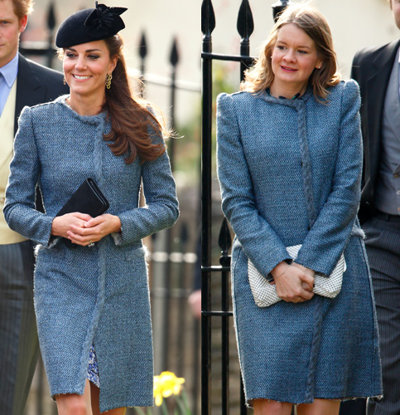
Remind me…

The New Neo Posted on April 8, 2014 by neoApril 8, 2014

…never, never, never to appear at a function wearing the same dress as Kate Middleton.

Never.

kateplus

Posted in Fashion and beauty | 32 Replies

Fun with statistics: women’s wages

The New Neo Posted on April 8, 2014 by neoApril 8, 2014

I’ve heard for years, perhaps even decades, that the oft-quoted statistic about women’s wages being so much lower than men’s as a result of wage discrimination is a myth, an artifact of other factors than discrimination. So this sort of article should be a big ho-hum to most people:

The supposed pay gap appears when marriage and children enter the picture. Child care takes mothers out of the labor market, so when they return they have less work experience than similarly-aged males. Many working mothers seek jobs that provide greater flexibility, such as telecommuting or flexible hours. Not all jobs can be flexible, and all other things being equal, those which are will pay less than those that do not.

Education also matters. Even within groups with the same educational attainment, women often choose fields of study, such as sociology, liberal arts or psychology, that pay less in the labor market. Men are more likely to major in finance, accounting or engineering. And as the American Association of University Women reports, men are four times more likely to bargain over salaries once they enter the job market.

Risk is another factor. Nearly all the most dangerous occupations, such as loggers or iron workers, are majority male and 92% of work-related deaths in 2012 were to men…

While the BLS reports that full-time female workers earned 81% of full-time males, that is very different than saying that women earned 81% of what men earned for doing the same jobs, while working the same hours, with the same level of risk, with the same educational background and the same years of continuous, uninterrupted work experience, and assuming no gender differences in family roles like child care. In a more comprehensive study that controlled for most of these relevant variables simultaneously””such as that from economists June and Dave O’Neill for the American Enterprise Institute in 2012””nearly all of the 23% raw gender pay gap…can be attributed to factors other than discrimination. The O’Neills conclude that, “labor market discrimination is unlikely to account for more than 5% but may not be present at all.”

But I would imagine that if you were to poll most people, they might be aware of the “wage gap” but unaware of what accounts for almost all of it. That’s what makes it so easy for politicians to use misleading statistics for political purposes.

And the reason we’re talking about this at all today is that, not only is it “Equal Pay Day” but, sure enough, Obama and the Democrats are planning for the “women make 77 cents to the male dollar” issue to be an important part of their 2014 campaign message.

Posted in Finance and economics, Men and women; marriage and divorce and sex, Politics | 19 Replies

Remember those Medicare Advantage cuts?

The New Neo Posted on April 8, 2014 by neoApril 8, 2014

Do you recall that part of the path to the passage of Obamacare involved some manipulation in order to get the proper CBO scoring? There were a lot of aspects to that, including the delay of many of the bill’s provisions until 2014. One way in which costs were kept low enough was the future reduction of federal payments to insurance companies in the Medicare Advantage program.

Well, as with so many of the unpopular but seemingly necessary parts of Obamacare, those cuts have been suspended—at least till after the 2014 election. How very convenient:

Under cuts planned by the administration, insurers offering the plans were to see their federal payments reduced by 1.9 percent, which likely would have necessitated cuts for customers.

Instead, the administration said the federal payments to insurers will increase next year by .40 percent.

The healthcare law included $200 billion in cuts to Medicare Advantage over 10 years, in part to pay for ObamaCare.

The Centers for Medicaid and Medicare Services (CMS) on Monday said changes in the healthcare market meant it did not need to make those cuts to Medicare Advantage this year.

It cited an increase in healthy beneficiaries under Medicare, which it said has lowered projected costs for that program…

The announcement comes after insurers spent millions on a public relations blitz seeking to head off the cuts, and after dozens of Democrats joined Republicans in calling on the administration to keep MA rates flat to avoid cutting benefits for seniors.

So, let’s see: the cuts were necessary to pass Obamacare. But they are poison at the ballot box, so there’s been pressure (from both sides, and insurance companies too) to call them off. Suddenly, as an explanation for their suspension, we find that old people have gotten healthier. Forgive me for being skeptical.

Republicans face a dilemma on this and myriad other issues connected with Obamacare. If they let all the terrible consequences of the original bill play out, it gives the Democrats ammunition for saying that Republicans want people to suffer. On the other hand, if Republicans block certain aspects of the bill that would make people feel pain (such as reductions in Medicare Advantage reimbursement), they increase their “compassionate” creds but they also improve the acceptability of Obamacare to the public, which is likely to end up blunting their own cause. Meanwhile, for most people, forgotten (if it was ever even known in the first place) is the hypocrisy and deception of the Democrats in perpetrating the original CBO scoring game, replaced by relief that Medicare Advantage will remain more or less the same for now.

So, what have we learned? We’re given a blueprint for how to manipulate future bills under consideration by Congress in order to get a good score from the CBO. Just put all sorts of cost-saving devices in there in order to pass muster, and then just cancel them afterward by executive order or other non-legislative approaches. As for the cost of Obamacare, we’ll worry about that later, after November 2014.

You can fool a lot of the people a lot of the time.

Posted in Health care reform | 8 Replies

Jeb Bush: the candidate without a constituency

The New Neo Posted on April 8, 2014 by neoApril 8, 2014

I’ve heard for years about the Republican “establishment” pushing this candidate or that candidate on the rank and file. Most of the time it’s seemed untrue to me.

But it seems absolutely on target with the current talk of Jeb Bush for 2016. He has no natural constituency. There is nothing special—or especially appealing—about him as a candidate. His name, IMHO, is a liability rather than an asset, both with Republicans and with Democrats.

So who would be voting for Bush in a primary? Darned if I know.

[NOTE: In choosing a category for this post, I thought about including him in “people of interest.” But the opposite is the point: he’s a person without interest.]

Posted in Politics | 44 Replies

Post navigation

← Previous Post
Next Post→

Your support is appreciated through a one-time or monthly Paypal donation

Please click the link recommended books and search bar for Amazon purchases through neo. I receive a commission from all such purchases.

Archives

Recent Comments

  • huxley on The Lindsay Clancy possibilities
  • Philip Sells on A lost skill
  • Molly Brown on A lost skill
  • ja on A lost skill
  • Molly Brown on The Lindsay Clancy possibilities

Recent Posts

  • A restrained AI spam comment
  • A lost skill
  • The Lindsay Clancy possibilities
  • Open thread 9/5/2026
  • The new AI spam comment generator is very very clever

Categories

  • A mind is a difficult thing to change: my change story (17)
  • Academia (328)
  • Afghanistan (98)
  • Amazon orders (6)
  • Arts (8)
  • Baseball and sports (164)
  • Best of neo-neocon (91)
  • Biden (536)
  • Blogging and bloggers (595)
  • Dance (292)
  • Disaster (244)
  • Education (323)
  • Election 2012 (360)
  • Election 2016 (566)
  • Election 2018 (33)
  • Election 2020 (513)
  • Election 2022 (114)
  • Election 2024 (403)
  • Election 2026 (92)
  • Election 2028 (13)
  • Evil (129)
  • Fashion and beauty (324)
  • Finance and economics (1,042)
  • Food (317)
  • Friendship (48)
  • Gardening (18)
  • General information about neo (4)
  • Getting philosophical: life, love, the universe (734)
  • Health (1,161)
  • Health care reform (545)
  • Hillary Clinton (184)
  • Historical figures (337)
  • History (716)
  • Immigration (448)
  • Iran (464)
  • Iraq (227)
  • IRS scandal (71)
  • Israel/Palestine (821)
  • Jews (437)
  • Language and grammar (365)
  • Latin America (212)
  • Law (2,975)
  • Leaving the circle: political apostasy (124)
  • Liberals and conservatives; left and right (1,321)
  • Liberty (1,117)
  • Literary leftists (14)
  • Literature and writing (394)
  • Me, myself, and I (1,498)
  • Men and women; marriage and divorce and sex (929)
  • Middle East (384)
  • Military (324)
  • Movies (353)
  • Music (533)
  • Nature (261)
  • Neocons (32)
  • New England (183)
  • Obama (1,738)
  • Pacifism (16)
  • Painting, sculpture, photography (131)
  • Palin (93)
  • Paris and France2 trial (25)
  • People of interest (1,043)
  • Poetry (258)
  • Political changers (178)
  • Politics (2,793)
  • Pop culture (397)
  • Press (1,635)
  • Race and racism (882)
  • Religion (428)
  • Romney (164)
  • Ryan (16)
  • Science (641)
  • Terrorism and terrorists (971)
  • Theater and TV (266)
  • Therapy (71)
  • Trump (1,630)
  • Uncategorized (4,553)
  • Vietnam (109)
  • Violence (1,445)
  • War and Peace (1,027)

Blogroll

Ace (bold)
AmericanDigest (writer’s digest)
AmericanThinker (thought full)
Anchoress (first things first)
AnnAlthouse (more than law)
AugeanStables (historian’s task)
BelmontClub (deep thoughts)
Betsy’sPage (teach)
Bookworm (writingReader)
ChicagoBoyz (boyz will be)
DanielInVenezuela (liberty)
Dr.Helen (rights of man)
Dr.Sanity (shrink archives)
DreamsToLightening (Asher)
EdDriscoll (market liberal)
Fausta’sBlog (opinionated)
GayPatriot (self-explanatory)
HadEnoughTherapy? (yep)
HotAir (a roomful)
InstaPundit (the hub)
JawaReport (the doctor’s Rusty)
LegalInsurrection (law prof)
Maggie’sFarm (togetherness)
MelaniePhillips (formidable)
MerylYourish (centrist)
MichaelTotten (globetrotter)
MichaelYon (War Zones)
Michelle Malkin (clarion pen)
MichelleObama’sMirror (reflect)
NoPasaran! (bluntFrench)
NormanGeras (archives)
OneCosmos (Gagdad Bob)
Pamela Geller (Atlas Shrugs)
PJMedia (comprehensive)
PointOfNoReturn (exodus)
Powerline (foursight)
QandO (neolibertarian)
RedState (conservative)
RogerL.Simon (PJ guy)
SisterToldjah (she said)
Sisu (commentary plus cats)
Spengler (Goldman)
VictorDavisHanson (prof)
Vodkapundit (drinker-thinker)
Volokh (lawblog)
Zombie (alive)

Meta

  • Log in
  • Entries feed
  • Comments feed
  • WordPress.org
©2026 - The New Neo - Weaver Xtreme Theme Email
Web Analytics
↑