
Pretty astounding kick:
Feet of clay and naked emperors
Even the WaPo seems to have noticed that Obama has been attacking a host of strawmen. And the WaPo is not alone; the NY Times suggested something similar when it wrote, as part of its editorial about Obama’s West Point speech: “In some ways, that was a straw-man argument…”
Obama’s actually been attacking strawmen from the beginning; it’s one of this favorite ploys. But something has changed ever-so-slightly lately, something in the air. Even the left is frustrated with him, and the frustration has been growing.
Why, I wonder? Do they think he looks dull and disorganized rather than smart at this point? Were they still expecting more from him in that speech at West Point? Not necessarily different content, but just something more resolute, more eloquent, more firm? Are they now embarrassed about their previous fulsome over-the-top support for him?
Don’t get me wrong. I don’t for a moment think that they are changing their politics; they’re not about to come out for Republicans or conservatives. I think they have just become more and more disgusted with Obama’s weakness and repetitiveness, and his reliance on words, words, words.
Of course, that was always true of Obama. But previously they believed he could deliver in many areas, and most definitely in this one area in particular: making the world respect us, getting along well with other countries. He’s not been doing that, has he? And so when NBC’s Richard Engel says he’s “hard-pressed” to find one country where relations with the US have gotten better under Obama, you know that the disillusionment has grown so large that some can no longer pretend as well as they did before. They’re exhausted with the effort it requires.
Barack Obama’s speeches have always been composed—from the very start of his national campaign, when I first began to follow him—of some combination of these things: platitudes, self-references, outrageous statements (lies, or promises that turn out to be lies), passing the buck to others, criticizing the US, ascribing bad motives to the opposition, and attacking strawmen. Has he ever had any other arrows in his quiver? I can’t think of any.
He’s still doing all of this, but even the left seems to be getting a little bit sick of it (does that mean they’ve turned into racists?). Oh, I suppose it would still be okay with them if his accomplishments were more obvious. But the biggest one so far, Obamacare, may turn out to be a pyrrhic victory.
That could all change, of course, if immigration “reform” passes. Ensuring a permanent Democrat majority and making the American people more and more dependent on big government would be the biggest accomplishment of all.
What’s Obama’s problem?
He’s too modest.
No, really, just too modest.
And what’s he too modest about? All the efforts he’s made around the world.
Let’s give him an A for effort:
Among this administration’s many, many flaws is that its public presentation is fundamentally unserious and insincere. That happens sometimes when you’re lying through your teeth and you know it, and the people you’re speaking to know it, and everybody knows it.
Shinseki resigns
President Obama has announced that he’s accepted Shinseki’s resignation.
Shinseki is guilty of more or less the same thing Obama is guilty of re the VA: being informed of the abuses and doing essentially nothing. Too bad Obama won’t accept his own resignation.
Of course, then we’d have Joe Biden as president, who would do more of nothing about the VA.
I think that, in general, Biden would do marginally less damage as president than Obama has, if only because his “fool” quotient is somewhat higher than Obama’s. And if he resigned, then we’d have John Boehner as president. That would be…weird.
By the way, John Kerry is fourth in the line of presidential succession, and Eric Holder seventh. If you look at the list (which has not been updated; Sebelius and Shinseki are still on there, for example) it is a parade of mediocrities at best, knaves at worst.
Sobering.
I suppose Shinseki had to go. But it seems to me as though he’s just the fall guy.
Maybe Obama should get a new speechwriter
Richard Fernandez, that is.
My favorite line: “There’s no problem so pressing that you can’t forget it by changing the subject.”
It’s a brilliant, brilliant piece.
[Hat tip: commenter “J.J.”]
Risky childhood play
A while back The Atlantic had an article by Hanna Rosin describing how it was that in just a couple of generations Americans became intolerant of exposing their children to what used to be considered normal risks.
Some of it had to do with lawsuits:
…[P]ark departments all over the country began removing equipment newly considered dangerous, partly because they could not afford to be sued, especially now that a government handbook could be used by litigants as proof of standards that parks were failing to meet…[T]he cultural understanding of acceptable risk began to shift, such that any known risk became nearly synonymous with hazard.
The consequences are somewhat paradoxical, but they make sense. Removing danger does away with an important learning experience:
Children are born with the instinct to take risks in play, because historically, learning to negotiate risk has been crucial to survival; in another era, they would have had to learn to run from some danger, defend themselves from others, be independent. Even today, growing up is a process of managing fears and learning to arrive at sound decisions. By engaging in risky play, children are effectively subjecting themselves to a form of exposure therapy, in which they force themselves to do the thing they’re afraid of in order to overcome their fear. But if they never go through that process, the fear can turn into a phobia. Paradoxically, Sandseter writes, “our fear of children being harmed,” mostly in minor ways, “may result in more fearful children and increased levels of psychopathology.”
Not to mention dependency. On government regulation and protection from risk, perhaps?
The public does not ♥ Obamacare
Despite all efforts, Obama and the Democrats have not been able to make the public like Obamacare, a fact reflected in polls such as this one from Gallup.
This is the chart that must make them gnash their teeth:
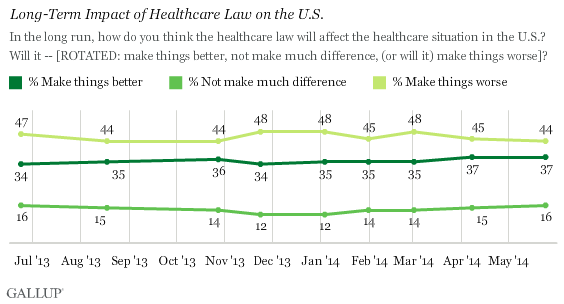
It is remarkably flat over time, isn’t it?
And this chart can’t warm the cockles of their hearts either:
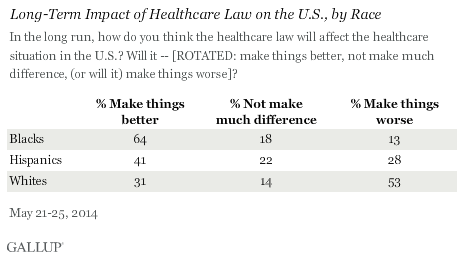
That’s pretty low support among blacks and Hispanics, considering their support for Obama and Democrats as a whole, and considering that Obamacare was designed to supposedly help low income people the most.
How widespread is the VA rot?
It now appears that an award-winning VA hospital in Texas was cooking the books for years—falsifying wait times in order to keep winning those awards and bonuses.
Investigations went nowhere:
Emails and VA memos obtained exclusively by The Daily Beast provide what is among the most comprehensive accounts yet of how high-level VA hospital employees conspired to game the system. It shows not only how they manipulated hospital wait lists but why””to cover up the weeks and months veterans spent waiting for needed medical care. If those lag times had been revealed, it would have threatened the executives’ bonus pay.
What’s worse, the documents show the wrongdoing going unpunished for years, even after it was repeatedly reported to local and national VA authorities. That indicates a new troubling angle to the VA scandal: that the much touted investigations may be incapable of finding violations that are hiding in plain sight…
“This newest case just further illustrates that the scandal is much more far reaching than most people realize,” Rieckhoff said, “Phoenix was just the tip of the iceberg. Scandal has become the new normal, it’s the status quo at the VA right now.”
Apparently it’s been the status quo at the VA for years. The only difference now is that it’s being revealed.
So we have the lengthy wait times, which would be bad enough. But then there was the coverup, motivated by the fact that long wait times were penalized and short wait times incentivized. The solution: lie about the wait times. It worked for quite a while, didn’t it? In a system that rewards lying, the truth-teller loses:
There’s enormous pressure to report favorable wait times for VA patients, the Texas whistleblower explained, even if those wait times are completely false.
“If [VA] directors report low numbers, they’re the outlier. They won’t stay a director very long and they certainly won’t get promoted. No one is getting rewarded for honesty. They pretty much have to lie, if they don’t they won’t go anywhere,” the whistleblower added. Weighted more heavily than other performance measures, the wait time numbers alone “count for 50% of the executive career field bonus, which is a pretty powerful motivator.”
Though VA hospitals may be struggling with increasing patient loads and inadequate resources””including too few medical providers””they are punished for acknowledging those problems.
Something that looks good on paper and seems to make sense—rewarding short wait times—is deeply flawed if it’s really really hard to effect short wait times because the resources to do so just aren’t there. So the lying begins, and people realize there’s no other way to function in that system.
That doesn’t make the lying okay, but it does make it explicable. Those who won’t lie tend to be winnowed out in a process of natural selection, a survival of the fittest for that particular environment. Not everyone in the system was corrupted, but enough were to make it a widespread and practically standard occurrence.
The article goes on to describe a coverup of the coverup, exoneration by an investigation that was also fraudulent.
And the final paragraphs of the article are just plain sad:
The current investigatons are not enough, Rieckhoff said. Having a White House political operative looking into this is not an adequate solution. This is not something that one of the president’s lieutenants should be handling.”
“There’s definitely reason to think there may have been criminal activity,” Rieckhoff said. “Maybe it’s time for Attorney Genral Holder and the Department of Justice to get involved, or for someone else trained to investigate criminal cases to take the lead on this.”
Do not sit on a hot stove waiting for that DOJ investigation to take place. And what is Eric Holder if not one of the president’s most loyal lieutenants?
The search of the area where “pings” were heard…
…thought initially to possibly be from the missing Malaysian airplane is complete, and it has turned up nothing.
Back to the drawing board.
The linked article calls the fate of the airplane and its passengers “one of aviation’s most baffling mysteries.” But I’d say it actually is aviation’s most baffling mystery so far.
Here’s a list of ten other supposedly baffling mysteries involving aviation. Some aren’t even baffling; they’ve been solved. Others continue to baffle, but I don’t think any of them are in quite the same league as Flight 370. They either occurred before instrumentation and tracking had reached today’s sophisticated level, or they represent a mystery in the sense that we don’t know why they crashed or why they weren’t found. No single event presents the depth of mystery that Flight 370 offers, involving these questions and more: why did the entire communication system turn off while the plane continued to fly for a long time? Did the plane even crash? Why has no debris ever been found, if the plane landed in the ocean?
Obama goes to battle against straw men…
Headline: Greatest Orator Since Cicero Successfully Refutes That Which Was Never Contended
Variously seen on Twitter, spoofs of Obama’s foreign policy address to the commencement class at West Point:
Lachlan Markay: “”Some say we should nuke the entire Asian continent. Others want our capital to be Pyongyang. Unlike everyone else, I’m a rational centrist.
Ben Shapiro:”We need to do stuff. And the stuff we will do will not be stuff that a crazy person says we should do. It will be good stuff.”
In a shocker, Obama informed the captive audience at West Point that from now on, the US military will be using might in the service of right. A revolutionary thought!
More from Scott Johnson at Powerline on the address:
I find it difficult to imagine the mental nullity required to draft and revise this speech.
I have felt that way about all of Obama’s speeches. But hey, that’s just me.
It also strikes me as ironic that, unlike their fellow graduates at so many other universities, the West Point graduates were unable to protest their commencement speaker, who dearly deserved it.
Why no outcry from Obama on this?
Mariam Yahia Ibrahim Ishag, under sentence of death for apostasy, has given birth in a Sudanese prison.
The US Embassy in Sudan has released a statement protesting her incarceration, and a few US Senators have also supported her. Others, including Kelly Ayotte of NH (Ibrahim’s wheelchair-bound husband, who suffers from muscular dystrophy, is from Sudan but is a US citizen and a resident of New Hampshire), have gone further and written a letter:
…asking John Kerry, U.S. Secretary of State, to offer political asylum to Ibrahim.
“We also urge you and President Obama to reappoint an Ambassador at Large for International Religious Freedom, whose primary purpose is to monitor, prevent, and respond to this exact type of incident,” the letter stated.
Some groups such as Amnesty International are on the case as well.
And what of President Obama? The guy who spoke up readily in the Henry Louis Gates arrest and the Zimmerman case? The answer appears to be silence—at least so far—and silence from Secretary of State Kerry.
Obama is in exactly the same position vis a vis Islam as Mariam Yahia Ibrahim Ishag herself, by the way, although of course he’s not in prison for apostasy. Here are the facts of her life as reported:
Mariam was born to a Muslim father, who left her mother to bring her up alone from when she was very young, and an Ethiopian Orthodox Christian mother. She was raised in her mother’s faith and married a Christian man.
That’s her defense to the charge of apostasy: she was never a Muslim in the first place, so there was no conversion. The parallels are that Obama was also born to a Muslim father who then departed from his life and a Christian mother (I’m not talking about beliefs, I’m talking about nominal religion of birth). He was raised mostly by his Christian grandparents, although his mother was also involved off and on. All of this would make him an apostate under the same reasoning that the court applied to Ibrahim Ishag. But whatever Obama’s religion (and my gut feeling is that he has none but leftism), he certainly seems reluctant so far to say much to defend this woman from the barbarism of Islamic law.
[NOTE: There’s a lot more background information about the couple’s story and background in this Telegraph article. It reads partly as a history of Africa’s troubles, reflected in the lives of these two people [emphasis mine]:
Like many in Sudan, both Daniel and his wife’s childhood were blighted by civil war.
Daniel managed to escape the brutal conflict in 1998 when he travelled to America with his brother Gabriel.
The biochemist returned to Sudan to marry Meriam at a Christian service in a chapel which was attended by around 500 people in December 2011.
Most who were at the wedding ceremony could vouch for the pair being committed Christians, defence lawyers say.
But witnesses who were willing to give evidence on her behalf were barred from testifying because they were Christian.
She even produced a marriage certificate identifying herself as a Christian.
Despite this, the judge determined that because her father was a Muslim, even though he abandoned the family while they were living in a refugee camp in the South East of Sudan when she was six, she too was a Muslim who had broken the law by leaving Islam.
But her mother, who is now dead, brought her up as Christian. Her mother was born in Ethiopia to Christian parents, but fled to Sudan because of famine, and chose to raise her daughter in the same religion.
Read the whole thing.]
I spy with my little eye…
The above link is to an interview Edward Snowden gave to NBC’s Brian Williams, but I’ve only read excerpts from it because the link to the original interview isn’t working right now. My use of the word “traitor” is based on previous conclusions of mine, rather than new revelations in the interview. But the reference to the word “spy” in the title of the post is due to the fact that in his Williams interview Snowden claims he was “trained as a spy,” not just a low-level computer operative.
His use of the word “spy” seems odd to me, mostly a self-aggrandizing attempt to make himself out to have been far more exceptional and ungeeky than he was:
“I was trained as a spy in sort of the traditional sense of the word in that I lived and worked undercover overseas – pretending to work in a job that I’m not – and even being assigned a name that was not mine.”
Describing himself as a “technical expert,” Snowden said: “I don’t work with people. I don’t recruit agents. What I do is I put systems to work for the United States. And I’ve done that at all levels from – from the bottom on the ground all the way to the top.”
Sorry, Ed, but that’s not the traditional sense of the word “spy,” although I can’t say the semantics matter all that much. Spies usually do either “work with people” and/or steal the secrets of other nations. But no matter; spy, schmy, it’s Edward Snowden the great and powerful, whose only spying was on the United States.
And nothing is his fault, either, including the fact that he’s living in Russia:
“I had a flight booked to Cuba and onwards to Latin America and I was stopped because the United States government decided to revoke my passport and trap me in the Moscow Airport,” Mr. Snowden said in the portion of the interview released Tuesday night. “So when people ask ”˜Why are you in Russia?’ I say, ”˜Please ask the State Department.’”
Why, if it weren’t for that mean old State Department, Snowden would be in grand old Venezuela, living it up.