…[T]he Muhammad Art Exhibit and Contest in Garland, Tex., was not really about free speech. It was an exercise in bigotry and hatred posing as a blow for freedom.
Pamela Geller, the anti-Islam campaigner behind the Texas event, has a long history of declarations and actions motivated purely by hatred for Muslims…
Geller revels in assailing Islam in terms reminiscent of virulent racism or anti-Semitism…
As for the Garland event, to pretend that it was motivated by anything other than hate is simply hogwash.
Well now, there’s a tightly reasoned argument for you, worthy of the Times.
You may think I’m leaving out something important—some reason the Times gives for all this invective against Geller, some quotes or proofs or examples. Something other than the bald assertion of the editors, the argument from authority with the editors as the authority.
So here’s my challenge to the Times editors: give us some quotes from Geller. Some, you know, evidence of her hatred. Surely there must be reams and reams and reams. What has Geller said that’s so venomous and bigoted? About whom did she say it, all Muslims or Muslim terrorists? What was so hateful about the cartoon that won the contest, and why is it so obvious it wasn’t about free speech?
And while you’re at it, watch this video, and then tell us again that Geller’s Garland conference wasn’t about freedom of speech and that the very idea that it might have been is hogwash and pretense, and that it’s she who is the hater:
I realize that the Times editors will never do any of this, and it’s not just because they don’t read this blog. They will never feel the need to back up what they are saying in their editorial about Geller because they don’t have to do it—their readers neither demand nor expect it.
It isn’t often you see a majority of this magnitude:
The vote on cloture on the Corker-Menendez bill was 93-6; the final vote on the merits, 98-1. With that, the Senate rebuked the White House’s plan to avoid Congress entirely on a final Iran deal. If there is a final deal, at least President Obama will be barred from immediately lifting sanctions, will have to turn over the whole deal to lawmakers and will risk a resounding bipartisan “no” vote. It is not ideal, but only Sen. Tom Cotton (R-Ark.) in the end made the perfect the enemy of the good to vote no on the merits.
So what, you might say? Lots of conservatives think it’s a bad deal because without it, a 2/3 vote would be needed to approve the deal as a treaty, and with it, a 2/3 vote (because of the necessity for a veto override) will be needed to block it. But they are ignoring reality, which is that without it there is not chance it would even come up before Congress at all, because Obama would consider it not to be a treaty, and he could win that argument.
Such a huge majority could only be achieved with a bill that didn’t contain any of the stronger amendments that McConnell blocked; in fact, no majority would have been achieved at all. The Don Quixotes among you probably don’t care; better no bill than this one. The Sancho Panzas (that includes me) disagree, and say this is a bill that at least has a chance of stopping some parts of an Iran deal, and it’s the only way that could have been accomplished.
I may be writing another post on this, but not today (busy day). In the meantime, I pretty much agree with what Scott Johnson has to say on the matter.
I have heard, or read, person after person stating as a given that Pam Geller is a hater, and/or that what she is doing is hate speech, and/or that she hates Muslims. Just Google “Pam Geller hates” and you’ll come up with a ton of hits to that effect. But when I look at a random selection, I see a bunch of articles that either fail to quote something specifically hateful that Geller has said, or quote something out of context in a way that doesn’t fairly represent what was being said by Geller if you go to the source.
You can do it yourself if you want; maybe you can find some Geller quotes in articles criticizing her that are more pointed or more accurate, and which make a good case that Geller is a hater. But as far as I can see, this alleged hate by Geller seems like pretty weak tea compared to two other types of hatred: the hatred expressed by some of those accusing Geller of hate, and the hatred regularly taught by Palestinians to children in a manner that’s become so mainstream that it’s even featured on children’s TV programs (and that latter hatred taught by Palestinians is, by the way, not just against Zionists or Israelis, it’s against Jews).
You don’t believe me? For an example from the category of the Geller-accusers, take a look at the very first article on Geller that comes up in the aforementioned Google search. It’s not on an obscure website, either; it’s at the NY Daily News, and it’s by Linda Stasi (no, I’m not making that name up). Entitled “With Pamela Geller’s Prophet Muhammad cartoon stunt in Texas, hate rears its ugly face again,” it’s a bit confusing as to whose “hate” is being referenced there—the would-be killers’, or Geller’s, or perhaps the author’s.
You be the judge. Here’s the lede:
Looks like Pamela Geller will get her wish: More dead Americans at the hands of radical Muslims. Hell, the hatemonger finally even got ISIS to pay attention to her.
It goes on, of course. You really have to read the whole thing to get the full and robust flavor of it. But I’ll excerpt a bit more:
Geller, like ISIS and al Qaeda, revel in hate and nothing would make any of them happier than to be the catalyst for the killing of hundreds of innocent Americans to prove a point. Geller would be a hero to the hateful. Damn the cost in innocent lives, damn the heartache.
Don’t think for a minute that violence isn’t what she, just like the murderers of ISIS, want.
Although my own commitment to free speech means I won’t be calling for Stasi to be censored, I find it extraordinary that the NY Daily News would choose to publish something as—well, I guess the word could be “hateful” in its blame-the-victim mentality—as that. But of course they’re perfectly free to do so.
But if you really want to see hate, I suggest you take a look at this:
That is one of many such videos you can find at the excellent website Palestinian Media Watch, a site dedicated to publicizing what the Palestinian media and leaders actually say rather than what the sympathetic west would like them to be saying. It does invaluable work at exposing the teaching and institutionalization of hatred among an entire group:
Founded in 1996, Palestinian Media Watch is an Israeli research institute that studies Palestinian society from a broad range of perspectives by monitoring and analyzing the Palestinian Authority through its media and schoolbooks. PMW’s major focus is on the messages that the Palestinian leaders, from the Palestinian Authority, Fatah and Hamas, send to the population through the broad range of institutions and infrastructures they control.
PMW’s many reports and studies on Palestinian summer camps, poetry, schoolbooks, crossword puzzles, religious ideology, women and mothers, children’s music videos and the PA’s indoctrination of adults and children to seek Shahada (Martyrdom), have had significant impact on the way the world sees the Palestinians. PMW has presented its findings before members of US Congress and to members of Parliament in numerous countries, including the European Union, Britain, France, Norway, Sweden, Holland, Switzerland, Canada and Australia, and has lectured at universities and conferences world wide.
Browse the site, send links to other people if you’re impressed, and if you care to donate, please go here.
Yesterday I had an ant infestation, mostly those large ones that can move very fast, although there were a couple of teeny tiny ones as well. They came out of nowhere—I couldn’t see where they were entering—and seemed evenly distributed in my kitchen and dining/living room.
I killed every one of them that I could. My philosophy is that ants belong outside; when they’re in my home they are not honored guests.
Today they seem to have departed. Maybe the word got back to the group that I wasn’t the best of hostesses—no hors d’oeuvres and not a single drink, much less the good Scotch.
But as a consequence of the event, yesterday I had the Robert Frost poem “Departmental” drumming through my head, at least the parts of it I know by heart.
“Departmental” is an atypical poem of Frost’s. It’s almost Ogden-Nashlike, pretty light fare in its description of ants and the way they function. But of course Frost being Frost there’s a deeper message that has to do with bureaucrats and how they function in terms of compartmentalizing their duties, and their ability to block out whatever they don’t want to deal with. Here’s the entire poem; it’s well worth reading in its entirety, but I’ve excerpted a section:
Ants are a curious race;
One crossing with hurried tread
The body of one of their dead
Isn’t given a moment’s arrest-
Seems not even impressed.
But he no doubt reports to any
With whom he crosses antennae,
And they no doubt report
To the higher-up at court.
Then word goes forth in Formic:
‘Death’s come to Jerry McCormic,
Our selfless forager Jerry.
Will the special Janizary
Whose office it is to bury
The dead of the commissary
Go bring him home to his people.
Lay him in state on a sepal.
Wrap him for shroud in a petal.
Embalm him with ichor of nettle.
This is the word of your Queen.’
The ruling greatly increases the pressure on Congress to make significant changes””or end outright””the surveillance program. The judges not only ruled against the phone program, but sharply criticized many of the legal theories upon which the U.S. government has built out its surveillance capabilities since the 2001 terror attacks…
The program gathers metadata””the records of which numbers are called, the time, and the duration of those calls””but not the contents of the conversations.
The actual ruling can be found here, if you’re up for close to 100 pages of reading. It was handed down by a three-judge panel in New York.
It was a relatively narrow ruling in terms of its effect:
The court declined to address the issue of whether the program violates Americans’ rights, because, they found, it was never properly authorized by existing law. And the judges didn’t order the collection to stop, noting the legislative debate and the looming expiration of Section 215 will force action on the issue one way or another.
So I’m not sure that this is a very big deal at all.
Another Tweeter with an itchy Twitter trigger finger* learns that pausing to think before tweeting might be wiser:
Chris Cuomo is co-host of CNN’s morning show. He’s also a former law and justice correspondent for ABC News. He has a law degree from Fordham University and is a licensed attorney. New York Gov. Andrew Cuomo is his brother.
In other words, this is somebody you’d expect would know what he’s talking about on the subject of basic constitutional facts. And yet [he tweeted]: “hate speech is excluded from protection. dont just say you love the constitution…read it.”
Robby Soave’s piece at Reason then proceeds to cite the relevant words in the Constitution (First Amendment), as well as case law in which “the Supreme Court has consistently interpreted the First Amendment to protect all kinds of odious speech, including speech perceived to be hateful.” There are a few exceptions—such as the “fighting words” exception—but they don’t apply to the situation in question, which is the Pamela Geller case.
How on earth did Cuomo make a goof of that magnitude? You might say that Cuomo must have known it wasn’t true but thought that no one would catch him. And yet that doesn’t make sense because Twitter is the sort of place where everyone on the other side is waiting to pounce on you and show off their own bon mots if your bon mot is flawed. So how is it that I, a mere blogger who went to law school 9,000 years ago, am aware that the Constitution generally protects even hate speech, and Cuomo seems unaware of it? This is not an esoteric legal principle, either; it’s a basic one.
The Baltimore Sunreports that an investigative Task Force of the Baltimore Police Department has found that, contrary to the assertion by prosecutor Marilyn Mosby, Freddie Gray’s knife was illegal (just as the arresting police had claimed):
While Mosby said Friday that the officers had made an illegal arrest because a knife Gray was carrying was not a “switchblade,” a violation of state law, the police task force studied the knife and determined it was “spring-assisted,” which does violate a Baltimore code [§59-22].
Details, details.
According to attorney Andrew Branca of Legal Insurrection:
The organized Task Force composed of senior department officers with access to specialized knowledge and the opportunity to examine the knife in complete safety and at their leisure concluded, as the arresting officers had, that the knife was unlawful. That makes laughable any argument that the officer’s own conclusion under stress to that effect was unreasonable on its face.
And if the arresting officers perception of probable cause for the arrest was not unreasonable, the arrest was not unlawful. Period…
Now Marc Zayon, Officer Nero’s attorney, is seeking an independent examination of the knife recovered from Gray at his arrest.
Branca’s entire piece is well worth reading; it contains much much more, and is fairly shocking (even at this point, when we shouldn’t be at all shocked) in its revelations about the scarcity of evidence for the charges against Officer Nero. Branca adds:
There never seemed to be much of an evidentiary basis for the more serious criminal charges brought by Mosby against the officers”“the second degree depraved heart murder and the multiple counts of manslaughter, in particular. Thus Mosby’s charges were always exceedingly vulnerable from “the top.”
Now it seems that even the lesser charges may lack even the minimal evidentiary basis to survive a probable cause hearing that due process demands the officers be entitled to, making Mosby’s charges vulnerable from “the bottom.”
I wonder whether Mosby may end up regretting not having taken a little more time to think this through. Yes, I know her charges were politically motivated and time was of the essence, but I doubt she wanted to make herself look like a bumbling fool.
When charges were announced Friday against Alicia White for the death of Freddie Gray, her phone started buzzing from journalists and bail bondsmen.
The problem was, they were calling the wrong Alicia White. The elementary school cafeteria manager from East Baltimore was not the Baltimore Police sergeant charged with manslaughter in the high-profile police custody death – even though court records listed her…
“The middle initial was off. Her address, her height, her weight, her driver’s license number – all of the information was my client’s information,” said Jeremy Eldridge, an attorney who says he has been hired by the resident.
“Her life has been a living hell the past four days…”
Alicia White wasn’t the only one, either:
An attorney for Lt. Brian Rice said his client’s information was also entered incorrectly when prosecutors filed charges, but declined further comment.
On Friday evening, Tammy and Brian Rice of Brunswick, Md. said they were receiving multiple calls from reporters looking for the lieutenant. Brian Rice of Brunswick is a plumber, they said.
Passengers noticed nothing out of the ordinary, but Alps-crash copilot Andreas Lubitz had practiced his descent-programming skills on the previous flight.
He apparently waited until the pilot had stepped out of the cabin for a few minutes, and then he set about his business:
Over the course of three or four minutes, Lubitz…designate[d] “100 feet” as the selected flight level. He did this several times, while the pilot was out of the cockpit.
But this was just after the plane had already begun its descent. After each occasion that he chose “100 feet” he then corrected himself and entered the correct flight level. The course of the plane was not altered at all.
So no one noticed at all. Here’s how it went:
The article speculates that, although it’s unknown what was in Lubitz’s mind at that point, he seems like a “man steeling himself for the challenge he has set himself, building up the courage but at each point pulling back – until finally the pilot re-enters the cockpit and normality returns.”
Perhaps. But my theory is that he may have been purposely desensitizing himself to the act of setting the altitude so that it became more and more routine, as well as testing whether he could get away with it. By the time he decided to follow through on the return flight, he was calm, collected, and ready.
And those people who were on that outbound Germanwings flight that left Duesseldorf at 06:01, arriving in Barcelona at 07:57 on the 24th of March, 2015, can thank their lucky stars that it seemed to be—and functioned as—an ordinary, uneventful trip. But now they know what was actually happening.
[NOTE: At the end of the article is the following:
Were you on the outbound Duesseldorf to Barcelona flight in March? Have you been affected by the issues raised in this story? You can email haveyoursay@bbc.co.ukwith your comments.
I would be very interested in reading any of the responses.]
This is certainly interesting: two of the surviving Charlie Hebdo cartoonists say they are very very different from Pam Geller and her group, organizers of the free speech event in Texas that was threatened by two gunman. Geller organized the event in explicit support of the Charlie Hebdo cartoonists, but these two don’t seem so happy at the association and don’t want people to make a comparison:
Charlie Rose invited two cartoonists for the French satirical magazine Charlie Hebdo, which experienced a deadly attack on its offices earlier this year, to comment on the parallels ”” or lack thereof ”” between the two incidents.
“To be honest, I can imagine the kind of comparison you can make between the Charlie Hebdo attack of January 7 and this event, but there is nothing to do [with one another], there is no comparison, absolutely no comparison,” Jean-Baptiste Thoret said in a clip of a longer interview set to air tonight [the clip is at the link].
While he described the group that put on the event in Texas as part of an “anti-Islamic movement” against the “Islamization of the U.S.,” Thoret said the motives of Charlie Hebdo are “absolutely not the same.” For the magazine, he said it “was a question of criticizing” all religions, not Muslim people “in particular.”
Thoret left out one huge difference: most of the Charlie Hebdo cartoonists seem to have been on the left politically, and Geller is on the right (I’m not sure about all her supporters).
There are often huge gulfs between left and right even if they agree on a single issue, and Thoret seems to want to disavow himself of any connection with what he may consider to be the tainted right. To do so he makes what seems to be an absurd statement. I haven’t heard the whole interview, so perhaps he qualifies it in some way, but as it stands it makes no sense that there is “absolutely no comparison.” The two are not the same, of course (and one difference is that the French attacks were horrifically successful and the Texas attacks were thwarted), but there are obvious comparisons that are not at all trivial.
The most important similarity is that each attack was made by Muslim extremists angry at cartoons they believed to be blasphemous and therefore unconscionable. This is actually the reason (and probably the only reason) that both attacks occurred at all.
But Thoret isn’t interested in looking at this through the eyes of the perpetrators. He seems more eager to assure his audience that he and his fellow cartoonists at the magazine were equal-opportunity satirists who did not discriminate against Islam but instead against all religions. You can be pretty certain that this distinction made no difference whatsoever to the perpetrators, but it makes all the difference in the world to the left, which defines Geller as a specialty hater and themselves as hard-nosed realists cynical about all religions, which makes them devoid of the taint of prejudice in their own eyes.
Let’s just say for the sake of argument that Charlie Hebdo spokesmen Thoret and Briand are right in saying that the Texas people represented an “anti-Islamic movement, a very harsh movement.” So what? If you believe in defending free speech, you believe in defending it even for speech with which you disagree, even speech that you consider hateful. But France’s free speech tradition is very weak, as I learned when I covered the al Durah trial (see this for background on the differences between that country and the US in terms of freedom of speech). In this, Thoret and Briand are not just being leftists, they are being rather French as well.
[ADDENDUM: It seems we are not as different from the French as I had thought, at least not any more.
I had a very busy day and was online very little, but now that I’m taking a (quick) look at my computer I see that the internet and the airwaves, as well as the MSM, have been rife with people criticizing Geller for a host of things that they find objectionable about her. This even includes some people who are on the right, or sort of on the right, but I bet it doesn’t include any libertarians.
Ace has an intense rant about the attitude of such people and their lack of devotion to freedom of speech. As I said above, “If you believe in defending free speech, you believe in defending it even for speech with which you disagree, even speech that you consider hateful.” That used to be the basic stance of most Americans; at least, I thought it was. Seems that the times they have a’changed.]
Lately it seems that nearly every transaction any more complex than buying groceries at the local market must be performed at least twice, sometimes three and four times.
A recent mail-order product return, for example. I had bought some jeans that I loved, but when I washed them, following the instructions, they shrank so much that they were unwearable. I decided to get another pair and figured I wouldn’t put them in the dryer at all this time, and so I went back to the store. But they were out of them.
The jeans still existed online—success, or so I thought. I ordered them, but when they arrived they were of a different style. Now, anyone who knows anything about jeans knows that that just won’t do. So I phoned and said I’d send them back and wanted a refund not only for the jeans but for the ten dollar shipping fee I’d paid, because the mistake had been the store’s (which was, by the way, a major nationwide retail chain).
No problem, they said. Thank you so very much, they said. They also said they’d email me a label for the return postage, too.
Great, right? Except for the fact that the label never came. So I had to call back a few days later and wait through their tooth-grinding phone message again. Listening to it was like going on a involuntary treasure hunt, it was that difficult to find a way to access an actual agent rather than a recorded message.
But I prevailed, and after some discussion with a human being, this time the label arrived as an email attachment. I prepared to return the jeans and even managed to get them back in the original shipping bag, although they have to be mailed by way of UPS, which involves a bit of a drive.
But before I managed to accomplish that chore I got a letter (that’s a real letter, a snail mail letter) from the store saying that “your shipment was recently returned to us because it was undeliverable by our carrier.” Now, how had that been generated? Nothing had yet been shipped back by me, and therefore nothing could have been undeliverable and returned. The refund amount listed on the letter was merely the price of the jeans alone minus the ten dollar shipping fee. Another error, which meant I had to call again (third time now), wait through the purposely confusing (are we getting paranoid here?) phone message, not to mention the hold, and talk to another person.
That person told me to disregard the letter. We’ll see whether I’ve heard the last of the matter. My guess is that there may be at least one more call to the store about this in my future.
I wouldn’t be complaining if this type of thing hadn’t become standard operating procedure rather than the exception. Is it super-important in the large scheme of things? No. But it’s the sort of petty annoyance, day after day, that chips away at people’s sense of trust and equanimity, and fosters the idea that something is falling apart, or perhaps has fallen apart.
What is that “something”? I’d say it’s the expectation of competence—caring if the job you do is good or not, and taking responsibility for your actions, both on the personal and corporate level. The entire thing is accompanied by the most galling (and almost Orwellian, under the circumstances) canned read-from-a-manual assurances about how valuable your patronage is and how very very much you are appreciated as a customer, in addition to fulsome praise for every small thing you might do such as give your name and address when asked, which is received with a heartfelt “thank you so much, Miss (fill in the name)”—all of which have the net result of making the call seem even more interminable than it already is (and almost as interminable as this sentence).
In other words, every such transaction now resembles an interaction with a government agency in terms of competence. And every such transaction now resembles an interaction with Uriah Heep in terms of fawning obsequious insincere pronouncements designed to divert you from what’s actually happening and create a false sense of service rendered.
NOTE: It took a while, but I found a tiny clip of Heep in the 1935 Cukor film “David Copperfield,” a favorite of my youth. He’s the guy who’s clasping his hands together:
I love those old black-and-white films.
By the way, in case you’re wondering: no, they would not give me any money back for the price of the original purchase, the jeans that had shrunk in the wash even though I used cold water and moderate heat.]
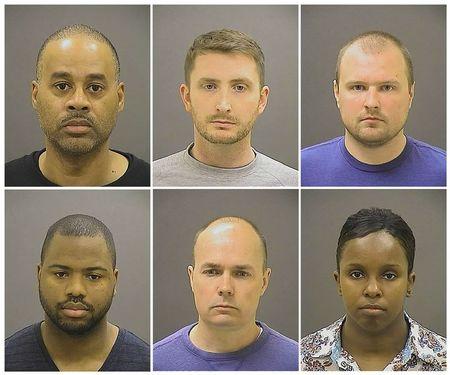
Anyone who follows the news knows by now that of the six officers who have been charged in Freddie Gray’s death, it is an even split in terms of race: three are white and three are black. The most severe charges are expected to be lodged against the van driver, who is black.
They look like America:
You might ask, so what? And I’d agree. Black or white, the important thing is what they did (or didn’t do).
But I can’t help but reflect that this case might have gone down differently if this information about their races had come out earlier. But although their names were released early on, their races were not. Not only that, but most of the speculation I read prior to learning their races indicated, or at least hinted or guessed, that they were all white. Typical is this article that appeared in the April 22 Atlantic:
Six officers have been suspended with pay and placed on desk duty in the Gray case, and while the Baltimore Police Department didn’t specify their races, the three officers in the clip arresting Gray all appear to be white. One thing that separates this case from, say, Ferguson or North Charleston is the demographics of those in power. It’s true that whites are overrepresented in the Baltimore Police Department compared to the city’s overall population, but black and white officers make up roughly equal proportions of the force. In addition, both Mayor Stephanie Rawlings-Blake and Police Commissioner Anthony Batts are African Americans.
Well, it turns out the races of the accused reflect almost perfectly the racial makeup of the police department. So one would imagine racism has nothing to do with this case, right? But I doubt we’ve heard the last of the “racism,” charge; the black officers probably will be excoriated as race traitors. Black police officers often have a difficult time working in black communities for that reason—like the kids who speak with too careful an articulation or who do too well in school, they are often seen as betrayers.
These police officers will almost certainly become the focus of a great deal of hatred. I watched a number of interviews of people in the crowd after it had been announced that the six were being charged, and not only was there a holiday sort of jubilation, but every person I heard interviewed said that he/she was sure the six were guilty. Not just that they thought it, or suspected it, but that they were certain, and it didn’t seem as though any possible evidence imaginable could be presented at the trial that could conceivably exonerate them in their eyes.
It was something like a reverse OJ Simpson phenomenon.
I also wonder what would have happened had Freddie Gray been white, with the same set of fact circumstances otherwise. Would there have been much of an outcry?
Or what if all the officers had been black; would that have defused the protests entirely? Or would it not have mattered?
Or what if all of the officers had been white? Don’t you think that, as in the Ferguson case, we would have heard right from the start, incessantly, in every single headline, that Gray’s death was caused by white officers?
It seems clear that these six officers were charged now in order to placate the mob. Mosby could have waited; more evidence could have been gathered, but she knew what the political ramifications would have been. Instead we have this sort of thing:
In Baltimore, before the racially and economically diverse crowd in City Hall plaza, Black Lawyers for Justice president Malik Shabazz praised Mosby for her decision, and called on the citizens of Baltimore to protect her.
“Every prosecutor should have such backbone,” he said. “Every prosecutor should have such spine.
“We’ve always got the cuffs on us,” he continued, “now the real criminals have the cuffs on them. Make sure no harm comes to this black woman who is prosecuting these police officers, because if any harm comes to this prosecutor while she is prosecuting this case we will hold Baltimore and America thoroughly accountable.”
When the mob gets what it wants, it feels even more powerful. “Justice” should be a response to the mob, according to the mob [emphasis mine]:
…Kweisi Mfume, the former congressman and president of the NAACP, who said the charges are a response to the passion and fury of young Baltimore residents.