Years ago, it used to be pretty common for light-skinned blacks to try to “pass” for white. When black people faced a tremendous amount of prejudice it made a certain amount of sense to do so, although I would assume it was not an easy decision.
Fast forward to now, and we have the case of Rachel Dolezal, president of the Spokane, Washington, chapter of the NAACP, who has a different approach. She’s apparently been falsely claiming to be black.
Well, why not? This opened doors for her that might have been more difficult to budge had she presented herself as a garden-variety white-bread white-privilege type. It’s not unheard of for people to falsely (or sometimes mistakenly) claim a certain status or identity in order to get some special consideration (Elizabeth Warren, are you listening?). There’s everything from fake racial claims to fake illnesses (Munchausen’s syndrome) to fake children’s illnesses (Munchausen’s by proxy) to fake disability claims to fake professional credentials, and on and on and on.
Apparently it’s not so hard to do if a person is sufficiently determined. Dolezal appears to have availed herself of a perm and some makeup or spray tan, and voila:
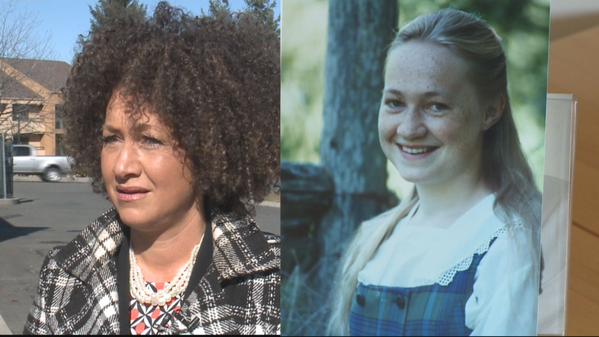
White people are allowed to join the NAACP (especially in Spokane, Washington, where there aren’t all that many black people to begin with). They are even allowed to hold office in it, and sometimes they do. But deception is a no-no. However, that’s not the worst of Dolezal’s probable deceptions. She appears to be quite the fabricator, and although her level of detail isn’t in the Stephen Glass-ish range, she’s pretty creative and prolific:
To get the whole story, read this article, but here are some excerpts:
Dolezal, a multi-media artist, professor of Africana studies at Eastern Washington University and former instructor at North Idaho College in Coeur d’Alene, has reportedly made similar ethnicity claims to local media outlets. In recent years, she has portrayed herself physically, and on social media platforms, as a woman of black African-American heritage.
However, her parents, Ruthanne and Larry Dolezal, who are both white and live in the Troy/Libby area in Montana, told The Press their daughter is not African-American. They backed up the claim with a copy of their daughter’s birth certificate and photos. The images show a younger, pale, blonde-haired, blue-eyed Dolezal who looks much different than the woman with caramel-colored skin now leading the Spokane NAACP and helping review claims of police misconduct in that city.
“Rachel is very good at using her artistic skills to transform herself,” Ruthanne said in a recent telephone interview…
n a February issue of the Easterner, EWU’s student-run newspaper, Dolezal reportedly told a reporter that the man who raised her with her mother is her stepfather. In January, a photo of Dolezal and a black man appeared on the Spokane NAACP’s Facebook page with the message: “President Dolezal’s father announced today that he will be coming to town for January 19th ribbon-cutting ceremony for the NAACP office … and is expected to speak at the 7 p.m. MLK tribute membership meeting.”
But the man in the photo is not her father. The person in the photo is Albert Wilkerson – a black man who lived in North Idaho and volunteered at the Human Rights Education Institute several years ago when Dolezal was in charge of the organization’s education programs. A similar picture was posted on Dolezal’s personal Facebook page in December, with a comment made from Dolezal’s account on the social media platform: “L-R: Me, my oldest son Izaiah, and my Dad.”
Dolezal’s mother said she has never met Albert Wilkerson and Rachel does not have a stepfather. She said her daughter’s father is Larry Dolezal, a former Lincoln County Commissioner in Montana. Ruthanne and Larry just celebrated their 41st wedding anniversary on Monday, she said.
“Anybody who lives in the town of Troy or Libby knows that Larry is her father,” Ruthanne said.
Wilkerson, who has since moved away from the area, could not be reached for comment.
Dolezal’s birth certificate filed in Lincoln County, Montana in 1977 states that Ruthanne is her mother and Lawrence Albert Dolezal is her father.
Ruthanne also clarified that Izaiah, who Dolezal often says is her son, is actually Dolezal’s adopted brother. Between 1993 and 1995, Ruthanne and Larry adopted four black infants: Ezra, Izaiah, Zachariah and Esther.
The story is pretty Byzantine, but it also involves a great many allegations by Dolezal of hate crimes against her, mainly involving nooses placed on her property and that sort of thing—that for various reasons are now considered to be highly suspect allegations.
Dolezal is, of course, denying that she’s done anything wrong. But she has a funny way of doing so:
KREM 2 asked to address the public sentiment that she misrepresented her race.
“I can understand that. And like I said, it’s more important to me to clarify that to the black community, and with my executive board, than it really is for me to explain it to a community that I quite frankly don’t think understands the definitions of race and ethnicity,” said Dolezal.
Her parent’s explanation for her behavior seems as good as any, at least in the psychological sense:
Ruthanne and Larry Dolezal said their daughter has always identified with the African American culture and had black siblings who were adopted. They said she went to school in Mississippi and was part of a primarily African American community.
The Dolezal’s said Rachel married and later divorced a black man. They said after the divorce in 2004 Rachel began identifying differently. She started claiming to be partially African American and the daughter of bi-racial parents. They said they have noticed her change in physical appearance but do not know how she did so.
“Rachel has wanted to be somebody she’s not. She’s chosen not to just be herself but to represent herself as an African American woman or a biracial person. And that’s simply not true,” said Ruthanne Dolezal.
The Dolezal’s said they do not have a problem with Rachel advocating for a civil rights group for African Americans, rather that she is being deceptive about it.
Rachel’s parents said she distanced herself from them and has not talked to them recently…
Rachel said she does not consider her biological parents her real parents.
That’s the psychological part, which I believe is true. But there’s also a practical part: getting perks (jobs, appointments, attention) that she otherwise wouldn’t have had access to.
Quite a few people have made analogies to the Bruce/Kaitlin Jenner transformation. After all, both are cases of a person feeling and/or thinking that he/she is something he/she is not, or at least was not at birth.
It’s true, for people who look physically as though they could be either white or black, that a racial identity really is to a certain extent a constructed identity, a matter of self-identification. In the biological sense, race is a cluster of traits (such as dark skin) which exist on a continuum within a race with no definite dividing line, and also exist across races—for example, there are Caucasians with far darker skin than many American blacks.
But someone such as Dolezal, who was born to white parents and is genetically white but is clearly trying to give the impression that she is black in more than the “constructed narrative” sense, has apparently been perpetrating a deception. The analogy to Jenner, who is not being deceptive and who acknowledges having been born biologically (and genetically) male, breaks down.
[NOTE: One thing I wonder is how Dolezal thought she could keep this secret forever. Did she think her parents would never speak up? Or did she think they would not be believed if they did?]