↓
 

The New Neo

A blog about political change, among other things

  • Home
  • Bio
  • Email
Home » Page 1038 << 1 2 … 1,036 1,037 1,038 1,039 1,040 … 1,934 1,935 >>

Post navigation

← Previous Post
Next Post→

News of the day, fashion of the day

The New Neo Posted on August 29, 2016 by neoAugust 29, 2016

Terrible presidential candidates continue to do terrible things.

Anthony Weiner has another Weiner incident, and his wife Huma says she’s finally leaving him (for now, anyway).

Everybody talks about it all.

That’s about it.

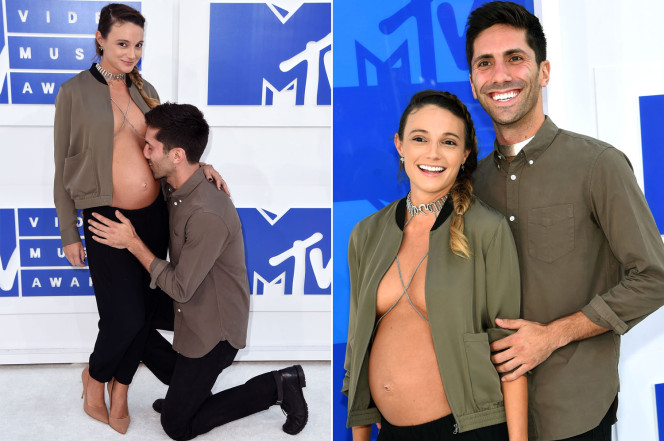
Oh, and then there’s the really important news, lead story on Yahoo home page today: this lovely fashion which appeared at the MTV Awards on some pregnant person named Laura Perlongo, who is the fiancee of some actor/producer named Nev Schulman who was the somewhat hapless focus of the movie “Catfish”:

Perlongo

If you are asking “who on earth is Laura Perlongo?” the answer is pretty much “Nev Schulman’s pregnant fiancee who dispensed with her shirt at the MTV Awards.” And if you’re asking “who is Nev Shulman?” the answer is pretty much “the Catfish guy whose pregnant fiancee…etc. etc..”

And if your real question is “why the **** should I care?”, my answer is that maybe you shouldn’t. And if your question is “Then why are you featuring it?” my answer is that (a) it’s better than talking about Trump and Hillary every single day; and (b) it’s another symptom of the decline in societal standards of propriety, as well as the ascent of a bizarre sort of body narcissism.

Sometimes that narcissism is combined with a focus on the nastily-named “baby bump” as a kind of trophy to display (I wrote about the phenomenon here, and also about post-preganancy baby “bumps” here).

And if you think there’s some connection between all the things in this post, you’re probably right.

[NOTE: By the way, about the grammar of that last sentence—yes, I know that “between” is used for two and “among” for more than two. But it seemed to me that after the word connection, “among” doesn’t quite work. I tried to look it up and didn’t find a definitive answer. So I went with my gut—as it were.]

Posted in Fashion and beauty, Pop culture | 27 Replies

The greatest makeovers

The New Neo Posted on August 27, 2016 by neoAugust 27, 2016

I’m here to announce another vice. This is a new one, although it also involves an old one—YouTube video chain-watching.

Chain-watching is when you go from one video on a topic to another, sort of like eating a bagful of potato chips. Suddenly you look up from your computer and it’s 3 AM.

My latest discovery is a guy who does makeup and hair makeovers, mostly of middle-aged women, although some are older and some younger. Now, this may not sound very interesting to most of you, but it’s more interesting than it seems, truly. And it’s very interesting to me—not only because I’m a woman of a certain age, but because I’ve always loved makeovers. They’re part of my fascination with change, be it of mind or emotions or body. The first type of change, mind, explains my fascination with political change. The second, emotions, is probably what drew me to training to be a therapist. And the third involves things like these makeovers.

Even as a teenager I had a strong interest in hair and makeup. I don’t think my parents knew what to make of it in such a bookish child, although I had other strong interests as well that vied with my academic bent—dance being one of them, of course. But I was so into hair and makeup that I used to cut out photos from magazines and make a little scrapbook, the only scrapbook I can ever remember making, and in high school and then in college I had a small side business of making up my friends and cutting their hair, for special occasions.

My parents discouraged me, but I persisted. Now with YouTube, the field has greatly proliferated, and these makeover videos are part of the fruit. The ones I’ve been watching are by someone called The Makeover Guy, and every now and then I may present some of my favorites here. The thing about these videos is that the physical transformation is only a small part of it. The truly gripping aspect (to me, anyway) is the transformation in these women’s affect. You can see them come to life and bloom before your eyes. It’s not just about vanity, either. It’s about people treating them like they matter, and about them getting a sense of heretofore undreamed-of possibilities.

I also find that most of the women in the videos are really, really likeable as people. The videos have the advantage of being quite short, too (the better to chain-watch, my dear):

Posted in Fashion and beauty, Getting philosophical: life, love, the universe, Me, myself, and I, Pop culture | 35 Replies

Winning at Monopoly

The New Neo Posted on August 27, 2016 by neoAugust 27, 2016

Here’s an article that purports to tell you how to win at Monopoly. It has a lot of stuff that anyone who’s played much Monopoly already knows: orange and green properties are good, for example, and nobody lands on Boardwalk much.

How that transfers to strategy I’m not sure. It’s not like anyone shuns owning the orange properties, do they? But you can’t always get what you want, in Monopoly as well as life or Rolling Stones songs.

I used to play a great deal of Monopoly when young. A great, great deal—when we weren’t playing cards or hopscotch or jacks or engaged in jumping rope. That’s what we did—oh, and also that bouncy ball game girls play that went “A my name is…”. In those days, when the internet was hardly a gleam in anyone’s eye and even TV had just a few channels (and in the after-school afternoons they were devoted mostly to soap operas—BORing!), we played games and those were our favorites.

I used to play these games with a neighbor—we’ll call her “Sue”—who was about my age. Actually, she was five months older, as she used to tell me archly and often because it conferred some sort of superiority on her. Sue always won at Monopoly. You may think that to be hyperbole—always? Surely not always!

Yes, always. She had her own never-fail formula. I used to wonder what it was; I still don’t know. Others suggested it involved cheating. But if it did I never detected a particle of it. As far as I could tell it involved unbounded confidence in herself, a confidence that was displayed in every other aspect of her life and which I didn’t share about myself. Can the conviction that you will always win every game you play be responsible for actually winning every game? Even in a game such as Monopoly, that is mostly chance?

Dunno. I merely report: Sue always won. She later became a bigshot lawyer, and I think she usually wins there, too. We’re still friends, but we don’t play Monopoly anymore.

Posted in Me, myself, and I, Pop culture | 20 Replies

Do you ever think…

The New Neo Posted on August 27, 2016 by neoAugust 27, 2016

…that we’ve reached the end of what there is to say about Hillary Clinton and Donald Trump?

I realize that there’s always more, of course. Time doesn’t stand still. Things happen. Words come out of their mouths. New gaffes, new outrages, new lies, new accusations. New polls. New events in the world.

But in some essential way, although the subject of the personalities of these two people feels mined out, excavated, fully explored, the fact that these are the two choices facing America for the next four years still feels altogether new and altogether unbelievable, as well as altogether unacceptable.

Perhaps that’s the reason we continue to talk so much about it, and by “we” I mean everyone: newspapers, magazines, books, talk shows, blogs, Twitter, and Facebook, all around the world. Sometimes it seems that there’s no other news to be had, although if one digs for it, the world still goes on in the same old way irrespective of the Big Two.

American presidential elections always get a lot of attention. But this year is unlike any I can ever remember before in the utter dominance of the story and the depth of perplexity, frustration, and depression most people feel.

Posted in Election 2016 | 86 Replies

Today is National Dog Day

The New Neo Posted on August 26, 2016 by neoAugust 26, 2016

Give your pet an extra hug.

I have a friend who’s putting his dog down today, and this photo-essay touched me.

I’ve always loved dogs, although I’ve only owned two in my life. Even as a young kid who could barely toddle around on her fat little legs, I gravitated towards them fearlessly, as documented in many photos and movies where I’m chasing after a dog in order to pet it. But my parents had no such positive feeling for them and didn’t want one, so for a long time we didn’t own a dog despite my begging.

Then we won the equivalent of the dog lottery. I still remember the glorious moment: I was eight years old, my brother had been allowed to place a hopeful quarter (a whole quarter!) on a number at a fair, and we won the darned thing. That meant my astonished and subdued mother got to take home a small terrier/chihuahua cross, a dog particularly unsuitable for our already dog-unfriendly home. No one trained it properly—no one knew how, and I certainly hadn’t a clue either—and a couple of months later the dog was given away to someone with more patience and more land. I never stopped hoping for a replacement, although I finally gave up asking for one when I realized it just wasn’t going to happen.

Later—interestingly enough, when my son was also eight—my husband and I got a dog. We’d done a lot of research and came up with a non-shedding cockerpoo, a dog with a great temperament who lived for a long time but alas, is now deceased. He was a real sweetheart. I don’t have a photo of him in his prime, although many exist—my ex-husband is the keeper of the photos.

But here is one I do have. It was taken on the last day of our dog’s life, and he is being held in my then-husband’s arms on his final visit to the vet:

DogDays

Posted in Me, myself, and I, Nature | 16 Replies

How can you tell when a campaign is ahead (and more on polls and Shy Tories)?

The New Neo Posted on August 26, 2016 by neoAugust 26, 2016

In yesterday’s post on how to tell when a candidate’s losing, commenter “Ackler” posed an interesting question:

I agree, Neo, that yard signs and campaign crowds are of little relevance (although this year is utterly atypical and should make everyone pause). My question is: what, besides polls, do you take as a sign a campaign is winning? You’ve offered a detailed explanation as to how to tell if a campaign is losing. The reverse?

My answer: it’s the other campaign that’s winning, the one that isn’t making those excuses.

I’m not just being facetious. It really does seem to boil down to that as being the best answer. The absence of those excuses and rationalizations (for example, the “I’m not seeing many bumper stickers for the opponent” excuse, and/or the skewed polls excuse) is a sign of being in the lead.

But other than that, the polls are the best indicators we have. Despite their flaws, they are (as I said in that post) fairly good predictors if you look at averages over time.

I’m always rather astonished at how many people seem to make the same mistakes over and over about this (although I certainly understand the need to rally the sagging troops). Don’t people get tired of talking about skewed polls and crowd enthusiasm? More to the point, don’t their listeners remember how many people talked about that in 2012 for Romney, and how wrong they all were?

Of course polls can be skewed, especially in the sense that turnout is impossible to predict from year to year. But most reputable mainstream pollsters try their best to predict outcomes accurately, particularly in the last few months and weeks of a campaign, because their reputations go down if they don’t predict accurately and consistently. They want to get it right. So they use algorithms to predict turnout (it’s my understanding that each pollster has his/her own) based on things such as turnout last time, changes in party registration from year to year, and querying the respondents as to their intentions and enthusiasm.

If polls are later found to be “off” in terms of party percentages, it may be because the turnout that election cycle was unusual in some way. That certainly might happen in this very very odd year—but in what direction? That’s the million-dollar question. For example, many people who don’t usually vote could come out this year because of Trump enthusiasm, or an unusual number of people could come out for the express purpose of stopping Trump. And none of this has much to do with the enthusiasm of his crowds (which constitute, after all, a small number of actual voters, however large they might be, and don’t measure the less-enthusiastic who nevertheless vote), or the number of signs on lawns. We’ve heard that sort of thing in election after election. But have you noticed that ordinarily you only hear it from the losing side?

In the post I wrote yesterday on which Ackler commented, I also mentioned the Shy Tory factor. Here’s a description:

Shy Tory Factor is a name given by British opinion polling companies to a phenomenon first observed by psephologists in the 1990s, where the share of the vote won by the Conservative Party (known as the ‘Tories’) in elections was substantially higher than the proportion of people in opinion polls who said they would vote for the party. This was most notable in the general elections of 1992 and then 2015, when the Conservative Party exceeded opinion polls and comfortably won re-election.

In this election, I’ve read many claims that there is probably a similar thing going on with Trump voters, a sort of “Shy Trumper” effect. Although the term may seem an oxymoron for people who supported Trump at the outset—they seem not the least bit shy to me—it certainly could describe those who are reluctant Trump voters. We have no way of knowing about their numbers, but my guess is that it’s a small factor if it exists at all. The only evidence I’ve found so far actually points in the opposite direction—you might say to an “extroverted Tory effect”:

In Republican primaries and caucuses, the polls generally had a pro-Trump and anti-Cruz bias. In races where Trump and Cruz were the top two finishers in some order, the bias was 5.5 percentage points in Trump’s favor. The bias dissipated as the race went along, and there wasn’t as much of a bias when another candidate ”” John Kasich or Marco Rubio ”” was Trump’s main competitor in a state. Still, the primary results ought to raise doubts about the theory that a “silent majority” of Trump supporters is being overlooked by the polls. In the primaries, Trump was somewhat overrated by the polls.

I’m not sure how much to make of that—after all, it was the primaries and not the general. But it certainly casts doubt on any Shy Tory effect being a pro-Trump factor in this particular election.

Posted in Election 2016 | 48 Replies

More on the question of whether gay or transgendered people are born that way

The New Neo Posted on August 26, 2016 by neoAugust 26, 2016

This old question has been in the news again recently because of the publication of a massive study on the subject that’s just been published, written by two Johns Hopkins affiliated professors, Laurence Mayer and Paul McHugh, that says there’s little to no scientific evidence that people are born with those traits.

If you want to read the entire article—it’s long—the whole thing can be found online here

A few points I’ll make at the outset:

(1)) Anyone who’s followed research in the field should already know that the evidence for an absolute biological genetic cause for either of the phenomena is murky, but that there has been strong evidence of a genetic contribution that is not trifling. That evidence has come from twin concordance studies (particularly concerning homosexuality), which I’ve already written about at some length in the addendum of this post.

So I fail to see how this Johns Hopkins article is news, but I suppose it is news in the sense that there are a lot of people politically devoted to a less nuanced point of view on either side, and the ones who are into strict heritability of the traits will be up in arms.

(2) McHugh is a psychiatrist at Hopkins who has previously written similar articles, particularly about the treatment of transgendered people. I wrote about one of these articles before here. Hopkins was a pioneer in sex-reassignment surgery and has since backed off from doing it because of problems with poor outcomes, and McHugh is nothing if not a controversial figure as a result.

I haven’t read the entire article, which is 143 pages long, but I immediately went to the section on sexual identity and then scrolled down to the portion on twin concordance. There I found this:

One powerful research design for assessing whether biological or psychological traits have a genetic basis is the study of identical twins. If the probability is high that both members in a pair of identical twins, who share the same genome, exhibit a trait when one of them does ”” this is known as the concordance rate ”” then one can infer that genetic factors are likely to be involved in the trait. If, however, the concordance rate for identical twins is no higher than the concordance rate of the same trait in fraternal twins, who share (on average) only half their genes, this indicates that the shared environment may be a more important factor than shared genes…

…[W]ell-designed twin studies examining the genetics of homosexuality indicate that genetic factors likely play some role in determining sexual orientation. For example, in 2000, psychologist J. Michael Bailey and colleagues conducted a major study of sexual orientation using twins in the Australian National Health and Medical Research Council Twin Registry, a large probability sample, which was therefore more likely to be representative of the general population than Kallmann’s.[33] The study employed the Kinsey scale to operationalize sexual orientation and estimated concordance rates for being homosexual of 20% for men and 24% for women in identical (maternal, monozygotic) twins, compared to 0% for men and 10% for women in non-identical (fraternal, dizygotic) twins.[34] The difference in the estimated concordance rates was statistically significant for men but not for women. On the basis of these findings, the researchers estimated that the heritability of homosexuality for men was 0.45 with a wide 95% confidence interval of 0.00”“0.71; for women, it was 0.08 with a similarly wide confidence interval of 0.00”“0.67. These estimates suggest that for males 45% of the differences between certain sexual orientations (homosexual versus heterosexuals as measured by the Kinsey scale) could be attributed to differences in genes…

…a heritability estimate of 0.45 does not mean that 45% of sexuality is determined by genes. Rather, it means that 45% of the variation between individuals in the population studied can be attributed in some way to genetic factors, as opposed to environmental factors…

…[In another study, the] values indicate that, while the genetic component of homosexual behavior is far from negligible, non-shared environmental factors play a critical, perhaps preponderant, role. The authors conclude that sexual orientation arises from both heritable and environmental influences unique to the individual, stating that “the present results support the notion that the individual-specific environment does indeed influence sexual preference.”

I could go on—the article certainly does—but I’ve not read most of it yet and so I’ll stop there. Suffice to say that I fully expect the answer to be some variation on the theme “it’s nature and nurture, and we don’t know the exact combination of each.” Which would make these things not so very different from many many other things in life, and somewhat of a mystery, which is where I’m at on it.

That makes me a non-militant on the subject. But I find it rather fascinating, and also somewhat irrelevant in that I think the issue of the rights of each group is separate from the issue of the traits’ heritability. That last bit puts me quite in the minority, I think, because a lot of people are invested in the question of heritability because they believe that the question of rights depends on it.

[NOTE: I’ve already opined on my stance on gay heritability and rights, and also about transgender treatment policies here, here, and here.]

[NOTE II: There’s a great deal more research on twin concordance in gay people than in transgendered people. I believe that’s because the first subject has been studied for a longer time, but more importantly because it is far more common in the population and therefore it is easier to find experimental subjects. The McHugh article cites only one twin study on transgenderism, as far as I can tell, and that one is a case study involving two cases, which can tell us little about anything but those cases.

I was unable to find good studies on the subject; in a quick Google search, this was about it, and I’m not sure how reputable a study that is, although the results seem to fall into a similar camp to those of the gay studies on twin corcordance. At any rate, we already know that identical twin concordance for transgenderism is far from perfect, as evidence by the photos in this post of mine.]

Posted in Health, Men and women; marriage and divorce and sex, Science | 22 Replies

Do people learn from their mistakes?

The New Neo Posted on August 25, 2016 by neoAugust 25, 2016

In the electoral/political sense, that is?

I think it’s very very rare. Or rather, they think they learn, but all too often they learn the wrong thing. In order to really learn from one’s mistakes and to correct them properly, a person must identify the true cause of the error, and be inclined and able to make the change.

That’s a very very tall order, believe me, and even with help (therapy, for example, in personal life) a lot of people can’t do it, because people are naturally resistant to changing their points of view, their way of thinking, their allegiances, and their own behavior.

Believe me, I know. And you probably do, too.

I have long fought with the “burn it down” people, for example, for the simple reason that they think that once things go all to pot, voters will somehow blame the proper culprits and gravitate to their preferred side. I see that as hubris and destructive thinking, but it’s widespread enough to have helped us to get candidate Trump this year and the possible destruction of the GOP (which many people celebrate).

I have also long fought with the “vote for the person you like least, put the Democrats in charge, let things slide, and voters will recognize how bad the left is and elect people on the right to fix it” crowd. Same problem. People do not necessarily draw the same conclusions that someone on the right does, when faced with the very same situation. It is clear that if a party is in power when something bad occurs, it’s people on the other side who tend to conclude it’s the fault of the party in power (people who were predisposed to think so anyway), and people on the same side are likely to rationalize it away and blame the opposition.

Except for a certain segment on the right who will blame the GOP for everything that happens, including failing to stop the left from whatever they are doing.

That’s just one problem; there are more.

Sometimes people accurately identify the problem and the cause, but can’t find a solution.

Sometimes people accurately identify the problem and the cause and the solution, but can’t execute it.

And sometimes people do all that, but—like the proverbial generals who are always fighting the last war and not the one they now face—the circumstances change in a previously unforeseen way, and the solution that would probably have worked the last time is no longer the right solution.

I don’t mean to say it’s impossible to learn from mistakes and to correct them. It’s possible. It’s just hard hard hard and challenging work.

Posted in Getting philosophical: life, love, the universe, Politics | 143 Replies

Polls, Florida, Trump, and the black vote

The New Neo Posted on August 25, 2016 by neoAugust 25, 2016

Polls in Florida can be used to illustrate the idea that Trump is staging a huge comeback, or that he’s hopelessly behind. There’s one that says he’s doing pretty well there (2 points ahead of Hillary) and two others that put him far behind her in a cloud of dust (losing by 9 and 14 points).

So, what’s a person to think? As I’ve said before, the best predictors are poll averages over time. And the averages get even more predictive as one gets closer to voting day, although averages over time will tell you the general trends. The poll showing Trump doing well in Florida is somewhat of an outlier at the moment, and only time will tell if it’s the beginning of a new and possibly meaningful trend back to a competitive race there. Till then, it will function as something that Trump supporters cite in order to shore up the Trump troops.

One of the most interesting results of the Florida poll showing Trump ahead is that it also shows him as having 20% support among black voters. But it’s always good to look more closely at what a figure like that actually represents, and how large the black sample was. Unfortunately, I can’t seem to locate the most detailed report of the poll, but this piece says that it questioned 1200 likely voters. If we’re trying to figure out how many black voters were queried, let’s be very generous and say it might have been 15%, which would have been 180. Twenty percent of 180 is 36. So, that would mean that 36 black people in the poll said they would vote for Trump (and the number would have been even smaller, if less than 15% of the poll respondents were black).

You can see that we’re dealing with a large margin of error here for reporting on the black voters, because of the small numbers involved. That’s true of a lot of polls, as it turns out.

One more thing. People assume that 20% would be an awful lot of black support for the Republican, if it were true. And I agree it would be impressive, although I’m not at all sure it’s true (and it is an outlier result compared to the trend of other polls on Trump’s black support, but let’s put that aside for the purposes of this discussion). In articles I’ve seen that discuss this new Florida poll and the 20%, the figure used for Florida comparisons is Obama’s 95% to 4% showing in Florida among that group. But that seems entirely the wrong comparison to me, because Hillary Clinton is not Obama—in many senses, but what’s particularly relevant is that she’s not black.

It seems to me that a better figure to use to compare would be the stats from the last time a black person was not on the presidential ballot, which brings us to ancient times: the 2004 election. And you may be surprised to learn (as was I, by the way) that George W. Bush received 13% of black votes in Florida that year.

That would be the baseline Trump would need to beat to be doing better. And in that poll I mentioned where Trump got 20% support from blacks, the difference between 20% and 13% would be (assuming as I did earlier that 180 black voters were questioned) 36 versus 23 supporters out of 180. I wouldn’t put all that much weight on differences of that magnitude.

Now, you may say “neo, you’re just trying to put down the poll because you don’t like Trump.” No, I’m not; you won’t find a lot of false optimism on this blog for candidates I like or false pessimism for ones I don’t. That’s my goal, anyway, and I think I reach it most of the time. Furthermore, in this case I don’t like either candidate and would love for someone else to win (not gonna happen, I know). So it’s not that Trump’s defeat would fill me with joy. It most definitely would not. It’s just that neither candidate’s victory fills me with anything but despair. So one could argue that I’m probably one of the more objective folks around when looking at their chances (and yes, I know that one of them is virtually certain to win, barring a black swan of extremely major proportions)—an elephantine black swan, if you like).

Posted in Election 2016, Race and racism | 21 Replies

The history of the lobster roll

The New Neo Posted on August 24, 2016 by neoAugust 24, 2016

I didn’t even know what a lobster roll was till I moved to New England, which was many decades ago. But I’ve never become a convert, although I’m well aware they’re a very popular item. You can hardly drive anywhere in New England, particularly in summer, without seeing stands all claiming to have the best one, or the most inexpensive one, or the biggest one, or all three.

But give me a lobster in the shell any day. I’ve got that Yankee ethic (adopted) that you should be willing to work for your lobster, not have it served up to you laced with gobs of mayo and stuffed into an insipid envelope of white bread.

Where I live, you can sometimes go to a stand and get two cooked chicken lobsters (that’s one-pounders to you folks from away) for between 15 and 19 dollars, with cole slaw. Why should I pay as much for a lobster roll that I can scarf down in almost two seconds flat? I like to draw out my eating pleasure, and a lobster in the shell certainly makes the eating take longer, and helps you to savor you meal.

Plus, I just like that red shell.

When my mother moved to New England she was almost ninety, and she always preferred a lobster roll. I forgave her due to her advanced age, although we were always willing to help her with a real lobster. But she insisted on the roll. I also once had a boyfriend who had a horror of lobsters—he said they were just big bugs—and preferred to see them out of their shells so he wasn’t reminded of the buggy nature.

Here’s an article from Downeast that goes into the history of the lobster roll:

A hundred years ago, nobody had even heard of a lobster roll ”” not even in Maine. According to John F. Mariani’s revered Encyclopedia of American Food and Drink, the phrase first appeared in print in The New York Times in 1937, and Mariani name-checks possible progenitor restaurants in Milford, Connecticut, and Long Island, New York (though our chats with lobster roll cognoscenti suggest there’s more to the story).

BrevityFor most of the 20th century, a smattering of New England restaurateurs hawked the dish in relative obscurity. Then, at the tail end of the ’90s, a tiny restaurant in Manhattan, Pearl Oyster Bar, transformed the once-humble lobster roll into an object of culinary obsession ”” and a fleet of eager chefs, hyper-productive Maine fishermen, and savvy New York editors took over from there. By 2006, Bon Appétit had dubbed the lobster roll the dish of the year. It graced the cover of Gourmet in 2009. A 2010 New York magazine feature proclaimed its utter conquest of NYC, even as the lobster roll popped up on menus coast to coast, arguably usurping the classic shore dinner as Maine’s quintessential dish.

There’s much more at the link. Enough to tell me that no one knows where it really originated, and that it’s of relatively recent vintage. The article is in a magazine that promotes Maine, so it emphasizes the lobster roll as a Maine icon, but my experience is that it ranges far and wide and that Maine’s claim to it isn’t really all that valid.

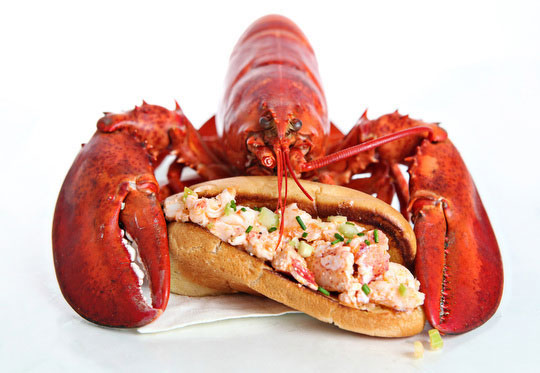
Also, what’s with the celery bit? To me, lobster rolls don’t have celery. Too crunchy; ruins the smoothness and succulence. I’m putting up a photo that includes celery, but only because I like the rest of it, for obvious reasons:
lobsterroll

Lobsters are sometimes cannibals, you know.

Posted in Food, Me, myself, and I, New England | 34 Replies

Trump’s “softening”on immigration: why is this considered news?

The New Neo Posted on August 24, 2016 by neoAugust 24, 2016

I repeat: why is this considered news?:

Republican presidential nominee Donald Trump said Tuesday he is open to “softening” laws dealing with illegal immigrants in a “Hannity” town hall with Fox News’ Sean Hannity.

His remarks were the latest sign he is considering softening a position he has taken since the onset of his campaign.

Hannity asked Trump if he would change current parts of the law to accommodate law-abiding citizens or longtime residents who have raised children in the U.S.

“There could certainly be a softening because we’re not looking to hurt people,” Trump answered. “We want people — we have some great people in this country.”

He also said he wanted to follow the laws on immigration policy instead of creating new ones.

Anyone who has followed Trump knows that he’s been all over the place on immigration, both historically (pro-amnesty, pro-Dreamers) and even recently (touchback immigration, letting the “good ones” back in). I documented much of the phenomenon on this very blog, and I was hardly the only one (just a few examples: on the visa program, on how deportation is “negotiable,” on amnesty).

Anyone who has paid attention to what Trump has actually said on the subject ought to know that he is a shape-shifter, and that all his positions are mutable. He said whatever needed to be said to win the nomination, and now he’s saying what he thinks needs to be said to win the election. All politicians do that to a certain extent, but the difference between Trump and them is that he does it more often and on more topics, and (unlike them) he has no political record to let us know what he’s more likely to do.

There have been many myths told about Trump and immigration, but they all seem to ignore that simple fact. Another myth about Trump and immigration is one I wrote about extensively back in the fall, which was the assertion that Trump was “the only one talking about immigration” or “the only one talking tough on it.” No, and no. But hey, it helped get him nominated, right?

Posted in Election 2016, Immigration, Trump | 27 Replies

How can you tell a campaign is way behind?

The New Neo Posted on August 24, 2016 by neoAugust 24, 2016

This post may seem to be about Donald Trump’s campaign, and it certainly was sparked by things I’ve been noticing about that campaign. But my aim is to describe some phenomena I’ve noticed over the years about campaigns in general, and how you can usually tell when a candidate is going to lose.

Not always. Sometimes there are surprises, and that’s what helps to feed the myths that candidates and campaigns and supporters tell themselves to shore up optimism and keep the energy flowing. But surprises are just that— surprising, and also unusual.

Take polls. They are often flawed, of course, but you know what? The averages of polls tend to have good predictive value. If a candidate has been consistently losing—and in particular, losing in almost all the polls, and losing by amounts outside the margins of error, and losing over time—it becomes easier and easier to have more and more confidence in making the prediction that the candidate will be losing the election.

I have a fairly good track record with election predictions, as it turns out, although I’m not perfect at it (and I often don’t make them, or don’t make them publicly). But, for example, I didn’t fool myself with Romney, and although I thought he had a chance of winning I never was optimistic about it. I was almost certain McCain would lose. With Bush I couldn’t really tell, and his two elections were remarkably close and so they really were difficult to predict.

Readers of this blog are probably aware that I’ve been very consistent in predicting a Trump loss, and probably a decisive one. Now, that doesn’t mean it couldn’t change. There is still time, although time is getting short and the only way I see it as happening is if there is some revelation about Hillary Clinton so extraordinarily dreadful that even her staunchest supporters would have trouble pulling that lever for her. It is hard to imagine what that thing might be, but I concede there might be something (Hillary is just that awful).

This prediction of mine that Trump will lose has nothing to do with who I want to win, either. In the case of this election, the thought of either candidate winning is sickening, and yet it will probably happen that one will be our next president. I have already said I will not be voting for her, and that I don’t know if I can vote for him.

But again, this post isn’t mainly about Trump vs. Hillary. It’s about the signs of a losing campaign, chief among them that spokespeople and columnists and bloggers and blog commenters who support the candidate talk about the following:

(1) Polling is constantly questioned. In particular “skewed polls” are cited, and the poor showing of this particular candidate is explained away as poor polling methods, period. Methodology is criticized incessantly and obsessively (including landlines vs. cellphones, response rates, etc.), and the averages that point in a single losing direction are said to be invalid or are ignored.

(2) This or that anomalous election of the past is brought up and cited (often incorrectly[*see below]). For example, if there was a time when a certain candidate was doing poorly up to a week or two before the election and then a reversal occurred and the candidate won, that’s the one that’s talked about. The fact that it constituted a very rare exception, or that it featured special circumstances that don’t appear to be currently present, is ignored.

(3) The Bradley effect or something similar is cited, even though it’s not at all clear that something like that is operating and there’s not even any evidence for it. When I say “the Bradley effect or something similar” I’m not limiting it to elections where race is a factor, I’m referring to the idea that people lie to pollsters about their true intentions for any number of reasons (including the Shy Tory factor).

(4) Way too much emphasis is placed on crowds and crowd enthusiasm. As I’ve written before, crowds are no measure of anything except the fervor and gregariousness of the candidate’s supporters and how eager people are to see him or her in the flesh. Losing candidates often draw very large and enthusiastic crowds, right up to the day those candidates lose.

To go from the general to the specific, the Trump campaign has been showing strong signs of all these phenomena. Trump has nearly always been behind in the polls, and the gap between the two candidates is getting worse. Not only that, but the state polls in swing or target states are getting worse for Trump as well. As I said before, this doesn’t mean it couldn’t change for the better, because this election is nothing if not strange. But beginning last summer I observed that Trump’s chances of winning were not just poor, but very poor, and that he was the GOP candidate least likely to beat Hillary rather than most likely.

Trump supporters have always disagreed vociferously with that assessment. It’s unprovable who is correct, because we don’t have an alternate history in which to test out all the other candidates. When I point to polls, they debunk them. But debunking polls—although that sometimes turns out to be correct—is to ignore the fact that the polls usually predict elections fairly accurately.

Another thing Trump supporters often say is something on this order: well, you were wrong about Trump being the nominee, and you’re wrong now. Although that was indeed true of a lot of people, I wrote about a year ago, in August of 2015, that I took his candidacy very seriously and that I saw him as having a very real chance of winning, a prospect that alarmed me in part because I thought he would lose the general. So my fear, nearly from the start, was that he did have a good chance of winning the nomination and also a very good chance of losing the election.

That last fact is something a great many Trump supporters have ignored, which is that one of the objections a lot of people on the right had to Trump is that they thought (and still think) he would be a weak candidate in that he was unlikely to win the general election. An extremely vulnerable opponent—Hillary Clinton—gave the right a golden opportunity to defeat her, and the Republican primary process appears to have led the party straight to the election of Hillary Clinton.

If no tremendous August, September, October, or early November Surprise occurs, I don’t think there’s any amount of anti-poll pep talk or rallying the GOP troops that can change that sad reality.

Sorry to be such a downer.

[NOTE: * One of the campaigns often cited by people on the right is Reagan in 1980. The claim is that Reagan was losing till the very last weeks, when he overcame Carter. If true, that would be unusual. But actually, it’s not even true—see this. Reagan had been ahead for a long time, and he merely widened his lead.]

Posted in Election 2016, Hillary Clinton, Trump | 105 Replies

Post navigation

← Previous Post
Next Post→

Your support is appreciated through a one-time or monthly Paypal donation

Please click the link recommended books and search bar for Amazon purchases through neo. I receive a commission from all such purchases.

Archives

Recent Comments

  • om on This type of ed is special, all right
  • AesopFan on This type of ed is special, all right
  • AesopFan on Trump says his deportation program might have been too tough
  • AesopFan on Open thread 11/11/2026
  • AesopFan on Open thread 11/11/2026

Recent Posts

  • News roundup
  • Veterans Day; Armistice Day
  • Open thread 11/11/2026
  • The refinery issue
  • This type of ed is special, all right

Categories

  • A mind is a difficult thing to change: my change story (17)
  • Academia (330)
  • Afghanistan (98)
  • Amazon orders (6)
  • Arts (8)
  • Baseball and sports (164)
  • Best of neo-neocon (91)
  • Biden (536)
  • Blogging and bloggers (599)
  • Dance (292)
  • Disaster (244)
  • Education (329)
  • Election 2012 (360)
  • Election 2016 (566)
  • Election 2018 (33)
  • Election 2020 (514)
  • Election 2022 (114)
  • Election 2024 (403)
  • Election 2026 (125)
  • Election 2028 (14)
  • Evil (130)
  • Fashion and beauty (324)
  • Finance and economics (1,054)
  • Food (319)
  • Friendship (48)
  • Gardening (18)
  • General information about neo (4)
  • Getting philosophical: life, love, the universe (737)
  • Health (1,169)
  • Health care reform (546)
  • Hillary Clinton (184)
  • Historical figures (338)
  • History (720)
  • Immigration (452)
  • Iran (467)
  • Iraq (227)
  • IRS scandal (71)
  • Israel/Palestine (836)
  • Jews (445)
  • Language and grammar (365)
  • Latin America (216)
  • Law (2,997)
  • Leaving the circle: political apostasy (125)
  • Liberals and conservatives; left and right (1,335)
  • Liberty (1,119)
  • Literary leftists (14)
  • Literature and writing (394)
  • Me, myself, and I (1,524)
  • Men and women; marriage and divorce and sex (935)
  • Middle East (385)
  • Military (327)
  • Movies (355)
  • Music (534)
  • Nature (262)
  • Neocons (32)
  • New England (185)
  • Obama (1,740)
  • Pacifism (16)
  • Painting, sculpture, photography (132)
  • Palin (93)
  • Paris and France2 trial (25)
  • People of interest (1,051)
  • Poetry (259)
  • Political changers (179)
  • Politics (2,797)
  • Pop culture (397)
  • Press (1,636)
  • Race and racism (885)
  • Religion (431)
  • Romney (164)
  • Ryan (16)
  • Science (642)
  • Terrorism and terrorists (983)
  • Theater and TV (266)
  • Therapy (71)
  • Trump (1,638)
  • Uncategorized (4,636)
  • Vietnam (109)
  • Violence (1,465)
  • War and Peace (1,036)

Blogroll

Ace (bold)
AmericanDigest (writer’s digest)
AmericanThinker (thought full)
Anchoress (first things first)
AnnAlthouse (more than law)
AugeanStables (historian’s task)
BelmontClub (deep thoughts)
Betsy’sPage (teach)
Bookworm (writingReader)
ChicagoBoyz (boyz will be)
DanielInVenezuela (liberty)
Dr.Helen (rights of man)
Dr.Sanity (shrink archives)
DreamsToLightening (Asher)
EdDriscoll (market liberal)
Fausta’sBlog (opinionated)
GayPatriot (self-explanatory)
HadEnoughTherapy? (yep)
HotAir (a roomful)
InstaPundit (the hub)
JawaReport (the doctor’s Rusty)
LegalInsurrection (law prof)
Maggie’sFarm (togetherness)
MelaniePhillips (formidable)
MerylYourish (centrist)
MichaelTotten (globetrotter)
MichaelYon (War Zones)
Michelle Malkin (clarion pen)
MichelleObama’sMirror (reflect)
NoPasaran! (bluntFrench)
NormanGeras (archives)
OneCosmos (Gagdad Bob)
Pamela Geller (Atlas Shrugs)
PJMedia (comprehensive)
PointOfNoReturn (exodus)
Powerline (foursight)
QandO (neolibertarian)
RedState (conservative)
RogerL.Simon (PJ guy)
SisterToldjah (she said)
Sisu (commentary plus cats)
Spengler (Goldman)
VictorDavisHanson (prof)
Vodkapundit (drinker-thinker)
Volokh (lawblog)
Zombie (alive)

Meta

  • Log in
  • Entries feed
  • Comments feed
  • WordPress.org
©2026 - The New Neo - Weaver Xtreme Theme Email
Web Analytics
↑