It’s deja vu all over again in the most recent of the Freddie Gray trials:
…Lt. Brian Rice was acquitted of charges involuntary manslaughter, misconduct in office and reckless endangerment…
Previous Freddie Gray trials have resulted in one hung jury in the trial of Officer William Porter, and two bench trial acquittals in the cases of Officers Edward Nero and Caesar Goodson. Still awaiting trial are Officer Garrett Miller and Sergeant Alicia White. State prosecutors have also scheduled a re-trial of Officer Porter.
The state’s theory of the case has only grown weaker and more laughable with each successive trial, and there is no reason to believe that the prospects for conviction will be any greater in those trials still to come than they have been previously.
Indeed, one cannot help but wonder whether State’s Attorney Marilyn Mosby has some motive other than criminal justice in persevering in her prosecutions of these officers when the overwhelming weight of the evidence not only indicates they did nothing criminal but that they their conduct was clearly that of reasonable officers on the scene.
Yes, one cannot help but wonder.
In fact, even before the trials—as the facts surrounding Freddie Gray’s death originally emerged over time—one could not help but wonder about Marilyn Mosby’s motives in charging these police officers. Over time, the weakness of the cases has meant that one could not help but wonder whether Mosby felt she had to placate the angry crowds, and decided that these were the convenient scapegoats to charge with crimes in order to do just that.
Freddie Gray’s death and the death of Michael Brown—and the subsequent trials of police officers in both cases—have had a similar trajectory. At least with Darren Wilson (Michael Brown’s death), there was a case to be made that Wilson was guilty. It wasn’t a good case, but it wasn’t utterly frivolous either. In the Freddie Gray cases, they really seem to be show trials—although they are show trials that have backfired on Mosby by showcasing the utter bankruptcy of the prosecution.
It’s part of the “get the police” frenzy, though, and has contributed to and augmented it.
Now that the MSM and the blogosphere and social media have offered the requisite in-depth analysis about the burning issue of Melania Trump’s speech—and this blog has weighed in, too—we can return to the real world in which there was an Islamist terrorist attack on a commuter train in Germany.
Fortunately, although four people were critically injured and another person less so, no one has died except the attacker, who was shot by police. But there are some elements to this crime that makes it especially troubling:
(1) The attacker was an “Afghan man who came to Germany as a ‘so-called unaccompanied minor refugee’. He was living in a refugee housing in Ochsenfurt, Wé¼rzburg since March. About 2 weeks ago, he was moved into a foster family.”
This is exactly the situation feared by those who objected to the recent flood of immigrants from the Middle East into Europe. Exactly.
(2) Guns had nothing to do with it; this was a knife and machete attack, as seems to be becoming more and more common in Israel and around the globe. Such items are simplicity itself to obtain.
(3) And then there’s the absurdity of the refrain that we are oh-so-puzzled as to the perp’s motive. In this case: “German authorities expressed their cluelessness about the motives of this latest terror attack. Despite eyewitnesses confirming that the perpetrator repeatedly shouted the Islamist war cry ‘Allahu Akbar,’ the spokesman for the local police department told reporters that ‘the motives of the crime are completely unclear at this point.’”
Completely unclear, if you’ve just dropped in from planet Xenon.
The Western world seems more and more to be composed of both knaves and fools, and it’s hard to see any good end to this.
I usually don’t watch convention speeches or speeches in general, but I was curious about two last night and decided to watch them. Neither was so very long, and both were interesting.
The first was Guiliani’s fiery anti-Hillary pro-Trump shoutfest, in which he really roused the rabble. And I mean that in a good way:
The second was that of Melania Trump, wife of Donald. I was curious about her not because I saw her speech as important, but because I wondered what she was like, whether she’d be nervous, what she’d wear, that sort of thing.
Now, you might say such concerns of mine were trivial, and I wouldn’t disagree on that. But hey, a lot of what catches our interest is that sort of thing; we’re human, after all.
Here’s the speech:
Afterwards I thought I was going to write a little blurb about Melania’s speech in which I would say that she did a good job at seeming beautiful and sexy, dignified and calm, foreign and domestic, and altogether riveting when she narrowed her beautiful eyes and looked sternly into the camera for emphasis. She gave out the aura of a Bond Girl in one of the older Bond movies featuring all those statuesque vaguely-European beauties with the chiseled features, the hot bods, and the take-no-prisoners attitudes.
Well, I’ve just managed to sneak that paragraph in there before getting to what is apparently the biggest and most important story of the day, which is that the speech Melania delivered contained several lines and phrases identical with some in the speech Michelle Obama delivered back in 2008 at the DNC. The MSM and blogosphere and social media coverage of this issue (some of which you can see here) is hot, heavy, and relentless—and although nearly meaningless, it may or may not be damaging to Trump depending on whether the American people care.
I sure hope they don’t, but you never know with Twitter nation.
If you want the details of the purloined speech and the exact phrases involved, see this. The lifting is of phrases so hackneyed and mundane that they could have been computer-generated, so it’s hard to see why anyone would want to borrow them. But it does seem that someone did.
That someone, however, would not be Melania Trump, who almost undoubtedly did not write the speech. It would be her speechwriter, who should be fired (Reince Priebus agrees with that latter sentiment).
This was not Melania’s doctoral dissertation. Nor was it her short story, or novel, or newspaper column, or anything she wrote that could make a person care about whether a paragraph of it was plagiarized or not. Nor was it any more important than the fact that Joe Biden gave a speech that plagiarized that of a British politician—somehow he has managed to become VP despite that, and the MSM seems rather calm about it—or when the Great Orator Obama himself cribbed lines from Deval Patrick (see this for those stories and others along the same line).
To me, a politician or his/her speechwriter borrowing a few lines in a prepared speech is of such small importance that I haven’t made a fuss about it even when the error was committed by a candidate I bitterly oppose, such as Obama. Now, if that person were found to have plagiarized work in an academic paper such as a thesis—and if the borrowing is not a careless error of failure to attribute but is in fact a real effort to pass the work of another off as one’s own—that is more serious (not to mention outright cheating in college such as acts that got Ted Kennedy suspended from Harvard). Still, on the list of transgressions of which politicians are regularly guilty, plagiarism of parts of a prepared speech barely registers on my radar screen and I don’t seem seem to have covered it except to mention a couple of times that Biden once got into trouble for it.
And these are candidates, for goodness sake. Melania Trump is a candidate’s wife.
I did write a couple of posts about plagiarism, but they were all about academics or journalists accused of plagiarism in their writings, not in their speeches, and sometimes involving a lot more “borrowing” than was present in Melania’s speech (see this, for example, as well as this and this). These people are supposed to be resting on their journalistic or academic laurels and writing their own work, so it’s of more importance for them who wrote what (and even there, I have given them somewhat of a pass when the errors appear to be careless ones).
There is no comparison to what happened last night with Melania. But the press adores catching any Republican in any sort of gaffe, and it gives them an excellent excuse to ignore just about everything else that happened at the convention that may have impacted negatively on the Democrats or on Hillary Clinton.
[NOTE: Did Melania’s speechwriter also include a rickroll in the speech? If so, I’m starting to wonder whether the speechwriter was a mole. Who was this person? Haven’t read anything about that, but a lot of other people are wondering, too.
Prior to giving the speech, Melania claimed she wrote it with “as little help as possible.” That certainly doesn’t mean she didn’t have a speechwriter. Most people need help writing a speech like that, and they get it.]
I recently came across an interesting book entitled Religious Literacy: What Every American Needs to Know–And Doesn’t, written by religion professor Stephen Prothero. The subject matter is the lack of education in the US about religious history worldwide, and what effect that ignorance has had on the public:
While it is plausible to claim that religion no longer counts for much in [some western European countries] religious beliefs and practices continue to have undeniable impacts on social, economic, and political life in virtually every other country in the world…
You wouldn’t know any of this by reading high school world history textbooks, however…[S]tudents are led to believe that religion somehow belongs to the past; the present (and presumably, the future) belongs to secularity. As philosopher Warren Nord has observed, in the case of Islam, the typical textbook teaches students a bit about Islam’s origins in the seventh century only to see the tradition disappear for more than a millennium before popping up, quite unexpectedly, in the form of the Iranian hostage crisis of the 1970s.
Interesting and almost certainly the case. If we know nothing or next to nothing about these things, how can we understand the religiously-inspired events occurring all around the globe? Here’s more from Prothero:
Schoolbooks tell us what we need to know and what we ought to value. They tell us what matters and what can be ignored, what is worth dying for and what (or who) is to be shunned. They tell us what America is, both as an ideal and as a reality,and they interpret the wider world—the beaker in which the American experiment is forever bubbling up. This is no small power: telling children what to think about themselves, their country, and the world—telling them as well what to think of Islam and Christianity and Judaism or whether to think of religion at all. At least for the time being the gospel that these ministries are peddling is that religion is moribund…
Things were not always so.
Much of his book is a study of the history of religion in this country, and in particular of the history of the teaching of facts about religious history in US schools. Whatever a person’s beliefs or lack thereof, he maintains (and I agree) that knowledge of religion is key.
And here’s what he writes in the introduction of his personal experience of teaching about religions (he is not a minister and is not trying to inculcate any particular religious belief, by the way):
When I first began teaching in the early 1990s I was a follower of Dewey and the Progressives. In high school I had come to the subject of history as nothing more than the mindless accumulation of names and dates, and I vowed upon entering college in the late 1970s that I would study every subject except history. Happily, I came across a professor who taught me that the vocatiion of history in not about memorizing names and dates but about forming judgments and contributing to debates about what happened in the past. So when I finished graduate school and became a professor myself, I told students that I didn’t care about facts. I cared about having challenging conversations, and I offered my quiz-free classrooms as places to do just that. I soon found, however, that the challenging conversations I coveted were not possible without some common knowledge—common knowledge my students plainly lacked. And so, quite against my prior inclinations, I began testing them on simple terms. In my world religions classes I told my students that before we could discuss in any detail the great religious traditions of the world, we would need to have some shared vocabulary in each, some basic religious literacy. In this I became…a traditionalist about content, not because I had come to see facts as the end of education but because I had come to see them as necessary means to understanding.
It’s hard to believe that such an intelligent man once believed that students could intelligently discuss a subject without knowing much about it. And yet theories of education can often lead people in such directions.
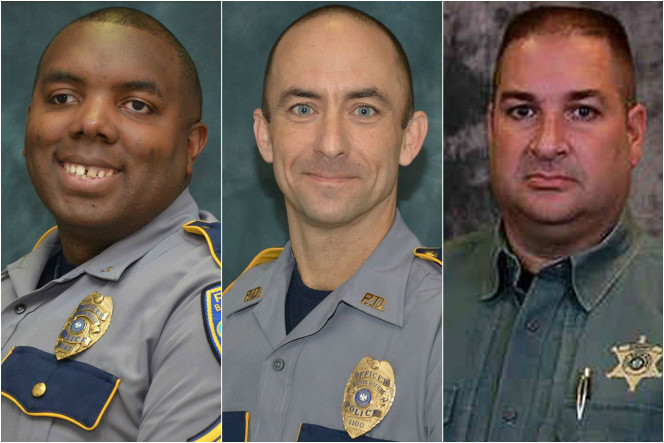
The killer is black separatist and former Marine Gavin Long, who murdered three police officers and wounded three more on his 29th birthday, and was in turn killed. He was also a former member of the Nation of Islam and railed against the police, “crackers,” and several other ethnic groups in his Facebook account.
Here are photos of the three murdered officers:
You will notice that one of the slain men is black, as was the perpetrator. This incident reminds me of the shooting of another black officer by black power separatists and members of the BLA, the murder of police officers Greg Foster (along with his partner Rocco Laurie) in New York City in 1972, which I wrote about several times, including in this 2014 post.
So this speculation about the Baton Rouge killing is just plain wrong:
Law enforcement officials said Sunday that the shooting does not appear to have been race-related. At least one of the officers killed in the attack was black.
Greg Foster was black, and his shooting was absolutely “race-related.” Black officers are seen by killers like these as the enemy, as betrayers who are working with the white man to oppress black people.
You can read about the police officers who were killed in Baton Rouge here and here.
It may be too late to stop this fire from spreading. But Obama has one more chance to try to put it out. He failed that opportunity in his remarks hours after the Baton Rouge carnage, delivering instead an anodyne call to heal “our divisions” and discard “inflammatory rhetoric thrown around to advance an agenda.” Implication: Blame for “inflammatory rhetoric” is equally shared by those who attack cops and those who defend them. Sorry, Mr. President, those who tell the truth about crime and policing are not part of the problem and they bear no responsibility for the massacre of cops. The killing of cops is furthered exclusively by those peddling a false narrative that cops harbor lethal bias toward blacks. Obama should call for the Black Lives Matter movement to fold its tent””and he himself should start telling the truth about inner-city crime.
And it certainly promises to be somewhat more “interesting” than usual. Even if all goes according to the book and Donald Trump becomes the nominee (as I believe will happen), he’s such an unconventional candidate that it promises to be different.
In a historic break from tradition at this week’s four-day celebration of the Republican Party in Cleveland, at least a dozen Republican senators, four governors, the past two Republican presidents and the past two GOP nominees intend to skip their party’s national nominating convention””just as presumptive nominee Donald Trump tries to show he is unifying the party.
It isn’t unusual for politicians to skip a convention, particularly for those who are facing tough re-election challenges and must devote their time to campaigning. But the sheer number of high-profile Republicans avoiding the party’s marquee event in 2016 is noteworthy, signaling the extent to which the billionaire businessman’s coronation has fractured the party.
I don’t blame those not attending, despite the incredibly high stakes and the need for the GOP candidate to win. If I were in their shoes I would find it difficult to stand up there, too, and speak for him—although I might try to force myself, if only to take a strong anti-Hillary stand.
But I don’t think Trump’s “coronation” (note the loaded word) has “fractured the party.” It’s not that I don’t see the fractures. But I think Trump’s nomination is a symptom, a result of an already-existing fracture that has widened somewhat but had already been getting large before Trump ever declared himself a candidate in the 2016 race.
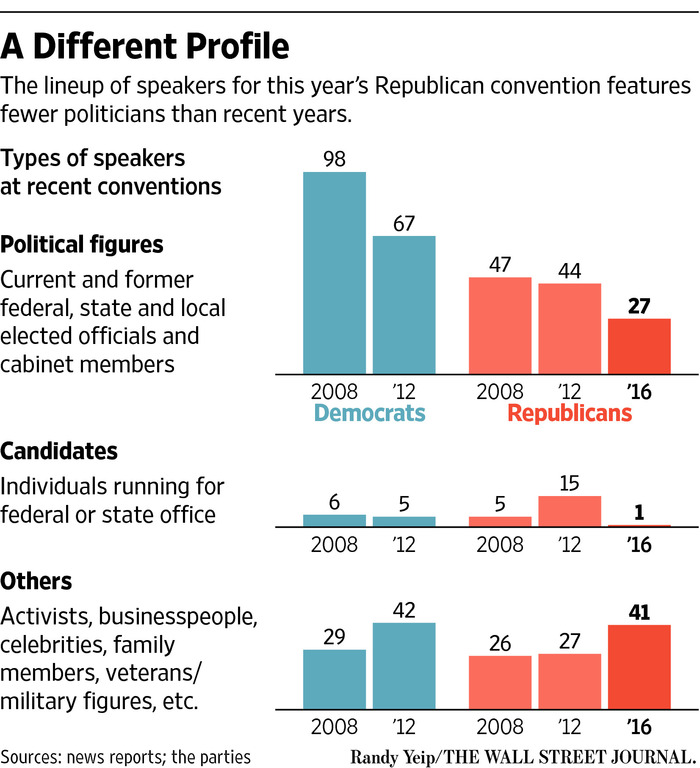
Here’s a handy chart of who the speakers will be this year by category, as compared to previous years:
Here’s the schedule for some (not all) of the speakers, subject to change. C-SPAN covers the whole thing, including non-prime time events, if you’re really into seeing every little last bit (some of the following names were not at the link, but appeared in an email I got from the GOP about the convention):
Monday evening: Melania Trump, Rudy Giuliani, Joni Ernst, Willie Robertson (of Duck Dynasty), Rick Perry, Scott Baio (!), Marcus Luttrell (retired SEAL), Pat Smith (mother of one of the men killed in Benghazi), Jeff Sessions, and Tom Cotton
Tuesday evening: Mitch McConnell, Paul Ryan, Scott Walker, Chris Christie (otherwise known as The Bridesmaid), Ben Carson, UFC (that’s Ultimate Fighting Championship) President Dana White, Tiffany Trump, and Donald Trump Jr.
Wednesday evening: Mike Pence, Newt Gingrich, Ted Cruz, Marco Rubio, and Eric Trump
Thursday evening: Ivanka Trump, Reince Priebus, Jerry Falwell Jr., Peter Thiel (libertarian tech entrepreneur), and of course the piece de resistance—Donald Trump himself.
I’ve never been a fan of political conventions, but the prospect of this one makes me feel especially sad. I suppose it’s a good thing that Trump has a lot of telegenic children to fill up those empty spots. I have no idea how a disaffected non-Hillary Democrat or an undecided Independent will feel about the lineup, but I comfort myself with the idea that I can’t imagine that the DNC lineup will be so very compelling either.
Of course, many people expect and fear that the more “interesting” events won’t be on the convention floor, but in the city of Cleveland, and that the racial unrest and political unrest that’s been escalating around the country will take disruptive and violent hold there. Let’s hope not.
There aren’t many details yet, but it is being reported that three police officers have been killed in Baton Rouge, Louisiana, and several have been wounded.
In the aftermath of the Bastille Day terrorist attack in Nice, some in the press seem to be emphasizing the fact that the perpetrator probably was not trained directly by ISIS, and had had marital troubles and reportedly been depressed.
Although authorities need to know all the details, this emphasis on the psychological can serve to minimize the huge influence of the ideological. Suicide murderers and suicide bombers of the Islamist variety have—as do all killers—a variety of motives, a mix of influences. There is the psychological (desire to die), of course. Even that is not simple with an Islamist terrorist—in other words, why do they want to die? Depression is probably in the mix for some, but for all there is the motive of their concept of religious martyrdom and reward—both in the next world, and prestige for their family in this world.
These are not the ordinary suicidal thoughts or even ordinary homicidal thoughts. And the Bastille Day attack was not an ordinary suicidal or homicidal act, or even a primarily suicidal act at all, any more than was true of the 9/11 plotters (who also knew they would die).
With every murder, the psychological interacts with the sociological (in the case of the Bastille Day perp, there was post-divorce and cultural dislocation as well). But in the case of Islamist terrorists they interact very powerfully with apocalyptic religious Islamist sentiment and the desire to kill the infidel as per ISIS’s commands. Even the modus operandi is usually suggested by terrorist manuals, as we’ve seen in the case of Nice.
A perpetrator’s psychological state may have some bearing on the question of “why this particular person and not another?” But when we hear of an atrocity such as what happened in Nice, most of us are able to name the religious ideology of the perpetrator before we know much more about him except the bare outline of his crime.
This does not mean there were not psychological and sociological aspects to the actions of the terrorist in Nice. There certainly were, and authorities need to take a look at them, too. But when newspapers emphasize them, it seems fairly clear that they are trying to draw attention away from the all-important “but for” element: inspiration by and identification with the destructive aims of Islamist terrorist groups such as ISIS.
I think it possible, even likely, that Erdogan staged the coup himself, or knew it was coming in advance and allowed the plotter so openly hang themselves.
Literally, Erdogan couldn’t have come up with a more successful plan to concentrate and extend indefinitely his grip on power. All of his legitimate opposition is likely to end up in front of a firing squad now.
Erdogan has been jailing his opposition for quite some time now, and this gives him a reason to do a lot more to them:
Jailing journalists has been one of the hallmarks of Turkey’s poor human rights record, a kind of shorthand for describing the country’s authoritarian tendencies and flawed justice system. But in the run up to a highly contested general election in June, that treatment has been extended to judges and prosecutors who issue decisions the government doesn’t like.
The Justice and Development Party (AKP) government, under the shadow of President Recep Tayyip ErdoÄŸan, has been accusing these judges of acting as members of an armed organization attempting a coup and other judges friendly to the government have been sending them off to jail while there is an investigation.
Over the past month, three judges and four prosecutors have been put in pre-trial detention, all as a result of decisions they made while discharging their professional duties rather than on evidence of criminal activity. Another four prosecutors barred from the profession during May may be next to see the inside of a cell. The shared feature of these cases is that the decisions that led to their arrests were all on issues pertaining directly or indirectly to allegations of unlawful activity implicating the ErdoÄŸan-dominated government.
That is from an article from NPR that appeared in May of 2015. Please read the whole thing; it’s long but very informative and very chilling. The Turkish election of November 2015 (which may or may not have involved fraud; see this) kept the Erdogan faction in power. Note in that NPR article the mention of accusations of coup-planning by the judges who had ruled against the Erdogan government. Whatever the origins of yesterday’s coup (bona fide attempt or not), there is absolutely no question that it will be used to kill a lot of people who are labeled by Erdogan as members of it.
President Obama either favors this or winks at it, and uses the mantle of “democracy” to defend it. But democracy means nothing without constitutional protections for liberty and rights such as freedom of speech and of the press (as I have written many times over the years in articles about what neocons believe).
Our own press has made much of the support Erdogan has received from the people taking to the streets in support of him, as he requested, during the attempted coup. But of course he has supporters—no one ever said he didn’t, as do most tyrants, and plenty of them. But the real question is who are they, what do they stand for, what percentage of the Turks are among them—and even more importantly, what do we stand for?
Picture Donald Trump on a series of calls with advisors and heads of government from around the region, and inside the NATO alliance, devising a constructive response to a coup attempt in Turkey.
Good luck…
…[T]o be a good president you do need to be able to run good meetings. You need to get up to speed in a chaotic situation, talk to a bunch of people who are more knowledgeable than you but not ultimately empowered or accountable the way you are, and you need to try to steer some inherently unfavorable situations toward a non-disastrous outcome.
From everything I know about Trump – not just his temperament and his character, but his actual ideas about politics and leadership – he simply doesn’t have what it takes.
Is this not a perfect description of Barack Obama’s track record? The only difference is that Yglesias is positing ignorance on the part of Trump (“fool” in the “knave or fool” narrative) and I am positing conscious intent on the part of Obama (“knave” with a dose of “fool” in that same narrative). Obama’s international outcome-steering has been very consistently disastrous for the entire seven and a half years of his presidency, and he never talks to people “who are more knowledgeable” than he is because there’s no one on earth more knowledgeable than he.
But Yglesia and his readers will almost certainly fail to see or appreciate the irony.
Anyone who reads this blog knows I’m no Trump fan, to say the least. But I’m also no NeverTrumper, and I also have read that Trump was on the side of the coup forces, which I believe is the correct (although losing) side. The coup in this case, as far as we can tell (given the fog of war and propaganda) was for secularism and the constitution, and against Erdogan’s advances towards tyranny—which I described in last night’s post, and the history of which seems to be being ignored by Obama and most of the MSM.
Which doesn’t mean that a president should have spoken out last night in favor of the coup. I believe that silence (at least for a day or two) would have been by far the best approach. But Obama jumped in to support the Islamist tyrant-in-the-making Erdogan, which is no surprise.
I think that Obama would dearly love to do the equivalent of what Erdogan did, which in this country would be something like (for example) running for vice president under a presidential candidate who delegates all the power to him, thus circumventing the two-term limit for the presidency (it may be technically possible to do so, by the way; see this). And then, once in the de facto (not de jure) powerful VP post, imprisoning the opposition, including journalists and jurists who criticize him. Because that’s Erdogan’s m.o.; Erdogan the democracy champ.

 , written by religion professor Stephen Prothero. The subject matter is the lack of education in the US about religious history worldwide, and what effect that ignorance has had on the public: