↓
 

The New Neo

A blog about political change, among other things

  • Home
  • Bio
  • Email
Home » Page 1017 << 1 2 … 1,015 1,016 1,017 1,018 1,019 … 1,935 1,936 >>

Post navigation

← Previous Post
Next Post→

Did the national polls get it so very wrong?

The New Neo Posted on November 21, 2016 by neoNovember 23, 2016

Yes, polls. Again. Why am I still talking about them?

Well, I see a lot of statements on the subject, here and elsewhere, that are just plain incorrect. That’s not new, either; it’s been going on as long as I remember. And not just concerning the recent election (the one I’ll mainly be discussing here); about past ones, too. So I think it’s good to point out a few salient facts—and then everyone can keep on arguing about the value of polls, the methodology of polls, and the intentions of pollsters.

To begin with, it’s necessary to understand that polling is inherently difficult to get right. That makes it flawed as a predictor (as I often say) but not totally flawed by any means. And besides, it’s the best predictor we’ve got. Crowds don’t matter, nor do yard signs (as I explained here, and as Romney discovered in 2012).

But if one pollster keeps getting it wrong when all the other pollsters get it right, that pollster isn’t going to last long, or if they last for a while they won’t have a good reputation. Pollsters’ most financially productive money-making activities—internal polling for candidates, and market research for businesses—depend on maintaining their reputation for accuracy, so they are interested in getting it right. There are also organizations that rank pollsters for accuracy over time, so among people who hire pollsters (for example, for market research, which is lucrative), the pollsters’ reputations are known.

But what if most of the pollsters get it wrong? Or did they?

I have yet to understand why so many people seem to think that the polls were so very, outlandishly wrong this year (except at the state level in a couple of states, particularly Wisconsin; but state polls are known to be much more difficult to do in terms of sampling, and are often somewhat outdated by the time the election rolls around). Why do I say the national polls were not so far off? Take a look at what the polls were actually saying the day before the election, rather than what you think you remember about what they were saying.

Remember also, when you look at this article (written one day before the election), that Hillary Clinton (so far, anyway) has won the popular vote by 1.27%. So any poll that showed her winning the popular vote by around that figure would have been remarkably accurate:

With just one day to go until the 2016 presidential election, Hillary Clinton’s support is at 46.8% while Donald Trump’s is at 44.3%.

When analysts refer to the Democrat’s 2.5 percentage point lead, they are talking about the difference between those two figures in polling averages.

It’s an important number but it’s also probably an inaccurate one. That’s because polling averages do not capture fully a few factors that will affect the final outcome.

So, the average of polls right before the election was only off from the actual result by 1.23%, and they got the popular vote winner (which is what national polls measure) right. That’s really pretty close.

The article goes on to state some of those factors that are not reflected in the polls but which affect the final outcome—early voters, turnout, margin of error, and vote distribution and the Electoral College (this turned out to be a very large factor which determined Trump as the winner). The article also mentions an unusual amount of uncertainty for this particular election. It doesn’t mention the undecideds, but we have learned since the election that they broke disproportionately for Trump, and this may indeed have made the difference between his winning and losing.

So I actually don’t see that the polls were especially inaccurate.

Take a look at what Nate Silver was saying two days before the election (Silver isn’t a pollster, but he analyzes polls and makes predictions based on them, and he has a pretty good track record):

In an appearance on ABC’s “This Week,” the FiveThirtyEight chief claimed Clinton is a “2-to-1 favorite,” but noted that recent polls show Republican presidential nominee Donald Trump with a slight edge in electoral college-heavy states like Florida, Ohio, and North Carolina.

“The electoral college math is actually less solid for Clinton than it was for Obama four years ago, where four years ago we had Obama ahead 320-some electoral votes. Clinton has about 270,” Silver said.

“So she’s one state away from potentially losing the electoral college. You’d rather be in her shoes than Donald Trump’s, but it’s not a terribly safe position.”

Finally, take a look at Nate Silver’s list of polls taken right before the election, from an article written two days before the election. Fourteen polls are listed. Two show Trump leading (by +1, and by +8). One shows a tie. Four more show Clinton leading by either 1% or 2%—and since it turns out she actually won the popular vote by 1.27% (at the time of this writing), I’d say those particular polls were highly accurate, the most accurate of all. That means that seven out of fourteen polls either got the winner right (Trump) or got the actual vote right or extremely close to right. That sounds accurate to me for six of the polls, which is approximately half (one of those that got the winner right was very inaccurate, so I’m not adding that to the “accurate” list, although it was right about the Trump win).

What’s more, three more of the polls measured Clinton at +3 in the popular vote. That turned out to be only 1.73% off. Not too shabby, either. That leaves two polls that said Clinton +4, and two that said Clinton +5. So the majority (9 polls) got it right or came quite close. And the LA Times poll, one of the two that got the winner right, was also the most inaccurate poll, because it showed Trump ahead by +8, which was actually 9.27 points off, whereas many of the polls that got the winner wrong actually were quite accurate about the popular vote.

Polling is flawed, as I’ve said almost every time I write about it. It’s just a guide. In races that aren’t close, it can be a very good guide. In close races (and this was definitely a close race) polls are iffy. But, contradictory to many people’s recollections, most of the polls this year right before the election predicted a close race. And if most also predicted a Clinton victory in the popular vote—well, they turned out to have been correct about that, too.

Here’s what Silver wrote two days before the election, and remember again that in the actual election Clinton seems to have won by about 1.27% (and that figure could actually rise over time, and has been steadily doing so):

On average across the 14 polls, Clinton’s lead is 1.9 percentage points…Or you can take the median instead of the average, which is also 2.5 points. Use only polls rated A-minus or higher? Her lead is 2.6 points. Use live-telephone polls only? It’s 2.3 points. Use only polls used to determine eligibility for the presidential debates? That gets you to 3.5 points. Use only the very recent surveys, which conducted all of their interviews in November? Her lead averages 2.3 points in those.

Not so very far off. And after reading the following from that same November 6th article by Silver, you may agree with me that Silver (who works with the poll figures as a whole, analyzing and commenting on them) was surprisingly accurate:

How about polls of swing states in particular? Right now, the tipping-point state in our forecast ”” the state that would provide the decisive 270th electoral vote if the polls got things exactly right ”” is New Hampshire. There, Clinton leads by only 1.7 percentage points in our adjusted polling average, as several recent polls show Trump tied or slightly ahead, along with others that still give Clinton the lead. Thus, Clinton’s doing a little bit worse in the tipping-point state than she is overall ”” a sign that she might win the popular vote but lose the Electoral College.

In case you’re unaware of what happened in New Hampshire, Clinton won—47.62% to Trump’s 47.25%, a margin of 2687 votes out of a total of 694,307 cast. So the polls in New Hampshire seem to have been pretty good; they predicted both a very close race (true) and the eventual winner in that state.

I was very impressed with Nate Silver’s predictions in 2012, and I remain impressed. And the polls weren’t so shabby, either.


Posted in Election 2016 | 32 Replies

The still point of the turning world

The New Neo Posted on November 19, 2016 by neoNovember 19, 2016

I’d never heard of ballet dancer Zenaida Yanowsky before. But I idly clicked on a video while procrastinating about something-or-other, and what I saw puzzled me.

It was the “Black Swan” pas de deux, and I didn’t love her dancing. Her line didn’t seem particularly beautiful to me. Her body, though flexible, didn’t seem pliant; something about her seemed too rigid and unyielding.

But something was wonderful there, too, and for a few seconds I couldn’t quite figure it out. But then I decided it was two things. The first was her calm, unruffled and unhurried manner, the fact that she took time to show you what the movements meant and what they were there for (the musical tempo is slow here, too). But even more, it was her extraordinarily centered quality.

All dancers must have a center, a plumb line that runs straight down and around which everything moves and swirls, whether the dance is fast or slow. Some of my teachers used to tell us that we needed to imagine that a string ran right through the center of our heads down through the middle of our bodies, and that we were suspended from it like puppets on strings. Or that we had a headlight on each hip, and those headlights had to shine straight ahead of us at all times (unless a hip-twisted movement was required, which it rarely was in ballet).

Watch, and you’ll see it:

I immediately was reminded of Cynthia Gregory, an American Ballet Theater dancer I saw in person countless times during the 70s. She also was tall, and was known for her calm center and rock-solid balances. You’ll see the similarity I think, but also the differences, particularly in Gregory’s more expressive arms, and the sharpness of her movements in this particular interpretation of the role. A couple of times towards the end of the passage I got a little shiver while I watched; something about her evil calculation and swanlike arms, mimicking Odette (the White Swan she is pretending to be, in order to convince Prince Siegfried to betray Odette—the section I’m talking about starts at 4:10 and ends around 5:42). Her partner Bujones was a rare dancer, too, although sadly he died relatively young:

And here’s Gregory now, talking about “Swan Lake”:

Posted in Dance | 8 Replies

Rothbard and the alt-right

The New Neo Posted on November 19, 2016 by neoNovember 19, 2016

[NOTE: This is a post in which I continue to explore the more extremist wing of the alt-right, because I think it bears watching and comprehending. That doesn’t mean I think it’s an enormous group. Nor do I think Donald Trump or even Steve Bannon are members of it. However, this group exists, and it is a big mistake to dismiss them out of hand.]

I had never heard of Murray Rothbard before his name came up in the comments here a while ago in connection with the alt-right. Commenter “J.J.” had mentioned a libertarian strain within the alt-right, and I expressed skepticism about the alt-right’s devotion to libertarian principles.

J.J. responded by citing Wiki:

Matthew Sheffield, writing in the Washington Post, said the alt-right has also been influenced by anarcho-capitalist and paleolibertarian theorist Murray Rothbard, specifically in regards to his theorizing on race and democracy, and had previously rallied behind Ron Paul in 2008.

Those are two terms I’d never come across before, in addition to the name Rothbard: anarcho-capitalist and paleolibertarian. Sounded like some sort of especially extreme form of libertarianism.

So I got curious. And there was quite a motherlode of information on Rothbard (whom I always seem to want to refer to as “Rothbart,” as in the evil wizard/magician in “Swan Lake” named “von Rothbart”):

Michael O’Malley, Associate Professor of History at George Mason University, characterizes Rothbard’s “overall tone regard[ing]” the Civil Rights Movement and the women’s suffrage movement to be “contemptuous and hostile”. Rothbard vilified women’s rights activists, attributing the growth of the welfare state to politically active spinsters “whose busybody inclinations were not fettered by the responsibilities of health and heart”. Rothbard had pointed out in his ”˜Origins of the Welfare State’ that progressives had evolved from elitist Gilded Age pietist Protestants that wanted to bring a secularized version of millennialism under a welfare state, which was spearheaded by a “shock troop of Yankee protestant and Jewish women and lesbian spinsters.”

Rothbard called for the elimination of “the entire ”˜civil rights’ structure” stating that it “tramples on the property rights of every American.” He consistently favored repeal of the 1964 Civil Rights Act, including Title VII regarded employment discrimination and called for overturning the Brown v. Board of Education decision on the grounds that forced integration of schools was aggressive.

So far that seems to be describing a very extreme form of the sort of objection a few people on the far right have to what they consider federal overreach, although Rothbard adds some extra-snarky tones.

However, that’s just the beginning. Continue reading →

Posted in Liberals and conservatives; left and right, Liberty, People of interest, Politics | 101 Replies

Trump Tower security challenge

The New Neo Posted on November 19, 2016 by neoNovember 19, 2016

I call the president-elect’s Trump Tower residence the Gold House.

And it’s quite the security challenge:

Other presidents have used retreats ”” the compound in Kennebunkport, Maine, or the ranch in Crawford, Texas, for the Bushes ”” but they were in easily protected locations.

Trump Tower, on the other hand, has hundreds of tenants in 263 apartments, according to its website. That’s on top of 26 floors of offices and a five-story public atrium with stores ranging from Starbucks to Gucci.

…SWAT teams, barricades and sand-filled trucks are already fixtures ”” along with protesters. The sky above it is a no-fly zone until the inauguration at least…

Law enforcement agencies are meeting this week to discuss plans for securing the skyscraper going forward. Possible scenarios include closing lanes on Fifth Avenue, home to Tiffany’s and other world-famous retailers, NBC New York reported.

New Yorkers can also expect to see restrictions on the side streets, bomb-sniffing dogs on the sidewalks and security booths popping up around the building…

Now, some of you may ask “who cares about New York?” Well, I do, for one. The Secret Service says it will meet the challenge, and I certainly hope that’s true. I also think that presidents should be allowed to retreat to their own homes at times, and this happens to be where Trump lives. But it’s just one interesting and mostly-unforeseen side effect of this whole crazy election that we have a president who lives in a place that is, shall we say, atypical and unusually difficult to protect.

I wonder how much time he actually will spend in each place.

The Trump mansion-apartment occupies three floors of the tower, and the scale of the thing and its Louis XIV style are unlikely to reassure those who fear an imperial presidency. Nor is the style one I particularly favor. But he’s not asking me, and I think the style is just Trump being the Trump he’s always been. I’m far more interested in Trump as president, which is uncharted waters. But so far I’ve approved of the majority of the things he’s actually done since winning the election (granted, it’s early).

Go here to see many photos of the inside of the Trump family’s living space. Here’s a sample:

trumptower2

trumptower3

Those who worry that Trump will put his signature over-the-top decorative stamp on the White House should be reassured by this, however:

[Trump] said he would not seek to leave his mark on a building which was designed by the Irish architect James Hoban in the 1790s and rebuilt after being burnt to the ground by the British in 1814.

The president-elect made his pledge on OBJECTified Donald Trump, a one hour documentary on Fox News…

“The White House is a special place, nothing will change at the White House,” Mr Trump said.

I assume he doesn’t literally mean “nothing,” since new presidents have traditionally made changes in the decoration of the living quarters portion of the White House.

Posted in Fashion and beauty, Trump | 10 Replies

A postmortem on the polls

The New Neo Posted on November 19, 2016 by neoNovember 19, 2016

Here’s an interesting article by Michael Barone that tries to say why the pollsters got it wrong.

First of all, I’d like to add that they didn’t get it quite as wrong as some people think. Many of the polls in the last week or so were well within the margin of error, and the election also ended up being close. Not as close as in 2000, but close enough that many states were won by small margins, and the loser won the popular vote, as in 2000. Here’s a post by Scott Alexander that says the same thing about the closeness of the polls—only he wrote it before the election.

But a win is a win is a win, and this particular win by Trump was predicted consistently only by the LA Times polling, which kept showing Trump ahead. But there’s no doubt that in general the poll averages (which have often been accurate in the past) got it wrong.

Barone mentions five elements that may have led to the error; please read the whole thing.

I’ll add that I’m very aware that some people think that polls are purposeful and strategic lies. I do not ascribe to that notion. As I’ve written many times before, however, polls are inherently flawed. There are too many things they must predict in order to predict the winner—such as, for example, turnout, which is one of the most changeable, difficult, and important to get right. However, pollsters would actually like to get it right, particularly in the weeks close to the election, which are the polls that matter most. Pollsters’ reputations are damaged by getting it so wrong, and they are running a business.

Turnout is always hard to predict, but it was especially hard to predict this year because the candidates (both of them) were so unusual. The Shy Tory effect may indeed have been in effect, as well. But purposeful skewing of polls in Hillary’s favor would have been a dangerous practice for the left anyway, as likely to depress Democratic turnout through cockiness as it would be to depress Republican turnout through despair.

So the polls were close enough at the end that, although they consistently predicted a Hillary win, there was no way to say that a Trump loss was an absolute certainty, and I don’t think many people were saying that. A Trump win was always a possibility, one I seem to recall as about 1 in 3 towards the end, and 1 in 3 aren’t such bad odds.

Here is a particularly interesting point by Barone about the geographic breakdown of voters these days:

The fact that Democratic voters are so clustered, concentrated heavily in central cities, sympathetic suburbs and university towns, has helped its presidential candidates in past elections (this one, not so much) but hurt them in congressional and legislative elections conducted in equal population districts.

Clustering, to oversimplify a bit, means that Democrats tend to be concentrated in a few 80 percent Democratic areas, while Republicans are spread more evenly around the country in districts that average somewhere between 55 and 60 percent Republican. To see the effect, consider the number of Republicans and Democrats elected to the lower houses of state legislatures in what turned out to be the 2016 target states. I cite the lower house, because some such states elected only half or none of their state senators this year; Virginia elected no state legislators except to a couple of vacant seats.

The states are ranked in the order of their percentage margins, starting with the most Republican:

Iowa 59-41
Texas 94-55
Ohio 66-33
Georgia 116-62
Arizona 32-26
North Carolina 72-45
Florida 78-39
Pennsylvania 118-81
Wisconsin 64-35
Michigan 63-38
New Hampshire 201-161
Minnesota 75-57
Maine 72-76
Colorado 28-36
New Mexico 31-37

There was lots of straight-ticket voting this year, which accounts for the Democratic edges in the more Democratic states at the bottom of the list. But the bottom line is pretty astonishing, particularly considering that these are states which were, like the nation as a whole, roughly equally divided between the parties at the presidential level.

It does seem as though polls have been less accurate in recent years, but one reason may be that the electorate has grown more evenly divided. Close races are harder to call, because small variations matter more. Pollsters also have had to scramble to keep up with changes such as the proliferation of cell phones. But the poll response rate still goes down (I never answer polls myself, for example) and that’s hard to correct for. And even exit polls—which after all, don’t have to predict anything, because everyone in an exit poll actually voted—still have the problem of low response rate as well as the complication of the increasing prevalence of early voters, a whole bloc that is missed by exit polls.

Posted in Election 2016, Politics | 37 Replies

A pas de deux

The New Neo Posted on November 18, 2016 by neoNovember 18, 2016

Commenter “IGotBupkis” recommended the following “dance” video, and I was flabbergasted and charmed when I saw it, because this is a genre of pas de deux that had somehow heretofore escaped my notice:

It turns out there’s an entire world of dogdancing competition. Who knew? You can find tons of videos on YouTube, but that’s one of the best. I’m especially impressed with how the dog in that video is not in constant contact with the trainer and can’t even see her at many points in the routine, and yet still hits her marks and makes her moves what looks like perfectly.

Also, dogdancing seems to be good exercise, because they’re all thin. The people, that is; not the dogs.

If you want to learn a little bit about it, here’s some information.

Another thing I didn’t know is that a dancing dog act had won “Britain’s Got Talent” back in 2012, and this made both the dog Pudsey and his teenage trainer Ashleigh celebrities. Here’s Ashleigh speaking:

”˜But there’s going to be a point where Pudsey can’t do what he’s doing and I do worry and think, “Oh, what am I going to do when Pudsey can’t dance any more?” I know this is a once-in-a-lifetime experience so I’ve just got to enjoy it as much as possible. At the end of the day I’m not a fashion icon or a singer.

”˜I’m a girl with a dog ”” and most people look at the dog.’

Most people look at the dog. Twas ever thus. Interesting article, actually. Ashleigh’s mother trains dogs and early on she realized Pudsey was something special. Ashleigh was a shy girl, not doing well in school, but tenacious when it came to training her dog, as one might imagine.

Posted in Pop culture | 20 Replies

The National Republican Congressional Committee has an endorsement to make

The New Neo Posted on November 18, 2016 by neoNovember 18, 2016

The National Republican Congressional Committee is a group of GOP members of the House who are dedicated to increasing the number of Republicans in that body. Even though the House actually lost six GOP members, that was considerably less than predicted and the GOP still has a strong majority

So the group is feeling its oats, as evidenced by this endorsement it made yesterday:

With Nancy Pelosi facing a challenge within her own party after House Democrats’ disastrous election results, the NRCC would like to offer its full support to the embattled former Speaker of the House.

Under Nancy Pelosi’s leadership, House Democrats squandered their majority by forcing through unpopular legislation like Obamacare, of which Pelosi famously told us, “We have to pass the bill so that you can find out what is in it.” After her party’s devastating 63 seat loss in the ensuing 2010 election, Pelosi miraculously maintained her spot as Democratic leader, which, predictably, led to the largest Republican majority since the 1920s.

Former Speaker Pelosi has also established herself as the world’s worst election prognosticator. Since her relegation to the minority, Pelosi has repeatedly assured reporters, cycle after cycle, that a Democrat majority is right around the corner, only to be soundly defeated each time.

“No single person deserves more credit for House Republicans’ historic majority than Nancy Pelosi,” said NRCC Communications Director Katie Martin. “Under Nancy Pelosi’s leadership, House Democrats have become completely irrelevant, and there is no better way to ensure that remains the case than by keeping her as Minority Leader. The NRCC offers its full support to Nancy Pelosi as she attempts to fend off this challenge to her failed leadership from within the ranks of her own party.”

Ouch.

Posted in Uncategorized | 11 Replies

Let’s take a local look: the state legislatures

The New Neo Posted on November 18, 2016 by neoNovember 18, 2016

One of the most interesting things this election cycle is something other than Donald Trump. Yes, you heard me—there is actually something other than Donald Trump in politics.

I’ve been saying for quite some time that, whatever happened with the presidency in the 2016 election, the composition of the Senate would be all-important to either president. If it was a Hillary presidency and a Democratic Senate, there would be a repeat of the heady days when Obamacare first went through. If a Trump presidency and Republican Senate occurred (an eventuality I thought much less likely, but still possible), the Republicans had a decent chance of enacting their policy dreams, whatever they might be. But any mixture in which president and Congress differed would spell more gridlock and a difficulty for either president to get his/her agenda accomplished, and would present that president with more and more temptation to do things by executive order, going around the legislature.

Well, we all know what happened: Republicans control both the presidency and the legislature.

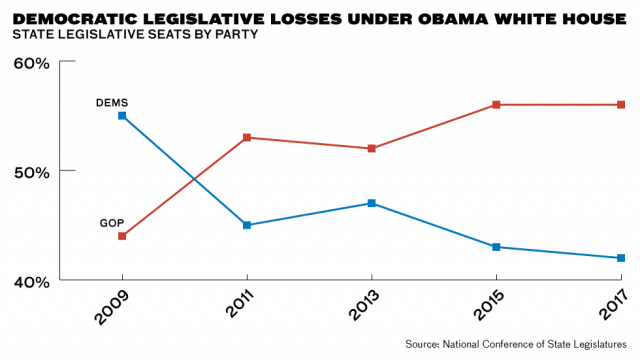
But the state elections are especially interesting, as well. More slowly (it’s been happening for quite some time), the Republicans have pretty much taken over on the local level:

statelegislatures

Republicans will control 4,170 state legislative seats after last week’s elections, while Democrats will control 3,129 seats in the nation’s 98 partisan legislative chambers. Republicans picked up a net gain of 46 seats in Tuesday’s elections, while Democrats lost 46 seats, according to the latest vote counts from The Associated Press.

Independents and members of minor parties hold 71 seats, including the entire Nebraska Senate, which is nonpartisan. Nearly two weeks after Election Day, about a dozen seats remain too close to call.

“Republicans have been working for this moment for years, to have a federal government with Republican majorities and now at the state level,” said David Avella, who heads GOPAC, a group that grooms young legislative candidates. “We have to deliver on breaking down barriers to job creation, we have to deliver on putting more money in people’s pockets through tax cuts and through higher wages.”

Remember that, because I don’t think the Democrats did: you have to show results, and good ones, or people will reject you. Reality still overcomes imagology, at least for now.

Note the final sentence here:

Since Obama took office, Republicans have captured control of 27 state legislative chambers Democrats held after the 2008 elections. The GOP now controls the most legislative seats it has held since the founding of the party.

That’s astounding. I’ve noticed that, during the bulk of his presidency when Obama has talked about his legacy, he hasn’t seemed to acknowledge this particular aspect of it. If he did, I missed it. But it seems as though it will be the focus of his immediate post-presidency energies.

Not the UN, but this:

The Democratic Party, “in close consultation with the White House,” has launched a new political group “which will coordinate campaign strategy, direct fundraising, organize ballot initiatives and put together legal challenges to state redistricting maps,” Politico reported Monday [a month ago]. Former Attorney General Eric Holder will chair the new group, named the National Democratic Redistricting Committee. And Obama himself, as Politico writes, has “identified the group ”¦ as the main focus of his political activity once he leaves office.” The group will focus on the “gubernatorial, state legislative and House races” in 2018 and 2020 that will determine the design of the next congressional redistricting maps.

Why would Obama concern himself with such seemingly small-fry politics? One reason could be tradition: Ex-presidents like to give their successors room to breathe, so hieing off to state-level battles is one way for Obama to remain active without meddling in the day-to-day grind of national politics. The other, more important reason is that control of state legislatures is in no way small-fry politics. By throwing his name behind the effort, Obama is trying to fix the colossal infrastructural damage his party sustained under his tenure: the Republican state-level domination””and thus congressional domination””achieved first in the midterms of 2010 and iced in 2014.

The article goes on to describe Obama as attributing these losses at the state level to the artifact of gerrymandering rather than any actual failing by Democratic leadership. He also attributes it—as he does almost every problem he has encountered with public opinion during his presidency—as a problem with messaging and communication. The Slate article I’m quoting is definitely Obama-friendly, but even the author seems to recognize what Obama does not (or at least does not publicly acknowledge), which is that it wasn’t all about districting or messaging:

[Obama’s] explanation is a self-flattering one: We were just so busy implementing perfect policies that we forgot to communicate them properly. One doubts that a more cleverly crafted party message””nipping and tucking an adjective here or there in public speeches””would have overridden the factors that led to Democrats’ catastrophic 2010 losses. The flat economy, the party-line stretch to pass the Affordable Care Act, the gravitational pull that was bound to drag Democrats down to Earth after their big successes in the 2006 and 2008 congressional elections.

That’s hardly an exhaustive list, either.

I wonder if Obama is able to acknowledge his actual failures, and not just the “communication” and districting ones, even to himself. I tend to doubt it. It does seem, though, that unlike most ex-presidents, he plans to stay very active in party politics, although not in an elective office.

Posted in Obama, Politics | 19 Replies

President-elect Trump’s first appointments

The New Neo Posted on November 18, 2016 by neoNovember 18, 2016

Jeff Sessions has been announced by the transition team as Trump’s pick for Attorney General.

It’s been obvious for a long time that Sessions was going to be part of the Trump administration; the only question was in what capacity. I had thought it might have something more directly to do with immigration—“immigration tsar” or something of the sort. But the post of AG certainly is connected with immigration, although its responsibilities are much broader than that

Sessions was an early and very important supporter of Trump, giving him the stamp of approval back in the days when not many respected Senate figures such as Sessions had come on board (actually, he was the first). He’s a very smart guy and not afraid to take unpopular positions (voted against the bank bailout, for example). Of course, the CNN article I linked at the start of this post manages to dredge up thirty-year old accusations of racism (CNN is not the only news outlet emphasizing the racism angle, either, which is also no surprise). You can find a further discussion of the substance or lack thereof of these allegations here. As you might imagine, in addition to their antiquity at this point, there really appears to be very little there there.

Most of us know Sessions as a senator. After all, he’s been a member of that body for almost twenty years. But prior to that (1995-1997) he was the AG for Alabama, and before that (1981-1993) he was the US Attorney for the Southern District of Alabama. So Attorney General is certainly a role for which he has relevant experience.

We’re probably going to get almost daily Trump appointment news from now on until the inauguration and for a few months after. I imagine some of these picks will be a lot more surprising than that of Jeff Sessions. The reported selection of Lt. Gen. Mike Flynn as National Security Advisor is not one of those surprises, however. Another Trump supporter with strong credentials including a background in intelligence matters (although of course the press emphasizes his controversies), he was an obvious choice.

Mike Pompeo is a good pick, too. I was less familiar with his credentials than those of the others, and hadn’t really seen much speculation about the CIA job for which he’s been named, but here’s a report on him:

Rep. Mike Pompeo, the Kansas congressman Donald Trump picked to lead the CIA, is a former Army officer and Harvard Law School graduate who is widely respected within the intelligence community for his intellect and his low key, analytical manner behind closed doors.

He also happens to be a conservative firebrand who sought to blame Hillary Clinton for the 2012 deaths of four Americans in Benghazi and vehemently opposed the Obama administration’s nuclear deal with Iran, which intelligence officials say has kept Iran’s nuclear weapons capability in check.

Still, many CIA insiders were breathing a sigh of relief over Pompeo’s ascension Friday, calling him the most favorable option among the many names the Trump team recently had floated.

All in all, I’d say those are three good choices. Trump’s picks are especially important for two reasons. The first is that each one gives us at least some small bit of information about what policy direction Trump will be likely to take as president. The second is that, with a president as inexperienced in government as Trump, it can be imagined (although we don’t know for sure) that Trump will be relying rather heavily on his appointees for information and advice.

[NOTE: Expect to see a lot more of this sort of thing from the MSM on the left, about Trump building a “team of racists.”]

Posted in Trump | 13 Replies

So, who do you think will be the next Secretary of State?

The New Neo Posted on November 17, 2016 by neoNovember 17, 2016

I haven’t a clue. One of the reasons I haven’t a clue is the same reason that a Democratic friend of mine had for saying that a Trump presidency would be “exciting,” and that’s Trump’s unpredictability. Particularly now, when the idea of his administration is still very new, and very few appointments have been made, we don’t know the direction he will take other than some broad outlines of promises and some specific proposals that may or may not pan out.

But a pick for Secretary of State sets a definite tone. Many names are being bandied about, but here’s one that probably took everyone by surprise:

Donald Trump is scheduled to meet this weekend with 2012 Republican presidential nominee Mitt Romney to discuss the secretary of state position, NBC reported Thursday.

Romney the loser, the non-fighter, the pushover, the greedy rich guy, the Trump-hating turncoat, the uptight privileged son of—well, you get the idea. There is hardly a figure on the Republican side more hated by a great many of the more vocal Trump supporters (which is not all Trump supporters, to be sure) than Mitt Romney.

I don’t feel that way about Romney, but the idea that he might be picked still surprises me, although it kind of pleases me. I think Romney would be tough when he needed to be. I also happen to think he won’t be Trump’s pick, but I don’t pretend to be able to predict at this point and that’s only a guess.

When I think of Romney and foreign policy, what immediately comes to mind was his prescience and correctness in 2012, and how Obama mocked him for it during the third debate. It Romney became SOS, it would be sweet vindication:

But if Trump is truly considering Romney, it heartens me because it would indicate that vindictiveness will not be as strong a motive for Trump as president as it seemed to be for Trump as candidate. And this is in line with a change I began to notice in Trump the night he walked into the roomful of supporters to give his victory speech. It would also indicate less friendliness towards Putin than many have previously observed in Trump.

Other possible SOS candidates were mentioned in the article. We already have heard about John Bolton, but here are some more:

Former CIA Director David Petraeus’ name has also emerged as a possible contender, according to The Guardian.

And on Thursday, South Carolina Gov. Nikki Haley met with Trump in Manhattan to discuss the coming job opening.

Former Mayor Rudy Giuliani, who began the week as a top contender for secretary of state, left Trump Tower on Thursday after just more than an hour.

Hmm, Petraeus. Didn’t he already plead guilty to “unauthorized removal and retention of classified information” and pay a fine? And isn’t he on probation till April, 2017? Ah well, maybe there’s somewhat of a new tradition among secretaries of state for those sorts of violations. And yes, Petraus’ crime was of a relatively minor sort, but still troubling.

I don’t know much about Haley’s international experience, but it seems to me that as a governor she hasn’t had much. And Giuliani has some potential conflicts of interest, although I’ve always liked him.

Or maybe it will be someone entirely different from all of the above.

Posted in Trump | 32 Replies

Trump and the racists

The New Neo Posted on November 17, 2016 by neoNovember 17, 2016

I’m not familiar with Scott Alexander or his blog, but here’s a post of his that’s well worth reading. It’s an in-depth attempt to evaluate some of the worst racism charges against Trump, and to estimate how numerous the supporters of white supremacist groups really are in this country (those are two separate issues, by the way).

Alexander is apparently not a Trump guy; he’s a psychiatrist who writes anonymously and is concerned about some of his patients who have become suicidally fearful since the Trump victory.

Alexander’s post is very long. I’m not in agreement with all of it, but it’s well worth reading. I think that white supremacist support for Trump is important and needs to be watched carefully. I don’t think the numbers are as small as Alexander seems to think, but both of us are merely estimating and I’ve consistently said I do not know, although these people are at least potentially dangerous. That said, I agree with Alexander that at the moment there’s no reason for alarm.

I also have said that one of the things that was a red flag for me with the Trump campaign in general was the failure of Breitbart et al to ban overtly racist or anti-Semitic comments from their sites. It’s easy enough to do it (believe me, I know) and it wasn’t done, which was a choice. You might say it was a libertarian choice, and I say “perhaps.” But it’s one of the things that has fueled the fires of the “Racism!” charges against Trump and his supporters—although that charge would be leveled anyway at Trump. It’s been leveled at almost every Republican on earth for quite some time.

Posted in Race and racism, Trump | 73 Replies

Executive power for me and not for thee

The New Neo Posted on November 17, 2016 by neoNovember 17, 2016

I’ve been thinking along these same lines:

Washington’s massive about-face on executive power is underway.

Donald Trump’s election has triggered a whiplash-inducing role reversal in D.C. legal circles, as liberals who spent the past eight years defending President Barack Obama’s use of his executive authority prepare to challenge Trump’s plans on issues like immigration, the environment and transgender rights, while conservatives who railed against Obama for acting unilaterally on those fronts seem ready to back the new president’s moves.

And then there are decisions to be made by Republicans about the filibuster, whose charms will suddenly become very very attractive to the Democrats.

Look, I understand the temptation to want more power when you’re in charge. Of course. That’s the siren song that the right is hearing now. But devotion to rules and checks and balances has been one of the major strengths of this country that has kept it (so far) from becoming a banana republic.

But hey, you say, it’s payback time.

I get it. Believe me, I get it. But I think the right has to stand for something, and refraining from the exercise of raw power by jettisoning some of the bulwarks of our republic needs to be part of what that. I respect anyone on either side who is able to do so.

It’s not wartime yet; no need to throw everything overboard that we supposedly hold dear. Maybe I’m also feeling so uncharacteristically optimistic right now that I actually think that some moderate Democrats (a few exist, you know) might come along for the ride, if they think their seats might be threatened if they’re too resistant to passing laws that the majority of people want, such as a replacement for Obamacare that actually might be an improvement.

My counsel continues to be “wait and see.” Patience.

Oh, and this:

[NOTE: Nothing in this post should be construed as implying that Trump can’t reverse by executive order what Obama proclaimed by executive order. He can do that, and should do that. In addition, changes to Obamacare can be passed through reconciliation. Also, the Republicans could probably keep in place the nuclear option for federal judgeships, which the Democrats instituted in 2013.]

Posted in Politics | 50 Replies

Post navigation

← Previous Post
Next Post→

Your support is appreciated through a one-time or monthly Paypal donation

Please click the link recommended books and search bar for Amazon purchases through neo. I receive a commission from all such purchases.

Archives

Recent Comments

  • Dave L. on Veterans Day; Armistice Day
  • ja on On the topic of election fraud in 2026
  • FOAF on Trump takes Vance off the Iran case
  • AesopFan on Open thread 11/12/2026
  • AesopFan on Trump takes Vance off the Iran case

Recent Posts

  • Fatal shooting in DC
  • Trump takes Vance off the Iran case
  • On the topic of election fraud in 2026
  • Open thread 11/12/2026
  • News roundup

Categories

  • A mind is a difficult thing to change: my change story (17)
  • Academia (330)
  • Afghanistan (98)
  • Amazon orders (6)
  • Arts (8)
  • Baseball and sports (164)
  • Best of neo-neocon (91)
  • Biden (536)
  • Blogging and bloggers (599)
  • Dance (292)
  • Disaster (244)
  • Education (329)
  • Election 2012 (360)
  • Election 2016 (566)
  • Election 2018 (33)
  • Election 2020 (514)
  • Election 2022 (114)
  • Election 2024 (404)
  • Election 2026 (126)
  • Election 2028 (14)
  • Evil (130)
  • Fashion and beauty (324)
  • Finance and economics (1,054)
  • Food (319)
  • Friendship (48)
  • Gardening (18)
  • General information about neo (4)
  • Getting philosophical: life, love, the universe (737)
  • Health (1,170)
  • Health care reform (546)
  • Hillary Clinton (184)
  • Historical figures (338)
  • History (720)
  • Immigration (452)
  • Iran (468)
  • Iraq (227)
  • IRS scandal (71)
  • Israel/Palestine (836)
  • Jews (445)
  • Language and grammar (365)
  • Latin America (216)
  • Law (2,997)
  • Leaving the circle: political apostasy (125)
  • Liberals and conservatives; left and right (1,335)
  • Liberty (1,119)
  • Literary leftists (14)
  • Literature and writing (394)
  • Me, myself, and I (1,524)
  • Men and women; marriage and divorce and sex (935)
  • Middle East (385)
  • Military (327)
  • Movies (355)
  • Music (534)
  • Nature (262)
  • Neocons (32)
  • New England (185)
  • Obama (1,740)
  • Pacifism (16)
  • Painting, sculpture, photography (132)
  • Palin (93)
  • Paris and France2 trial (25)
  • People of interest (1,051)
  • Poetry (259)
  • Political changers (179)
  • Politics (2,797)
  • Pop culture (397)
  • Press (1,636)
  • Race and racism (885)
  • Religion (431)
  • Romney (164)
  • Ryan (16)
  • Science (642)
  • Terrorism and terrorists (983)
  • Theater and TV (266)
  • Therapy (71)
  • Trump (1,639)
  • Uncategorized (4,637)
  • Vietnam (109)
  • Violence (1,466)
  • War and Peace (1,037)

Blogroll

Ace (bold)
AmericanDigest (writer’s digest)
AmericanThinker (thought full)
Anchoress (first things first)
AnnAlthouse (more than law)
AugeanStables (historian’s task)
BelmontClub (deep thoughts)
Betsy’sPage (teach)
Bookworm (writingReader)
ChicagoBoyz (boyz will be)
DanielInVenezuela (liberty)
Dr.Helen (rights of man)
Dr.Sanity (shrink archives)
DreamsToLightening (Asher)
EdDriscoll (market liberal)
Fausta’sBlog (opinionated)
GayPatriot (self-explanatory)
HadEnoughTherapy? (yep)
HotAir (a roomful)
InstaPundit (the hub)
JawaReport (the doctor’s Rusty)
LegalInsurrection (law prof)
Maggie’sFarm (togetherness)
MelaniePhillips (formidable)
MerylYourish (centrist)
MichaelTotten (globetrotter)
MichaelYon (War Zones)
Michelle Malkin (clarion pen)
MichelleObama’sMirror (reflect)
NoPasaran! (bluntFrench)
NormanGeras (archives)
OneCosmos (Gagdad Bob)
Pamela Geller (Atlas Shrugs)
PJMedia (comprehensive)
PointOfNoReturn (exodus)
Powerline (foursight)
QandO (neolibertarian)
RedState (conservative)
RogerL.Simon (PJ guy)
SisterToldjah (she said)
Sisu (commentary plus cats)
Spengler (Goldman)
VictorDavisHanson (prof)
Vodkapundit (drinker-thinker)
Volokh (lawblog)
Zombie (alive)

Meta

  • Log in
  • Entries feed
  • Comments feed
  • WordPress.org
©2026 - The New Neo - Weaver Xtreme Theme Email
Web Analytics
↑