
Big blue marble
Here are photos of earth taken from Artemis, and an explanation for why they are somewhat darker than previous space photos of earth:
The differences in color between the two photos stem from the settings used to take them, and where in space they were taken from.
NASA’s Flickr page, where the Artemis II crew’s photos live, shows the type of camera and the settings used to take the picture. Most of the settings are usual for taking photos, except for one. The ISO setting, which controls the camera’s sensitivity to light, is set to a staggering 51,200. For context, a common ISO setting for pictures taken on Earth is around 200.
The reason Wiseman had to use such a high ISO was that his spacecraft was on the opposite side of the Earth from the sun, meaning to the astronauts’ naked eyes, the Earth appeared much darker than it does in the photo. The sun is actually what’s causing the bright light on the bottom right of the Earth.
And here’s a post of mine from February of 2005, very early in my blogging career, on the subject of first seeing photos of earth from space:
I’m not so very old, but when I grew up and artists or scientists drew conceptual drawings of the earth from outer space, the globe was always pictured as just that–a globe like those spinning ones in school, tethered to their metal stands (only, of course, without the metal stands). No clouds at all. Despite the fact that we all should have known better–all we had to do was look up at the sky most days to see those voluminous clouds–no one did seem to know better.
I still remember the shock of seeing those first photos …
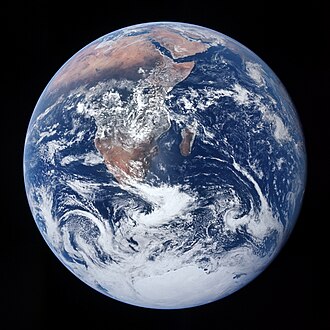
By now we’ve incorporated the clouds into our mental image of the earth. Here’s one of those early photos, though – the “Big Blue Marble” one:
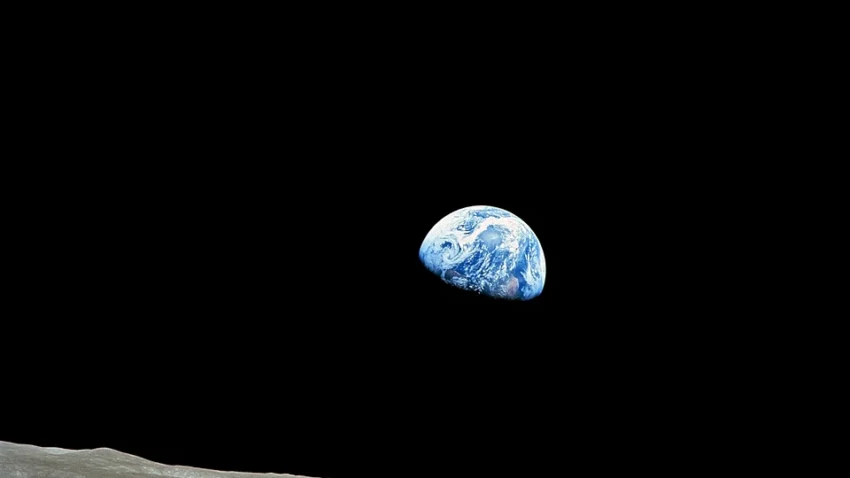
And here’s my very favorite so far, the “Earthrise” photo taken in 1968:
If you’d like to see a history of photos taken of earth, please go here.
Lovely planet. Shame about the people, though.
Thank you, that was cool.
I hear the crew brought only Nikons on this trip. I’ve been shooting more Canon lately, but this makes me want a new Nikon—like the astronauts use!
The sun behind the earth effect reminds of the painful lesson I had to learn more than a couple of times: do not take photos of people with bright windows behind them. Sometimes all you get are their sillhouettes.
And the nutjobs claiming Artemis II is a hoax are out in force. It is so tiresome.
And the record has been broken. Apollo 13 is now only the second farthest that mankind has gone.
And if you are on that blue marble around the equator, you are moving at about 1000 mph as it rotates. But it is only an intellectual exercise that we really recognize that we are moving because we are moving relative to the sun, other planets, and stars.
IrishOtter49 on April 7, 2026 at 4:32 pm:
“Lovely planet. Shame about the people, though.”
Also a shame about the germs and the viruses, and the mosquitoes, and the scorpions, and the poisonous snakes and toads and frogs and spiders, etc., along with bella donna, poison ivy, and other related plant risks.
If the planet still has another 10 billion years to go before Sol goes Nova, we will probably be long gone before then. Has anyone ever developed a theology comparing entropy and sin?
I suppose one of the glories of humanity is that we get to realize that we are doomed, while the other animals are excused from that realization. So we make the best of what we have when, where, and how we have it. Even blogging commenters and friends. 🙂 Plus bots and trolls.
Mary Catelli: “And the record has been broken. Apollo 13 is now only the second farthest that mankind has gone.”
Regarding that distance record, physicist Tom Murphy provides sensible perspective: https://dothemath.ucsd.edu/2026/04/empty-records/
It’s much ado about essentially nothing.
In 1966 Stewart Brand, founder of the Whole Earth Catalog and at the time inspired by an LSD trip, launched a campaign to pressure NASA to release a satellite photograph of the entire Earth.
Brand distributed 25-cent buttons and posters bearing the slogan “Why haven’t we seen a photograph of the whole Earth yet?” to NASA officials, members of Congress, scientists, and diplomats, as well as selling them on college campuses.
Brand’s advocacy reportedly had some influence in the release of the “Big Blue Marble” photograph.
Which was used, along with other such photos, as the standard cover of all editions of “The Whole Earth Catalog.”
–Louis Armstrong, “What A Wonderful World (Official Video)”
https://www.youtube.com/watch?v=rBrd_3VMC3c
@Paul Nachman: It’s much ado about essentially nothing.
Oh, I don’t know. Human records are usually inches a time. Still worth celebrating.
I’m just happy to see us getting serious about manned space exploration again.
Feel-good video of President Trump’s phone call to the Artemis II astronauts (13 minutes):
https://theconservativetreehouse.com/blog/2026/04/07/president-trump-calls-artemis-ii-crew/#more-282300
Great photos of Earth, with the clouds.
Mention of which reminds me of contradictory cloud effects on warming: high clouds reflect more sunlight, colder temps; low clouds reflect more infrared heat from Earth back, higher temps.
Also, H2O is the most common of all greenhouse gasses, yet the climate models remain poor about predicting cloud cover accurately.
CO2 is now up around 420 ppm (parts per million).
I remain an alarmist skeptic, in disagreement with my near genius son, the doctor.
He’s due to get sent that Dan Williams note, glad TommyJay & AesopFan liked it, too.
I glad to see that planet is still hanging out there. It’s a relief knowing I have somewhere to lay my head.
Love the Marble reference — reminds me of that marvelous sequence at the end of “Third Rock from the Sun.”
@ R2L > “Has anyone ever developed a theology comparing entropy and sin?”
Ackshually, I have given some consideration to the relationship of entropy to God and the universe and human behavior.
As a rough model, one can characterize the “carnal, sensual ,and devilish” mode of human behavior to an embodied spirit intelligence succumbing to the natural entropy of biological organisms, including the brain (not the “mind” but let’s don’t get started on that perennial controversy).
In the model, the Plan of Salvation enacted by the atonement, death, and resurrection of Christ is the process God uses to reverse that entropy.