The huge telescope will peer at the universe’s first stars and galaxies, sniff the atmospheres of nearby alien planets and perform a variety of other high-profile, high-impact work over the next five to 10 years, if all goes according to plan…
Webb is “the most complex thing, by far, that NASA has ever done,” Webb Deputy Senior Project Scientist Jonathan Gardner, of NASA’s Goddard Space Flight Center in Greenbelt, Maryland, told Space.com. “It’s arguably the biggest pure science project that the United States has ever done.”…
Webb has been in the works for more than three decades…
Webb was always going to be a spectacularly big and complicated machine. Its ambitious observing goals dictated as much.
For example, the telescope must keep its scientific instruments extremely cold; any significant thermal emission from them would swamp the faint infrared signals Webb is after. The target operating temperature for the observatory is around minus 370 degrees Fahrenheit (minus 220 degrees Celsius), which the spacecraft will achieve via a two-pronged strategy.
One of those prongs is a five-layer sunshield, each sheet of which is the size of a tennis court. The other is location: Webb is headed not to Earth orbit but to a gravitationally stable spot 930,000 miles (1.5 million kilometers) from our planet known as the Sun-Earth Lagrange Point 2 (L2).
“What is special about this orbit is that it lets the telescope stay in line with the Earth as it moves around the sun,” NASA officials wrote in an L2 explainer. “This allows the satellite’s large sunshield to protect the telescope from the light and heat of the sun and Earth (and moon).”
Much more at the link. This thing is really really really complex. Will it work? It will take a while to know.
It’s the day after Christmas. My Christmas Day was fine, and I had the rare pleasure of spending it with my grandchildren. They’re too young to really understand much of anything about it except that there’s a tree with ornaments and lights, presents with wrapping paper to tear off, and special treats to eat.
The following is an effort of mine from the past. That’s one of the advantages of having been a blogger for umpteen million years – you have a backlog of these sorts of things.
It’s been a while since I’ve asked for donations. In the meantime, quite a few readers have donated without any prodding, and I thank you all profusely. Some of you even have a setup whereby you make a monthly payment, which is also great.
If anyone wants to contribute to thenewneo, just click on the Paypal button either to the right or at the bottom of the page. If it’s not showing, disable your adblocker and that should make it visible.
I thank everyone in advance. Your contributions go a long way towards making this blog possible.
I’ll probably keep this post at the top of the blog for the next week.
[NOTE: This is a repeat of a previous post. Merry Night-Before-Christmas and Merry Christmas!]
…a creature was stirring.
Last night was Christmas Eve. I was expecting a visit from my son, who was flying in as a rare treat. I had tidied up, and was putting on the finishing touches while waiting for him to arrive from the airport. As I was poised at the top of the staircase on my way down from the second floor, I saw a movement on one of the lower steps.
A dark shape. A small dark shape—very still, and then in motion again. With tiny little ears, and a long tail.
A mouse. Very much stirring.
I let out a shriek, like in the cartoons. Yes, I know that mice do not hurt people. But yes, they give me the willies when they startle me and scurry around—like—mice. The few times when this has happened before, they’ve always sought the little opening from whence they’d come and scurried away, hardly ever to be seen again.
But this mouse seemed to be lost and disoriented. Maybe because it was almost midnight on Christmas Eve, and no creature was supposed to be stirring. In the midst of my unreasonable fear was a sort of amusement. What was it doing here, this evening of all evenings?
The mouse was still on the staircase landing, and although I assumed that somehow it had managed to climb the three stairs to where it was, it appeared to be perplexed about how to get up or down from there. I watched it from what I considered a safe distance at the top of the stairs, and I could see it moving back and forth, back and forth, first towards the wall and then towards the edge of the step, but it could not seem to get the courage to make a break for it.
What did I do? I called my son and asked how far away he was. Forty-five minutes. And then I settled in, not for a long winter’s nap but for a long viewing from a good vantage point to monitor the mouse’s position till he arrived. For the moment, the mouse seemed quite well-contained on the stairs, but I didn’t trust that—and sure enough, slowly but surely, with many fits and starts, it managed to get back down those three stairs to the ground floor.
Now, it turns out that watching a mouse is actually sort of interesting. This one darted from stair-bottom to hall to bathroom to bedroom and back again (my place is built upside-down, with the bedroom and bathroom downstairs and living room and kitchen upstairs). I had a special horror of the mouse being in the bedroom—so after its one foray into the bedroom for five minutes and then out again, I slammed the bedroom door shut and placed a thick towel to block the crack at the bottom. The towel seemed to act as an effective barrier, like a small mountain range, and the mouse didn’t venture into that room again.
But back and forth it went—along the wall in the hall, into the bathroom, up a few stairs and then back down them again. I noticed that it seemed to get smarter and smarter; each time it climbed the stairs it was better at it, until it seemed as though it had been doing this all its little life.
And then by trial and error it found the molding along the side of the stairs, which then acted as a sort of ramp by which the mouse could easily climb all the way to the top. This filled me with dread. I was conceding the downstairs for now, but the upstairs was my territory! But what to do? That molding-ramp made it so easy; the mouse was coming up in a determined sort of way, till I could look into its beady little eyes and it could look into mine. I let out another involuntary yelp, stamping my feet and clapping my hands, trying to make enough noise to frighten it off.
I looked and sounded completely and utterly ridiculous.
And yet it was effective; the little thing stopped in its tracks, then turned and went back downstairs again, to my great relief. Then a few minutes later it came up the ramp-molding again, and I re-enacted the same stupid pantomime I had before. The mouse kept coming—up up up, light and fleet of foot, relentless and implacable. I actually thought of throwing something at it to head it off—perhaps my shoe, like Clara in “The Nutcracker.” But oh, for a platoon of tin soldiers like hers! (I’ve cued up this video to start at the right spot, although it’s mistitled because these are not meant to be rats, they’re mice):
But alas, we were alone, just the two of us, mousie and me. And I didn’t really want to hurt it, which I thought might happen if I threw my shoe, so I reached for a pillow—and at that moment I heard the key turn in the lock and my son walked in.
I’m always happy to see him, but perhaps never so happy as this time, as I stood at the top of the stairs in a semi-crouch, clutching a small pillow and making silly-yet-hopefully-scary noises at a mouse that was climbing a molding-ramp on the edge of the staircase.
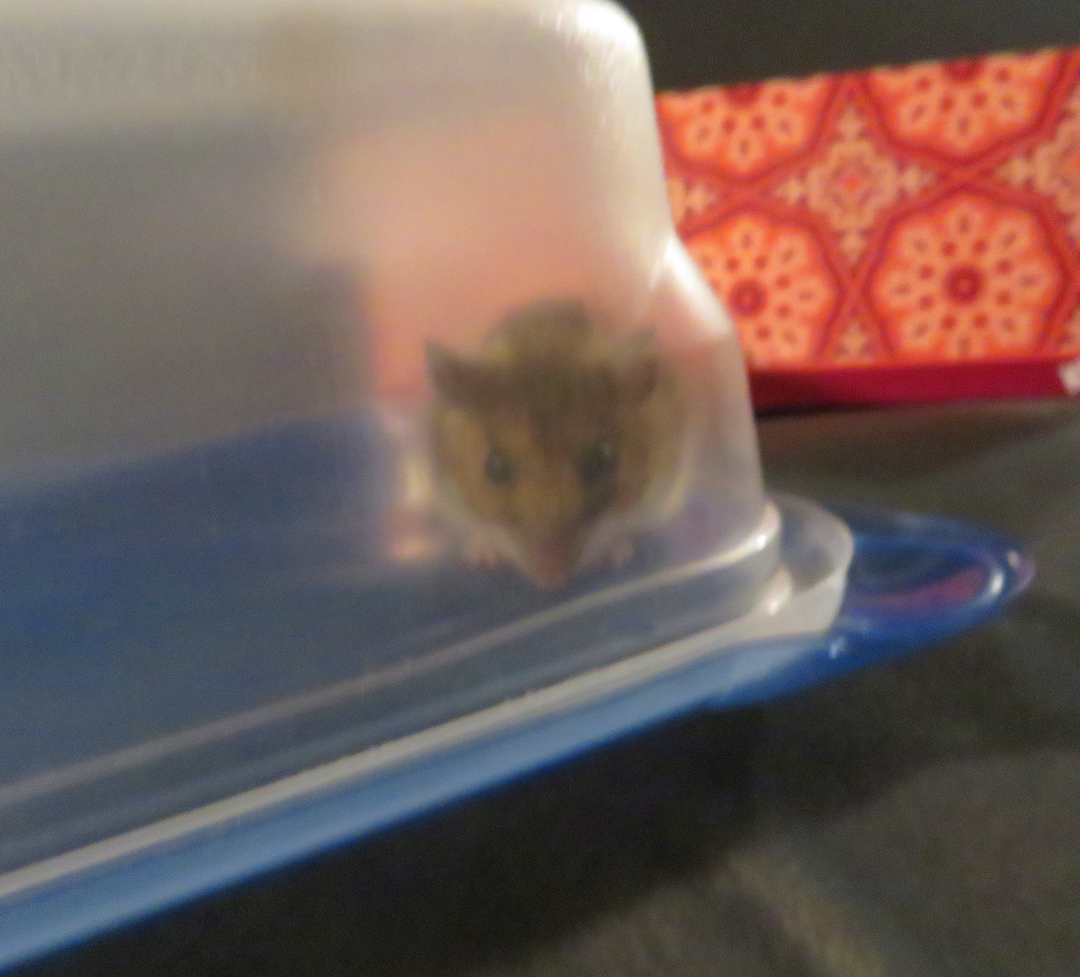
My son managed to keep his disdain under control long enough to catch the mouse in a plastic container and escort it outside to be released, but not before we took a photo though the plastic. Yes, the mouse is cute. But no, I don’t want him in my house, not on Christmas Eve or any other time.
Two new scientific studies indicate that the Omicron COVID-19 variant appears to be milder than prior strains like Delta, but it still has the potential to kill and overwhelm hospitals worldwide.
Potential – even though it’s done nothing of the sort in countries such as South Africa that have been dealing with it for longer than most.
The University of Edinburgh study, which examined nearly 24,000 patients infected with the Omicron variant in November and December, says those who’d received a vaccine saw milder symptoms and were “substantially less likely” to need hospitalization compared to Delta.
Substantially less likely. That’s very good news, is it not?
The Imperial College London study said its study found that those infected with Omicron are roughly 20% less likely to need hospitalization compared to Delta — and as much as 45% less likely to stay in hospital for more than one night.
The analysis also said people who have previously been infected with COVID-19 were even less likely to end up in the hospital — as much as 60% less likely.
When I looked at a more detailed article about one of the studies, it was hard to make out what it actually means. The whole thing seems to be an estimate of some sort. It doesn’t really have a breakdown between vaccinated and unvaccinated, much less vaccinated plus boosters. Nor does it deal with serious illness and death rates. It’s really relatively worthless-seeming.
An Israeli hospital on Tuesday confirmed the first known death in the country believed to be caused by Omicron, the latest variant of SARS-CoV-2, which has brought back 2020-like restrictions across the world. With Isreal, now there are three countries that have recorded fatalities from Omicron, the variant which is spreading faster than Delta, but causing apparently milder illness.
The Israeli hospital, where the death was reported, said the patient was a male in his sixties with a number of serious pre-existing conditions. “His morbidity stemmed mainly from pre-existing sicknesses and not from respiratory infection arising from the coronavirus,” the hospital said.…
Almost all Omicron cases across the world have zero to mild symptoms. The virus is also not affecting the lungs, as scientists believe that the variant is multiplying in the throat making scratchy throat a symptom of the variant. For weeks, there was no death attributed to Omicron. The deaths reported from these three countries — though details of all cases are not known — indicate people above the age of 50 with comorbidities are at a greater risk.
“Greater” risk of what – dying from Omicron COVID, or with Omicron COVID?
Meanwhile, Biden keeps lying about nearly everything connected with COVID. Or maybe he just forgets. Or maybe some of both.
I believe it’s The White Album that includes a memorable and very sharp put down of feminist writing. I’m sure there was a lot of resentment about that.
I haven’t read that essay, but I suspect her complaints were along the lines of most feminist writing being of the type that allowed the Sokal Hoax Trilogy to sail through the leftist journals.
It’s not just a criticism of feminist writing. It’s a criticism of feminism, and it’s a very sharp put-down indeed. A few excerpts:
To make an omelette you need not only those broken eggs but someone “oppressed” to break them: every revolutionist is presumed to understand that, and also every woman, which either does or does not make 51 per cent of the population of the United States a potentially revolutionary class. The creation of this revolutionary class was from the virtual beginning the “idea” of the women’s movement…
…[I]t depended entirely upon the popular view of the movement as some kind of collective inchoate yearning for “fulfillment” or “self expression,” a yearning absolutely devoid of ideas and therefore of any but the most pro forma benevolent interest. In fact there was an idea, and the idea was Marxist, and it was precisely to the extent that there was this Marxist idea that the curious historical anomaly known as the women’s movement would have seemed to have any interest at all.
Marxism in this country had ever been an eccentric and quixotic passion. One oppressed class after another had seemed finally to miss the point. The have?nots, it turned out, aspired mainly to having. The minorities seemed to promise more, but finally disappointed: it developed that they actually cared about the issues, that they tended to see the integration of the luncheonette and the seat in the front of the bus as real goals, and only rarely as ploys, counters in a larger game. They resisted that essential inductive leap from the immediate reform to the social ideal, and, just as disappointingly, they failed to perceive their common cause with other minorities, continued to exhibit a self-interest disconcerting in the extreme to organizers steeped in the rhetoric of “brotherhood.”
And then, at that exact dispirited moment when there seemed no one at all willing to play the proletariat, along came the women’s movement, and the invention of women as a “class.” One could not help admiring the radical simplicity of this instant transfiguration. The notion that, in the absence of a cooperative proletariat, a revolutionary class might simply be invented, made up, “named” and so brought into existence, seemed at once so pragmatic and so visionary, so precisely Emersonian, that it took the breath away, exactly confirmed one’s idea of where 19th?century transcendental instincts crossed with a late reading of Engels and Marx might lead. To read the theorists of the women’s movement was to think not of Mary Wollstonecraft but of Margaret Fuller at her most high-minded, of rushing position papers off to mimeo and drinking tea from paper cups in lieu of eating lunch; of thin raincoats on bitter nights. If the family was the last fortress of capitalism, then let us abolish the family. If the necessity for conventional reproduction of the species seemed unfair to women, then let us transcend, via technology, “the very organization of nature,” the oppression, as Shulamith Firestone saw it, “that goes back through recorded history to the animal kingdom itself.” I accept the universe, Margaret Fuller had finally allowed: Shulamith Firestone did not.
…Burn the literature, Ti-Grace Atkinson said in effect when it was suggested that, even come the revolution, there would still be left the whole body of “sexist” Western literature.
My first thought on reading about this verdict was I guess Minnesotans don’t want to have any police officers left. Because I don’t understand why any person would run the risk of becoming a police officer in such an anti-officer environment – and that’s not just based on this case.
Here’s more:
COUNT I – Charge: First-Degree Manslaughter Predicated on Reckless Use/Handling of a Firearm GUILTY
COUNT II – Charge: Second-Degree Manslaughter GUILTY
Judge orders Potter taken into custody without bail. Attorneys ask for argument on the issue. Not a danger to public, has made all court appointments, it’s Christmas season, will seek dispositional departure due to clear remorse. Ask that she not be incarcerated until sentencing. Deep roots in community, not a flight risk.
Prosecution asked she be taken into custody immediately. Customary to take into custody upon conviction for this level of crime. Potter not living in state, aggravating factor. Will be seeking Blakely sentencing enhancement.
Judge: Presumptive sentences immense, will require she be taken into custody without bail. Can’t treat this case differently than any other case.
The maximum penalty is 15 years, but as already stated, the prosecution will be asking seeking “sentencing enhancement.”
From the comments to the Legal Insurrection post:
The difficulty for the jury is the obvious fact that the law is not really clear. The jury instructions don’t help much but that is not really the fault of the judge. Some situations come down to the judgment of the jury on who they think was at fault in the incident. It is hard to see how a law could be written that would decide this question for the jury.
Personally, I would vote to acquit. It is hard for me to see how police can protect the public, let alone themselves, if they are not given some leeway in reacting to suspects who flee arrest.
…In the absence of knowledge of [Duante] Wright’s [very lengthy criminal] record, it was prudent to require that he not be allowed to escape. The state’s use of force expert was terribly naive and taken to its logical conclusion by law enforcement, civic order would collapse.
But isn’t that sort of the point? That civic order should collapse? As long as the Kim Potters of the world – a police officer who clearly made an error in a situation of tremendous pressure – are sentenced to the maximum, what else matters?
Potter could have been acquitted of criminal charges and remained civilly liable. That obviously hasn’t happened.
ADDENDUM: I think the racial aspects mattered as well. If Potter had been black or Wright white, I doubt she would have been charged at all, and I doubt that if she had been charged she would have been found guilty.
Didion specialized in the non-fiction essay, one of my favorite genres. I read her 1968 work Slouching Towards Bethlehem (title taken from Yeats’ wonderful poem “The Second Coming”) a couple of years after it came out and admired it greatly, re-reading it several times. That was so long ago, though, that I no longer remember the details. What I do remember is how well-written it was, and what a sense of anxious foreboding it conveyed.
That was my own feeling about the 1960s, too.
I later read her very sad memoir The Year of Magical Thinking, about the sudden death of her husband John Gregory Dunne and the illness of her daughter (who also died not long after the book was written). That was over fifteen years ago. Her obituaries say that she died of “complications from “Parkinson’s disease,” so she also had that affliction. Difficult.
[NOTE: Regulars here may remember that most years I put up a family Christmas recipe. And here it is again.]
This recipe was brought over from Germany sometime in the mid-1800s, and was my favorite of all the wonderful treats cooked by my great-aunt, a baker of rare gifts. She and my great-uncle were not only exceptionally wonderful people, but to my childish and wondering eyes they looked very much like Mr. and Mrs. Santa Claus.
The name of the treat is lebkuchen, but it’s quite a different one from the traditional recipe, which I don’t much care for. This is sweet and dense, can be made ahead, and keeps very well when stored in tins.
Flora’s Lebkuchen:
(preheat the oven to 375 degrees)
1 pound dark brown sugar
4 eggs
2 cups flour
1/2 tsp. baking soda
1/2 tsp. baking powder
1 tsp. cinnamon
1/2 cup chopped walnuts
4 oz. chopped dates
1 cup raisins
1 tsp. orange juice
1 tsp. vanilla extract
1 tsp. almond extract
1 tsp. lemon juice
Sift the dry ingredients together (flour, baking soda, baking powder, cinnamon).
Beat the eggs and brown sugar together with a rotary beater till the mixture forms the ribbon. Add the orange juice, lemon juice, and extracts to it.
Add the dry mixture to it, a little at a time, stirring.
Add the raisins, dates, and walnuts.
Grease and flour two 8 X 8 cake pans [NOTE: In previous years I sometimes said 9 X 9, but 8 X 8 is actually much better and makes for a far moister product.] Put batter in pans and bake for about 25 minutes (or a little less; test the cake with a cake tester at 21 or 22 minutes to see if it’s done yet). You don’t want it to get too dark and dry on the edges, but the middle can’t still be wet when tested.
Meanwhile, make the frosting.
Melt about 6 Tbs. of unsalted butter and add 2 Tbs. hot milk, and 1 Tbs. almond extract. Add enough confectioner’s sugar to make a frosting of spreading consistency (the recipe says “2 cups,” but I’ve always noticed that’s not exactly correct). You can make even more frosting if you like a lot of frosting.
Let cake cool to at least lukewarm, and spread generously with the frosting. Then cut into small pieces and store (or eat!).