↓
 

The New Neo

A blog about political change, among other things

  • Home
  • Bio
  • Email
Home » Page 1852 << 1 2 … 1,850 1,851 1,852 1,853 1,854 … 1,861 1,862 >>

Post navigation

← Previous Post
Next Post→

Home again

The New Neo Posted on April 25, 2005 by neoApril 25, 2005

Amtrak report:

Well, by the end of the trip, 80% of the toilets were dysfunctional. And the train was virtually full (methinks there is some sort of correlation between the two).

On the other hand, the seats were comfortable, my seatmate was silently plugged in the entire time (laptop, headset), the train was exactly and precisely on time (4 hours NY-Boston)–and we are alive, unlike at least 50 people in today’s horrific and tragic train wreck in Japan.

In light of my discussion yesterday of European safety standards vs. US ones, I wonder how Japan safety regulations factor in. Excessive speed seems to be the leading theory for the cause of today’s crash. A terrible, terrible thing.

Posted in Uncategorized | 4 Replies

Part 4C: work in progress

The New Neo Posted on April 24, 2005 by neoApril 24, 2005

An update for those awaiting Part 4C of the “A mind is a difficult thing to change” series: it’s in the process of being written.

But I always seem to underestimate the amount of work these things take (hmmm, I wonder what that’s all about). Previously, I said that it should be coming out early this week. That still might happen. But it’s more likely to be out mid-week, or even towards the end of the week. I will update further if that changes.

Posted in Uncategorized | 5 Replies

Traveling again

The New Neo Posted on April 24, 2005 by neoApril 24, 2005

I’m going home today.

According to the Amtrak website, my train is sold out. That should be…interesting.

And, as luck would have it, this appears in today’s NY Times, entitled “Acela, built to be rail’s savior, bedevils Amtrak at every turn.”

Excerpts from the article:

Before the first train was built, the Federal Railroad Administration required it to meet crash safety standards that senior Amtrak officials considered too strict. That forced the manufacturers, Bombardier Inc. of Canada and GEC Alstom of France, to make the trains twice as heavy as European models. Workers dubbed the trains “le cochon” – the pig.

Some experts have speculated that the added weight contributed to a series of problems, including the latest one, with Acela’s wheels, brakes and shock-absorbing assemblies. Federal regulators are still investigating the cause of those problems….

The railroad agency has long required that passenger trains be heavier than European ones to withstand crashes.

Bombardier knew its new train would have to meet those requirements, a spokeswoman said. But Mr. Downs said he asked the rail agency to ease that standard for the new high-speed trains, to no avail.

“They decided they wanted to make this the safest train in the world,” he said. “All my engineers thought the rules were nuts.”

It’s interesting that some of the problems with the Acela seem to have come from the relative strictness of safety standards here in the US vis a vis Europe. I’ve noticed this trend before in other areas, such as the pharmaceutical industry. For example, those who recall the thalidomide babies may remember that there were relatively few born in this country as compared to Europe, because our regulations on the medication’s use in pregnancy were stricter.

I have no way of knowing who is right in the case of train safety–the US or Europe–and whether the regulations are too strict here, or are too lenient there. If I lack expertise in economics, I am a wizard in that field compared to my knowledge of train design. But I suspect that the sentence “All my engineers thought the rules were nuts” may be telling. Then again, maybe not.

In any case, it’s just another topic on which the US and Europe don’t see eye-to-eye.

Posted in Uncategorized | 2 Replies

Economic illiteracy

The New Neo Posted on April 24, 2005 by neoSeptember 18, 2008

Even though I was a good student, economics was my nemesis. I passed it, but it was a slow slogging grind, and it didn’t quite stick. And, although I’ve made an effort to learn more about economics since then, every time I try, my eyes seem to glaze over and I find myself nodding off over the book.

It’s not something I’m especially proud of, but at least it keeps me from writing a whole lot of claptrap on the topic.

However, lack of economic acumen doesn’t seem to stop many (probably many on both sides, to be fair) from spouting off on economic subjects. Blogger Dennis the Peasant isn’t too keen on these folks. He is a bona fide tax expert and CPA, as well as being a very funny guy–that’s funny ha-ha, not funny strange. (Oh, well, maybe just a little funny-strange, if you look at his photo–although, come to think of it, who am I to talk on that score?) Dennis takes to task those who write about economic matters while being economically uninformed.

I have a strong feeling that I have a great deal of company in my relative economic illiteracy. I’ve been struck by how many people know enough to get by–keep their bank accounts in order, do a little investing, pay their taxes–but don’t really understand the ramifications of specific proposals designed to affect the ecomony. And yet we need good information in order to make decisions on issues that matter: what to do about the deficit? What about tax cuts vs. tax hikes? Who–if anyone–is right in the battle of the dueling experts? Do they even know? After all, economics is not exactly a science on the order of chemistry or physics. How can the vast majority of us who aren’t tax attorneys or CPAs wade through the vast quantity of information– and misinformation, deliberate or otherwise–out there?

To a certain extent, of course, that’s true of any topic that has technical aspects–which is most topics. But I have a hunch that the subject of economics is a particular sticking point for many, whether they’ll admit it or not.

Posted in Finance and economics, Me, myself, and I | 13 Replies

The view from Brooklyn Heights

The New Neo Posted on April 23, 2005 by neoMarch 4, 2007

I’ve been visiting New York City, the place where I grew up. I decide to take a walk to the Promenade in Brooklyn Heights, never having been there before.

When you approach the promenade you can’t really see what’s in store. You walk down a normal-looking street, spot a bit of blue at the end of the block, make a right turn–and, then, suddenly, there is New York.

And so it is for me. I take a turn, and catch my breath: downtown Manhattan rises to my left, seemingly close enough to touch, across the narrow East River. I see skyscrapers, piers, the orange-gold Staten Island ferry. In front of me, there are the graceful gothic arches of the Brooklyn Bridge. To my right, the back of some brownstones, and a well-tended and charming garden that goes on for a third of a mile.

I walk down the promenade looking first left and then right, not knowing which vista I prefer, but liking them both, especially in combination, because they complement each other so well.

All around me are people, relaxing. Lovers walking hand in hand, mothers pushing babies in strollers, fathers pushing babies in strollers, nannies pushing babies in strollers. People walking their dogs (a prepoderance of pugs, for some reason), pigeons strutting and courting, tourists taking photos of themselves with the skyline as background, every other person speaking a foreign language.

The garden is more advanced from what it must be at my house, reminding me that New York is really a southern city compared to New England. Daffodils, the startling blue of grape hyachinths, tulips in a rainbow of soft colors, those light-purple azaleas that are always the first of their kind, flowering pink magnolia and airy white dogwood and other blooming trees I don’t know the names of.

In the view to my left, of course, there’s something missing. Something very large. Two things, actually: the World Trade Center towers. Just the day before, we had driven past that sprawling wound, with its mostly-unfilled acreage where the WTC had once stood, now surrounded by fencing. Driving by it is like passing a war memorial and graveyard combined; the urge is to bow one’s head.

As I look at the skyline from the Promenade, I know that those towers are missing, but I don’t really register the loss visually. I left New York in 1965, never to live there again, returning thereafter only as occasional visitor. The World Trade Center was built in the early seventies, so I never managed to incorporate it into that personal New York skyline of memory that I hold in my mind’s eye, even though I saw the towers on every visit. So, what I now see resembles nothing more than the skyline of my youth, restored, a fact which seems paradoxical to me. But I feel the loss, even though I don’t see it. Viewing the skyline always has a tinge of sadness now, which it never had before 9/11.

I come to the end of the walkway and turn myself around to set off on the return trip. And, suddenly, the view changes. Now, of course, the garden is to my left and the city to my right; and the Brooklyn Bridge, which was ahead of me, is now behind me and out of sight. But now I can see for the first time, ahead of me and to the right, something that was behind me before. In the middle of the harbor, the pale-green Statue of Liberty stands firmly on its concrete foundation, arm raised high, torch in hand.

The sight is intensely familiar to me–I used to see it almost every day when I was growing up. But I’ve never seen it from this angle before. She seems both small and gigantic at the same time: dwarfed by the skyscrapers near me that threaten to overwhelm her, but towering over the water that surrounds her on all sides. The eye is drawn to her distant, heroic figure. She’s been holding that torch up for so long, she must be tired. But still she stands, resolute, her arm extended.

Posted in Best of neo-neocon, Liberty, Me, myself, and I | 12 Replies

A mind is a difficult thing to change: Part 4B (Vietnam–photographic interlude)

The New Neo Posted on April 22, 2005 by neoJanuary 13, 2019

[Previous posts in the series:
Part 1
Part 2
Part 3
Interlude
Part 4A]

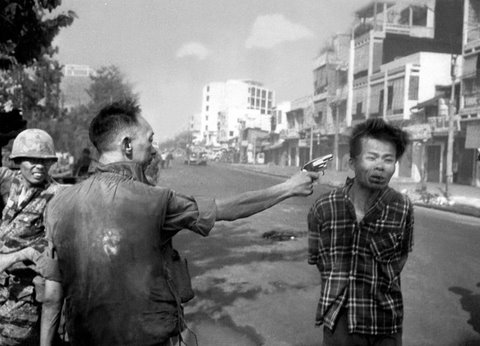
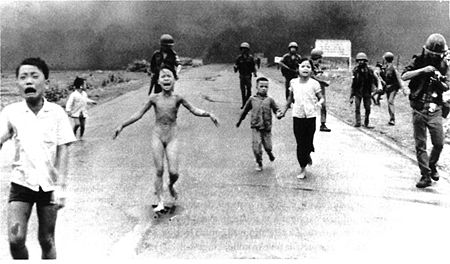
There were two widely-circulated and iconographic photographs taken during the Vietnam War. If you were around then, I can almost guarantee that you saw them, and that you remember them. They are so famous that you may have seen them and remember them even if you weren’t around at the time.

The first photo shows the February 1968 field execution of a Vietcong. Amazingly, the picture appears to have been taken at the very split-second the bullet is exiting his head. The prisoner is young-looking and slight, even boyish, dressed in a plaid shirt. He is facing the viewer and we see his face clearly and frontally, wincing, although the shooter is seen only in profile. The Vietcong’s hands are tied behind his back, and he seems terribly vulnerable. The entire photo conveys the idea of an innocent victim put to death by a ruthless and almost faceless executioner, as well as the brutality of war in general. There is no question that this photo, presented without much context, shocked people and engendered the belief that the South Vietnamese we were defending and dying for were no better than the Vietcong in their brutality.

loan3.jpg

The other photo came a few years later, towards the end of the war, in June of 1972. It is the photo of the little girl running down the road, shrieking, her clothes blown off with the force of the blast (or burned off? torn off? who knew?) her burns visible on her naked flesh. She is surrounded by other children, some of whom are shrieking, mouths open as in the Munch painting, conveying wordless horror. The children are without their parents; the only adults in the photo are several blurry and helmeted soldiers in the background (in some versions the photo was cropped to take out the soldiers on the right). The sky is dark with smoke. It’s a terrible evocation of the anguish that war inflicts on its most innocent of victims, children. A photo you couldn’t help looking at, and then you couldn’t help looking away from, and then you couldn’t help but remember it. By the time the photo was published, it was near the end of a war which had lost most of its support, but support eroded even further as a result of its wide dissemination.

napalmgirl.jpg

The photos tugged at people at a deep emotional level, screaming, “War is bad. Stop it. Stop the madness.” Furthermore, they induced a deep feeling of guilt, making the onlooker somehow conspiratorial with the executioner and with those who had dropped the bombs—doubly conspiratorial, both as voyeur to unspeakable violence, and as a citizen of the country, the US, seemingly responsible for both acts.

It never occurred to me at the time that there might be more to learn about these photos than what I already knew. That there might be a whole other “story behind the story,” one the media wasn’t telling. After all, one picture is worth a thousand words—right? Pictures don’t lie—right? What more could there be to tell? What more could there be to know, and what difference could it ever make?

And yet, it turns out that there was more. Lots more. That “more,” when I finally learned it, didn’t change the fact that bad things happen in war—lots of them. But that “more” made a difference in the way that some viewers (including me) saw those photos, the South Vietnamese military, the US, and the press.

But I didn’t discover what that “more” was until about two years ago, around the time of the Iraq war. So I’m going to need to wait until I get to that point in my tale to tell the story behind the photos, and how learning the truth about them, after so many years, was one of many steps I took that swept me along the path of change, post-9/11.

[Next post in series here.]

Posted in A mind is a difficult thing to change: my change story, Me, myself, and I, Vietnam | 44 Replies

A mind is a difficult thing to change: Part 4A (Vietnam–the home front)

The New Neo Posted on April 21, 2005 by neoJanuary 13, 2019

(Part 1)
(Part 2)
(Part 3)
(Interlude)

PREFACE

Part 4 has been a long time coming. The article itself is long, too–so long that I finally decided it would be best to divide it into segments, so readers might have a chance of swallowing it without getting a massive case of indigestion.

I’ll tell you what this post isn’t–it’s not a history of the war itself. It isn’t about those who fought in it, or the Vietnamese people who suffered through it. It’s a political psychological history, an attempt to describe how perceptions were formed in those who remained in this country, particularly those who were young liberals, or who became liberals as a result. So, please don’t castigate me for ignoring this or that aspect of the war; this is not meant to be comprehensive or definitive.

This first segment, Part 4A, deals with my own personal history during the Vietnam era. I start with it to set the scene, and because I think in many ways it is typical of liberals of the time, and can serve as a springboard for later, more general, discussion. Part 4B, which will probably come out tomorrow, is relatively short, and deals with some Vietnam-era photographs. If you think Part 4A is self-indulgent, or rambling, or pointless–after all, who cares about my history?–please bear with me; there’s method to my madness. The payoff (I hope!) will occur in Part 4C.

Part 4C, the third and final segment of Part 4, will probably be posted at the beginning of next week. It’s the part in which I attempt to bring it all together in terms of intrapersonal political change, the theme of this entire “Mind is a difficult thing to change” series. In Part 4C, I will be coming to some more general observations about how the Vietnam War formed (and, in some cases, transformed) political perceptions for many people of my generation, particularly liberals. In later posts (as yet to be written, but definitely on my mind), I will attempt to connect all of this to post-9/11 political change.

So, that’s my blueprint and my plan.

THE VIETNAM WAR–THE HOME FRONT

For those of you accustomed to the almost lightening-quick “major operations” phase of the Gulf, Afghan, and Iraq wars, it’s hard to get a sense of how agonizingly interminable the Vietnam war seemed to those of us who grew up during it. And the Vietnam war was long, even by WWI and WWII standards, although smaller in scope.

The first Green Beret advisors arrived in Vietnam in 1961, when I was still in junior high. The Gulf of Tonkin Resolution occurred in the summer of 1964, right before my senior year of high school, and the first US combat troops entered Vietnam shortly thereafter. In this manner, the war went from a distant background noise throughout my junior high and early high school years to a much more audible presence by my senior year of high school, and continued as a loud and discordant cacophony the entire time I was in college and for four years thereafter, with peace talks occurring in 1972, and the catastrophic US leavetaking in 1973. Saigon finally fell to the Communists in 1975. The toll in human life was high: the total number of US deaths there was over 58,000, with Vietnamese deaths in the war variously estimated as having been between one and two million.

The most serious escalation of the war coincided exactly with my college years, 1965-1969. I was younger than most of the other students; I had entered college shortly after my seventeenth birthday. We were all Cold War babies, having grown up with the constant threat of nuclear war but without the US actually having been involved in a major “hot” shooting war (except for the Korean conflict, which we were too young to really remember). So this was new to us.

I was very uneasy about the Vietnam war right from the start of the first troop commitments. At the beginning, the war upset me simply by the distressing fact that people were being killed; later on, I hated the war because it seemed unwinnable and thus an utter waste of human life.

Like most young people of the time, I took the war very personally. It’s probably hard to convey to later generations the powerful and all-pervasive nature of the draft, a sword of Damocles that hung over the heads of everyone. Even though I was a woman, and therefore couldn’t be drafted myself, every young man I knew was facing it, and so it affected me indirectly.

My boyfriend had flunked out of college (almost deliberately) in 1967, was drafted early in 1968, and six months later was sent to Vietnam and into heavy combat. Looking back, it seems to me that we were both painfully young. I was eighteen when we had begun to date, nineteen when he was drafted, twenty when he went to Vietnam, and barely twenty-one on his return. He was only one year older than I. I made sure I wrote to him every day while he was there. He was wounded and spent several weeks recuperating, but was sent back into the thick of the fighting. I was frantic with fear and pretty much alone with it; I didn’t personally know anyone else in college who had a loved one in a similar situation.

During the time he was there, and afterwards, I continued to hate the war (as did my boyfriend, by the way, although he felt it was his duty to serve). I hated the killing, was stricken by the nightly TV news featuring what seemed to be the same harrowing scenes played over and over: wailing Asian women clutching children, wounded soldiers on stretchers (I strained and squinted to see whether any of them looked like my boyfriend, because one of them might actually be my boyfriend), thick vegetation, burning huts. Over and over and over, to no seeming purpose, and with no end in sight. I could barely stand to watch, and sometimes I turned away, overwhelmed.

Throughout this time, both during the war and after, I was getting my news from several sources: network TV, Newsweek, Time, the Boston Globe, and the NY Times. I was under the impression that this represented a broad spectrum of news. These sources displayed a unanimity of opinion that I never questioned–after all, if so many highly respected media agreed, it must be because they were written by intelligent people who were seeking the truth, and telling it to us as best they could.

I remember Tet, Hue, Khe Sanh, all bunched together within a few short months in 1968, around the time my boyfriend was drafted. I remember those battles being portrayed as pointless scenes of carnage, signifying nothing. I remember the My Lai massacre, which also had occurred during the same time period, although we didn’t find out about it until a year later. It was deeply shocking to most of us; we had previously believed American soldiers incapable of such atrocities. We had been raised in the 50s on heroic WWII movies from the 40s, and had grown up with a press that had generally considered soldiers heroes, so this was a profoundly troubling revelation.

My attitude towards the war seemed to be quite typical, according to what I remember of my friends in college. We weren’t political junkies, for the most part, and hadn’t learned about the war in exhaustive detail. We read and/or watched the basic news and discussed the war, but in general terms–we felt we had the big picture correct, which was the most important thing, and we all agreed with each other, anyway. A few of my leftist friends (SDS was very active on my campus), spouted a more extreme version of events, in which they demonized the US–for example, I got into an argument with one friend who insisted that the goal of the US was to commit genocide in Vietnam–but the leftists seemed to me to be more interested in sloganeering and grandstanding than in actual facts or rational debate.

Of course, there were people who had different ideas about the war. But I personally knew none of these people, nor did I see their ideas being advocated in the media, for the most part. But there was the idea that the war originally had been both a good cause and a winnable one, although for political reasons the war had been mismanaged and fought in a half-hearted fashion. There was the idea that a liberal press had misrepresented the battles of 1968, including Tet, as defeats, when in fact they had been victories. There was the idea that, if we were to put more effort and money into it, the later policy of Vietnamization had a real chance of working and giving us the “peace with honor” we all desired, but the public had so turned against the war by that time that such money and effort would not be forthcoming.

But these voices seemed barely audible at the time. The only airing of some of these thoughts that I can recall was by John O’Neil during his June 1971 Dick Cavett show debate with John Kerry. O’Neill seemed sincere but naive and idealistic; Kerry had a world-weary air of having seen it all and known it all. But at least the debate provided food for thought and an airing of alternate views in a substantive manner, in a popular and readily-available forum. As such, it seemed unusual to me.

As time and the war had gone on, the tale told to us by the media wasn’t just about the war itself: it was about how the government had lied to the American people and deceived us, how it couldn’t be trusted. That message grew more focused during the early 70s, during the spring 1971 Congressional hearings on the war (the ones that featured John Kerry), and with the publication of the Pentagon Papers, which came out two months later. It was particularly convincing to hear disillusioned veterans such as Kerry speak out and demonstrate against the war–after all, they were the ones who been there and seen it firsthand. The Pentagon Papers revealed that the government had been deceptive about the war and the planning behind it. Then there was the invasion of Cambodia, perceived as an escalation of the war after Nixon had promised a reduction; and the killing of student protesters at Kent State by the National Guard, which made us feel as though war had been declared on us, too–on young people, on students. The message that the government could not be trusted was further reinforced by the Watergate scandal, commencing with the break-in in 1972 and ending later, after we had left Vietnam, in the ignominious 1974 resignation of Nixon.

If we couldn’t trust the government–well, then, who could we trust? Many decided to trust the whistleblowers: the press, our new heroes. After all, they had published the Pentagon Papers. They had shown us photos of what had happened at Kent State. They had brought the horror of My Lai to our attention. They had been instrumental in the exposure of the Watergate scandal, which had disgraced (and later was to bring down) a President most of us already disliked anyway.

WAR’S END

By the early 70s, virtually everyone I knew had become convinced that the war had been a tragedy and that the lies were so endemic we had no way of learning the truth from the government. I attended the 1969 march on Washington and a few smaller rallies. I believed that what the US had tried to do–prevent the Communists from taking over the whole country–had been a worthwhile goal, but an impossible one.

It seemed that, in our efforts to prevent that takeover, we had caused great damage. I wasn’t even sure that the Vietnamese people had ever wanted us there in the first place, or that they supported the South Vietnamese government; there seemed to be so many North Vietnamese, and they just would not give up. What about that domino theory, anyway, the original justification for the war? It was just a theory, after all–was it even true, did it actually apply here? If the war kept going on this way, indefinitely, Vietnam itself would be destroyed (if it hadn’t already been), and more and more Americans would die, too, all in a losing cause.

Therefore I rejoiced as we pulled troops out, and was happy about the peace talks. I watched some of the footage of the fall of Saigon, and was heartsick, but I believed nothing could have prevented this–it had been inevitable, and better sooner than later, after more death and destruction. Finally, I turned away from those pictures, just as I’d turned away, at times, from footage of the war itself–too painful, too hopeless, too sad, too powerless to help.

These Vietnam memories and judgments remained encapsulated within me for the next thirty or so years, untouched and unexamined, a painful and unhealed wound. I saw no reason to re-examine them, and nothing to make me doubt them. They lay dormant but retained their potency, needing only the right conditions to germinate in surprising ways much later, post-9/11.

UPDATE: Part 4B has been posted.

Posted in A mind is a difficult thing to change: my change story, Me, myself, and I, Vietnam | 75 Replies

I guess they like the kimchee (“Escapee elephants visit Seoul restaurant”)

The New Neo Posted on April 20, 2005 by neoApril 20, 2005

The MSN headline did what it’s supposed to do–it certainly caught my eye: “Escapee elephants visit Seoul restaurant.” The article has a few wonderful details. There were six elephants in all; one elephant bolted during their daily parade outside a children’s park, and the others followed because, “they have a tendency to do that,” according to an official.

I had no idea elephants were such sheep.

One elephant “was briefly detained at a police station.” I hope they read him (her?) his (her?) Miranda rights.

I know elephants can be very dangerous, so it’s no joke when they escape, but all’s well that ends well, and this escapade did–although I’m not sure the elephants would agree. They are now back in captivity.

Posted in Uncategorized | 4 Replies

Pope Benedict XVI

The New Neo Posted on April 19, 2005 by neoAugust 28, 2009

Just in–a new pope has been elected. He’s Benedict XVI (formerly Cardinal Ratzinger from Germany), considered a hard-line conservative.

I think it’s interesting, in light of my previous post about cardinals over 80 not being allowed to vote for pope, that the new pope is 78 years old. So we came very close to that speculative scenario in which the new pope would be considered too old be part of the selection process, but not too old to serve as pope.

Other biographical facts about this pope that caught my eye, from the Wikipedia article I linked to: he deserted from the German army during WWII (a move punishable by death), and was briefly held by the Americans as a prisoner of war. Also, he was a university professor for a while, but “was confirmed in his traditionalist views by the liberal atmosphere of Té¼bingen and the Marxist leanings of the student movement of the 1960s.” Hmmm.

It seems that the cardinals aren’t interested in any change right now from the conservative doctrines of John Paul II (although I’m not a Catholic, I’d hoped for someone less conservative). But, by choosing an older man, they also don’t seem to want to lock this up for a long time.

I wish him well in dealing with the problems within the church and the world, and in following in the large footsteps of the charismatic John Paul II.

Posted in People of interest | 7 Replies

Bloggers in person

The New Neo Posted on April 19, 2005 by neoMarch 4, 2007

I’m here in New York, with the unbelievably lovely weather and the daffodils all in bloom. It feels like the tropics to me. Big celebration tonight for a major birthday of my brother–which one? I’ll never tell.

But last night I managed to meet up with a bunch of bloggers for a drink, dinner, and conversation. Present were the illustrious Cara and Jeremy from Who Knew, Norm Geras of Normblog (visiting from England and doing the tourist thing in NY), Mary of exit zero (and presently guesting, with Jeremy, at Michael Totten’s), and Judith of Kesher Talk.

See, you have dinner with me, you get a link–just like that!

One of the many beauties of the event is that I don’t have to write about it much, because I imagine the others will. But I did want to say a couple of things. The first one is that, as you might imagine to be the case, bloggers can talk. Even bereft of our computers, no problem at all.

Secondly, I think there might be a future in some sort of twelve-step program for bloggers. It does have a fairly addictive quality. Those bloggers among you, you probably know what I mean.

Thirdly (although I know it’s hard to believe), we are all even more fascinating and charming in person than in print.

Posted in Blogging and bloggers | 3 Replies

Timeless Orwell

The New Neo Posted on April 19, 2005 by neoMarch 4, 2007

George Orwell was certainly one for the pithy saying with a lot of punch, short and to the point. I came across a web page specializing in Orwelliana, and was struck by the number of comments that seemed to be remarkable encapsulations of powerful truths, as topical today (if not more so) as the day he wrote them.

Some of my favorites:

The high sentiments always win in the end, the leaders who offer blood, toil, tears, and sweat always get more out of their followers than those who offer safety and a good time. When it comes to the pinch, human beings are heroic.

To see what is in front of one’s nose requires a constant struggle.

No advance in wealth, no softening of manners, no reform or revolution has ever brought human equality a millimeter nearer.

Whoever is winning at the moment will always seem to be invincible.

There is hardly such a thing as a war in which it makes no difference who wins. Nearly always one side stands more or less for progress, the other side more or less for reaction.

Early in life I had noticed that no event is ever correctly reported in a newspaper.

So much of left-wing thought is a kind of playing with fire by people who don’t even know that fire is hot.

And this, from another website

War is evil, but it is often the lesser evil.

Posted in Historical figures, Literature and writing | 11 Replies

Going out in style

The New Neo Posted on April 19, 2005 by neoApril 19, 2005

Viewed at Roger Simon’s–the following headstone seems to have inspired me to poetry. Please forgive me; I must obey my muse.

Technology gallops apace,
Computers, hybrids, men in space.
So, now there’s a headstone
That’s shaped like a cellphone
To “phone home” from the other place.

Posted in Uncategorized | 2 Replies

Post navigation

← Previous Post
Next Post→

Your support is appreciated through a one-time or monthly Paypal donation

Please click the link recommended books and search bar for Amazon purchases through neo. I receive a commission from all such purchases.

Archives

Recent Comments

  • HC68 on Our intrepid allies: Spain, Britain, Germany, and France
  • HC68 on Another roundup
  • Barry Meislin on Another roundup
  • AesopFan on Open thread 3/5/2026
  • huxley on Another roundup

Recent Posts

  • Another roundup
  • Rubio the seer, circa 2015
  • Our intrepid allies: Spain, Britain, Germany, and France
  • Open thread 3/5/2026
  • If it bleeds, it leads – especially if it makes the US or Israel look bad

Categories

  • A mind is a difficult thing to change: my change story (17)
  • Academia (318)
  • Afghanistan (97)
  • Amazon orders (6)
  • Arts (8)
  • Baseball and sports (161)
  • Best of neo-neocon (88)
  • Biden (536)
  • Blogging and bloggers (580)
  • Dance (286)
  • Disaster (238)
  • Education (319)
  • Election 2012 (360)
  • Election 2016 (564)
  • Election 2018 (32)
  • Election 2020 (510)
  • Election 2022 (114)
  • Election 2024 (403)
  • Election 2026 (11)
  • Election 2028 (3)
  • Evil (126)
  • Fashion and beauty (323)
  • Finance and economics (998)
  • Food (316)
  • Friendship (47)
  • Gardening (18)
  • General information about neo (4)
  • Getting philosophical: life, love, the universe (724)
  • Health (1,132)
  • Health care reform (545)
  • Hillary Clinton (184)
  • Historical figures (329)
  • History (698)
  • Immigration (425)
  • Iran (391)
  • Iraq (223)
  • IRS scandal (71)
  • Israel/Palestine (782)
  • Jews (411)
  • Language and grammar (357)
  • Latin America (199)
  • Law (2,879)
  • Leaving the circle: political apostasy (124)
  • Liberals and conservatives; left and right (1,269)
  • Liberty (1,095)
  • Literary leftists (14)
  • Literature and writing (386)
  • Me, myself, and I (1,463)
  • Men and women; marriage and divorce and sex (902)
  • Middle East (380)
  • Military (304)
  • Movies (342)
  • Music (522)
  • Nature (253)
  • Neocons (32)
  • New England (176)
  • Obama (1,735)
  • Pacifism (16)
  • Painting, sculpture, photography (126)
  • Palin (93)
  • Paris and France2 trial (25)
  • People of interest (1,014)
  • Poetry (255)
  • Political changers (176)
  • Politics (2,764)
  • Pop culture (392)
  • Press (1,608)
  • Race and racism (857)
  • Religion (409)
  • Romney (164)
  • Ryan (16)
  • Science (621)
  • Terrorism and terrorists (964)
  • Theater and TV (263)
  • Therapy (67)
  • Trump (1,569)
  • Uncategorized (4,321)
  • Vietnam (108)
  • Violence (1,390)
  • War and Peace (952)

Blogroll

Ace (bold)
AmericanDigest (writer’s digest)
AmericanThinker (thought full)
Anchoress (first things first)
AnnAlthouse (more than law)
AugeanStables (historian’s task)
BelmontClub (deep thoughts)
Betsy’sPage (teach)
Bookworm (writingReader)
ChicagoBoyz (boyz will be)
DanielInVenezuela (liberty)
Dr.Helen (rights of man)
Dr.Sanity (shrink archives)
DreamsToLightening (Asher)
EdDriscoll (market liberal)
Fausta’sBlog (opinionated)
GayPatriot (self-explanatory)
HadEnoughTherapy? (yep)
HotAir (a roomful)
InstaPundit (the hub)
JawaReport (the doctor’s Rusty)
LegalInsurrection (law prof)
Maggie’sFarm (togetherness)
MelaniePhillips (formidable)
MerylYourish (centrist)
MichaelTotten (globetrotter)
MichaelYon (War Zones)
Michelle Malkin (clarion pen)
MichelleObama’sMirror (reflect)
NoPasaran! (bluntFrench)
NormanGeras (archives)
OneCosmos (Gagdad Bob)
Pamela Geller (Atlas Shrugs)
PJMedia (comprehensive)
PointOfNoReturn (exodus)
Powerline (foursight)
QandO (neolibertarian)
RedState (conservative)
RogerL.Simon (PJ guy)
SisterToldjah (she said)
Sisu (commentary plus cats)
Spengler (Goldman)
VictorDavisHanson (prof)
Vodkapundit (drinker-thinker)
Volokh (lawblog)
Zombie (alive)

Meta

  • Log in
  • Entries feed
  • Comments feed
  • WordPress.org
©2026 - The New Neo - Weaver Xtreme Theme Email
Web Analytics
↑