↓
 

The New Neo

A blog about political change, among other things

  • Home
  • Bio
  • Email
Home » Page 1750 << 1 2 … 1,748 1,749 1,750 1,751 1,752 … 1,863 1,864 >>

Post navigation

← Previous Post
Next Post→

Bill: been missin’ ya, miss kissin’ ya

The New Neo Posted on August 15, 2007 by neoSeptember 4, 2007

Yesterday I saw my first one of these:

miss-bill.JPG

Can’t say as I do. But that’s just me. I was never a big fan, even though I voted for him—twice, with vigor. But in the NH primary of 92, I was a registered Democrat and voted for this guy instead (RIP):

tsongas.jpg

And if you’re wondering about the source for the title of this post, see this. And despite what that lyric sheet says, I stand with eliminating the “g” in “missing” and “kissing.” It was dropped in the song—listen up!

Posted in Music, Politics | 44 Replies

Iraq: Spiegel bravely reports the good news

The New Neo Posted on August 14, 2007 by neoAugust 14, 2007

This is highly recommended reading—Spiegel reports on the possibly turning tide in Iraq, and the fact that many just don’t want to hear it.

I plan to write at greater length on the subject some time soon.

[ADDENDUM: Oh, no! Could it be there’s political progress in Iraq, too?]

Posted in Uncategorized | 22 Replies

Religion and the Presidency

The New Neo Posted on August 14, 2007 by neoAugust 25, 2007

Presidential candidate Rudy Giuliani is a Catholic, although—as this column by Richard Cohen points out—his marital history isn’t precisely what the Catholic church would consider ideal.

Cohen compares Giuliani’s recent answer to a question about his Catholicism with that of a man widely known as “the first Catholic President,” JFK. Giuliani told reporters his religion was his own private affair; JFK said it would not influence his policy decisions as President.

I remember hearing a lot about JFK’s Catholicism during the 1960 campaign. It’s hard to believe now, but his religion really was an issue for many people, who entertained the notion that his election might mean the Pope would be running the country by proxy.

Those sorts of ideas are way behind us. Or are they? Continue reading →

Posted in Politics, Religion | 7 Replies

Let’s not sully that narrative with anything as picayune as facts

The New Neo Posted on August 13, 2007 by neoAugust 13, 2007

I just love the following statement by Evan Thomas, Newsweek editor, concerning his periodical’s reporting of the Duke rape case: The narrative was right, but the facts were wrong.

Thomas actually was one of the writers who wrote early on that there was some doubt about the lacrosse students’ guilt. But, unfortunately, that didn’t stop him or his magazine from pushing a different “narrative,” one that made an assumption of a heady and titillating mix of rape and racism.

Thomas’s words about narrative vs. facts would be laughable—a sort of Onion-like parody—if they weren’t meant so seriously, and if they didn’t represent a perversion of what journalism is meant to be about. Thomas is actually describing the sensibility of fiction writers rather than of reporters. The former make up facts in order to get at a “greater truth.”

But everyone knows that fiction is an act of creative writing, whereas journalism is supposed to be its exact opposite, a discipline in which the facts should be paramount. “Narratives” help people make sense of and order facts and put them in perspective and context. They give those facts meaning, but they must never supercede them,

Of course, reporters are often merely reporting facts that others are feeding them. But investigative reporters are different; they are supposed to question those facts and do independent research to see whether they are corroborated. If not, the story—the “narrative”—shouldn’t hold together.

In addition, in criminal cases, the media is supposed to preserve the presumption of innocence as much as possible in all its reportage. But that isn’t very “sexy.” It’s the more sensational “narratives” that sell magazines and newspapers, and get people watching the cable networks.

We all maintain “narratives,” arrived at from our observations over time. This is as true of conservatives as it is of liberals. Most people have a tendency to filter out or discount facts that don’t agree with their already-formed worldview, which is why change of opinon is so difficult to accomplish.

I’ve written many words on the subject of how people end up changing their minds (see all the posts on the right sidebar in the category “A mind is a difficult thing to change”), and probably will write many more. But one thing necessary for such change to occur is a mind open to the assimilation of new facts, and flexible enough to change in response to an accretion of supporting facts.

How many supporting facts are enough to cause that “leap” into a new point of view? The tipping point is different for different people. Some hold so stubbornly to their belief systems that no amount of “steenking facts” can dislodge them. If a person can’t change even in the face of overwhelming evidence to the contrary (see the last part of this post for a good example) then his/her set of beliefs is impermeable to the challenge of facts, and resembles an act of faith rather than a matter of cognition.

I’m not meaning to knock faith, which inherently transcends the rational (Pascal’s very logical “wager”—which is based, paradoxically, on the idea that the existence of the deity cannot be decided by reason— notwithstanding). But politics should not be religion, and court cases cannot be decided on faith—or “narratives.”

[ADDENDUM: If you want to read a wonderful book that explains how the Left came to rely less and less on facts and more and more on narratives, please read this wonderfully lucid explanation.]

Posted in Press | 15 Replies

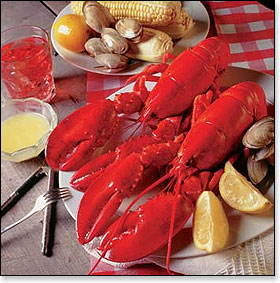
What, no lobster or steamers?

The New Neo Posted on August 12, 2007 by neoAugust 12, 2007

President Bush and my man Sarkozy are together at last—and in my neck of the woods, more or less. Sarkozy has been staying at Lake Winnipesaukee in New Hampshire, and Bush is at the family manse in Kennebunkport; two places I know well, at least from numerous drive-bys.

Well enough to say that this AP report is wrong when it refers to Walker’s Point, the site of the Bush estate, as “craggy.” It’s certainly not craggy by Maine standards—or perhaps by any standards. I’ll let you decide:

bushcompound.jpg

That’s a minor quibble, of course. And I’ve got a couple more, only this time for Bush: why no lobster on the menu? And why no steamers? And please, George, giving him the choice of a hamburger or a hot dog? C’mon don’t be stingy, this is your new buddy, not Jacques Chirac. How about both?

Come to think of it, don’t stint; offer the guy a shore dinner:

shoredinner.jpg

And invite neo-neocon. There’s still time.

Posted in Uncategorized | 20 Replies

The Democratic candidates and the pullout: will they find themselves in the Nixon position?

The New Neo Posted on August 11, 2007 by neoAugust 11, 2007

This NY Times article describes how the Democratic Presidential candidates are starting to offer a few more ideas about how they might manage an Iraqi pullout, if elected.

I guess they’ve given up on their earlier strategy of pressuring Bush. Now they seem to be accepting that the consequences of actually attaining power in 2008 might be the need to fulfill their own campaign promises rather than to get Bush to do it for them.

Which means that the Democrats now fear the “helicopters on the roof” scenario that I wrote about here. The President presiding over that debacle was Ford, but the drawdown of troops that preceded it—known as “Vietnamization,” was Nixon’s fulfillment of his own 1968 campaign promises (see this) to reduce the number of US forces while making the South Vietnamese take more responsibility for the fight.

Nixon’s policy was a slow one; the elimination of active US fighting forces in Vietnam took many years:

vietnamization.png

We supported the South Vietnamese military with money and equipment for several more years. The end, when it came—forced by the Democratic Congress of the time, with the weakened and unelected President Ford in charge instead of the disgraced Nixon—featured those famous helicopter emblems of retreat, shame, and abandonment.

What do the Democrats plan now that they realize they might need to preside over something similar? Their basic message is still “withdraw,” but the details given by most of the frontrunners are vague, with suggestions that the process would involve some time rather occurring very quickly, and would need to feature protection from the possibility of an Iraqi bloodbath or genocide.

It’s a good sign that the Democratic candidates are beginning to take tentative steps towards the reality of Iraq and what a precipitous withdrawal would probably mean. But nothing indicates they know how to go about preventing one, or protecting the troops and the Iraqi people from the consequences of such a pullout. As the Times says:

…[the Democratic Presidential candidates] all discuss a mix of vigorous diplomacy in the region, intensified pressure on the Iraqi government and a phased withdrawal of troops to begin as soon as possible. But their statements in campaign settings are often silent on the problems of how to disengage and what tradeoffs might be necessary.

Perhaps that’s because previously they really believed they had the power to make the current administration handle it, and so they didn’t think they had to come up with much in the way of a program.

Candidate Bill Richardson (who is unlikely to actually win the nomination) seems to be the most minimalist of all. His proposal is a model of simplicity: I have a one-point plan to get out of Iraq: Get out! Get out!

Doesn’t inspire much faith, does he—except perhaps in moveon.org members.

It’s a strange irony that Democrats may find themselves in the position of the hated and reviled Nixon, attempting to finish a war they feel they bear no responsibility for having started (despite their vote in support of it; that’s why the “Bush lied” meme is so important for them), and inheriting all its conundrums, risks, and dilemmas.

Posted in Politics | 15 Replies

Predicting the blog clog: Kundera saw it all

The New Neo Posted on August 10, 2007 by neoAugust 10, 2007

There are an awful lot of blogs these days (and a lot of them, no doubt, are awful).

Technorati tracks about 57 million blogs, with a little over half of them regarded as “active”—meaning that the bloggers post at least once every three months, which doesn’t sound all that active to me. Ex-bloggers outnumber current bloggers: there are 200 million of the former.

What drives those of us who persevere? It helps to have an audience, I must confess. But the impetus is mostly internal. The majority of the bloggers I’ve met are people with ideophoria, who’ve been plagued—or blessed, take your pick—all their lives by active minds crowded with thoughts that they want to express. A blog certainly gives them the forum for that.

Predictions are that the trend will peak in 2007 because of saturation of both readers and bloggers. And it’s true that many people I know simply aren’t interested in reading blogs, or in spending any more time online than they already do, and probably never will be. Their habits are set, and they get their news through print, TV, and radio. With each new generation, though, my guess is that the blogosphere will continue to grow, although how much is anyone’s guess.

Favorite author Milan Kundera has already weighed in on the matter, of course. In his wonderful Book of Laughter and Forgetting (1978), he foresaw the ultimate consequences of it all, although not the mechanism (computers and blogs).

And so this post is just a sneaky way to get in this quote from Kundera:

The irresistible proliferation of graphomania among politicians, taxi drivers, childbearers, lovers, murderers, thieves, prostitutes, officials, doctors, and patients shows me that everyone without exception bears a potential writer within him, so that the entire human species has good reason to go down into the streets and shout: “We are all writers!”

For everyone is pained by the thought of disappearing, unheard and unseen, into an indifferent universe, and because of that everyone wants, while there is still time, to turn himself into a universe of words.

One morning (and it will be soon), when everyone wakes up as a writer, the age of universal deafness and incomprehension will have arrived.

Posted in Blogging and bloggers, Literature and writing | 20 Replies

War stories: TNR and Beachamp—what’s all the breast-beating about? (Part II)

The New Neo Posted on August 9, 2007 by neoAugust 10, 2007

[Part I here.]

In previous wars, allegations of atrocities have been made by either victims or witnesses. For example, in the case of My Lai, reports were originally made by US helicopter pilots who were shocked by what they saw as they hovered over the action. There’s no indication that anyone involved in the actual murders came forward with a mea culpa, and the investigation was stalled until it went public.

My Lai was a watershed of sorts, a bona vide and documented atrocity by the US military involving hundreds of victims (and please see this link to understand what actually happened there). Vietnam—and the shock of My Lai—seemed to open the floodgates towards self-revelation of war crimes, as exemplified by the Winter Soldier hearings in 1971, which occurred about a year after My Lai became public but before the trial and sentences had been completed.

These hearings were nothing if not profoundly controversial, and remain so even today. This is not the place to debate whether they were “packed with pretenders and liars” (as this comprehensive site alleges. and this book describes), or whether the testimony given at the hearings was valid. You can do the research and come to your own conclusions. What I’m most interested in for the purposes of this post is the fact of people—veterans or pretenders—publicly confessing to their own war crimes (or misdemeanors), real or imagined.

I’m hardly equating those who tell the truth with those who lie. Those who are telling the truth have fairly straightforward motivations, although they may indeed have an agenda. In this they are probably motivated by the same things that drive any confessor of a crime he/she has committed: conscience, and/or the apprehension that he/she might be about to be caught anyway.

But what about the liars or exaggerators (and Beauchamp may well be among them)?

Lying about war exploits is not at all unusual. In fact, it’s so common that there’s a stock commedia dell ‘arte character known as “Capitano” who fits this description, as Roger Simon pointed out in connection with John Kerry during the 2004 campaign. But this figure, although a liar and pretender, pretends at heroism, not barbarity. His lies are designed to augment his claims of bravery; they are most decidedly not confessions of wrongdoing.

My Lai, although an incident unique in scope and circumstance, had a profound effect on perceptions of the military in the US. Traditional kneejerk assumptions of bravery and honor—those that any “Capitanos” would previously have been bragging about—were stood on their head.

The peculiarities and special characteristics of the Vietnam War that provided the context for My Lai were largely unknown to the American public; to gain some insight, please go here, scroll down to about a quarter of the way from the bottom, and take special care to read the sections entitled “Rules of Engagement,” “General Westmoreland’s ‘Strategy of Attrition,'” “Rotations,” “Enemy Tactics,” “Project 100,000,” and “Heavy Losses/Casualties.” These problems and others meant that Vietnam was a sort of transitional war in which the military was facing conditions for it was inadequately prepared, which led to especially heavy stresses for those who fought there.

This, combined with the beginnings of what might be called the “therapizing” of America, may have led to a different sort of “bragging”—this time, about wrongdoings. Unlike the vets of WWII, who believed that the best way to deal with whatever psychological trauma they had experienced during that war was to keep their mouths shut and reenter the peacetime world, Vietnam (and all subsequent) vets have been exposed to the idea that voicing feelings helps to exorcise them, and that confessing to crimes (or misdemeanors) could be one good way to do that.

During Vietnam, the Left was very active in organizing confessional events such as Winter Soldier. There is evidence that they were assisted in this by the Communists in Hanoi, who rightly supposed that such mass confessions would be good for their propaganda purposes as well. Whether or not the Communists were actually involved, there’s no doubt that the entire Winter Soldier event was a group rather than an individual one, and as such the confessing vets would have been subjected to interpersonal pressures, including suggestibility and even competitiveness.

False confessions are not limited to wartime crimes, however; they are a well-known phenomenon that police often have to deal with (one recent case is here.) Sometimes they are coerced, but it’s not at all unheard of for them to be voluntary.

What would motivate a person to make a false confession? Ordinarily, one (or some combination) of the following: the need to expiate guilt over some other offense, real or imagined; the desire for attention, even if negative; and/or the delusion that the false confession is actually true.

Beauchamp’s stories, if false, would almost undoubtedly fall under one or several of these headings. I will speculate that the second one—desire for attention—is the most likely motivator for Beauchamp, although that doesn’t rule out any of the others. But publication in TNR is certainly a plum for an aspiring writer (I wouldn’t mind that gig myself). He’s already revealed that he initially went to Iraq in order to write a book about this “misguided” war, so it’s clear that—whatever else may or may not have occurred to him after arriving there—he came there already having an antiwar agenda. It would stand to reason that Beauchamp also came to the Iraq war with the template set down by My Lai and the Winter Soldier testimony about the US military (as well as Abu Ghraib) set firmly in his mind.

If notoriety was his motivation, Beauchamp has already gotten his fifteen minutes of fame, and more—perhaps more than he originally bargained for when he took computer in hand and set about to write his dispatches. And he’s done his bit to further the image of the American soldier as demented war criminal—although, as with much of history, it’s repeating itself “the first time as tragedy [My Lai], the second as farce.”

[ADDENDUM: Here’s a related and recommended article by Rev. Paul W. McNellis, entitled “Pvt. Beauchamp: Proud of Being Ashamed?”]

[ADDENDUM II: A psychological phenomenon that ties in somewhat is the odd syndrome known as Munchausen’s.]


Posted in Press, Vietnam | 39 Replies

War stories: TNR and Beauchamp—what’s all the breast-beating about? [Part I]

The New Neo Posted on August 8, 2007 by neoAugust 9, 2007

Private Beauchamp’s war dispatches to The New Republic have created a storm of attention and criticism (here’s a roundup, if you’d like to catch up on what the furor’s all about).

The Army says Beauchamp lied, whereas TNR says his story is corroborated (by anonymous sources) except for a little detail that turns out to be a big detail: one of his major tales purporting to show the dehumanizing effects of war on soldiers relates an incident that occurred before he ever went to war—not after, as he alleged (if in fact it happened at all; the jury’s still out on that).

Beauchamp wasn’t some typical grunt, either; he’s married to a TNR reporter. Hmmm. And it turns out that, according to his own admission, he actually went to war in order to write a book. Double hmmm.

What interests me most about this story are two questions: even if true, why was it considered worth telling in the first place (Part I)? And if false, what was the motivation for the lie (Part II)?

After all, Beauchamp’s allegations are hardly on a par with those of My Lai, or even Abu Ghraib. The former was an extensive war crime with a group of perpetrators, well documented even before the story broke in the press, and already the subject of an army investigation (and whitewash) at that point. The latter involved mistreatment of prisoners by a group of guards, and was complete with corroborating photos, and an army investigation that was already underway when the press made it public.

Beauchamp’s war stories, even if true, involve something else. They are mostly anecdotes of pranks that are in abominable taste: (a) the mess hall mocking of a burned woman (soldier or contractor) (b) playing around with a dug-up skull fragment (c) the deliberate killing of dogs with a Bradley vehicle. The first is a story about hurt feelings, the second about desecration of human remains (rather than live human beings), and the third about animal abuse.

None of these are commendable and all are deeply objectionable, but they do not rise to the level of true atrocities. The first involves two perpetrators (and one is Beauchamp himself), the second and third each involve a single perpetrator, with any group participation alleged to be limited to either laughing or winking at the offense.

What is Beauchamp trying to say here? His theme is “war is degrading”—especially psychologically degrading. In fact, in his words, “war degrades every part of you.”

Is this is a valid antiwar argument? The answer would depend on how important the war is; whether what it’s fighting against is more degrading than the amount of damage it does to those who fight it; how many people actually are degraded by it, and to what extent; and how permanent that damage is. Beauchamp’s article, which recounts a few isolated incidents of relatively minor seriousness, provides very little that would address those questions, although that doesn’t stop him from making sweeping allegations about the answers.

I don’t think there’s any doubt that war often can be desensitizing (which is very different than degrading), especially while the soldier is in the thick of it, and that gallows humor plays (and has always played, and always will play) a role in dealing with its stresses. I also don’t doubt that wars can be degrading to some people who fight them—although to what extent that’s true, and what the prewar personalities of those people might be, are unknown.

None of this is news, though, and in the context of the Iraq war it would appear that one of the goals of Beauchamp’s article may have been the discrediting of the US military—and perhaps of the war itself—for the actions of a few.

In much the same way that doctors must learn not to fall apart at every patient’s death, those in the military must steel themselves to look at very hard things without falling apart psychologically or physically. How to do this without becoming dehumanized is something our military seems to be relatively good at—compared to other countries, and compared to the past. The incidence of true atrocities in this war appears to have been very small considering the number of people who are in active service, and the pressures they are under.

But just as in earlier wars correspondents told tales of heroes and used them as object lessons to illustrate a thesis—“our fighting men are brave and noble”—Beauchamp uses himself and a few buddies as object lessons (in stories either true or false) to a different purpose: that of flagellation, both of country and of self.

But that’s the subject of Part II, coming tomorrow.

Posted in War and Peace | 18 Replies

Who’s reading neo-neocon?

The New Neo Posted on August 7, 2007 by neoAugust 7, 2007

Have O’Malley and Ford become neo-neocon readers? Inquiring minds want to know.

Posted in Uncategorized | 3 Replies

World War II in real time

The New Neo Posted on August 6, 2007 by neoAugust 6, 2008

[This is a repeat of a post that first appeared here on June 10, 2006. I thought in light of the post I wrote today, it could bear repeating.]

I was rummaging around the house where I’m staying, looking for something to read, when I encountered an old favorite from my childhood, choreographer Agnes De Mille’s memoir And Promenade Home.

While skimming through it, I came across a passage in which De Mille, a newlywed whose husband has gone off to fight World War II (he was to remain abroad for the two remaining years of the war but returned unharmed), describes some of the conversations she endured at social events during her long wait:

For dark, personal reasons, many people could not resist this chance at cruelty. There were the intellectuals who demanded aggressively if we believed in war and asked across our dinner tables did we relish the idea of being the widows of dead heroes? There were men of peace who fulminated against destruction and argued that no idea was worth fighting for that leveled Casino or Dresden….There were the newscasters who, after the fourth Martini, swore with something akin to professional pride that the war would last another eight years….

And this was World War II, the Good War. Interesting, no?

Posted in History, War and Peace | 25 Replies

Alternate history and context: re-evaluating the A-bomb (and more) on its 62nd anniversary.

The New Neo Posted on August 6, 2007 by neoAugust 6, 2007

A year comes round rather quickly, and once again it’s the anniversary of the dropping of the atomic bomb on Hiroshima. Nagasaki followed three days later, and Japan surrendered on August 15, 1945.

To date these two bombs remain—astoundingly enough, considering the nature of our oft-troubled and troubling species—the only nuclear warheads ever detonated over populated areas. (I’ve written at length on the subject of those bombs: see this, this, and this.)

Oliver Kamm has an article today in the Guardian on the subject, in which he writes:

Our side did terrible things to avoid a more terrible outcome. The bomb was a deliverance for American troops, for prisoners and slave labourers, for those dying of hunger and maltreatment throughout the Japanese empire – and for Japan itself. One of Japan’s highest wartime officials, Kido Koichi, later testified that in his view the August surrender prevented 20 million Japanese casualties.

This context always needs to be kept in mind when evaluating any “terrible thing”—and there is no question that the dropping of these bombs was a terrible thing.

But critics who are bound and determined to portray the West as evil, marauding, bloodthirsty— whatever the dreadful adjective de jour might be—are bound and determined to either avoid all context, or to change the true context and replace it with fanciful myth. As Kamm writes, those who want to portray Hiroshima and Nagasaki as American crimes cite evidence of an imminent Japanese surrender that would have happened anyway.

Trouble is, there’s no such evidence; available information points strongly to the contrary. It’s difficult to know whether those who argue that the bombs were unnecessary and the deaths that ensued gratuitous are guilty of poor scholarship, wishful thinking, or willful lying—or perhaps some combination of these elements.

Truth in history is not easy to determine (see this), although it helps greatly if conventions of scholarship (sources, citations) are properly followed. Oh, the main events themselves are often not disputed—except for fringe groups such as those who think we didn’t go to the moon—although the details are often the subject of disagreement. But it’s the motivations behind the acts, the hearts and minds of the movers and shakers, the “what-might-have-been’s” and the “but-fors” that are so open to both partisan interpretation and willful distortion, and so deeply meaningful.

It’s hard enough to determine what happened. How many died in Dresden, for example? Do we believe Goebbels’s propaganda as promulgated by David Irving, or do we believe this work of recent exhaustive scholarship? The former “facts” have reigned now in popular opinion for quite a while, and although the latter mounts a far more convincing case, how many have read it or are familiar with the facts in it, compared to those who have been heavily exposed to the former?

There’s what happened, and then there’s why it happened—the meaning and intent behind the policy. A combination of the two is what propaganda is all about. It takes a lot of time and effort to wade through facts, make judgments about the veracity of sources, and be willing to keep an open mind.

Much easier to stand in a public square (as a bunch of nodding, smiling, waving, middle-aged peace-love Boomers regularly do in the town where I live) holding huge banners declaring “9/11 WAS AN INSIDE JOB.” Repeat it often enough, and the hope is it will become Truth in people’s eyes.

Especially in the eyes of the young, and of future generations, who don’t have their own memories to go on. It’s much harder to convince a WWII vet that Hiroshima was an unnecessary war crime than it is to convince a young person of same; the former not only has the context, he has own personal memories of the context. But propagandists are not just interested in changing opinions in the present, they’re interested in history and the future.

Posted in History, War and Peace | 31 Replies

Post navigation

← Previous Post
Next Post→

Your support is appreciated through a one-time or monthly Paypal donation

Please click the link recommended books and search bar for Amazon purchases through neo. I receive a commission from all such purchases.

Archives

Recent Comments

  • JohnTyler on Open thread 3/13/2026
  • huxley on Terrorist attacks in Virginia and Michigan
  • Telemachus on Terrorist attacks in Virginia and Michigan
  • Barry Meislin on Open thread 3/13/2026
  • huxley on Open thread 3/12/2026

Recent Posts

  • Open thread 3/13/2026
  • Update on the two terrorist attacks
  • Terrorist attacks in Virginia and Michigan
  • Save the SAVE Act?
  • Open thread 3/12/2026

Categories

  • A mind is a difficult thing to change: my change story (17)
  • Academia (318)
  • Afghanistan (97)
  • Amazon orders (6)
  • Arts (8)
  • Baseball and sports (161)
  • Best of neo-neocon (88)
  • Biden (536)
  • Blogging and bloggers (580)
  • Dance (286)
  • Disaster (238)
  • Education (319)
  • Election 2012 (360)
  • Election 2016 (565)
  • Election 2018 (32)
  • Election 2020 (510)
  • Election 2022 (114)
  • Election 2024 (403)
  • Election 2026 (12)
  • Election 2028 (4)
  • Evil (126)
  • Fashion and beauty (323)
  • Finance and economics (999)
  • Food (316)
  • Friendship (47)
  • Gardening (18)
  • General information about neo (4)
  • Getting philosophical: life, love, the universe (724)
  • Health (1,132)
  • Health care reform (545)
  • Hillary Clinton (184)
  • Historical figures (329)
  • History (699)
  • Immigration (426)
  • Iran (400)
  • Iraq (223)
  • IRS scandal (71)
  • Israel/Palestine (785)
  • Jews (414)
  • Language and grammar (357)
  • Latin America (201)
  • Law (2,881)
  • Leaving the circle: political apostasy (124)
  • Liberals and conservatives; left and right (1,269)
  • Liberty (1,097)
  • Literary leftists (14)
  • Literature and writing (386)
  • Me, myself, and I (1,463)
  • Men and women; marriage and divorce and sex (902)
  • Middle East (380)
  • Military (308)
  • Movies (342)
  • Music (523)
  • Nature (254)
  • Neocons (32)
  • New England (176)
  • Obama (1,735)
  • Pacifism (16)
  • Painting, sculpture, photography (126)
  • Palin (93)
  • Paris and France2 trial (25)
  • People of interest (1,015)
  • Poetry (255)
  • Political changers (176)
  • Politics (2,765)
  • Pop culture (392)
  • Press (1,609)
  • Race and racism (857)
  • Religion (411)
  • Romney (164)
  • Ryan (16)
  • Science (621)
  • Terrorism and terrorists (967)
  • Theater and TV (263)
  • Therapy (67)
  • Trump (1,573)
  • Uncategorized (4,329)
  • Vietnam (108)
  • Violence (1,394)
  • War and Peace (959)

Blogroll

Ace (bold)
AmericanDigest (writer’s digest)
AmericanThinker (thought full)
Anchoress (first things first)
AnnAlthouse (more than law)
AugeanStables (historian’s task)
BelmontClub (deep thoughts)
Betsy’sPage (teach)
Bookworm (writingReader)
ChicagoBoyz (boyz will be)
DanielInVenezuela (liberty)
Dr.Helen (rights of man)
Dr.Sanity (shrink archives)
DreamsToLightening (Asher)
EdDriscoll (market liberal)
Fausta’sBlog (opinionated)
GayPatriot (self-explanatory)
HadEnoughTherapy? (yep)
HotAir (a roomful)
InstaPundit (the hub)
JawaReport (the doctor’s Rusty)
LegalInsurrection (law prof)
Maggie’sFarm (togetherness)
MelaniePhillips (formidable)
MerylYourish (centrist)
MichaelTotten (globetrotter)
MichaelYon (War Zones)
Michelle Malkin (clarion pen)
MichelleObama’sMirror (reflect)
NoPasaran! (bluntFrench)
NormanGeras (archives)
OneCosmos (Gagdad Bob)
Pamela Geller (Atlas Shrugs)
PJMedia (comprehensive)
PointOfNoReturn (exodus)
Powerline (foursight)
QandO (neolibertarian)
RedState (conservative)
RogerL.Simon (PJ guy)
SisterToldjah (she said)
Sisu (commentary plus cats)
Spengler (Goldman)
VictorDavisHanson (prof)
Vodkapundit (drinker-thinker)
Volokh (lawblog)
Zombie (alive)

Meta

  • Log in
  • Entries feed
  • Comments feed
  • WordPress.org
©2026 - The New Neo - Weaver Xtreme Theme Email
Web Analytics
↑