It shouldn’t be Julianne Moore who is slated to play Palin in the movie:

It should be Mariska Hargitay:

[Hat tip: commenter at Althouse.]

It shouldn’t be Julianne Moore who is slated to play Palin in the movie:
It should be Mariska Hargitay:
[Hat tip: commenter at Althouse.]
Obama may not be spiking the football—but ever since the Bin Laden killing, have you noticed how much the left has been doing so? I’ve also observed a general increase in visitors from the left to blogs or periodicals on the right, trumpeting the Bin Laden action and suggesting it has made Obama virtually invincible. The aim is to demoralize the right.
Today comes an AP poll that was probably designed to do just that. It shows Obama’s approval rating shooting up to 60%, with more than half of respondents saying he deserves to be elected.
That’s a substantial bounce. But when Ed Morrisey looked at the fairly well-hidden sampling data, he found that Democrats were way oversampled in the poll. That’s a transparent way to affect a poll’s results.
There is little question that Obama and his supporters are riding the Bin Laden death for all its worth, and we’ll be hearing a lot more about it until November of 2012. And yet anyone who really thinks about it knows that the real victory belongs to the military, the CIA and the Navy SEALS; Obama’s role was to give an order. Everything else was a culmination of many years of work that stretches back to its beginning in the Bush administration response to 9/11.
We can argue about the details: did Obama really give the order or was his hand forced? How much did enhanced interrogation matter? But even with those disagreements, it’s clear that Obama’s role was relatively small. And if the people of the United States are so susceptible to biased media spin and can’t figure that out on their own, then perhaps we do deserve another Obama term.
As far as demoralization on the right goes, I have to admit I’m not too happy myself. But it has nothing to do with Osama Bin Laden’s death and little to do with whatever bounce Obama may have received from it. It’s the sparseness and poor quality of the Republican field that’s got me down.
What’s going on with that? Are there really no decent Republican politicians willing to enter this fray? And if not, why not? Is it because Obama is so invincible (I doubt that)? Is it just chance that most of the best contenders are too new on the national scene to feel confident about winning (hey, it didn’t stop Obama from declaring)? Or is it that most good people will not enter the internecine world of politics these days?
…by the prospect of a Gingrich candidacy.
[ADDENDUM: And according to Jon Ward at HuffPo, Mitch Daniels also wants to enter the race, but his wife may be reluctant because of their marital history.
What is that history? A lot less controversial than Gingrich’s. The gist of it is this:
In 1993, Cheri Daniels left her husband with their four daughters and married another man in California. She returned a few years later, reconciled with Daniels, and the two were remarried in 1997.
Seems almost quaint to me.]
Maybe I’m late to the party, but I only recently noticed the arrival of the giant marshmallow.
They look like regular marshmallows, only bigger. Is bigger necessarily better? I don’t see why; I’d never found anything wrong with the size of marshmallows before. They seemed to be sized just about right for toasting. And at about 20 calories, the old style marshmallow was ideal for popping in the mouth uncooked when just a little sweetness was desired.
The new ones initially looked to me to be about double the size. But when I picked up the package and checked the calories, I saw to my horror that their count was a whopping 90.
Who would want to waste 90 big ones on a marshmallow? They’re just not that tasty. For that sort of total, you could have a cookie, or even three Pepperidge Farm Bordeaux cookies.
Is this guy on the left
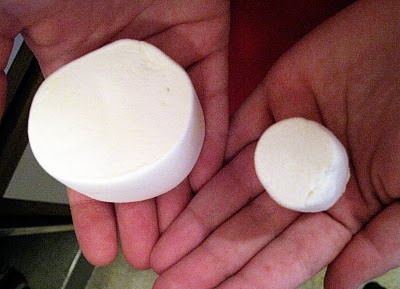
worth three of these guys?
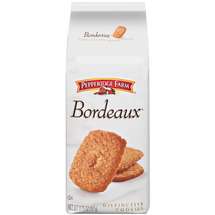
I think not!
But you can have fun with the giant marshmallow nonetheless, if you don’t mind abusing one:
I’ve written a lot about the media and its vagaries and biases. So I suppose at this point nothing should surprise me.
And yet it does. I must still retain a smidgen of the respect I once held for reporters/journalists and their stated desire to discover and tell the truth.
So that’s why this extraordinarily strange Atlantic article about Sarah Palin by Joshua Green amazed me with its ability to be fair about some things and duplicitous about others in looking at the Palin resume.
Green starts out by asking what went wrong with Sarah Palin. How did she go from being an excellent governor who managed to work with both sides to find solutions for her state to a polarized and despised figure?:
What happened to Sarah Palin? How did someone who so effectively dealt with the two great issues vexing Alaska fall from grace so quickly? Anyone looking back at her record can’t help but wonder: How did a popular, reformist governor beloved by Democrats come to embody right-wing resentment?
In the course of trying to answer this question, Green writes nearly 6,000 words and yet manages to leave out any mention of the role of the press and its smear campaign against Palin in the 2008 presidential election and since.
That’s quite a feat of omission.
Initially Green seems fair and even sympathetic to Palin about her Alaskan record, and then seems utterly puzzled about what could possibly have gone wrong later. This is one of his efforts at an answer:
…[T]he qualities that brought [Palin] original successes””the relentlessness, the impulse to settle scores””weren’t nearly so admirable when deployed against less worthy foes than Murkowski and the oil companies.
Green also acts as though Palin made some huge partisan shift with her convention speech; he wishes she had run instead on her Alaskan record as a reformer who could work with both parties. But she did run on that record; her message was drowned out and lost in the libelous media din. That was purposeful on the part of the MSM, who set out to destroy her and have largely been successful.
[NOTE: And just when I thought I’d lost it forever, one of the missing posts turned up again. Mysteries abound. Here it is.]
Yes, I knew it. It turns out that (hat tip: commenter “Mr. Frank”) silver is the most popular car color, with black next, and white quite popular too. All of them neutrals.
And gray is third, so my observation the other day about gray being such a common car color (including silver as a subset of gray) turns out to have been correct.
By the way, remember when I was looking for a car a while back? Well, I got a used Ford Fusion a couple of months ago. My new/used car’s color is dark green metallic, so dark it’s almost black. Very spiffy, IMHO.
Here’s a photo (not of my actual car, but of one that’s the same color), which doesn’t really show the color to advantage. It has to be seen sparkling in the sunlight to properly appreciate all its finer nuances and subtleties:
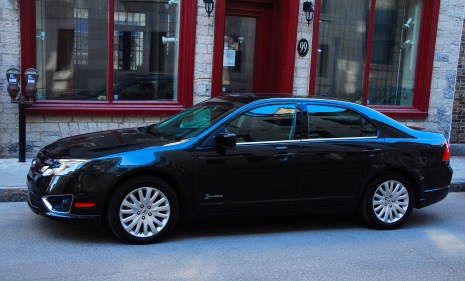
Of course, the dark green color does get dusty rather easily. And of course, it isn’t made any more; it was phased out for 2011, along with the highly adjustable passenger seat option that was the main reason I bought the car in the first place. Progress.
Note the colors of the 2011 Fusion: red, white, black, silver, gray, light blue, and something called “steel blue,” which is a grayish blue. In other words, out of seven available colors listed at the site, three of them are more or less gray. I rest my case.
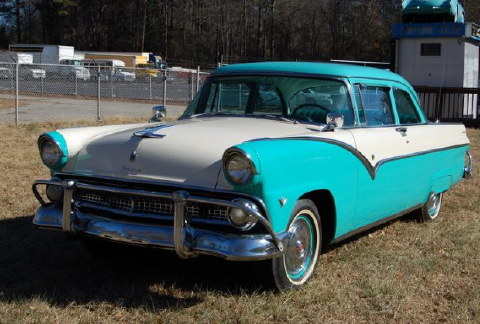
Ah, for the car colors of yesteryear:
Something that hasn’t happened to me in a long time just occurred: I lost a post I’d worked on for quite a while.
And then I lost a second one. Argghhh!
I have no idea why it happened. But I do know that it used to be an unfortunately frequent occurrence, back in the quaint days of dial-up. Also, I seem to recall that the old Blogger site, where neo-neocon first resided, would go down quite a bit, and auto-save was barely a gleam in some programmer’s eye.
Who would have thought—in the days when you could brew a cup of coffee and start sipping it while you waited for a webpage to load—that some day we would be able to connect to the internet from virtually anywhere, to upload our home movies for all the world to see (if the world knew or cared), and to do much of this from our cell phones?
[NOTE: Now I’ve got to go—sorry for the light posting. Talk amongst yourselves for a while.]
…up close and personal, watching himself on TV:
…but unless they can also duplicate her figure, I don’t think the dress is gonna work out so well for a lot of people.
Do not attempt unless you’re rail-thin. And have a passle of attendants to deal with the buttons.

…the marrying kind. The triumph of hope over experience.
Although this is his first brunette. Let’s hear it for brunettes!
SEAL reservist Eric Greitens on SEAL training:
What kind of man makes it through Hell Week?…
Some men who seemed impossibly weak at the beginning of SEAL training””men who puked on runs and had trouble with pull-ups””made it. Some men who were skinny and short and whose teeth chattered just looking at the ocean also made it. Some men who were visibly afraid, sometimes to the point of shaking, made it too.
Almost all the men who survived possessed one common quality. Even in great pain, faced with the test of their lives, they had the ability to step outside of their own pain, put aside their own fear and ask: How can I help the guy next to me? They had more than the “fist” of courage and physical strength. They also had a heart large enough to think about others, to dedicate themselves to a higher purpose.
Physical and mental endurance are hardly mutually exclusive. As Greitens makes clear, prospective SEALS must have both in extremely generous proportions. The physical is a given, and without it the mental would not even matter. But in the end, the mental seems to be the deciding factor that gives the winners the edge.
Just as it seems to be in so many other aspects of life.