[NOTE: I came across this post from 2006 the other day and thought it could bear a recycling.]
When I was in junior high there was a large poster of the Periodic Table of the Elements that hung in the science classroom in front of a little-used blackboard spanning the right side of the room, next to where I sat.
I’m not sure whether anybody in the junior high learned what the chart was about—we certainly didn’t. But it was a grim reminder of what awaited us in high school, when we’d be required to take Chemistry and Physics and Geometry and Trigonometry and a bunch of other subjects that sounded Hard, and sounded like An Awful Lot of Work.
I wasn’t looking forward to the experience. In my more bored moments in class (and I had quite a few of them) I would glance at that chart on the wall and idly ponder its arcane mysteries. It looked like a more old-fashioned and slightly yellowing version of this:
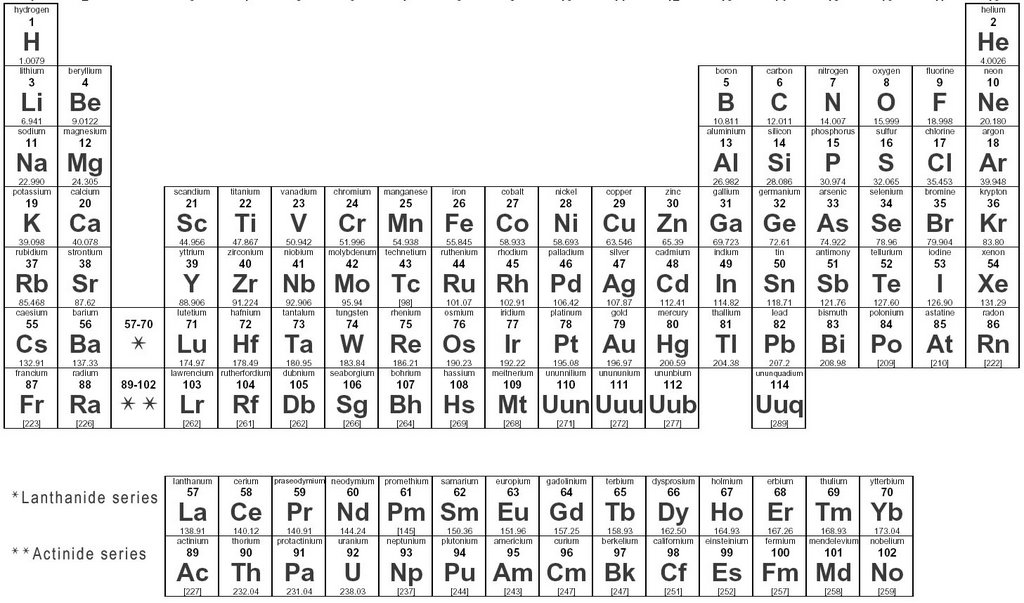
That chart was the sort of thing that made me nearly sick to my stomach whenever I looked at it, something like slide rules and drawings of the innards of the internal combustion engine, and the long rows of monotonous monochromatic law books in my father’s office.
But then time passed—as time often does—and I found myself a junior in high school, sitting in chemistry class and finally (and reluctantly) about to penetrate the secrets of the Periodic Table. The teacher, a small, elderly (oh, he must have been at least fifty), enthusiastic, spry man, explained it to us.
I sat awestruck as I took in what he was saying. That chart may have looked boring, but it demonstrated something so absolutely astounding that I could hardly believe it was true. The world of the elements at the atomic level was spectacularly orderly, with such grandeur, power, and rightness that I could only think of one term for it, and that was “beautiful.”
I did very well in chemistry, and even thought of majoring in it in college, although in the end I stuck to psychology and anthropology. But I never forgot the lesson of the Periodic Table (actually, it taught many lessons, although some of them I did forget). But the one I remembered most was that appearances can be deceptive, and that what lies beneath a bland and stark exterior can be a world of magic.
And now I’ve finally discovered a Periodic Table worth its salt—or, rather, its sodium chloride. Take a look at this, a Periodic Table nearly as lovely as the elemental wonders it illustrates:

If you follow the link to the poster at its source, you can click on parts of it to enlarge them and see more of the detail. And then you might say with Keats:
When old age shall this generation waste,
Thou shalt remain, in midst of other woe
Than ours, a friend to man, to whom thou say’st,
‘Beauty is truth, truth beauty,””that is all
Ye know on earth, and all ye need to know.’