
Also, although this is unrelated to the above, I can’t figure out where else to put it. It’s a fascinating article about Obama’s highly sophisticated effort to reach and persuade potential supporters. The GOP seems to be bringing a knife to a gun fight in this regard.
The missing Republican vote
Here’s my theory about the missing two million (or whatever it turns out to be) McCain 2008 voters: it represents mostly blue-collar men and women who were turned off by Romney’s rich-elitist-Bain persona and decided to stay home. In that regard, Obama’s attack ads not only affected swing voters but conservatives and Republicans as well.
Yes, there were also libertarians who sat it out or voted for Johnson. There were also those who hate both parties and have vowed “never again another “establishment Republican,” as well as those who think if they hasten the financial apocalypse it will bring on a brighter conservative future. But I think that when the smoke clears we’ll find out that the bulk of the stay-at-homes were as I have said. That’s my hunch.
The blame game…
…is a losing one.
I remember my sinking feeling when, during the run-in to the 2012 campaign, each person I thought had a chance to win refused to run, until all of them had been eliminated from the race. Never mind who they were; my list of good candidates would probably have been different from yours, anyway. Let’s just say that for me, Mitt Romney was not among them. The point is that when the slate shaped up, and the Republican debates begin, I was stunned at what a weak field it was.
That’s not to say they were weak people. Each had many admirable traits, each had strengths. But it was pretty clear that all of them would have big problems beating Obama, who inexplicably remained popular and charismatic (that is, popular enough, and charismatic enough).
I thought Romney was the best prospect of the bunch. Still do. Unfortunately, he had flaws: somewhat wooden, not good at articulating conservative principles, mega-rich white guy, Bain history, label of flip-flopper, and even his extraordinary handsomeness which bordered on the unreal.
I also knew (and everybody knew) that whoever was the eventual nominee would be the subject of a relentless attack machine the likes of which we’ve hardly ever seen before in our lifetimes in this country—unless you count what was mounted against Sarah Palin in 2008. That was the incredibly successful template. The details would be different—because each candidate’s vulnerabilities are different—but the strategy would be the same: “Kill Mitt”—or “Kill Sarah,” or “Kill” whomever the nominee would be.
It worked. For example, unmarried women became deathly afraid that Republicans would take away their contraceptive rights (and by the way, Limbaugh’s attack on Sarah Fluke didn’t help the Republican cause any in that regard, although he’s a free agent and not a party representative). It also worked (mostly, the Bain and elitist stuff) to depress the working class Republican vote in swing states like Ohio that could have put Mitt over the top.
Romney tried to counter the attacks, but it was too little, too late. I’m not at all sure, however, that anything would have helped. When a campaign is willing to get as dirty as Obama’s was willing to get, as well as to lie, and especially when the MSM backs that campaign up, it’s extraordinarily difficult to fight back without seeming mean yourself. That’s especially hard when fighting a sitting president with 50% approval.
There’s a great quote attributed to LBJ, a man who knew an awful lot about politics:
Legend has it that LBJ, in one of his early congressional campaigns, told one of his aides to spread the story that Johnson’s opponent f***ed pigs. The aide responded “Christ, Lyndon, we can’t call the guy a pigf***er. It isn’t true.” To which LBJ supposedly replied “Of course it ain’t true, but I want to make the son-of-a-bitch deny it.”
So even fighting back against attacks by denying them, and explaining the truth, tends to give them legs. When an opponent is willing to say anything to destroy you (including that you helped someone to die of cancer in some circuitous way), then you’re already in trouble. Romney actually fought back against some of this stuff, but it was more or less like a game of whack-a-mole that never ended, and the cumulative effect was to weaken him.
But don’t kid yourself—they would have had a field day with any of these candidates, just in different ways. We can’t wait around for the perfect candidate to present him/herself. Not going to happen. So I’m asking you to stop the incrimination and blaming, because the other side feasts on the petty and counterproductive squabbling we’ve been having among ourselves since Tuesday. That doesn’t mean criticism is off limits—criticism is encouraged. What went wrong? How could it go right next time? It’s solutions we’re after, not divisiveness.
Of course, we could come up with great solutions and suggestions here, and that doesn’t mean anyone will take them up next time. But word spreads, and there are ways to be heard if an idea is good enough.
Some practical suggestions…
[ADDENDUM: Here’s another.]
Just for fun: streetwalking
[NOTE: We need a little relaxation today, don’t we? Here’s a repost of something I wrote in January of 2010. Enjoy.]
See the way he walks down the street
Watch the way he shuffles his feet—
“He’s a Rebel” was one of those wonderful girl-group numbers that entertained us in the early 60s. It’s also one of a host of rock songs that walk the walk in addition to talking the talk—that is, they feature the words “walk” and “street” (or its variant, “road”), either in title or lyrics.
That got me to thinking of all the other oldies but goodies (or in some cases not-so-very-oldies, and sometimes not-so-very-goodies) that contain the words “walk” or “street.” “He’s a Rebel,” with its glorification of the perennial bad boy, almost inevitably led me to the Shangri-Las‘ paean to another rebellious-but-lovable hottie: “Give Him a Great Big Kiss” (“he’s good-bad, but he’s not evil”):
And now let us shift from badass street-walking boys to alluring street-walking (although not in the professional sense) girls—or shall we say “women:”
And just as The Crystals’ “He’s a Rebel” led to the Shangri-Las’ “Give Him a Great Big Kiss,” the great Roy Orbison’s “Pretty Woman” (“walkin’ down the street…I don’t believe you, you’re not the truth/
No one could look as good as you) almost inevitably leads to The Doors’ “Hello, I Love You” (“she’s walkin’ down the street…sidewalk crouches at her feet/like a dog that begs for something sweet”)…
And then, if you want to continue to talk about resemblances (in theme, if not in musical style), there’s also “The Girl From Ipanema” (“the girl from Ipanema goes walking…And when she passes, he smiles/but she doesn’t see”):
Which leads us to the newer hit “You’re Beautiful” (“she caught my eye/As we walked on by…And I don’t think that I’ll see her again”), which to me seems to express a version of the same unquenched yearning:
And here, without further ado or commentary (but with You Tube links for every one), and in no particular order, are the others that popped into my head:
“Love Street”
“Boulevard of Broken Dreams”
“Boogie Street”
“I Get Around”
“Don’t Think Twice, It’s Alright”
“Long and Winding Road”
“Walk on By”
“When You Walk in the Room”
“You’re So Vain”
“Country Roads”
“Blowin in the Wind”
“These Boots Are Made for Walkin’”
But that’s just my little list. It turns out the someone else has been down this road before. And a much much longer road than mine it is.
[ADDENDUM: How could I have left out “Walk Away Renee?” To remedy that shameful omission, I’ll post the You Tube video:
The Republican turnout
I’ve said before that even had Mitt Romney won this election, unless it was by a landslide, we’d still be in big trouble. It would only have bought us a little time.
Or maybe it would have just given us the illusion of buying time, because so many of the difficulties and trends seem to have been set in motion long ago. I’m talking, of course, about the big three: schools, media, and family.
However, it’s still interesting to ask why turnout for Romney was lower this year than for McCain in 2008, when enthusiasm for the candidate himself was so much higher. I submit that turnout was not that much lower in 2012 than in 2008, and enthusiasm was indeed higher for Romney than for McCain—among those who were enthused. But a small but significant number were not enthused—they seem to have been turned off.
Some of them were probably libertarians. Some of them were probably people who didn’t warm up to Romney because they felt he was a rich fat cat. Some of them may have been those “a plague on both your houses” voters who want the apocalypse to come because then Americans will finally see the conservative light.
The latest figures I can seem to get on the 2012 election is that Mitt Romney received 57,901,531 votes. McCain’s final tally (remember, that includes all the absentee and provisional ballots) in 2008 was 59,934,814. That’s a difference of about 2 million, some of which might be made up over the next week or so as the absentee and provisional votes come straggling in. So in the end the difference might not be that far off between the two years.
But if the difference holds, it is surprising. One would have expected more votes rather than fewer, or even the same. So in addition to the possible explanations I offered above, I’ll add:
(1) Sarah Palin may have brought out a lot of people that Paul Ryan failed to reach.
(2) A significant number of military voters (who tend to be strongly Republican) may not have received ballots in time to vote.
(3) Voter fatigue, whatever that means.
(4) Quite a few McCain voters must have died over the last four years. But wouldn’t they have been replaced by young ones? Yes, but young people went overwhelmingly for Obama. So the replacement rate isn’t 1 for 1.
If Romney’s get-out-the-vote effort had increased turnout by just a little bit over McCain’s figure, he would have beaten Obama. But it is a fact—and a longstanding one—that Republican get-out-the-vote efforts run far short of the organizational abilities of Democrats. Democrats perfected the techniques way back in Tammany Hall days, when big-city machine politics ruled at a local level. That era began centuries ago. It’s hard to figure out what the conservative equivalent could be, especially since conservatives are demoralized at this point.
Conservatives are not natural at organizing, although the Tea Party was a start. But the Tea Party has often showed bad and narrow judgment in the candidates it supports. When I think of the Tea Party movement, I think there was a lot of naivete involved. In fact, one of the lessons of this election is that conservative must stop being naive about the left, and must start anticipating their attacks. For example, remember when the Tea Party began, and the immediate, almost instantaneous meme that was spread—by Democrats, assisted by their helpmates in the MSM—was that it was racist? There was not a shred of evidence for that, so it was manufactured.
And it worked. Ask most people today about the Tea Party, and you’ll see that the disinformation campaign about it has won.
I miss Andrew Breitbart immensely right now. He was one of the very few people on the right who understood all of that, and who tried to fight fire with fire.
[ADDENDUM: Maybe the problem with turnout is no mystery at all. Read this. A complete mess, and it might have mattered a lot.]
[ADDENDUM II: More.]
Some statistics—and the much bigger picture
[NOTE: I copied these graphs last night but neglected to note the site they came from. Now I can’t seem to find it, so I apologize for not offering it.]
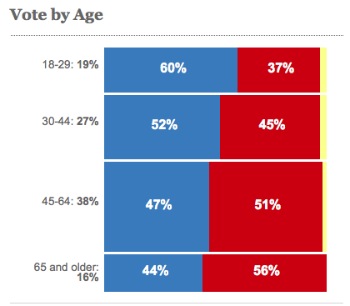
If voting had been limited to people 30 years old and over, Mitt Romney would have won this election:
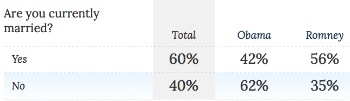
Here’s the war between the married vs. the unmarried:
Likewise, if women were not voting, Romney would have won. It’s interesting, though, that despite the huge emphasis on women this time, and Obama’s enormous effort to discuss their “issues,” his support among them didn’t increase over what it had been in 2008: “the president won among female voters by 12 points. He took 55 percent of the demographic, compared with 43 percent for Romney ”” not far off from 2008, when he won women by 13 points.”
But in some ways this one is the oddest chart of all:
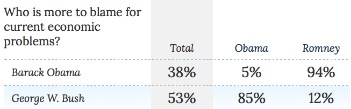
Why do so many people still blame Bush for the economy? For that matter, why did so many ever blame him? The simple answer: they were told to, and most people don’t think for themselves.
Bush was president for eight years. Most of those years the economy was pretty good. It went south only the last couple of months of his administration, and he had been dealing with a Democratic Congress in the final years of his administration. So what specific policies of Bush‘s led to the crash? Wasn’t it the culmination of a decade or two of bipartisan goings-on? And didn’t Bush want to reform Fannie and Freddie in ways that might even have helped,and was blocked by Democrats such as Barney Frank?
But that story somehow never got heard by many people. What did get heard was “blame Bush,” a story on which Obama, the Democrats, and the MSM were full collaborators.
But even if that meme worked to convince people in 2008, why would it work in 2012? After all, remember that Obama himself said this:
I wonder if even at the time Obama said that he was well aware that he’d never be held accountable—that blaming Bush would become the meme that never dies, and that it would insulate him from being thrown out after only one term no matter what happened with the economy.
I am always surprised when people turn to Democrats in hard economic times. But I shouldn’t be. In hard times they want someone who cares—they want a direct bailout. So Democrats, who successfully convey the idea that they care (see this), and who offer what looks like direct and palpable assistance—government jobs, welfare, Obamaphones, etc.—are favored over Republicans, who suggest changing something else in order to create the conditions for a better economy as a whole that would then help employ more people. After all, that’s so indirect; it can be hard to connect those dots.
And there is no question that—Romney or no, Obama or no—the Democratic arguments intrinsically appeal to women, especially single women and especially single women with children, who now constitute an unprecedentedly huge chunk of the population. This is no accident; the breakdown of the family and traditional family values and structure has long been one of the goals of the left, who knew exactly and precisely what they were doing, and why. It is no surprise it has borne fruit, and the victims haven’t a clue about the process.
All of this is not rocket science. And it’s not about Mitt Romney as a candidate—who, like any other candidate, had his flaws. We look at Obama and other liberal Democrats and see huge flaws. But we are not their target audience. And to their target audience, they hit the mark, bull’s-eye.
Conservatism and its principles don’t necessarily make intuitive sense to people. They are relatively complex rather than simple, and the whole thing can sound uncaring and mean, and therefore conservative argument has to be taught. Some of that teaching also is cultural and familial. Gabe at Ace’s discusses this:
People telling themselves that we had an insufficiently conservative candidate, that having a more conservative candidate would have made a difference, are kidding themselves. We didn’t lose because of conservative or even liberal issues. We lost because of cultural issues — binders, Big Bird, birth control, and blame Bush. Those four issues would have dogged ANY Republican candidate, regardless of their conservative bonafides.
That, if you want to skip the rest of this post, is the point. Republicans didn’t lose a policy debate. They lost a PR contest. And the hardest part is that we insufficiently understood that we were even fighting on cultural grounds and not for political issues…
A regular commenter at this blog, kolnai, has offered a brilliant comment that I suggest you read in full. Here are some excerpts; the topic is why it’s harder now than it used to be to get across the conservative point of view:
Perhaps it can be put like this: in the past, “Americanism” was something that always had the potential to give a “warm glow” to a majority of people. “Personal responsibility,” “self-government,” “the Constitution,” “American exceptionalism,” and all of the conservative buzzwords and slogans had a place in the electorate’s psyche to go and resonate profoundly…
It wasn’t that Romney/Ryan ran a bad campaign or didn’t make a principled argument (as Jonah Goldberg thinks). They definitely did, even providing some nice Reaganesque phrases, such as “trickle down government,” “picking only the losers,” etc. Rather, it was that these arguments and buzz-phrases had no place to go in the minds of the un-Americanized to activate a warm fuzzy feeling.
Again, I’m repeating what I’ve said elsewhere (for which I apologize), but this point bears repetition: saying, as Goldberg and many others have, that we “failed to make a compelling argument” is comforting ”“ similar to the Democrats eternal excuse that they just need to work on their messaging ”“ but for that reason we should be wary of it. The lesson of this election is not comforting ”“ I think we all sense that ”“ so we shouldn’t run to the comforting account of it. The lesson is that conservative arguments DO NOt RESONATE anymore with a majority of the voting populace who will turn out in national elections…
The reality is that both sides here [libertarians and social conservatives] are making American arguments to un-Americanized people. For illustration, think of what it’s like making libertarian/socon arguments to a European. It’s not just that we can’t get the messaging right. It’s that it’s absolutely pointless, like smashing your head on an iron maiden.
On the flip side, though, we have also seen that when elections take on a more local complexion and the price of a vote seems higher to people, these arguments can get through to people, even in blue states. There’s nothing we can do to raise the price of a vote in a national election ”“ that depends on events and luck.
The other factor, as we’ve said, it the Gramscian complex, and this we can fight actively. This tells me that the suggestions of Occam’s Beard should be seriously considered. It is very important to have an army of surrogates deployed and ready to character-assassinate, investigate, slime, and undermine. Breitbart was a master of this. There must be more of it, and it must percolate up into the party.
Rich conservatives need to take some lessons from Rupert Mourdock. Buy out papers, magazines, news outlets ”“ use the money to create chaos in whatever Granscian institution we’re targeting. Money should become the political equivalent of a smart bomb.
There’s more, much more.
Kolnai goes on to say that there’s not much we can do about education. I disagree. There are school boards to try to influence and/or take over. There are private schools to start, and if those private schools are not especially rigid and have good track records academically, even liberals might send their kids there to get a good education (I personally know some liberals who have done just that, locally, and were astounded that their child ended up thinking more conservatively).
Conservatives have been asleep at the switch for too long. Sometimes I think that the election of Ronald Reagan and the Contract With America in the 90s were the dying gasps of a culture, rather than the encouraging revivals that conservatives mistook them for. Meanwhile, the Gramscian march continued apace.
[ADDENDUM: More from kolnai in the comments section. Well worth reading.]
Uncivil war
I’ve noticed it already, right after last night’s election was understood to be truly lost. On the message boards and the comments sections of many blogs, two types of commenters started to proliferate: those on the right who were lashing out in rage at the loss, blaming Mitt Romney, their fellow conservatives, election fraud, Karl Rove, you name it. And then there were the mocking Obama supporters, come to crow about their victory and taunt and tweak and insult the grieving conservatives.
No surprise, really. The internet can be a nasty place, with a lot of free-flowing anger. I well remember the trolls of the left who visited blogs on the right in 2008, spiking the ball and celebrating in a mean-spirited way, like jackals or vultures feasting on the bodies.
I don’t frequent enough left-wing blogs to know whether their equivalent on the right comes to taunt the left in years of defeat, such as 2004 or 2010. But I do know that those on the right who are tearing each other apart in their agony over what happened last night should find a way to cease and desist.
Maybe that’s impossible. Maybe human nature just doesn’t allow it. Maybe they need to vent. But taking it out on each other is exactly what the left wants, and it can only weaken and splinter the right. We’re weak and splintered enough right now without doing more damage to each other.
The day after
I had been dreading yesterday for weeks, and I felt that dread especially keenly in the week leading up to the election.
The arguments on the right that the polls were rigged never made sense to me. When I researched polls I noted that, historically, poll averages have tended in most cases to correctly predict the outcome of elections. Exceptions are very rare. So the only hope I had about that was that, because the response rate to polls has gotten so low in recent years, polls had become more unrepresentative than they used to be.
But the polls stubbornly kept saying the same thing: Romney continued to fall a tiny bit short in many important states. And that’s the way the election panned out.
Last week I also discovered that, when I spoke to a bunch of liberal friends I knew who had adored Obama in 2008, they were all still very supportive of him and very strongly motivated to vote for him. They didn’t say “Mitt Romney, oh he’s a nice guy but I prefer Obama,” either. They had swallowed all the nasty Democratic talking points about him whole: he was going to take away this and that right of theirs, he was a rich whatever who didn’t care about poor people, and all the rest. Those on the right who felt that declining crowds and lack of yard signs meant that enough of Obama’s supporters had defected probably didn’t have the experience I had in talking to so many people who still had a very high regard for him. I saw almost no fall-off in support for him at all.
So I was worried that yes, Democratic turnout would be pretty good. And that yes, lots and lots and lots of people who voted for Obama in 2008 would probably do it all over again. Not all of them, it turns out (Obama lost quite a few percentage points from his 2008 total), but way too many considering his record over the last four years. And strangely enough, turnout for Romney was worse than for McCain, even though he came much closer to beating Obama. So there was a tremendous lack of enthusiasm on the right for the candidate, despite the cheering crowds. Was it his Mormonism? Or did the contentious primary season take its toll? Maybe it was his lack of the common touch? Or lingering distrust of him from those who felt certain he was a RINO? Whatever it was (and perhaps some combination of all of that), it was apparently the right that failed to vote for Romney in large enough numbers.
The left is patient, very very patient. I’m not so sure about the right. But that’s what’s going to be required, I’m afraid: patience. It’s easy to say “we need to take back education and take back the media,” but it’s a lot harder to figure out how to do that. But I am convinced that, until that happens, we will not be winning many elections nationwide.
Mitt Romney came close to winning, a lot closer than John McCain. But close isn’t good enough, I’m afraid. And as I wrote earlier, even had he won it would only have bought us a bit of time (and several SCOTUS nominations, which would have been very helpful). There are those on the right who say “fine, let the country sink ecnonomically, and then people will see the value of conservative policies”—but I don’t get that logic, I’m afraid. It’s possible, but unless they are exposed to conservative thought (which isn’t going to happen in the school system or the MSM), how will they figure it out? Economic hard times are more likely to increase the desire for government dependency, not increase it. As the left is well aware.
I see the polarization of this country increasing. The red and blue states are further apart than ever, and never the twain shall meet. Obama is fond of increasing that polarization and adding to it class warfare, gender warfare, and racial entitlement and resentment. It’s become a winning formulation, and looking at that it’s hard to believe we haven’t lost our way. The question is: can we find it again?
[ADDENDUM: Vanderleun has called our attention to this article, which deals with the same topic: how to regroup? I’m not sure what the author is actually suggesting, though; it’s short on practical measures. And it has the flaw of seeming to suggest that conservatives become the very thing they hate, something commenter “kolnai” referred to in this comment of his:
The critical proportion of leftists has been attained. So now the numbers for us conservatives don’t add up. We need, in effect, a leftist elan for our causes, and in sufficient numbers, to take down the Gramscian institutions, but also to remain conservatives (and not Bolsheviks). It’s as though we must change our nature in order to preserve it…
So the question is: How do we turn the conservative disadvantage into an advantage without selling our souls or becoming Tories? How do we fight like leftists, and effectively, while remaining what we are? This isn’t about libertarian vs. social conservative, establishment vs. grass roots. It’s about how we, all of us, together, can act like Gramscians and Alinskyites in order to overthrow the tyranny of the Gramscians and Alinskyites.
I’m not sure we can. Conservativism is by definition opposed to ideologizing everything. I’m not sure we should, either.
There’s the rub. It seems an almost impossible dilemma, a catch-22, from which there is no way out. We can continue to fight honorably and with half of our souls, as we have ”“ and keep losing. Or we can fight like the scum of the earth with our whole polluted souls ”“ and maybe even continue to keep losing, but granting that we win, perhaps becoming unrecognizable to ourselves.
That is exactly why I called this a watershed election, and why the prospect of its loss scared me so deeply. And I think it’s the same dilemma faced by European conservatives (or what passes for conservatives there these days; not the same as conservatism here), once a population has become seduced by leftist thought and leftist largesse. I’ve quoted Dostoevsky’s “The Grand Inquisitor” before in similar contexts, and now I’ll do it again:
Oh, never, never can [people] feed themselves without us [the Inquisitors and controllers]! No science will give them bread so long as they remain free. In the end they will lay their freedom at our feet, and say to us, “Make us your slaves, but feed us.” They will understand themselves, at last, that freedom and bread enough for all are inconceivable together, for never, never will they be able to share between them! They will be convinced, too, that they can never be free, for they are weak, vicious, worthless, and rebellious. Thou didst promise them the bread of Heaven, but, I repeat again, can it compare with earthly bread in the eyes of the weak, ever sinful and ignoble race of man? ]
2004 and 2012
In my most recent update to the previous post I mentioned how similar tonight is looking to 2004.
Bush won in 2004, of course. It looks like Romney won’t, although it is still within the realm of possibility that he might. But it’s the distribution of red and blue states that is so similar (at least, potentially similar; many have not been called yet). Look at the 2004 electoral map:
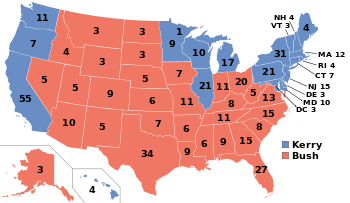
Ohio was called for Bush very late at night on election evening in 2004, if I’m recalling correctly. The state was very close, as were some others (New Mexico, for example). In 2004 Bush received 286 electoral votes to Kerry’s 251. Ohio, with its 20 electoral votes, accounted for the difference. It it had gone to Kerry, Kerry would have become president. Bush’s margin of victory in Ohio was a mere 118,000 votes, and if just 60,000 of them had gone for Kerry instead of Bush, Kerry would have won the whole thing while losing the popular vote big time (to the tune of about three million).
That made a deep impression on me at the time. And things may pan out in some similar fashion this evening—either with Romney winning or losing, but similarly in the state pattern of voting. It seems to me the states have become more locked in for one party or another, and I’m not sure what it would take to break that stranglehold. This election—in which Obama’s failure as president seemed crystal clear to me, and Romney’s superiority as a potential president—does not seem to have done so.
If Obama wins, it won’t be with a mandate. Compared to 2008, it’s embarrassing, especially if he loses the popular vote. But if I’m any judge of Obama, it won’t matter to him; he’ll pretend it’s a resounding victory. He will try any way he can (executive orders, czars) to get around a Congress that will not resemble the one he was fortunate enough to have in 2008. If he is reelected, it will be interesting to see what the Republicans in Congress are made of re Obamacare and all the rest.
“Interesting,” hmmm. Do we live in interesting times, or what?
Perhaps it seems I’m taking this lightly. I’m not. You never heard any “rah-rah, Romney is bound to win” stuff here. I am naturally somewhat of a pessimist anyway, so there’s that. But I thought the polls just weren’t strong enough for Romney—and, as I wrote earlier, my own internal polling as it were (friends who were still all in the tank for Obama) gave me a strong sense of foreboding.
[ADDENDUM: I’ve got a question for all of you. In 2004 (as I mentioned earlier today) I was incredibly nervous about the election, almost as nervous as in 2012. I also had trouble watching the results on TV, and I remember it as being a real squeaker. But I don’t quite remember the timeline. Looking it up just now, I find that Ohio (the state that made all the difference) was not called for Bush until 1 AM in the morning.
So here’s my question: do any of you remember that night? Did you think for quite some time that Kerry had won, and were you surprised at the reversal?
I remember 2000 much more vividly. I went to bed thinking Gore had lost, and woke up to the news that the outcome was still in doubt. And then, of course, the lingering battles…]
It’s time…
…for a new Election Night thread.
I haven’t yet turned my TV on. Nerves.
Talk amongst yourselves.
UPDATE (9:31 PM EST) I said I wasn’t watching TV, and I haven’t been. But every now and then I’ve looked at blogs, and I can’t help but notice the news is bad. Not finished yet, but trending bad. I have to be honest about that.
I have been worried about this election ever since last weekend, when I got together with a bunch of friends who are liberals. I expected most of them to still favor Obama, but I had also expected at least a couple to be markedly less enthusiastic. But I discovered this was not the case, and I got a sinking feeling in my stomach. Afterwards, I wrote:
Although they are not quite as starry-eyed about Obama as they were in 2008, their enthusiasm and determination to vote for him remain undiminished. In fact, my impression is that their drive to do so may even be greater than before, because I sense a protective and defensive quality in them now, a perception that Obama has been under siege and is vulnerable.
They have also most definitely bought into every talking point the Obama campaign has given out about Romney, and they demonize him. One or two even cited Romney’s Mormonism against him, although they themselves are not religious and Obama’s affiliation with Reverend Wright has never been a problem for them.
It was a real shock to me, and it made me realize that although some people are dissatisfied with Obama and would not vote for him again, enough people were still determined to vote for him and had bought the attack line on Romney that Obama had a pretty good chance of re-election.
It’s still possible Romney could win, but he’d absolutely have to carry Ohio. That was always an iffy proposition. If Pennsylvania and Michigan and Wisconsin didn’t break for him, could Ohio? Well, it happened for George Bush in 2004, another very close election that this one is shaping up to resemble quite a bit. The thing is, Bush won that in a squeaker (although not quite as squeaky a squeaker as in 2000).
That year New Hampshire didn’t go Republican, but New Mexico did, by a tiny margin. And Iowa and Colorado too. Those are all still possibilities for Romney, as far as I can tell (I’m having a bit of trouble keeping up with the states that have been called so far, but I don’t think they’re among them).
Even if Romney loses, he may win the popular vote. If so, it would be another example of how evenly polarized the nation is. Of the last four elections, three have been extremely close.
I cannot get over the fact that Obama received more than about a third of the votes, but it has become clearer and clearer to me that most people are not paying attention and that the MSM has been very instrumental in making sure they don’t, and a lot of other people buy into the scare tactics (“Romney will take away your contraceptives”—remember how funny it seemed when George Stephanopoulos asked a question about that in one of the Republican primary debates?) and/or want the free stuff.