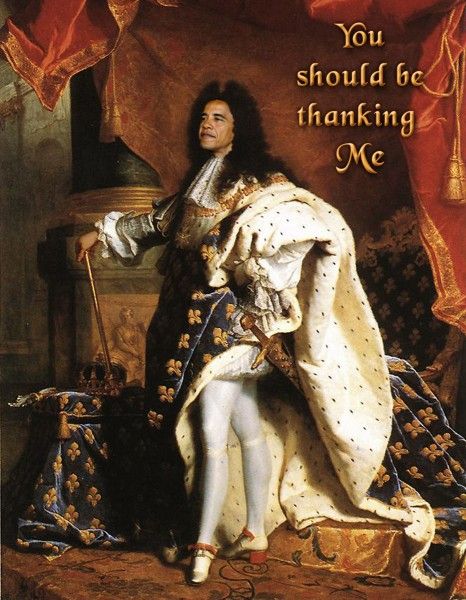
I know quite a few people who don’t think all that highly of President Obama but don’t think he’s all that unusual. They see him instead as a typical politician doing typical political things.
Now and then I’ve tried to convey to these people — and even to some Obama supporters I know — just what I find so very different, and so very reprehensible, about him. For the most part, I’ve gotten uncomprehending stares when I try to explain, or shrugs and statements that “all politicians are like that,” or remarks that the person just doesn’t see what the fuss is about.
To me there are so many character “tells” that they leap out nearly every time I hear Obama speak or read a transcript of his words. These are things that I cannot remember any other president doing before in my lifetime, whether he be Democrat or Republican, liberal or conservative. They used to be Just Not Done by presidents, acts and/or statements that smacked of weakness or blaming or inappropriateness or lack of understanding of the office and its responsibilities.
I remarked on the first one back in May of 2007; it was Obama’s tendency to make excuses for himself. That was actually one of the very first things I ever noticed about the man, about whom I knew virtually nothing except the bare bones of his biography. His excuse-making struck a strange and discordant note, like a flat where a sharp is supposed to be in a musical scale, something that made me recoil. At the time I wrote:
And if the President doesn’t feel up to it all the time, he/she is supposed to shut up about it and not let others see.
No excuses, although of course Presidents make mistakes. But, as Harry Truman said, “The buck stops here” for the President — and for the Presidential candidates.
That used to be the rule, and there was a reason for it: strength and leadership. But the rules have been re-written for Obama.
Since then there have been hundreds of other “tells” like that, moments when Obama seems—for want of a better word — “unpresidential” in a way that reveals a lack of character. In his press conference this past Wednesday there was another one of these tells — Obama’s outrage at the criticism of Susan Rice, through which he probably meant to convey the idea that he is very presidential, very much a leader and alpha male, and very protective of his subordinates:
If Senator McCain and Senator Graham and others want to go after somebody, they should go after me…But for them to go after the U.N. ambassador who had nothing to do with Benghazi, and was simply making a presentation based on intelligence that she had received, and besmirch her reputation is outrageous.
Try as I may, I cannot recall any other president implying that criticism of the statements of an ambassador to the UN, acting in his/her official capacity as spokesperson, should be off-limits — and especially the approach Obama takes here, which is to say that the men who criticized Rice (McCain and Graham) are somehow “besmirching” her reputation (Rice is a vulnerable little woman, not just a gender-neutral official, when it suits Obama’s political purposes) and that such comments are “outrageous” and beyond the pale. Should those on the left who criticized Colin Powell for presenting information about WMDs to the UN, information “based on intelligence that he had received,” have been admonished to shut up because they were “besmirching his reputation” in an “outrageous” manner? Of course not, as they’d be the first to tell you. But Rice is apparently off-limits, because Obama says so.
Has any other president even hinted that his appointed officials are beyond reproach, and that anyone who would question them is a lout? There’s something truly imperial about Obama making such a suggestion, and anyone in the press who fails to call him on it is complicit.
It wasn’t just an isolated statement, either. Obama said something very similar during the second debate:
And the suggestion that anybody in my team, whether the Secretary of State, our U.N. Ambassador, anybody on my team would play politics or mislead when we’ve lost four of our own, governor, is offensive. That’s not what we do. That’s not what I do as president, that’s not what I do as Commander in Chief.
I really can’t imagine how anyone could hear statements like his and not think: This is a dangerous man. But I’ve learned that most people do not seem to hear the warning bells that are sounding so loudly. The fact that his is a new and alarming attitude, one that is different from that of presidents on both sides in the past, presidents who understood that it was the job of the press and the opposition to criticize them and their administration, including UN ambassadors, and certainly including women — seems to have been utterly lost. Perhaps this is due in part to the fact that the press hardly ever does criticize Obama, so it has become unthinkable to him and to his supporters.
I would dearly love for some member of the MSM to ask Obama exactly why such criticism is “offensive” when it’s directed at him or at someone in his administration, and yet it was inoffensive (and even laudable) when it was directed at his predecessor George W. Bush. But no, I’m not foolish enough to expect to ever see that day.
[ADDENDUM: Instapundit Glenn Reynolds links, and adds some apropos artwork: