I love these painting of famous historical figures as they might look if alive today. Here’s one (there are four others at the link):
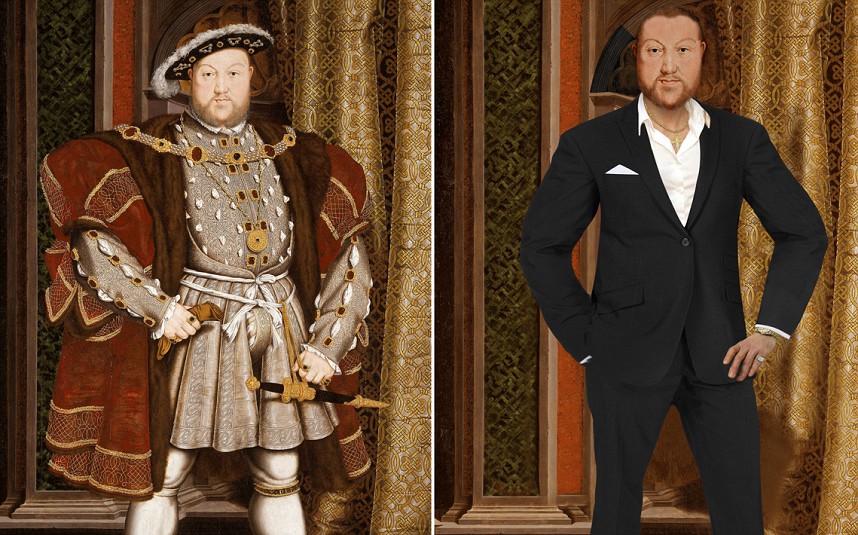

I love these painting of famous historical figures as they might look if alive today. Here’s one (there are four others at the link):
If you live to be over 100 I guess you get to opine about how you think you managed to do it. But that doesn’t mean you really have a clue.
My extremely strong hunch is that these stalwarts lived to be over 100 because they lived to be over 100. And that probably happened because they were favored with fantastic genes for longevity, and had the good fortune to not be met with serious accidents or foul play. The rest of it is probably blather, although it makes for very entertaining reading:
Pearl Cantrell, 105, attributes her long and healthy life to bacon. “I love bacon, I eat it everyday”…
Jeanne Calment, who died in 1997 at age 122…gives credit to olive oil, which she poured on her food and used on her skin, drinking port wine, and eating about two pounds of chocolate every week. “I’ve never had but one wrinkle,” she used to tell her friends, “and I’m sitting on it.”…
Vivian Henschke, 109, smoked for most of her life, had two cocktails before dinner nearly every night, and ate whatever she wanted, according to her daughter, Karen Preston. “Mother did nothing by today’s standards to help her have great longevity,” Preston told Everydayhealth.com, adding that Henschke also “never exercised a day in her life.”
Read the whole thing. You’ll be glad you did—although it probably won’t add a day to your longevity.
I suppose it’s moot, but there’s been a bit of discussion here and elsewhere about Mitt Romney’s failure to emphasize the Benghazi debacle during his campaign.
I want to make my position clear. If you followed the evolution of my attitude towards Romney, he was not my favored candidate but once he was nominated I supported him wholeheartedly. I thought he was the best of the candidates, with the best chance of winning—which, unfortunately, wasn’t saying much, because I didn’t think he had a particularly good chance of winning.
I consistently said Obama was a much stronger candidate than most people credited him with being, and that the race would be very tight and if Romney did manage to win it would be a very narrow victory. I was nervous beyond belief the whole time, and never indulged in the “all the polls that say Romney is behind are lying” routine.
So that’s where I’m coming from; I never thought it was Romney’s election to lose, despite the chorus of people who did think just that.
Nor am I writing this to say “oh, I’m so smart!” It was just the way I saw it, and although I happened to have been right this time it doesn’t mean I’m such a fabulous prognosticator, and in fact I very much wish I’d been wrong and that Romney had won the election.
And so I think that those who say that, had Romney pounded Obama harder on Benghazi, Romney would have been likely to have defeated him, are engaging in Monday morning quarterback wishful thinking, if there is such a thing. The American electorate who voted for Obama could not have cared less about Benghazi—and I mean that literally. Not just liberals, either; most moderates cared not at all. The only people I talked to at the time who cared at all, or who believed Romney was not just being politically expedient when he spoke of Benghazi, were political junkies on the right who were already going to vote for him and did.
Romney’s attempt to hit at Obama on it during the second debate failed abysmally due to Candy Crowley’s collusion with Obama (see also this) in misrepresenting what he said in his Rose Garden speech after the attacks. Romney then saw the writing on the wall and pulled away from further discussion of the matter.
I still think he should not have done that; I think he should have hammered away at it anyway. But I don’t think that hammering would have made a difference in the election result—in fact, it was probably likely to have backfired on him, although I still think he should have done it.
But I’m with Ann Althouse on what would have been the result had he done so:
You can say with hindsight that you think it might have worked, now that you know that what was done did not work, but you need to picture the outcry from the Obama campaign ”” the ugliness, the damage to national security interests, Romney’s unreadiness to play on the international stage, the disrespect for the dead and their mourning families, and ”” it worked against Hillary’s original 3 a.m. ad ”” the dog-whistle racism.
This seems spot on to me, and I say with regret that those who think it would have gone otherwise are overestimating the judgment of the American people and underestimating the influence the MSM still has on the viewpoints of voters today.
Now, forward: will Benghazi matter, even now? I lean to the side of “no.” There’s no dearth of articles purporting to say one way or another—or to spin and convince one way or another (see also this). But when ABC allows itself to publish a piece about how the talking points on Benghazi were changed over and over to scrub references to terror, it gives me a teeny bit of hope that some of this will filter down to the general public, the so-called low information voters, a few of whom might even be convinced to care. In more cynical moments, though (which I experience more often than the hopeful ones on this score), I’m with Kevin O’Brien, who writes:
Once again, the most insulated president in the history of the republic will employ a strategy of blaming underlings and changing his story at will, knowing that anyone who tries to call him to account will be branded a racist, dismissed as a political opportunist or simply ignored.
The left’s strategy on Benghazi is clear: ignore and/or minimize and/or mock (see this). Their talking points have pretty much boiled down to “anyone who pays attention to Benghazi is a stupidhead” or “pay no attention to those men temporarily in front of the curtain. They’ll go away soon.”
There’s nothing subtle about it, but it works. The secret to its success is one the right couldn’t copy even if it tried, because it depends on the full cooperation of the MSM in the coverup (or, in the case of Benghazi, the coverup of the coverup).
Greg Sargent offers a typical column here in which he says to pay no attention to Benghazi, it’s nothing, a big fat nothing of a nothingburger. And the proof he offers, the analysis, is—well, it amounts to “Because I said so.” He never deals with the actual charges or tries to refute them systematically with logic or evidence. It is unnecessary.
Sargent is a writer for the WaPo. Surely in the past writers for the WaPo were required to maintain at least a pretense of arguing about actual facts before they dismissed them? But Sargent is hardly alone; this caliber of writing has become standard: the responses of liberals and the left to the concerns of the right re Benghazi amount to a claim that the right’s objections are absurd on the face of it.
But just exactly what is absurd about questioning what went on during an attack at a consulate in which four people—including the Obama-appointed ambassador to that country—were murdered and the president slept through it all despite having been informed that it was ongoing? And what’s absurd about asking why inadequate security was provided the consulate despite repeated pleas for more, and an obviously dangerous climate there? What’s absurd about questioning why potential rescuers were ordered to stand down early in the battle? Or why although the administration knew there was no demonstration it lied repeatedly to the American people and said there was? And what about the jailing of a fall guy to take the heat, who is still in prison? Or about the possible coverup by investigators specially appointed by the very people who may have been at fault in much of this? Or about accusations that very well-placed and important whistleblowers were purposely intimidated from testifying?
Whether or not you believe that these charges will pan out or not, there is no question they are extremely serious. How could they be bogus concerns? And actually, the left does not really think they are absurd, either. They just think people aren’t paying attention, and if they pooh-pooh the whole thing enough, people will continue to not pay attention. And that’s about the gist of it.
Here’s another typical approach, by Joe Klein in Time. Note his contemptuous tone, and his repeat of the Candy Crowley lie from the second debate (“Obama called the Benghazi attack an ‘act of terror'”). I (and many others) demolished that argument back when Crowley made it—but then again, Klein and Crowley get a lot more exposure than I do (or, much more importantly, than the truth does), and the big lie works.
Just to refresh your memory, here’s what I wrote about Obama’s Rose Garden speech, the one Klein is referencing when he writes that Obama called the Benghazi attack an “act of terror.” He absolutely did not do any such thing, but Klein (and Crowley before him) are relying on the fact that we’re too lazy, and it’s all too complicated, for us to go back and actually, like, you know, look at Obama’s speech. They count on the fact that we should just take their word for it, and they are right—for the most part we (the American public) will.
[NOTE: DaTechGuy points out a seeming exception to the rule: he writes that Morning Joe on MSNBC has, for the first time, covered Benghazi fairly thoroughly. I don’t watch MSNBC or Morning Joe (or many TV or radio news or opinion shows at all), so I can’t say. Of course, Joe Scarborough is a strange hybrid, not really a man of the left at all (he was, and I believe still identifies as, a Republican), although he doesn’t seem to be on the right either. As I said, I don’t follow his show at all, but my sense is that he’s the token “conservative” at MSNBC, which means not much of a conservative at all. But still, I suppose it’s better than nothing. As DaTechGuy points out, it at least introduces the MSNBC crowd to the arguments:
Why does this matter? Two things:
1. Morning Joe is usually where you go for the left’s talking points for the day, that isn’t the case today.
2. The MSNBC viewer base has simply not seen this argument. As far as they are knew before today the Biggest villains on Benghazi were the makers of the worst film EVAH & Mitt Romney and anyone who suggested otherwise was part of a GOP conspiracy to bring down our beloved president before the election and their beloved Hillary after.
This is a story they never heard! As Stacy McCain put it
the only TV reporter not employed by Fox News who has treated the Benghazi cover-up as a legitimate story ”” Sharyl Attkisson of CBS ”” is being treated like an unprofessional pariah by her own network, while Chuck Todd of NBC News quite literally laughs off criticism of the Obama administration’s handling of the Benghazi attacks.
Really, they out-did themselves on this one. Check out the “Don’t Bother to Read This Dull Story” headline from the New York Times:
Official Offers Account From Libya of Benghazi Attack
Here’s another way you might headline the story, if you actually wanted to get readers to, y’know, read the story:
VIDEO: Benghazi Whistleblower Gregory Hicks Describes
”˜Saddest Phone Call’ That Ambassador Stevens DiedUnless you saw that testimony ”” which was just one highlight of a six-hour hearing that the major networks did their best to ignore or dismiss as mere politics ”” you would have no reason to suspect how riveting it was, if all you saw was that bland New York Times headline.
For the professional left, this story on Morning Joe is a double disaster.
In the short term it forces the MSMBC audience to confront the possibility that their heroes President Obama & Hillary Clinton left Americans to die in Benghazi & lied about it for political reasons. It gives a story they have been able to dismiss MSM credibility, that’s bad.
In the long term it raises the possibility that there is another story beyond the wall of silence. That there is a whole world of news they might be missing.
I wish I could share DaTechGuy’s relative optimism. I don’t, because I’ve devoted quite a bit of time and effort to studying and observing how resistant people are to letting in and fairly evaluating information that goes against their already-established worldviews. Still, I’m glad Scarborough has given it the old college try.]
[ADDENDUM: Related, and well worth reading.]
The MSM can’t tolerate any deviation from the script; it must present a unified front to maintain the fiction of its own neutrality.
I was watching CNN last night, and learned some more things about the gothic horror show that was Ariel Castro: his deceased ex-wife Grimilda Figueroa had filed very serious physical abuse charges against him, allegations of violent and multiple beatings at his hands (including being hit in the head with some barbells). But the case was dismissed because Castro failed to show up several times, and at a critical juncture his ex-wife’s lawyer didn’t appear.
That’s a reason to dismiss a case of such severity?
Castro’s son Anthony has backed up his late mother’s accusations, describing his father “as a controlling, abusive and often drunk ogre who once nearly beat his mom, Grimilda Figueroa, to death as she was recovering from brain surgery.” She and her four children, including Anthony, left Castro in 1996, long before the kidnappings occurred.
To make matters worse, Castro’s daughter Emily is in prison for attempting to murder her baby, an act which occurred when she was nineteen years old. It was her own mother Grimilda who saved the baby. The story is hideously pathetic; Emily is alleged to have been mentally ill:
Legal documents state that on April 4, 2007, Castro, 19 at the time, was upset that her boyfriend — the baby’s father — had moved out of the family’s home in Fort Wayne. She took the baby into a garage and cut her neck four times with a knife.
Castro also cut her own neck and wrists.
Police were summoned to the house by a passerby who came upon Castro’s mother carrying the baby and running from the home. Officers found Castro covered in mud, water and blood. Castro told paramedics she had tried to drown herself in a creek, according to an appeals court decision document.
The baby survived.
According to the Fort Wayne Journal Gazette, the defense argued at trial that Castro had suffered from mental depression and became paranoid, thinking her family was trying to kill her and the baby.
However, in light of what has now come out about Emily Castro’s father, one wonders what was really going on. Were her mental problems at least partly because of the severity of the abuse she witnessed as a young child (she would have been about 8 when she last lived with her father)? Or had she herself suffered abuse at his hands? Was she in fact justified in thinking that some members of her family might be trying to kill her and her baby? What secrets might she know about her father that she has not yet revealed?
Also on the same CNN broadcast was an interview with Fernando Colon, the man to whom Figueroa had been engaged when she died and who had apparently been in a relationship with her for many years. Colon said that Ariel Castro had successfully—and falsely—accused him of abusing the children, and he thought that now he might have a chance to clear his name of the charges.
I have no way of knowing whether Colon was being truthful, but I’d certainly take his word over Castro’s any day. After a little research, I came up with this bombshell article. Hold onto your hats; if Colon’s story as related there is true, the Cleveland police and even the FBI have even more to answer for than previously thought [emphasis mine]:
Fernando Colon said that he was intensively interviewed, followed by officers and made to give samples of his DNA following the disappearance of Georgina DeJesus, who was then 14, in 2004.
Ms DeJesus had last been seen walking home from school by her friend Arlene Castro, the youngest daughter of Ariel Castro and Grimilda Figueroa, who had by then left the school bus driver.
Mr Colon, who as Ms Figueroa’s boyfriend was a stepfather figure to Arlene, was suspected by police of being involved with her friend’s disappearance and became the focus of their inquiries.
“Ariel wasn’t investigated at all,” Frank Caraballo, his former brother-in-law, told The Daily Telegraph. “Why was Arlene’s actual father out of the picture? He’s the bus driver, he knows where all these kids go.”
Mr Colon, now 49, claimed to have told his FBI interviewers that Mr Castro was a more likely culprit, but said that his suggestion was totally ignored by investigators.
Wow.
More details here about Castro’s abuse of his wife, and the sort of violence he had gotten away with for decades.
[BUMPED UP]
Say what you will.
More details here
Also, see Bryan Preston’s live-blogging of the hearings.
UPDATE: Preston summarizes the hearings here. He points out that the timing was bad, but I disagree. I don’t think the timing, or the hearings’ length, or anything else of that sort mattered in the least. Why? Because the MSM is determined to minimize this, and always was determined to minimize it.
I truly don’t know what it would take to break though that barrier. We’ve had information right from the start that should have raised a million red flags—and that would have, if a Republican had been in charge. If Republicans had been in charge we would almost have heard of nothing else since September 11, 2012.
But they weren’t, and we didn’t, and we won’t. And if the American people don’t care, I don’t think there’s anything that can be done to make them care.
…this be? Can a dog survive a month without water, just on McDonald’s scraps?
And have you noticed that McDonald’s has been featured prominently in another story lately? That would be the escape of the Cleveland women, whose rescuer was eating a McDonald’s burger when he heard Amanda Berry’s cries and ran over to kick open the house’s door. What’s more, her kidnapper Ariel Castro was apprehended at a McDonald’s. I’ve also read that neighbors and relatives of Castro say he mostly ate McDonalds food over the years, and I have a hunch that’s what he fed the women, too.
Although Amanda Berry was originally kidnapped after leaving her job at a Burger King.
I certainly don’t mean to make light of the kidnapping story. Merely pointing out the odd prominence of fast food restaurants in the news lately.
[UPDATE ON MCDONALD’S: McDonald’s has plans regarding Ramsey:
After thousands of people contacted McDonald’s regarding Ramsey’s rescue, on Tuesday, the corporate Twitter handle, @McDonaldsCorp tweeted: ”We salute the courage of Ohio kidnap victims & respect their privacy. Way to go Charles Ramsey- we’ll be in touch.”
A spokeswoman for McDonald’s said on Wednesday that the company, including a local franchisee, is planning to “reach out to Mr. Ramsey directly,” but does not have specific details at this time.
“We saw an overwhelming response on Twitter calling on McDonald’s to do something,” said the spokeswoman. ”As we committed, we will be in touch.”]
[UPDATE ON CLEVELAND: More details are emerging about the Cleveland women, including photos of Amanda Berry’s 6-year-old daughter, who seems to be doing well. Berry apparently delivered her daughter in a kiddie pool and has been home-schooling her (although “home” is a relative word here).
What resilience and strength these women seem to have shown! If they do end up okay, it would be a testament (although the phrase is cliched) to the human spirit. As some of the videos indicate, they appear to have had some access to each other during their captivity, and to all have taken an interest in Berry’s child. This bonding is probably similar to that sometimes experienced by captives of war, and may be at least partly responsible for their relative mental health. The videos are also very touching when their relatives speak; the depth of their joy now was probably matched by the depth of their anguish earlier.]
[FURTHER CLEVELAND UPDATE: Another great interview with the inimitable Charles Ramsey:
It certainly seems that way. Neighbors report having called police numerous times with complaints of suspicious goings-on around that house, and the police did nothing. What’s more, the police visited the house once because Castro had left a child on the bus he drove, but it was determined to have been an honest mistake by Castro.
On the other hand, the police say they have no record of those phone calls. Although my guess is that this is just another example of police incompetence, it’s also possible that the neighbors never made the calls in question at all, and now are trying to cover for their own sense of guilt at not having done more or suspected more earlier.
As the wonderful Charles Ramsey, the neighbor who was Berry’s rescuer, said on ABC’s “Good Morning America,” noting that “he had lived next to the Castro house and had no inkling there was something wrong”:
Isn’t that scary? So either I’m that stupid or his [Castro’s] kind are that good.
Perhaps Castro was just that good at what he did.
Furthermore, if you think about it, what were the police supposed to do in the case of the child left on the bus? Search Castro’s house? Would you like them to be able to search homes for that sort of offense, or for reports by neighbors that someone was screaming at a certain residence? In other words, what constitutes reason enough to do a search of that nature in someone’s private home?
The Cleveland case is eerily similar to the Jaycee Dugard case, although with Dugard’s captivity the police negligence seems to have been much much worse. In fact, the case of Dugard’s kidnapper, Phillip Garrido, features one episode of astounding police and prison system incompetence after another. Read it and you will almost weep with frustration and anger. Why was this man ever paroled in the first place? He had kidnapped and raped before, yet despite receiving a federal sentence of 50 years and a Nevada state sentence of five-to-life, he was released after eleven years and was only very lightly supervised afterward.
The Castros have no such felony background. (And, just to clear up a question I’ve seen asked on other blogs, they are all American citizens, having been born in Puerto Rico.)
Let’s assume that in Cleveland the neighbors’ calls were actually made, but the police found no cause to search the house. And let’s assume that police there, as in other municipalities, get a great many of these sorts of calls from neighbors about strange or suspicious behavior at a certain location, and that it can be hard to sort out the important ones from the unimportant. But shouldn’t there at least be some way to flag calls that involve suspicious behavior in the home of a person living in a neighborhood which has experienced kidnappings (in this case, multiple kidnappings)? And shouldn’t there be a way to note when many complaints come in from unrelated people about a certain house, triggering an alert that this might be a special case?
How many more girls (or children, or men) are being held this way? The parents and relatives and friends of other missing persons probably find the news of the Cleveland women both encouraging and difficult. It revives hope that, even after many years, their own loved ones might still be alive. It revives fear that they are still suffering, in untold and horrific ways, perhaps even nearby, and yet have not been found.
Mark Sanford has won back his old Congressional seat.
He’s certainly not my favorite politician, but if I lived in that district I would have voted for him over opponent Elizabeth Colbert Busch.
…they won’t have as much of Chris Christie to kick around any more.