Ian Reisner, a New York hotelier who identifies as gay, is pro-gay marriage, and owns gay-friendly hotels with names like “OUT NYC,” has experienced the wrath of the gay marriage absolutists.
What on earth did Mr. Reisner do to cause the threat of a boycott of his properties? Nothing more or less than “hosting a non-fundraising ‘fireside chat’ with Ted Cruz.”
Perhaps I should have written “fire-breathing demon Ted Cruz,” whose besetting crime (at least as best I can tell) is that he opposes gay marriage but believes the issue should be left to the states, and has no problem with gay people whatsoever. I believe that leaving it to the states is at the moment the official law of the land, until the Supreme Court rules otherwise, which it may be about to do but perhaps not. And up until a very short while ago opposition to gay marriage was so common and so commonly accepted that even President Obama and Hillary Clinton had to at least pretend to hold that position.
A few days ago, Ted Cruz said this:
Speaking at the Iowa Faith and Freedom Coalition Summit, Cruz said that in the new Democratic Party, there would [not] be any room for Christians. It has “become so radicalized for legalizing gay marriage in all 50 states that there is no longer any room for religious liberty,” he argued.
Borrowing a concept from the National Review’s Jonah Goldberg, Cruz said blamed an incipient “liberal fascism” for the increase in attacks on Christians in America today. “It is heartbreaking,” he said, “but it is so extreme.”
That does seem to be the way this is going—and I say this as a person who does not oppose gay marriage (but believes it should be left to the states) and as a non-Christian. The forces of political correctness are not benign.
But Cruz did not go far enough when he said the attacks were on Christians. They are on anyone who would dare oppose gay marriage, or who fails to spout the leftist political orthodoxy of the day. In fact, they fall on someone such as Reisner, who is in favor of gay marriage and completely PC, and yet who dares to host a chat with someone who differs from that opinion. A person like Reisner must have his livelihood destroyed as punishment.
But first he must be humbled and made an example of, and maybe, just maybe, the PC forces will relent. Reisner has issued an abject apology in hopes of fending off the wolves:
I am shaken to my bones by the e-mails, texts, postings and phone calls of the past few days. I made a terrible mistake. I was ignorant, naive and much too quick in accepting a request to co-host a dinner with Cruz at my home without taking the time to completely understand all of his positions on gay rights. I’ve spent the past 24 hours reviewing videos of Cruz’ statements on gay marriage and I am shocked and angry. I sincerely apologize for hurting the gay community and so many of our friends, family, allies, customers and employees. I will try my best to make up for my poor judgement. Again, I am deeply sorry.
This article makes it clear that many will never forgive Reisner for his transgression. He has fraternized with the enemy. The Purge continues.
I have a dream. It’s a small one, but it’s mine. I dream that, after reasserting his own pro-gay-marriage position, and describing his support for gays in his business and his personal life, Reisner had stood up for liberty and said something like this:
But do you understand what you are doing when, instead of just disagreeing with people like Cruz, you demonize them and also demonize and persecute anyone who would give them a forum in which to speak? You are marching down a road that others before you have trod, and it ends in the killing fields where you murder those with whom you disagree.
You think I exaggerate? Perhaps. But if you study history you will see that most of the movements that end in gulags began in idealism. There are not as many steps along the way from one to the other as you might think. Beware of taking them.
It is a profound shock to a person who knows/believes he/she is on the side of right (in this case, Reisner’s history as a proponent of gay marriage), and who thinks that will protect him, to find out otherwise. But once “liberal fascism” is unleashed it’s hard to stop it. Reisner is probably learning that now, perhaps for the very first time.
Reisner isn’t the only one, either. His partner Mati Weiderpass said his own mea culpa. In a way, Weiderpass’ statement was even more revealing than Reisner’s:
“I share in Ian’s remorse. I, too, lay humbled with what has happened in the last week,” he wrote on Facebook. “I made a terrible mistake. Unfortunately, I cannot undo this. You taught me a painful but important lesson. The people that know me know the work that I have done over the last 20 years for the advancement of gay rights. Today, I came to realize that I might have nullified my past efforts and accomplishments in just one week. On the eve of this momentous legal occasion at the Supreme Court, I dedicate myself to work even harder to advance our cause that I share with the LGBT community; our community. Again, to all that I have hurt, please accept my sincerest apologies.”
In other words, he had thought that twenty years of pro-gay activism was enough to shield him from the suspicion that he had betrayed the cause merely by hosting a discussion with someone who holds a different view. He has since discovered how wrong he was, and he promises to toe the line from now on.
Looking at the comments to that article I just quoted, the very first one I see (I can’t find a way to link to it) says this, which gives you an idea of the flavor of what’s happening:
Let’s face it. You screwed up big time. You made the worst mistake you could have possibly made. You showed your true colors. We ALL now know that you love only yourselves and your money.
You are true wolves in sheep’s clothing.
Your involvement in the gay community is nothing more than a tax write off, done for publicity to further your financial gain and not to truly help, assist, promote or support any gay causes.
You could care less that the gay community is oppressed, discriminated against, harassed, or even if they have equal rights under the constitution.
You BIT OFF the hand that feeds you!
It will be a cold day in hell before you ever see a dime of my money and I believe now that the rest of our community sees you for what you really are, you won’t see any more of their money, either.
I think all Log Cabin Republicans should be burned at the stake. They love only their money, first and foremost and any one that loves their money so much they would sell their own community down the road to keep it cannot possibly know a love of humanity.
Money is a cold bed fellow. Good luck making any more of it from us.
Your apology is to little, to late. We’ve seen your snarl and felt the bite of your fangs, we won’t make the same mistake again by taking you at your false face value. You’ll have to do a hell of a lot better than an apology.
Well, during the Great Purges many people actually were executed. I wonder whether that would be enough for the commenter I just quoted?
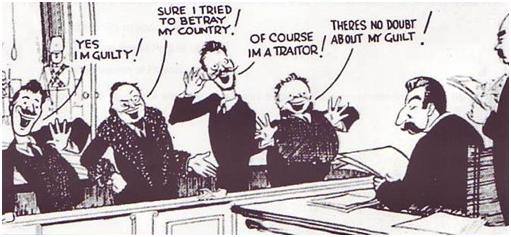
[NOTE: The above cartoon is a contemporaneous British commentary on the purges.]
[ADDENDUM: See also this.]

