
On trying to understand higher-level science
I’ve long tried to understand the upper reaches of scientific thought, often to no avail. Even as a very young child, I tried reading books about cosmology or higher-level physics, and although every now and then I managed to absorb something, most of the time the ideas went tantalizingly over my head. But I kept trying.
At the age of eight or nine I was fascinated by George Gamow’s One, Two, Three … Infinity. I don’t know how it came into my hands – I certainly didn’t buy it because I wasn’t buying much of anything back then except the occasional comic book or candy bar. But I tried and tried to understand it, and although much of it was opaque to me, I got the general idea for other parts of it.
I was especially fascinated by the four color theorem, which at the time had not yet been proven (a proof came in 1976):
In mathematics, the four color theorem, or the four color map theorem, states that no more than four colors are required to color the regions of any map so that no two adjacent regions have the same color. Adjacent means that two regions share a common boundary of non-zero length (i.e., not merely a corner where three or more regions meet).
I can’t find my decrepit copy of the book right now, although I’m pretty sure I still have it. But my recollection is that Gamow wrote that, if anyone could offer a proof or could design a map that used more than four colors, that person would achieve fame. I didn’t even know what a proof was, but I tried to design such a map. That, I could understand.
I didn’t quite comprehend the assignment, because after much trial and error I thought I had it. But my map had some countries which resembled pie pieces – a no-no, although I don’t recall if that limitation was made clear in the text of the book. Somehow – how, I don’t recall – I managed to write a letter to Gamow at the university where he taught, and boldly offered my map. It must have been clear that the letter came from a young child of eight or nine; I didn’t even have the ability to type it.
But wonder of wonders, I got a response. I still have that response, which was a standard note sent to the many people who wrote to Gamow with this or that idea. The letter said he just didn’t have time for a reply. But someone – almost certainly not Gamow himself, but someone – was being very kind, and there was a handwritten part in red that explained the error I’d made.
Here is that part:
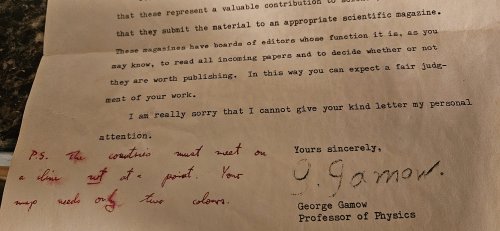
In case you can’t read that, it says:
P.S. The countries must meet on a line, not at a point. Your map needs only two colors.
Many years have passed since then, and I haven’t stopped trying to understand advanced science. But these days it’s mostly through YouTube videos. I listen when I’m exercising, or doing the dishes, or just vegging out in a chair. This was the latest, and although I think I got the basic idea (everything spins due to initial asymmetry, and continues to spin because there’s nothing to stop it), I simply don’t get the details. But here it is:
However, I’ve also read that the Webb has discovered that the majority of galaxies spin in the same direction, which was not predicted:
About two-thirds of the 263 galaxies studied in a paper published February 17 in the Monthly Notices of the Royal Astronomical Society rotate clockwise, while the other one-third rotate counterclockwise.
“The analysis of the galaxies was done by quantitative analysis of their shapes, but the difference is so obvious that any person looking at the image can see it,” Lior Shamir, a computer scientist from Kansas State University and sole author of the study, says in a statement. …
The problem is that astronomers have long posited that galaxies should be evenly split between rotating in one direction or the other, astronomer Dan Weisz from the University of California, Berkeley, who was not involved with the study, wrote for Astronomy back in 2017. “This stems from the idea that we live in an ‘isotropic’ universe, which means that the universe looks roughly the same in every direction. By extension, galaxies shouldn’t have a preferred direction of spin from our perspective,” he added. According to Shamir, there are two strong potential explanations for this discrepancy.
One explanation is that the universe came into existence while in rotation. This theory would support what’s known as black hole cosmology: the hypothesis that our universe exists within a black hole that exists within another parent universe. In other words, black holes create universes within themselves, meaning that the black holes in our own universe also lead to other baby universes. …
Another possible explanation involves the Milky Way’s rotation. Due to an effect called the Doppler shift, astronomers expect galaxies rotating opposite to the Milky Way’s motion to appear brighter, which could explain their overrepresentation in telescopic surveys.
“If that is indeed the case, we will need to re-calibrate our distance measurements for the deep universe,” Shamir explains in the statement.
I’m not going to try to tackle that one.
To everything
Turn, and turn, and turn
There is a season
Turn, and turn, and turn
And a time
For everything
Under heaven.
The Byrds, from Ecclesiastes 3:1-8
So why does the cosmos spin? The maths are just as imponderable to me.
“Turn, Turn, Turn” was written by Pete Seeger (1959) and eventually covered by The Byrds.
Post in haste and edit or append as needed.
I read that book many, many years ago. Eventually learned that Gamow misled me on the subject of transfinite numbers (aleph zero, aleph one, aleph two, . . .). Apparently his understanding of pure mathematics wasn’t on a par with his physics and cosmology.
I wrote to and got answers back from Isaac Asimov, John W. Campbell, Willy Ley, and Stan Ulam. I wonder if they are worth anything to autograph collectors.
but I tried to design such a map
Plane tilings are an area of mathematics where amateurs are still making discoveries.
I dunno, seems to me as though clockwise and it’s flip-side twin anti-clockwise are tantamount to meaningless in a cosmological(ish) frame. Look at a rotating disk how one may, step around to the opposite face of said disk still rotating and presto-change-o it’s the anti-pair. So, context winks out where there’s no necessary orientation, no up, no down, no north, no south. Confusing though, I’d give it that.
Gamov wasn’t mathematically strong, but he had a great knack for asking interesting questions. I think the latter is what distinguishes scientists from otherwise equally talented people.
I feel the same way when I try to read the cosmological stuff on RealClearScience. Frustrating, but on the other hand after General Physics in college I’d had enough of that field.
Trying to get to the heart of physics and astronomy without the math (physics math, not math math) is very difficult. One can try using just prose (Feynmann was really good at it, but even he ran into limits). A bachelor’s degree in physics gets one about 50% there. For myself it wasn’t until I passed my qualifying exams that I finally had a more complete understanding.
For the general public, if most people had a basic, qualitative understanding of the 1st and 2nd laws of Thermodynamics, conservation of momentum, both angular and linear, and Newton’s 3, then the scientific literacy would be much greater.
A lot of times there’s not much to understand, it’s more in the nature of get used to especially the ones that rely heavily on mathematical recipes. Feynman’s QED mostly does a good job explaining in English something you have to get used to in quantum physics. A working physicist typically picks that sort of thing up mostly by osmosis through familiarity in applying the recipes, and will improve understanding not just through study but through frequently making mistakes and unlearning misconceptions created in lower-level physics classes.
Because one thing that is very rarely explicitly said is that as you move through the course work a good percentage of things you spent time learning turn out to be convenient oversimplifications or were just never really generally true, and the process of learning includes a lot of unlearning. But you don’t forget the oversimplifications because they’re useful and save a lot of work if applied where they are valid.
Consequently, few people, even those who’ve had some classes, understand “ordinary” physics very well, they rely on rules of thumb are that are often right in a limited domain but don’t scale and give badly wrong answers if applied outside their limit. For example, when you teach the freshman and sophomore physics classes it’s so hard to get them to not add mysterious “throw” forces that make a ball fly through the air. You have to repeatedly reinforce that every force is applied by one object to another object and if you can’t name both objects, you don’t have a real force, and except for gravity and a couple of others, the objects have to be touching somehow. They also really want objects to somehow know where they are supposed to end up or know about objects far away.
It is an interesting challenge to make a list of the fundamental Lego pieces that can be expressed in English and would cover most of the basics. I’m not sure exactly what would be in it but a few things I can think of:
The importance of symmetry and the connection of symmetry with conservation laws.
The importance of the indistinguishability of particles, and how equations that describe what they do have to account for the possibility of them changing places when you aren’t looking, because they can’t even tell themselves apart.
That energy is a property of a system, it’s not “stuff” that things carry around with them, and you can redefine coordinate systems or zero points for convenience and change the amount of energy, but that can’t possibly change what the system actually does or you’ve made a mistake somewhere.
The differences between energy, heat, and work. Heat and work are transfers of energy, and are different kinds of transfers.
That weighing and measuring time can be done extremely precisely, and the precise measurements put bounds on how wrong our ideas of physics can be.
That any new physics anyone comes up with has to not only explain new things but also explain all the old things, and that “explaining” is quantitative, implying a prediction of some measured property. It’s not just a story.
I dunno
I’ve been exploring this with Grok, which is being difficult. The spin direction was determined by galaxy morphology (trailing arms) and, here is where I am unclear, an up/down relative to the milky way. Another way to say that would be that spin directions are not uniformly distributed but the distribution is biased. How you label the bias is the question.
A bachelor’s degree in physics gets one about 50% there.
In mathematics, I would say that a masters degree gets you to about 1920 without a lot of depth, with maybe a bit of the 1940s-1950s for algebraic topology and PDEs (weak solutions).
why would it spin, i understand there is a gravitational factor involved, and why would it spin in opposite directions, from our point of view, what trek called the alpha quadrant, we on the south east corner of the galaxy, at least the way we look at it, the farther one is from the center i’m guessing 50,000 light years the greater the spin?
correction only about 30,000 light years,
Niketas at 4:06, near the end is
“That weighing and measuring time can be done extremely precisely, and the precise measurements put bounds on how wrong our ideas of physics.”
What do you mean by “weighing time”, please?
@Marlene:What do you mean by “weighing time”, please?
LOL. I mean weighing (whatever), and measuring time. Two different kinds of measuring.
I dunno
Another way to look at it is that the view of the universe from earth is essentially a view of a spherical surface, i.e., a two dimensional surface. If you think of an “S” and its reflected version in a plane, you cannot match them by rotation in the plane. In three dimensions you can flip one over on top of the other, but in two dimensions you can’t and need to do a reflection. The direction of view then defines an axis, and you can determine left/right about that axis.
Niketas, ahhhh! Heh.
Lol, and thanks.
@Chuck:In mathematics, I would say that a masters degree gets you to about 1920 without a lot of depth, with maybe a bit of the 1940s-1950s
Physics coursework as of my grad school days (the 2000s) gets you to 1970 or so, without a lot of depth, and you get up to speed on your research specialty on your own with the help of your advisor.
neo:
I read “One, Two, Three … Infintiy” in sixth grade, when I got a telescope. I also became fascinated with the Four-Color Map problem and I made a terrible Science Fair project based upon it.
In my retirement I relearned calculus partly with the idea of reading the Feynman Lectures, but I couldn’t see the ROI on the time investment. French and AI are more meaningful now.
I too keep track of science from popularizations.
Anyway, pretty cool that you wrote Gamow and got a response, even if not from him.
I’ve long tried to understand the upper reaches of scientific thought, often to no avail.
It is all incredibly difficult to understand no matter how intelligent one is. In fact, because we’ve evolved to think classically, and at slow speeds, an intuitive understanding of much of what we seek may even be impossible.
Neo, wonderful story about the map!
I like huxley’s story too.
“One explanation is that the universe came into existence while in rotation.”
So that would imply something before this universe. How does an absolute nothing spontaneously create something? Which is why I believe that there is a God. We can debate the particulars.
I can get an understanding of most science. But I am still stuck on page two of my college calculus book.
It’s not the math or the physics rather is the “right” question.
@rjb1:So that would imply something before this universe.
“Before” the universe, “after” the universe, “outside” the universe are all contradictions in terms. The universe is everything that is, has been, or will be.
Which is why I believe that there is a God.
I’m afraid you can’t get to God that way without logical contradiction. If you say you believe in God because the universe needs a cause, then why do you invoke God without also needing a cause for God? If God is uncaused, why isn’t the universe uncaused? Only because you choose to use words that way, and your words can’t affect reality.
I’m afraid we’re stuck with faith when it comes to God, and it seems to me that that is how He prefers it, because He certainly could appear to everyone face-to-face as He did with Moses and chooses not to. Lots of ideas why that is.
One of my favorite stories in all of science revolves around the degree of difficulty in intuitively understanding all this stuff. The physicist John Bell (of the famous Bell Inequality), while trying to think up good ways to teach relativity, came up with the following simple thought experiment – simple as in straightforward.
Two space ships in a straight line are attached to one another by a thin fragile thread. They begin to accelerate. The acceleration is perfectly in sync such that no stress is placed on the thread. In fact, it could be a spider web.
The acceleration does not stop and eventually these ships reach relativistic speeds (reasonably close to the speed of light). What happens to the thread?
Bell had one notion, but a distinguished theoretical physicist disagreed. They took this problem to…wait for it…the theoretical physics division at CERN! Even they could not agree, but a consensus eventually started to form around what was actually the WRONG answer.
The thread will break. The initial consensus was that it will not, but eventually, after a lot of discussion, and a lot of math, everyone agreed that it would.
Before anyone starts arguing about the thread, let me make it clear that I don’t care. My point is that even the best physicists in the world can’t really think this shit through, so don’t beat yourself up for not being able to.
One could argue, and people like Tim Maudlin (philosopher of science at Yale) have, that these physicists, even at CERN, don’t really understand relativity.
@Mike Plaiss: My point is that even the best physicists in the world can’t really think this shit through, so don’t beat yourself up for not being able to.
Not limited to relativity. You know those metal bead chains that hold down bank pens. Those things do something like what a siphon does and no one has yet settled what exactly is the best explanation. My guess is that it’s a bug that will be fixed in the next released universe patch.
Some stuff is really hard to explain in words, especially if it derives from a conservation law. The explanation always ends up sounding like the object “knows” what it needs to do to make the law come out right and that is not how the math works at all.
If I had a time machine I’d find the guy who first started saying “path of least resistance” and I’d take him to the present with me and force him to grade all the exams of students who “solve” circuits by identifying the “path of least resistance” and saying all the current goes through that.
…these physicists, even at CERN, don’t really understand relativity.
Consider the implications if Maudlin is right. These people are crazy, over-the-top smart. For their entire academic careers they had relativity spoon fed to them by other crazy smart science professors, and yet they struggle to really get it.
What does that say about the genius of Einstein who didn’t have it explained to him, but came up with it alone while working as a patent clerk?
Goosebumps.
I think that the 4 Color theorem proof was one of the first to involve computers. Someone had figured out a proof that left some large but finite number(300? on that order) of cases which were ambiguous given the proof. The computer was used to prove that each of the ambiguous cases COULD be solved with 4 colors. My memory is that many mathemeticians thought this was effectively cheating 🙂 .
@Mike Plaiss: while working as a patent clerk.
This is frequently misunderstood. He was an already-published physicist working on his dissertation, and the patent clerk position was a sinecure given him through a classmate’s father while he waited for a Swiss university position to open up. He was not an outsider and he had a mainstream physics education.
Special relativity is mostly taking Maxwell’s equations at face value. Somebody was going to come up with it especially given that some of the experiments had already been done. Which is not to take credit from Einstein.
neo,
I had a similar, natural(?) interest from as early as I can remember (and it seems many others here did also). I read anything on the subject of science I could get my hands on, and, I also read a lot of biographies of scientists, especially Physicists. Maybe I thought I’d find some formula or pattern to their nature or their upbringing that would shed some light on how they could do what they did?
I’ve met a lot of folks who started diving into Astronomy and Physics after seeing Carl Sagan on the Tonight Show, or maybe watching his series, “Cosmos.” I got the bug prior and discovered Sagan while I was waist deep in my attempt to understand the nature of things. I’ve never seen the series, “Cosmos,” but I read the book and enjoyed it; although I think I had already encountered most everything in it in other books by the time I read it.
“Broca’s Brain” was the Sagan book that influenced me most. I read it again about 15 years after my first reading and was surprised at how much was already outdated. We still have much to learn in neurology.
Somehow somewhere I got my hands on a 1964 edition of The Peterson’s Guide to Stars and Planets by Donald Menzel and that changed my life quite a bit for a few years (ages 13 to 18?). I think I memorized the whole thing. All 88 constellations. Taught myself the Greek alphabet to distinguish their brightest stars in order of magnitude. There were charts on the location of all 9 (nine!) planets on one date (maybe something in 1964?) with formulae to calculate their positions for any date in the future. I would do those calculations over and over… From the guide I learned how to tell time based on Ursa Major and the day of the year. Got within 5 minutes of accuracy.
I read a lot of great science books in my teens and twenties. Daniel Boorstin’s, “The Discoverers” was also a great read. I had already read a lot of what he covered in other works, but his writing style was great and the stuff on the history of the discovery of human anatomy and Galen was mostly new to me. I also read Boorstin’s, “The Creators,” but, for some reason it didn’t hold my interest like “The Discoverers.”
Bill Bryson’s, “A Short History of Nearly Everything” is a good book and I know a lot of people who learned a lot about science and nature from it. By the time I read it I think I knew most everything in it, so it had little impact on me, but he writes well for a general audience.
Harvard Mathematician, Larry Gonick’s, “A Cartoon History of the Universe” is an incredibly good compendium of human history and human discovery. It’s difficult to believe it was all done by one man.
I can’t understand why it is not more popular. If every student spent a school year reading it, and doing nothing else, it would likely be the most beneficial year of education he or she ever had.
I don’t recall a true, lightbulb moment with Math or Physics. I found them both interesting and did my best to understand what I could, but studying George Boole and Logic was a true watershed moment in my education. It was almost like a religious epiphany. There was me before and me after. I remember a young woman I was dating when I had the class where I was introduced to it asking me what had happened to me; she noticed such a change in the way I spoke and acted.
It is a true shame more members of our federal and state legislatures are not scientists, or do not at least understand the foundations of the Scientific Method. Legislative laws are the same as scientific laws. If results don’t match the hypothesis, the thesis behind the law is invalid.
Special relativity is mostly taking Maxwell’s equations at face value.
In retrospect, it might be considered obvious 🙂 The transformations are called Lorentz transformations, although Poincare was the one who wrote them in modern form. But it took Einstein to pull out the basic principle in two axioms: the first was basically Galileo’s ship thought experiment (you can’t tell you are steadily moving), and the second the sameness of the speed of light measured in steadily moving ships. Taking Maxwell’s equations seriously means the second follows from the first, since the speed of light is computed from two quantities that can be determined at the lab bench. And yet it took genius to put the two together.
One of the smartest accomplishments of the popular, long-running sitcom “The Big Bang Theory” was that it got us to understand what physicists are talking about when they talk about higher-level physics, without actually having to understand the higher-level physics themselves.
Well, hats off to the commentators here. You all sound very intelligent when it comes to science and know more than I do and I’m a science undergrad.
Just watched a NOVA program on where mammals came from and that is about my speed: Therapsids to Cilodonts to mammals.
@Chuck:In retrospect, it might be considered obvious.
I was pretty what I said would be taken for that despite not being meant that way, but there’s only so many ways to put it. Like I said, not taking credit from Einstein, but the pieces were there and he’s not the only world-historical genius in the 20th century.
And yet it took genius to put the two together.
Not disputing that, but I think the needed genius would have come along within 20 years or so without Einstein. Quantum physics was short of geniuses in the ’20s and ’30s because too many of the graduate students had died in the trenches, and its development was somewhat slowed, but a new crop came along, as it does. Wouldn’t have had to wait long for P. A. M. Dirac, for example, if there hadn’t been Einstein.
As an optimistic young woman, I tried to read Bertrand Russell’s “The ABC of Relativity.” I made it through only the first chapter or so before giving up in dismay at the adamantine unreceptiveness of my supposedly so-smart brain. Years later, my teenaged nephew, neither particularly cerebral nor known for his mathematical ability, read it and explained it to me so simply and clearly that — for at least five minutes — I understood exactly what he said.
And then there’s this: “This theory would support what’s known as black hole cosmology: the hypothesis that our universe exists within a black hole that exists within another parent universe. In other words, black holes create universes within themselves, meaning that the black holes in our own universe also lead to other baby universes.” This was my mind-blown experience for today. Condensed, as I understand it, into everyday English, this means that it really is turtles all the way down!
One of the ways long distances are measured is looking at the subjective brightness of objects that have a known objective brightness*. So if the subjective brightness was altered in some way, the measured distance will come out different.
Random, and mostly useless, thoughts on Lorentz transformations. I’ve always been intrigued with the period 1887-1905 and have read a lot about it. In 1887 the Michelson–Morley experiment found no variation in the speed of light for a moving observer when any dunder-head could see there should have been. 1905 brought Einstein and special relativity. What was going on in between?
Two physicists Lorentz and Fitzgerald were dancing all around the right answer and had even come up with the concept of length contraction. Lorentz developed formulas for translating coordinates for observers moving at different speeds in a world where the speed of light is measured as the same by all observers.
One day in my life, and it was all of one day, I got it into my head to try and solve a few problems involving Lorenz transformations. Leonard Suskind made it look downright easy in a videotaped lesson on special relativity. It was a pretty demoralizing experience.
but the pieces were there
And one could say the same of the photo-electric effect, the stimulated emission of light, and non-equilibrium thermodynamics. The remarkable thing is their simplicity, not their profound mathematics. Einstein’s genius was pulling out fundamental principles and making deductions from them. Newton was the same, and arguably Dirac. The classical model is Euclid. This is not to say this is how they discovered things, but it is how they organized and presented results. Such an approach is a form of generalization, much is suggested beyond the immediate observations that motivated the discoveries. Oh, I would also throw in the equivalence principle. It wasn’t new, but Einstein made it fundamental in general relativity.
@MikePlaiss:One day in my life, and it was all of one day, I got it into my head to try and solve a few problems involving Lorenz transformations. Leonard Suskind made it look downright easy in a videotaped lesson on special relativity. It was a pretty demoralizing experience.
Easier if you use graph paper and follow some simple rules. All your events have space and time coordinates marked on the graph paper. They will stay in the same place, but the coordinate systems you draw for different reference frames will shift while the events stay put. Then you can just read off the transformations.
RTF, great set of comments tonight, including:
“Legislative laws are the same as scientific laws. If results don’t match the hypothesis, the thesis behind the law is invalid.” Except tell that to the judge, who will then tell you to write your Congressman about changing the law (or to write your appeal) … from jail! 🙂
@ Niketas Choniates:
“All your events have space and time coordinates marked on the graph paper.” One of the ideas I still really struggle over is trying to unlearn the Newtonian concept of gravity as a force between masses and replace it with “the presence of mass concentrations somehow distorts or bends the space-time continuum”. And if the universe includes the creation of “time” then any language discussing before, during, or after something relating to the universe’s creation becomes … what?
And speaking of Time (at 12:02pm), Niketas: “… He certainly could appear to everyone face-to-face as He did with Moses…”
Some years ago (shortly before, during, or after 2008 I think) I read something from Christopher Hitchens wherein he stated that Moses had done something (I forget that detail now) in 1205 BCE. I thought this reference was from his book God Is Not Great, but I could not find that mentioned therein upon relooking for it. It may have been one of his other writings? But it stuck with me because 1) it was a very specific date when my prior exposure to the “time of Moses” was rather more vague (13th Century, or some such, if mentioned at all); and 2) it was a number, which I tend to remember better than words.
Does anyone have any idea why Hitchens would have mentioned that specific year? I thought it might be going backward from King Solomon or something like that, except I understood the history of Solomon was not definitively known that well either. (??)
Neo, I understand you are trying to get a handle on advanced physics. But understanding relativity is a first step. Please consider a book by Brian Cox, Why Does E = mC2? It will give you a foundation in relativity using only algebra!
Ludwig Boltzman, who spent much of his life studying statistical mechanics, died in 1906, by his own hand. Paul Ehrenfest, carrying on the work, died similarly in 1933. Now it is our turn to study statistical mechanics.
David L. Goodstein’s 1975 textbook “States of Matter”
Rufus’ mention of Cosmos struck a chord; that was the main gateway to astronomy for me, I think. Not that I ever became much good at physics.
@Mike Plaiss
I’ve been thinking about the accelerating rockets with a chain between them. In this case the results differ depending on whether the rockets are side by side — no effect –, or one behind the other. In the latter case, in the coordinate system determined by the lagging rocket, the leading rocket needs to accelerate at a lessor rate to maintain the distance, hence the breaking chain. Note that in that coordinate system the trailing rocket is not moving, just accelerating. This isn’t curvature of spacetime because in the side by side case nothing happens, but rather a developable surface, rather like rolling paper into a tube.