↓
 

The New Neo

A blog about political change, among other things

  • Home
  • Bio
  • Email
Home » Page 1787 << 1 2 … 1,785 1,786 1,787 1,788 1,789 … 1,863 1,864 >>

Post navigation

← Previous Post
Next Post→

Uneasy lies the head next to the head that wears a crown

The New Neo Posted on September 13, 2006 by neoSeptember 13, 2006

I sense a theme here–two headlines spotted today in the supermarket checkout line, composing the entire front page of the tabloid the Globe:

Camilla Runs Back to Ex-Hubby

Laura Bush’s Nervous Breakdown: “I can’t take any more,” she tells Prez

I assume “Prez” isn’t Elvis Presley–last spotted, I believe, in my local Store 24.

Posted in Uncategorized | 8 Replies

The cycle of violence: revenge on the stingrays

The New Neo Posted on September 13, 2006 by neoSeptember 13, 2006

When I first read this I thought it was from the Onion. But no, it turns out to be for real.

It appears that some person or persons in Australia are seeking vengence for naturalist Steve Irwin’s death by killing stingrays. No, not that stingray–the one that stung him in the heart and was responsible for his death–but stingrays in general:

Up to eight stingrays were found with their tails removed on Sept. 11 on Dundowran Beach, near the Queensland tourist resort of Hervey Bay…

Then, again, perhaps it wasn’t murder. Or maybe it’s the motive that’s in question.

There is no evidence that the stingrays were killed as an act of revenge following Irwin’s death, Kirsten Phillips, a media spokeswoman for the department, said in a phone interview. Officers are looking into the possibility, she added.

I’m not sure how officers would investigate this particular crime. Forensic evidence would seem scarce. Hidden cameras? Informants? Moles?

[ADDENDUM: Singrays themselves look rather cloaked, spylike, and clandestine, not to mention sinister. Here’s a photo:

As for moles, I nominate the eel.]

Posted in Uncategorized | 7 Replies

New Podcast

The New Neo Posted on September 13, 2006 by neoSeptember 13, 2006

The latest Sanity Squad podcast is up at Pajamas.

Posted in Uncategorized | 1 Reply

Khatami, Cheney, whatever: misunderstanding freedom of speech

The New Neo Posted on September 12, 2006 by neoJuly 25, 2009

Last night I was talking to my fellow Sanity Squad members after taping this week’s podcast (no, it’s not online yet, but should be soon).

The session you hear is usually just the tip of the iceberg for us. As I’ve said before, we bloggers can talk, and after our tongues are loosened by the thirty or so minutes allotted to the taping, we usually go on–and on and on and on. And of course, we’re even more fascinating–as well as sublimely humorous–with the recording device turned off, but you’ll just have to take my word for it.

Last night we got into–among many other things–a post-taping discussion of Khatami’s invitation to speak at Harvard. We all agreed that Harvard shouldn’t have tendered the invitation; after all, why give him such an illustrious forum? I said that Harvard’s argument in its defense is that all views should be heard in the marketplace of ideas, and that truth will out. We all were in agreement, however, that in that case he should at least have been invited to debate with someone on the other side. Netanyahu came to mind, or perhaps Dershowitz, but it could have been any number of people.

Of course, that wasn’t done. Why not? Well, for one thing, Khatami probably would have declined the pleasure if he’d had to face an opponent. If there’s one thing Khatami is about, I think we can safely say that it’s not free debate in the marketplace of ideas.

Then today I came across this article by Caroline Glick that appeared in yesterday’s Jerusalem Post. The subject is Khatami’s invitation to speak at Harvard as compared with a visit by none other than Dick Cheney, who entered the Harvard Club through a back door to evade two hundred protesters who greeted him when he arrived to give a speech there recently.

Well, I happened to have been at the Khatami protest (forgot to bring my camera, folks, but here are Sol’s shots) and although I’m not an expert at crowd estimation, I’d say there were a goodly number of protesters there, but that the number came in well under two hundred.

Ms. Glick also seems to feel that there may be more hatred for Cheney at Harvard than for Khatami. And in her article she makes the exact point the Sanity Squad was discussing in our off-the-record talk last night (could she have been overhearing us through some sort of Rovian wiretap?)–that, if Harvard’s intent in inviting Khatami was to offer a free flow of ideas so that truth would emerge, it would have been good to have had an opposing side present at Khatami’s speech. She agrees, however, that such an invitation would probably have put the kibosh on the whole shebang.

No, I’m not saying that every single speaker at Harvard has to have an opposing viewpoint presented at the same time. That would be ludicrous, for either side. But certainly for a speaker who represents such abhorrent polices as Khatami, it would be a good idea.

The bottom line is that there is no requirement that Harvard offer our enemies a bully pulpit, nor is there any prohibition on Harvard’s doing so. It simply is a matter of the school’s judgment and policy. And given the present state of relations with Iran–actually, the same state of relations we’ve had for virtually all the years since the Islamic revolution there in 1979–inviting Khatami to speak at Harvard is a bit like having invited Hermann Goering over to speak at Harvard during the late 30s. I haven’t checked it out yet, but my guess is that it didn’t happen. The Greatest Generation wasn’t quite as stupid and self-destructive as we are.

One of these days I plan to write at greater length about the misconceptions many people have about freedom of speech (we’ll see–I’ve got notes for several hundred as yet unwritten articles, so I’ve got my work cut out for me). But the summary version is that, when last I looked, the Bill of Rights states that Congress shall make no law abridging freedom of speech.

Freedom of speech is mainly concerned with prohibiting government intrusion into the right to speak out. It’s not absolute, of course; there are always restrictions, most famously that the government has a right to prohibit the shouting of “fire” in a crowded theater. But there is no requirement that any non-governmental institution invite all comers to spout off from a podium. Of course, if Harvard chooses to do so, the government can’t stop it. That’s why Governor Romney, as a state agent, had no ability to keep Khatami away from Harvard. Instead, he was limited to refusing to supply Khatami with state support for the trip, such as an official state escort (the Federal government provided the main security) or state VIP treatment. The only other thing Romney could do was to use his freedom of speech to harshly criticize Harvard for offering the invite.

But somehow, for some people, the guarantees of prohibition of governmental restriction on freedom of speech has somehow morphed into the thought that one must actively provide an opportunity to speak for those who oppose you or are against you. No. Let them speak on a street corner. Let them publish a leaflet and distribute it in Harvard Square. And yes, of course, if you wish to provide them with a forum in your institution, I can’t stop you. But I can exercise my right to freedom of speech by criticizing you for doing so.

The argument that having someone like Khatami speak at Harvard is a good thing because it furthers discussion in the free marketplace of ideas sounds good on paper (or on the computer screen). But in reality it doesn’t always work that way; it’s best to use some judgment about this. Here’s the much-maligned Wikipedia (how’s that for the marketplace of ideas?) on the subject:

A classic argument for protecting freedom of speech as a fundamental right is that it is essential for the discovery of truth. This argument is particularly associated with the British philosopher John Stuart Mill. Justice Oliver Wendell Holmes wrote that “the best test of truth is the power of the thought to get itself accepted in the competition of the market, and that truth is the only ground upon which their wishes safely can be carried out.”…

This marketplace of ideas rationale for freedom of speech has been criticized by scholars on the grounds that it is wrong to assume all ideas will enter the marketplace of ideas, and even if they do, some ideas may drown out others merely because they enjoy dissemination through superior resources.

The marketplace is also criticized for its assumption that truth will necessarily triumph over falsehood. It is visible throughout history that people may be swayed by emotion rather than reason, and even if truth ultimately prevails, enormous harm can occur in the interim.

“Dissemination through superior resources” does seem to be the very definition of giving a speech at Harvard. So, why encourage Khatami in this way? Granted, he’s not Ahmadinejad (is he next on the speaker invite list?) But he’s bad enough.

Posted in Education, Iran, Liberty | 73 Replies

Looking at 9/11, half a decade later

The New Neo Posted on September 11, 2006 by neoJuly 25, 2009

Does it seem as though five years have passed since that dreadful day of the stunningly blue sky, the orange flames, the plumes of grey-black smoke?

In some ways it seems a lifetime; one looks back at before-9/11 and thinks “never such innocence again.”

But the New York skyline without its two huge exclamation points no longer seems so bereft. Yes, it happened, and somehow we have assimilated that fact, although we still haven’t comprehended all its consequences nor divined its deepest meaning.

But it no longer seems impossible that such a thing happened. Now it seems surprising that it came as such a shock at the time, because the general pattern and the shape of things to come should already have been clear. There was Khobar Towers. The twin Embassy blasts. The Cole.

But the clearest foreshadowing of the event that would henceforth be known only by those numbers, “9/11”–as though words were somehow inadequate to describe it–was its most direct predecessor, the 1993 World Trade Center bombing. That earlier attack distinguished itself in audaciousness by being the only large-scale Islamist totalitarian terrorist attack within the boundaries of the United States prior to 9/11.

And it was every bit as serious in intent. The only reason it wasn’t taken as seriously as it should have been was the seemingly Keystone Cops-like incompetence of its perpetrators. They would learn from their errors, and quickly. It would take us longer to learn what we needed to know.

Another thing that makes 9/11 feel more distant in time than five years ago is the dissipation of the unity that seemed to unite us in the first few months afterwards. I say “seemed” because there were always many dissenting voices, even from the start–voices that blamed the US for the attack, or said that the Jews had stayed home that day. Voices that suggested America deserved what it got. Voices that were against attacking Afghanistan, saying we would kill millions of people in that country.

Yes, 9/11 seems a long time ago. But in other ways 9/11 seems fresh and recent–and especially so on the anniversary, when documentaries revisit the pain and open old wounds. Last night I rewatched much of “9/11,” the documentary film made by the Naudet brothers as they followed a downtown Manhattan fire company on a routine call that turned out to be adjacent to the World Trade Center on that fateful day at that fateful time. The brothers captured many startling images of 9/11, but the most horrifying thing in the movie was not visual. It was auditory: the harsh percussive sounds of the leapers hitting the pavement.

Viewing how events unfolded that day and knowing what we know now, the urge is to say: “Look out! Don’t go to work! Run away, fast! Don’t go up those stairs!” Or to think, “If only.” If only the people on the first planes had known what was in store, for example, they could have united to stop the hijackers the way those on Flight 93 did. If only the FBI and CIA had been allowed to speak to each other. If only. If only.

I recall one of the most poignant “if only’s” from a documentary I saw several years ago. A female air controller was monitoring flights that day, knowing what had happened at the WTC, helpless as the plane she was tracking (I believe it was the one that eventually hit the Pentagon) dropped and disappeared off the radar screen. She said that, ever since, she’s had a recurrent dream. In it, she’s watching that same radar screen. The “blip” of the plane is dropping again, and her heart sinks with it. But this time, instead of being helpless, she reaches into the screen with her hand and scoops the tiny plane out, rescuing all its passengers.

Magical thinking, of course. But very human. Many who were part of the rescue effort that day think they should somehow have done even more, despite the heroism they showed.

And of course we all somehow should have done more, both then and now. The problem, both then and now, is the same: figuring out what that “more” might be. Knowing how to interpret the past and the present in order to be able to foresee the future and act to forestall tragedy.

We can do that perfectly only in our dreams, and not even in all of those. But still we must try, to the best of our ability– because history, like life, can only be understood backwards (if at all). But it must be lived forwards.

Posted in Getting philosophical: life, love, the universe, Terrorism and terrorists | 20 Replies

Assignment 9/11: Glenn Wilkinson, firefighter, father

The New Neo Posted on September 11, 2006 by neoJuly 25, 2009

I signed up with the 2996 Project, a tribute to the victims of 9/11. The idea was to get 2996 bloggers to volunteer, and to have each write a post devoted to one person who was killed by Islamist totalitarian terrorists on that day.

Name assignments were random, and I drew 46-year-old Glenn Wilkinson, one of the firefighters who answered the call to go to the burning World Trade Center to try to save lives, and who ended up losing their own.

Remembering the wonderful NY Times series “Portraits of Grief” that featured short, moving biographies of the victims, I searched at that website for Wilkinson. To my surprise, there was nothing about him. I had thought all the victims had been included, but it turns out that the Times only covered 1800.

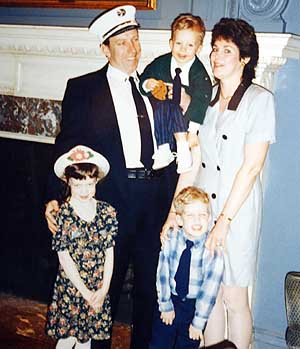
There was, however, a little information about Wilkinson in a short article from Newsday, featuring this photo of Glenn, his wife Margaret, and their three children, taken a few years before 9/11:


The picture doesn’t say everything there is to say about Wilkinson’s life, of course. But I realized it still said an awful lot, and maybe it even shows the essence of his life. Because the two things that seem to have been most important to Wilkinson are there: firefighting and family.

Back when I was getting my degree in marriage and family therapy, I once did a project on how family photographs can reveal family dynamics. And now, as I looked at this photo, I couldn’t help but notice Wilkinson’s beaming face, his firefighter’s uniform, his evident pride in his brood, and the warmth and ease of the interactions between them. Yes, the little girl looks a little shy, but see how her father stands protectively and encouragingly over her.

Here’s the entire text of the Newsday article:

Fire Lt. Glenn Wilkinson had just ordered his company, Brooklyn’s Engine 238, out of the lobby of the crumbling World Trade Center’s Tower Two Tuesday morning when he took a roll call and discovered someone was missing.

“He gave a mayday and he ordered his company to move to a safe location and he returned to the building,” Wilkinson’s widow, Margaret, recalled yesterday. “And he didn’t make it back.”

The body of the 46-year-old Bayport resident and father of three – a 14-year veteran of the New York City Fire Department – was recovered early Wednesday, ending a day of uncertainty for Margaret, whose first fears watching the news on television that morning were only for other victims and for the horrors her husband would have to bring home with him.

“My thoughts were, ‘They are from Brooklyn, they can’t possibly be in the midst of it,'” she said Friday, standing in a house full of family and neighbors who had come to bring food and run errands and keep the three Wilkinson children from thinking too much about what had just happened to their family.

Margaret Mackey Wilkinson, a teacher’s assistant in special education at Blue Point Avenue Elementary School, worked all day Tuesday and came home to an answering machine with 16 messages on it. “I skipped and skipped and skipped through them hoping to hear his voice,” she said. There were no messages from him.

But there will be plenty of memories of bike rides and basketball and father-daughter dances to comfort Wilkinson’s children, Kelsie, 13, Craig, 12, and Kevin, 8, as they grow. Wilkinson jogged regularly and the boys had recently started to join him on his runs, his wife recalled. When he came home at night, he’d be summoned to the bedroom of straight-A student Kelsie and be on the rug helping her work out math problems.

“He was very, very loving,” Margaret said. “The thing he loved best in life was being a dad.”

You can see it in the photo, and hear it in his wife’s words.

And I think he must have loved his job, even though it was hard, very hard. That last day, it must have been exceptionally hard. But firefighters do that–they go against every instinct built into us to run, screaming, as fast as we can, away from burning buildings, not into them. And not only do they go into burning buildings, they go–as Wilkinson did–back into burning buildings, to save those as yet unaccounted for.

Wilkinson was only one of the 343 active and 3 retired firefighters who died on 9/11, by far the single most dreadful day in the history of a profession that has known its share of mass death and tragedy. Prior to 9/11, the highest death toll of firefighters in New York in a single incident had been twelve. And the total number of firefighters lost on 9/11 was greater than the total number of New York City firefighters who’d died on the job since WWII.

I recall hearing the news of the shockingly high number of firefighter deaths late in the afternoon of 9/11, after a day of ever-escalating horror. Even then, after we’d heard so much, the numbers seemed unbearable. It was unimaginable that so many firefighters had died at once; and yet it was sadly, and most terribly, true.

I wrote that Wilkinson was “only one” of the firefighters who died. But there’s really no “only” about it. Each and every one of them was a hero–an overused word, but an appropriate one in this case–a hero not only on that day, but on every day they came to work.

Posted in People of interest | 8 Replies

9/11: the watershed

The New Neo Posted on September 11, 2006 by neoSeptember 11, 2006

[On this fifth anniversary of 9/11, I am reposting the following. It is part of my “A mind is a difficult thing to change” series, and deals with the events of 9/11 and my reaction to them.]

INTRODUCTION

Although I’ve written in my “About Me” section that I was “mugged by reality on 9/11,” that’s really just a convenient and probably misleading shorthand description of a much more complex reaction, one that began that instant but emerged only slowly, over a period of several years. It’s probably still in the process of evolving and changing.

But the beginning wasn’t slow. Not at all.

It began in an instant, the instant I heard about the 9/11 attacks. Like most of you, I remember exactly where I was at the time and how I learned the news. My story isn’t a particularly dramatic one. I don’t tell it for that reason. I tell it to learn more about the process by which a mind is changed–sometimes, as in this case, through a sudden and dramatic event that sparks intense feelings and begins a cognitive process by which a person tries to make some sort of sense of that overwhelming event and those chaotic feelings.

9/11

I was having trouble sleeping that night. I don’t know why–I wasn’t in pain, I didn’t have a stomach ache, nor was I anxious about anything in particular. But I lay awake in bed for hours in a sort of unfocused but nevertheless unpleasant and restless agitation, until I finally fell into a fitful sleep from about 5 AM to 8 AM, and then woke up again.

I was visiting with friends, so I wasn’t in my regular bed. My work didn’t force me to get up early, so I tried to relax and sleep a bit more. But the strange wakefulness continued, and at about 10:15 I finally gave up and went downstairs.

My friend was at her job, but her husband John works at home in a basement office. Since he was nowhere to be seen, I figured he was down there working at his computer. I grabbed a yogurt for breakfast, and I was engaged in eating it a few minutes later when John appeared in the kitchen.

John is one of the calmest people I know, almost preternaturally so. I’ve never heard him raise his voice, and never even seen him look agitated, despite the vagaries of raising two teenagers and assorted pets. Nor did he appear particularly distressed that day. He seemed to be looking through some piles on the countertops for something–a pen? some notepaper?–when I caught his attention and started to ask some casual question.

John stopped shuffling through the stacks, and gave me a look I can only characterize as quizzical. He seemed to be studying me. And what he said next are words that are burned into my brain, a phrase I never want to hear again, not ever: “You don’t know what happened, do you?”

I write it as a question, but it didn’t really have a rising inflection at the end. It was more of a statement, an expression of intense wonderment that anyone could be so ignorant of something so obvious. It was as though he’d said “You don’t know the sky is blue, do you?”

No, I guess I didn’t know what had happened, I said, and waited for him to tell me.

What did I suppose it might be? I had already sensed, somehow, that it was nothing good. But in the split second of innocence I had left to think about it, I might have thought John was about to say that there had been an auto accident, a bus collision, or a fire, an upsetting but ordinary and generic tragedy of some sort or another.

But instead, John’s calm words came out in one long run-on sentence, although their content was anything but calm, or calming.

“Two planes just crashed into the World Trade Center, and the towers have fallen, and then another plane crashed into the Pentagon, and a fourth one is missing, and a few others are missing, too” (the final destination of Flight 93 was unknown as yet, and a mistaken report had been issued that there were further planes still unaccounted for).

If John had told me that Martians had landed in Central Park, or that an asteroid was on a doomsday course towards earth and we had only a few hours to live, I could not have been more surprised. My body reacted instantly, before my mind did–my legs felt shaky, my mouth went dry, and something inside my gut was shaking, also.

I knew immediately and intuitively that a watershed event had occurred. I didn’t know the exact parameters of it, nor any details of the direction in which we were headed, but I knew that this moment felt like a break with everything that had gone before. Assumptions I hadn’t even known I’d held were dead in a single instant, as though their life supports had been cut. I didn’t know what would replace them.

What were the main assumptions that had died in that instant for me? They had to do with a sense of basic long-term safety. Some utterly fearful thing that had seemed contained before, although vaguely threatening, had now burst from its constraints. It was like being plunged into something dark and ancient that had also suddenly been grafted onto modern technology and jet planes–Huns or Mongols or Genghis Khan or Vlad the Impaler or Hector being dragged behind Achilles’ chariot–a thousand swirling vague but horrific impressions from an ancient history I’d never paid all that much attention to before.

I remembered having read articles within the last couple of years that had told of terrorist plans and threats, but managing to successfully surpress my rising fear and reassuring myself that no, it wouldn’t actually happen; it was just talk and boasting bravado. The nuclear nightmares of my youth now came to mind: the fallout shelters, the bomb drills, the suspicion that I wouldn’t live to grow up. I had suppressed those, too, especially in recent years when the fall of the Soviet Union had removed what had once been the likeliest source of the conflagration. It now felt like one of those horror movies where the heroine is chased by someone out to do her harm and then she gets home, feels safe, closes the door and breathes a sigh of relief–and then the murderer leaps out of the closet, where he’d been hiding all the time.

But all these thoughts and images weren’t fully formed, they were a jumbled set of apprehensions that hit me almost simultaneously with John’s news. In the next instant, I had a sudden vision of the two WTC towers toppling over and falling into the other buildings in downtown New York, crushing them as in some ghastly game of giant dominos. So the first question I asked John when I could get my suddenly dry mouth to function was, “How did the towers fall? Did they fall over and smash other buildings?

John didn’t know the answer. The reason he didn’t know was that the family television set had recently been unplugged and stored away, deemed too distracting for the kids, who’d been having some trouble in school lately. This meant that John had no visuals, and so he couldn’t answer my question.

And then John left to get his daughter, and I was left alone with my thoughts.

I had always been glad I’d been born after World War II because I had a sense that the stress of those horrific war years would have taken a terrible toll on me. I had often wondered whether I could have handled such a lengthy time of deep uncertainty about whether the forces of good or evil (not that I really thought in those terms ordinarily, but WWII did seem to present a stark choice of that type) would triumph. I wondered about the sense of impending doom and personal danger that a worldwide war with so many casualties would have entailed, especially in those early years when it wasn’t going very well for the Allies.

I’d known war, of course–most particularly, Vietnam. But as much as that war had affected me personally by affecting those I loved, and as much as I’d been upset by all the killing and struggle, the actual fighting had been far away “over there,” and in a relatively small area of the globe.

From the very first moment that John had told me the news of 9/11, there had been no real doubt in my mind that the attacks had been the work of terrorists. There had also been no doubt that this was something very different from what had gone before.

But why was that difference so clear? After all, there had been terrorist attacks before that had killed hundreds of people at a time. There had even been a previous attack on the World Trade Center, and I had known that the intent of the terrorists back then had been to bring the building down. So, why this feeling of something utterly new?

Each prior terrorist attack had contained elements that had allowed me to soothe and distance myself from it, and to minimize the terrorists’ intent. Most of the attacks had been overseas, or on military personnel, or both. Or, if the attack had been in this country and on civilians (both were certainly true of the previous WTC bombing), the terrorists had seemed almost comically inept and bumbling. Each attack had been horrible, but the presence of one or more of these elements had kept knowledge of what was really going on at bay.

Those planes that had crashed into the towers and toppled them on 9/11 also had smashed the nearly impenetrable wall of my previous denial. These attacks had been audacious. I could not ignore the fact that the intent of the terrorists was to be as lethal and malicious as humanly possible. The change in the scope and scale of the project made it seem as though they did indeed want to kill us all, indiscriminately, and it gave their motives even less grounding in any sort of rational thought that I could fathom, or any real strategic end. The creativity of the attacks (and I do not use that word admiringly, but the attacks were indeed an instance of thinking outside the box) made it seem that anything was possible, and that the form of future attacks could not be anticipated or even guessed at. The attacks had imitated an action/adventure movie far too well, the type of thing that had always seemed way too improbable to be true. But now it had actually happened, and the terrorists seemed to have become almost slickly competent in the split-second timing and execution of the attacks.

After John had left the house, I did a few practical things. I called my family in New York, who were all safe, though very shaken (my sister-in-law had witnessed the second crash from her balcony, and their small yard was covered with ash and papers). I managed to get to a television set and watch the videotapes, and it was then that I learned that the towers had fallen neatly, collapsing onto themselves like a planned demolition.

And then I did something impractical. I went to the ocean and sat on the rocks. It was the loveliest day imaginable. I had been alive for over fifty years at the time, and I cannot recall weather and a sky quite like that before. It added to the utter unreality of the day and my feelings. The sky was so blue as to be almost piercing, with a clarity and sharpness that seemed other-worldly. It made it feel as though the heavens themselves were speaking to us; but what were they saying?

All this clarity and purity was enhanced by the fact that there wasn’t an airplane in the sky. There were boats of all types on the bluest of oceans, the sun beamed down and made the waves sparkle, and it all seemed to have a preciousness and a beauty that came with something that might soon be irretrievably lost.

I thought there might be more attacks, bigger attacks, and soon. So I might as well enjoy the sky. I wondered whether I should go ahead with a house purchase I was about to make. I wondered whether it mattered. But most of all, I wondered why the attacks had happened.

I’d studied human behavior for a good many years, but I can honestly say there was a tremendous and unfathomable mystery here. I had always been a curious person, but the amount of time and effort I had spent studying world history or political movements had been relatively minor. I’d been more interested in literature and art, psychology and science.

Now, and quite suddenly, I wanted to learn what had happened, why, and what we might need to do about it. In fact, I felt driven to study these things, in the way that a person suddenly faced with the diagnosis of a terminal illness might want to learn everything possible about that disease, even if they’d had no interest whatsoever in it before. Samuel Johnson has written that the prospect of being hanged focuses the mind wonderfully. A terrorist attack on this scale had focused the mind wonderfully, too. That was, perhaps, its only benefit.

Even on that very first day, as I sat on the rocks overlooking the beautiful ocean that I loved so much, I thought we had entered a new era, one which would probably go on for most of my lifetime however much longer I might live. The fight would be long and hard, and there would be many many deaths before it was over. Perhaps it would result in the end of civilization as we knew it–yes, my thoughts went that far on that day. This war would encompass most of the globe. I had no idea how it would work out, but I knew that we were in for the fight of our lives.

The legal actions of the past–the puny trial after the first World Trade Center attack, for example–no longer seemed like an effective response. It seemed, in retrospect, to have been almost laughably naive. The situation didn’t even seem amenable to a conventional war. Something new would have to be invented, and fast. And it would have to be global. It would have to have great depth and breadth, and it would probably last for decades or even longer.

So for me the day began with an emotional intensity–a stunning shock that very quickly was matched by a cognitive intensity as well. It now seemed to be no less than a matter of life and death to learn, as best I could, what was going on. I knew it wasn’t up to me to solve this; I had no power and no influence in the world. But still something drove me, with a force that was almost relentless, to pursue knowledge and understanding about this event. The pursuit of this knowledge no longer seemed discretionary or abstract, it seemed both necessary and deeply, newly personal.

Posted in Uncategorized | 3 Replies

Chemistry lessons: a thing of beauty is a joy forever

The New Neo Posted on September 9, 2006 by neoJune 12, 2009

When I was in junior high school there was a huge poster of the Periodic Table of the Elements that hung in the science classroom in front of a little-used blackboard spanning the right side of the room, next to where I sat.

I’m not sure whether anybody in the junior high learned what the chart was about—we certainly didn’t. But it was a grim reminder of what awaited us in high school, when we’d be required to take Chemistry and Physics and Geometry and Trigonometry and a bunch of other subjects that sounded Hard, and sounded like An Awful Lot of Work.

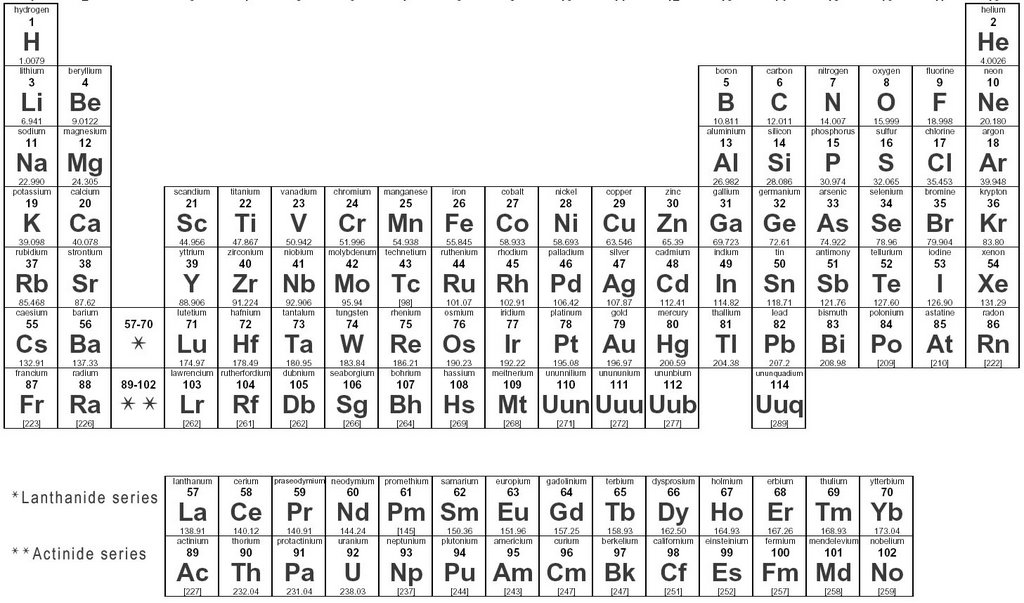
I wasn’t looking forward to the experience. In my more bored moments in class (and I had quite a few of them) I would glance at that chart on the wall and idly ponder its arcane mysteries. It looked like a more old-fashioned and slightly yellowing version of this:


That chart was the sort of thing that made me nearly sick to my stomach whenever I looked at it, something like slide rules and drawings of the innards of the internal combustion engine, and the long rows of monotonous monochromatic law books in my father’s office.

But then time passed—as time often does—and I found myself a junior in high school, sitting in chemistry class and finally (and reluctantly) about to penetrate the secrets of the Periodic Table. The teacher, a small, elderly (oh, he must have been at least fifty), enthusiastic, spry man, explained it to us.

I sat awestruck as I took in what he was saying. That chart may have looked boring, but it demonstrated something so absolutely astounding that I could hardly believe it was true. The world of the elements at the atomic level was spectacularly orderly, with such grandeur, power, and rightness that I could only think of one term for it, and that was “beautiful.”

I did very well in chemistry, and even thought of majoring in it in college, although in the end I stuck to psychology and anthropology. But I never forgot the lesson of the Periodic Table (actually, it taught many lessons, although some of them I did forget). But the one I remembered most was that appearances can be deceptive, and that what lies beneath a bland and stark exterior can be a world of magic.

And now (via Pajamas Media), I’ve finally discovered a Periodic Table worth its salt—or, rather, its sodium chloride. Take a look at this, a Periodic Table nearly as lovely as the elemental wonders it illustrates:


If you follow the link to the poster at its source, you can click on parts of it to enlarge them and see more of the detail. And then you might say with Keats:

When old age shall this generation waste,
Thou shalt remain, in midst of other woe
Than ours, a friend to man, to whom thou say’st,
‘Beauty is truth, truth beauty,””that is all
Ye know on earth, and all ye need to know.’

Posted in Me, myself, and I, Science | 17 Replies

The Rover Conventions

The New Neo Posted on September 9, 2006 by neoJuly 25, 2009

Commenter “Sergey” has contributed a wonderful piece of folk wisdom about international law and its enforceability:

In old Russia there was a proverbial Yiddish saying on usefulness of formalities of law in dealing with those who do not respect law: “Scribe mit a Hund a Dogovor” (sign a treaty with a dog so it would not bite you).

Yes, indeed. Dip Rover’s paw in the ink and have him sign on the dotted line, and I’m sure everything will be just fine.

Posted in War and Peace | 16 Replies

For those of you who like to follow the sport of troll morphing…

The New Neo Posted on September 8, 2006 by neoSeptember 8, 2006

…it turns out that our new friend “Stephen Britton,” a far more polite version of his predecessors Stevie/Yahmir/Suzy/anon, is almost certainly one and the same.

Posted in Uncategorized | 17 Replies

J’accuse: a case of libel, the blood libel, and the French press

The New Neo Posted on September 8, 2006 by neoJuly 25, 2009

There’s a case about to begin in France that–according to blogger Richard Landes–could rival the Dreyfus case in importance.

I’ve written previously about the underpinnings of the present case: the misleading media coverage of the alleged death of 12-year old Mohammed al Durah. Those of you who read Augean Stables and Second Draft are probably quite familiar with the fact that a deception was most likely perpetrated by the French media in broadcasting the story to the world.

But now there are new wrinkles to the tale.

If anyone isn’t familiar with the original incident, here’s a quick summary: in late September of 2000, the boy Mohammed al Durah and his father were taking cover from an exchange of gunfire between Palestinian and Israeli forces in Gaza. Mohammed was either (take your pick, depending on the source) purposely gunned downed by the Israelis, or “caught in the crossfire” and accidently killed by them, according to Talal abu Rahmeh, a Palestinian cameraman who filmed the only video that exists of the supposed death scene; French correspondent Charles Enderlin; and the TV station for which they both worked, France2.

The incendiary footage of al Durah and his father was beamed all over the world. It was viewed with rage and condemnation of Israel, especially in predominantly Moslem and Arab countries as well as in Europe. The al Durah incident and photos of it were prominently visible in propaganda justifying the bloody and horrific Second Intifada against Israel, with its repeated terrorist attacks against Israeli civilians, including many children.

But subsequent research and revelations have led those who have investigated the incident to the almost inescapable conclusion that the facts were not only not quite as reported (for example, the direction of the shots were such that Israeli forces could not have been responsible for hitting al Durah), but what is far worse–that it was bogus from start to finish. That is, that it was staged. The Second Draft site has a great deal of information on this subject; take a look for yourself.

Why am I bringing this up now? The first reason is that media misrepresentation in the recent war in Lebanon has highlighted possibly widespread media complicity in promulgating misinformation and propaganda favoring the Arab/Palestinian position in the Middle East. The al Durah case is an example from six years ago that makes one wonder just how long this has been going on, and how successful it has been in shaping anti-Israel opinions (the answer to both questions appears to be: very).

The second is the aforementioned trial about to begin in France over the al Durah case. The operative French law is one that was passed in 1881, aimed at protecting the press from defamation that “strikes at the honor and consideration (reputation) of ‘the individual or institution in question.'”

And who is France2 suing for defamation? Three French citizens who used their websites to publish internet critiques of the station’s coverage of the al Durah affair. As far as I can tell, this is the equivalent of the television station suing a blogger such as myself (who, fortunately, lives in the US rather than France) for pointing out that the France2 emperor has no clothes in this matter.

The hubris of France2 is astounding. What’s more, they might actually win, according to Landes, despite the fact that anyone viewing the video on which they based the al Durah story can only conclude that France2’s journalistic standards in airing the footage were abysmal and deplorable.

If one reviews the history of the coverage of al Durah by France2 with an open mind, it becomes clear that the TV station should be the defendant in a defamation trial, not the plaintiff. The truth appears to be that France2 has not just been duped, but that it has lied, especially in the persons of cameraman Tamal and Charles Enderlin, who asserted that they had respectively taken (Tamal) and personally viewed (Enderlin) twenty-seven minutes of corraboratory video showing the death throes of al Durah, footage that cannot be produced and that in fact never existed.

What does exist? A mere fifty-nine seconds of video, embedded in more minutes of other obviously staged material, filmed by a single Palestinian stringer (Tamal), and showing not al Durah’s death throes, but his voluntary movements after he had supposedly been killed by a strangely bloodless shot in the stomach. Take a look at the footage (click to download “Death of an Icon”) and see what you think. The egregiousness of the Big Lie must really be seen to be believed (or, rather, disbelieved).

Why does this matter? Al Durah has become both an icon and a rallying cry, a modern and non-Christian twist on an ancient deception, the blood libel. Both the old stories and the new are propaganda used for the same purposes, to ignite anti-Jewish feeling–or its modern-day incarnations, anti-Israeli and anti-Jewish feeling. The repercussions have been vast, especially in Europe, in which both anti-Israeli and anti-Jewish sentiment has risen since 2000, the year of the al Durah incident.

I find the very existence of the French law under which this lawsuit is being brought to be astounding. Why would the media, of all things, need a special stature to protect itself against criticism? Moreover, why is the media so accepting of evidence that anyone with a grain of critical thought would view as suspicious? And why are these fakes so badly done?

The latter question gnaws at me, as it did when the Rathergate memos were exposed as fakes. It wasn’t just that they were fakes, it’s that they were patently obvious fakes. The inescapable conclusion is that the media on which we rely so heavily to shape our view of the world is either stupid or lying. There’s no other possibility, and both alternatives are almost equally horrendous in their consequences.

My other supposition is that we only have uncovered these particular fakes because they are so very obvious. But we can’t assume that all the fakes that have been perpetrated on us over the years have been so poorly executed. Are there in fact many others that have passed muster because they are technically far more competently done?

For example, in the case of Rathergate, what if the forgers had actually gotten hold of an old typewriter from the proper era (duh–not so difficult to do, after all)? Would we have ever known such a document was fake? And, with al Durah, what if they’d actually staged these scenes more carefully? It seems to me that it wouldn’t have been so very difficult to have done so; moviemakers do it all the time, do they not?

Even so–even with the amateurish and slipshod nature of these forgeries–they still worked, for a while, and still work for many viewers. Al Durah has worked much better and longer than the memos. I fear that, in the future, the perpetrators of such fictions will become more skillful, having learned their lesson from these cases.

There is some cause for cautious–very cautious–optimism, however. I agree with Landes that if the present case in France receives wide coverage, and if the video of al Durah is ever released to the public and receives wide dissemination, it could be a turning point. I like to think that, with repetition (including new incidents such as Reutergate), distrust of media coverage in the area will reach some sort of critical mass. Then, if that happens, even if a lie continues to get halfway round the world before the truth has a chance to get its pants on, maybe that lie won’t be so easily believed.

Posted in Paris and France2 trial, Press | 30 Replies

The Dread Pirate Bin Laden

The New Neo Posted on September 7, 2006 by neoSeptember 7, 2006

More on the subject of fear:

Dean Esmay, a fan of “The Princess Bride,” points out that the Dread Pirate Roberts of that movie was an actual historical figure.

Pirates have become almost comical these days, good for a laugh in a children’s movie, not to mention a classic costume for Halloween. That’s about it.

But in their day they were much-feared, and rightly so. This piece (also reached through a post linked by Dean) offers a discussion of the history of piracy and of laws against it, and suggests applying the concept to terrorists.

Pirates were once state-sponsored, hidden agents for nations to wage war against each other. Then piracy degenerated still further, into free-form nihilism:

…[latter-day pirates] struck indiscriminately in ferocious revenge against the societies that they felt had condemned them. Often these disenchanted sailors cast their piratical careers in revolutionary terms. The 18th-century English legal scholar William Blackstone defined a pirate as someone who has “reduced himself afresh to the savage state of nature by declaring war against all mankind,”…Perhaps the most telling statement of the pirates’ motives comes from a pirate named Black Sam Bellamy. To a captured merchant captain, he boasted, “I am a free prince, and have as much authority to make war on the whole world as he who has a 100 sail of ships and an army of 100,000 men in the field.”

The laws against piracy rest on:

…the concept of universal jurisdiction. The crime of piracy is considered a breach of jus cogens, a conventional peremptory international norm from which states may not derogate. Those committing thefts on the high seas, inhibiting trade, and endangering maritime communication are considered by sovereign states to be hostis humani generis (enemies of humanity).

In the mid-19th century, the nations of Europe had finally stopped using piracy to further their own ends and got together to help weaken its hold on the world. A similar unity among the world’s nations right now against the current enemies of humanity might relegate terrorists of the future to characters in children’s movies, and to colorful costumes at Halloween. Unfortunately, that’s not likely to happen: terrorists still serve the interests of many countries, who use them as convenient surrogates and hidden agents.

Posted in Uncategorized | 23 Replies

Post navigation

← Previous Post
Next Post→

Your support is appreciated through a one-time or monthly Paypal donation

Please click the link recommended books and search bar for Amazon purchases through neo. I receive a commission from all such purchases.

Archives

Recent Comments

  • Barry Meislin on Peeking through Iran’s fog of war
  • Richard Cook on Peeking through Iran’s fog of war
  • Jim Melcher on Peeking through Iran’s fog of war
  • Richard Cook on The press and that Iranian school that was reported to have been hit
  • Steve (Retired/recovering lawyer) on Peeking through Iran’s fog of war

Recent Posts

  • Peeking through Iran’s fog of war
  • The press and that Iranian school that was reported to have been hit
  • As the sun quickly sets, not on the British Empire – that’s already gone – but on Britain itself
  • Open thread 3/11/2026
  • Those plucky ISIS kids

Categories

  • A mind is a difficult thing to change: my change story (17)
  • Academia (318)
  • Afghanistan (97)
  • Amazon orders (6)
  • Arts (8)
  • Baseball and sports (161)
  • Best of neo-neocon (88)
  • Biden (536)
  • Blogging and bloggers (580)
  • Dance (286)
  • Disaster (238)
  • Education (319)
  • Election 2012 (360)
  • Election 2016 (565)
  • Election 2018 (32)
  • Election 2020 (510)
  • Election 2022 (114)
  • Election 2024 (403)
  • Election 2026 (11)
  • Election 2028 (3)
  • Evil (126)
  • Fashion and beauty (323)
  • Finance and economics (999)
  • Food (316)
  • Friendship (47)
  • Gardening (18)
  • General information about neo (4)
  • Getting philosophical: life, love, the universe (724)
  • Health (1,132)
  • Health care reform (545)
  • Hillary Clinton (184)
  • Historical figures (329)
  • History (699)
  • Immigration (426)
  • Iran (400)
  • Iraq (223)
  • IRS scandal (71)
  • Israel/Palestine (785)
  • Jews (412)
  • Language and grammar (357)
  • Latin America (201)
  • Law (2,880)
  • Leaving the circle: political apostasy (124)
  • Liberals and conservatives; left and right (1,269)
  • Liberty (1,097)
  • Literary leftists (14)
  • Literature and writing (386)
  • Me, myself, and I (1,463)
  • Men and women; marriage and divorce and sex (902)
  • Middle East (380)
  • Military (307)
  • Movies (342)
  • Music (523)
  • Nature (254)
  • Neocons (32)
  • New England (176)
  • Obama (1,735)
  • Pacifism (16)
  • Painting, sculpture, photography (126)
  • Palin (93)
  • Paris and France2 trial (25)
  • People of interest (1,015)
  • Poetry (255)
  • Political changers (176)
  • Politics (2,764)
  • Pop culture (392)
  • Press (1,609)
  • Race and racism (857)
  • Religion (411)
  • Romney (164)
  • Ryan (16)
  • Science (621)
  • Terrorism and terrorists (965)
  • Theater and TV (263)
  • Therapy (67)
  • Trump (1,573)
  • Uncategorized (4,327)
  • Vietnam (108)
  • Violence (1,393)
  • War and Peace (958)

Blogroll

Ace (bold)
AmericanDigest (writer’s digest)
AmericanThinker (thought full)
Anchoress (first things first)
AnnAlthouse (more than law)
AugeanStables (historian’s task)
BelmontClub (deep thoughts)
Betsy’sPage (teach)
Bookworm (writingReader)
ChicagoBoyz (boyz will be)
DanielInVenezuela (liberty)
Dr.Helen (rights of man)
Dr.Sanity (shrink archives)
DreamsToLightening (Asher)
EdDriscoll (market liberal)
Fausta’sBlog (opinionated)
GayPatriot (self-explanatory)
HadEnoughTherapy? (yep)
HotAir (a roomful)
InstaPundit (the hub)
JawaReport (the doctor’s Rusty)
LegalInsurrection (law prof)
Maggie’sFarm (togetherness)
MelaniePhillips (formidable)
MerylYourish (centrist)
MichaelTotten (globetrotter)
MichaelYon (War Zones)
Michelle Malkin (clarion pen)
MichelleObama’sMirror (reflect)
NoPasaran! (bluntFrench)
NormanGeras (archives)
OneCosmos (Gagdad Bob)
Pamela Geller (Atlas Shrugs)
PJMedia (comprehensive)
PointOfNoReturn (exodus)
Powerline (foursight)
QandO (neolibertarian)
RedState (conservative)
RogerL.Simon (PJ guy)
SisterToldjah (she said)
Sisu (commentary plus cats)
Spengler (Goldman)
VictorDavisHanson (prof)
Vodkapundit (drinker-thinker)
Volokh (lawblog)
Zombie (alive)

Meta

  • Log in
  • Entries feed
  • Comments feed
  • WordPress.org
©2026 - The New Neo - Weaver Xtreme Theme Email
Web Analytics
↑